Graveyard Alive (2003)

[Poster]

(On DVD, July 2009) It takes a special kind of viewer to appreciate low-budget horror comedies, and those who feel up to the task may want to have a look at Graveyard Alive, perhaps the finest zombie nurse low-budget comedy ever made.  Deliberately made to ape a number of black-and-white cheap horror films of the 1950s, Graveyard Alive’s budget is almost visible on screen, and so are its intentions to embrace camp: There’s as little dialogue as possible (what remains is badly dubbed; apparently the film was first intended to be silent), constrained locations, a handful of hammy actors and staging meant to simplify the number of camera setups.  But once you learn the grammar of the film, it’s not entirely unenjoyable: Anne Day-Jones makes a strong impression as a frumpy nurse who, thanks to being turned into a zombie and (then) devouring acquaintances, discovers her inner sex goddess.  The film turns more conventional once the narrative shifts and nurse “Goodie Tueschuze” (yes, it’s that kind of script) discovers that she’s the last edible human in the hospital.  There are a few laughs along the way –including the visual aftermath of a spectacularly thorough zombie meal.  Graveyard Alive is not a classic by any stretch of the imagination, but it’s the kind of film that sympathetic horror fans will like to recommend to each other: “So, hey, have you seen the zombie nurse movie?”

Spirit, The (2008)

[Poster]

(On DVD, July 2009) There are many ways to be disappointed by Frank Miller’s The Spirit.  The most esoteric one is by comparison to Will Eisner’s classic comic strips (or even Dwayne Cooke’s wonderful revival): The off-beat medium-specific tone of the original is a tough assignment for adaptation at best, but it becomes a mishmash in Miller’s hands, who seems more interested in ripping off his own Sin City than to deliver a coherent film.  But you don’t have to be familiar with Eisner’s form experiments to think that this is a poor film:  The Spirit veers from high camp to pitch-dark noir without much grace, and not even an astonishing gallery of lovely actresses is enough to redeem the result.  Samuel L. Jackson does well as a high-spirited villain, but it’s a shame that Gabriel Macht doesn’t have more to do as the square-jawed hero.  Visually, it’s a Sin City sort-of-sequel, although the quality of the images is much higher than what comes out of the speakers: The dialogue is over-the-top to a degree that seems stiff and self-conscious rather than amusingly arch.  For a mash-up of crime and superhero fiction, there aren’t that many set-pieces worth remembering and the only one that sticks in mind has no choice than to resort to full-blown Nazi imagery.  Little of it makes sense, and so the biggest disappointment of The Spirit is to think of what a much better film it could have been in other hands.

Gaudeamus, John Barnes

[Cover]

Tor, 2004, 320 pages, C$34.95 hc, ISBN 0-765-30329-9 jul30

I rarely get close enough to authors for them to give me reading tips about their own novels, but a chance encounter with John Barnes at 2006’s L.A.Con IV had him telling me that I would either love or hate Gaudeamus.

Never mind that it took me three years to follow up on his suggestion: I can definitely see what he meant by polarized reactions.  Gaudeamus is anything but a conventional genre SF novel: It’s meta-fiction, tall tale, genre parody and RudyRuckeresque weirdness all at once.  It makes little and complete sense, takes risks that would doom less outrageous SF novels and manages –almost despite all ongoing expectations– to fulfill its own ambitions.

A conventional plot summary would probably start by an acknowledgement that the novel’s narrator is one “John Barnes” and that most of the novel is made out of three long conversations with a friend of his.  The friend in question, Travis Bismark, is an industrial spy whose latest case gets weirder by the minute, and it’s Travis’ story that Barnes tells, at a remove.  Technically, Gaudeamus doesn’t have to be a Science Fiction novel: you can dismiss it by saying that it’s all taking place in Travis’s head and the rest is just a tall, tall tale.  How tall?  Tall enough that coincidences and long-lost friends all fit perfectly… and that’s not even considering the science-fiction elements.

Because whenever it comes to SF elements, Barnes uses the freewheeling spirit of his story to pull out all the stops.  Gaudeamus (“Let us rejoice” in Latin, and not a regionally-accented bastardization of “Goddamn mouse” as I was hoping for) ends up being a code word for all sorts of neat classic SF devices all thrown willy-nilly in the plot.  Not to spoil anything, but: Telepathy, teleportation, time-travel or aliens?  All Gaudeamus!  (Also; a web comic)

To fit all of this, plus mainstream observations on the daily life of one SF writer named “John Barnes” (the first few pages are all about how to begin a story), Gaudeamus moves at a pretty fast pace, especially when Travis’ initial investigation quickly evolves out of anything we can feel comfortable with.  My most serious complaint about the novel, in fact, is that a fascinating techno-thriller could have been written out of Travis doing industrial espionage and stumbling into a high-tech mystery.  Still, that Gaudeamus then pick up at light-speed toward ever-stranger vistas isn’t really a problem, so file this under “Ideas another writer may want to use some day.”

In fact, there’s a refreshing looseness in the story that Barnes allows himself with the tall tale conceit.  In its attempt to go against the grain of genre SF, Gaudeamus manages to become a rather charming novel in which the usual tropes are displayed differently, and with constant winks to the seasoned readers.  I’m not sure that I would like to see a steady stream of such self-referential novels, but once in a while isn’t a bad thing.  I’m also pleased and impressed at the way the entire story comes together at the end, even when it seems, at times, that the whole thing will crumble on its own rich mixture of elements.  (For all remaining complains for plot holes, see “Tall tales, telling of”)

Gaudeamus also fits pretty well in Barnes’ bibliography as a genre SF writer: Elements of the conclusion seem to echo a little bit of Barnes’ Jak Jinnaka series, while we get a sly wink about his two collaborations with Buzz Aldrin.  That it laughs, in-text, at overly picky SF readers is an extra bonus.  In fact, I regret that the narrator never makes to the SF convention he spends a few moments complaining about: it would have been fun to see such an event from the point of view of narrator-Barnes.

In short, Gaudeamus is weird, unique, intentionally off-putting and yet completely successful.  It’s a successful gamble, and the kind of novel that ought to appeal to SF readers who don’t mind a bit of genre-bending.  I’d go as far as saying that it’s one of Barnes’ strongest efforts in ways that directly relate to the rest of his bibliography to date.  In fact, looking at his list of publications to bolster this argument, I’m struck at how Barnes fits the model of a mid-list genre SF author while, at the same time, writing a long and relatively successful series of books that struck back at genre conventions.  But we’re running out of space, and so this observation will have to be postponed to another review…  In the meantime, frankly, I’ll read anything the man will write.

In Defense of Food, Michael Pollan

[Cover]

Penguin, 2008, 244 pages, C$26.50 hc, ISBN 978-1-59420-145-5

“Eat food.  Not too much.  Mostly Plants.”

There.  In seven words, that’s a summary of Michael Pollan’s wisdom.  Helpfully, the cover of the book even sports those words.  If you’re not yet satisfied, you can always read Pollan’s New York Times article “Unhappy Meals” in which he laid out most of his book’s central message.

Otherwise, well, what can I say?  It’s tough to review great books.  Once I have urged you to go and get the book, everything else is an anticlimax.

Oh, OK, a few more contextual details may be useful: For instance, you really should read Pollan’s The Omnivore’s Dilemma before tackling In Defense of Food.  While both can be read independently, Polaln’s previous book provides a theoretical framework over which his latest book elaborates.  In fact, Pollan is up-front about the fact that reader reaction to The Omnivore’s Dilemma led him to write In Defense of Food: After spending four hundred pages explaining all about the unsustainable and unhealthy process through which our food comes from, Pollan found himself deluged with questions about what to do about it.  In Defense of Food is an answer: not a rigid system, but a set of ideas and guidelines meant to help us navigate through supermarkets booby-trapped with false nutritional claims and processed variants of mostly-corn.

The first few chapters of In Defense of Food tackle the industry of nutrition.  With brief historical overviews of how Americans have been seduced over and over again by dubious claims about what they should be eating, Pollan comes to the conclusion that trying to add explicitly-nutritive ingredients to synthetic food is a losing proposition.  Humans, he reasonably reminds us, have co-evolved with their natural food sources for thousands of years: The interaction between human nutritive systems and natural food means that it’s difficult to isolate the building blocks of what food does to the body.  A reductionist approach (add this much fat, that many carbohydrates, a little bit of protein…) is actually harming us: it’s better to stick as closely to naturally-grown whole food as possible.

That’s not exactly a new or revolutionary message, although Pollan’s catch-phrases are memorable: “Don’t eat anything your great-grandmother wouldn’t recognize as food” is one of the best.  But as a reminder of what we should strive to do in-between the convenience of food-court lunches, it’s an entertaining and convincing discourse.

Along the way, though, we learn a bit more about government intervention in the mechanics of the food pyramid (both the one that hangs on walls, and the real one that favours certain industries over others in bringing you sustenance) and reflect on the meaning of a healthy food culture.  Passing nutrition manias such as the “Atkins Diet” (which seems to have disappeared from the mainstream as quickly as it entered it) are symptoms of a bigger problem, which is to say the appalling lack of knowledge that most (North-)Americans have about how and what to eat.

If nothing else, In Defense of Food will make you feel a lot better about how much you know about food.  In the last section of the book, Pollan suggests ways to best shop at the supermarket: Avoid food with unpronounceable ingredients, avoid food that make health claims, go to a farmer’s market whenever possible, cook, eat slowly, plant a garden… the trouble with a lot of those recommendations are that they’re very familiar: It’s what your mom told you, and most of it can be deduced from “Eat food.  Not too much.  Mostly Plants.”  Culinary wisdom is simple:  it’s sticking to it despite inconvenience that’s hard.
There’s also the suspicion that In Defense of Food will mostly be read like people who intend well and already do most of what it recommends: At a time where market forces are what really changes supermarkets (and in turn, what’s easily available to us), the real issue here will be to get people who aren’t concerned about their diet to start paying attention.

So: “Read Pollan.  Eat better food.  Discuss issues.”

Brothers Bloom, The (2009)

[Poster]

(In theatres, July 2009): It’s a familiar and dispiriting feeling to watch a brilliant first ten minutes of a film lead to a good middle hour and then on to an average third act.  So it is that The Brothers Bloom (yes, there’s a meaningful pun in the title given that “Bloom” is the first name of one of the brothers) over-thinks itself all the way into a box stamped “I don’t care anymore”: As a self-aware story about two con artists and their latest (last?) scam, it’s always engaged in a war of deception with its audience, and if that works when the audience is pleased with an ending, it’s not so amusing when the story keeps going where the audience is unwilling to follow.  There was a point, late during the film, when I thought that the film was ninety seconds and ten lines of dialogue away from a happy ending; alas, it just kept going in another darker direction, jettisoning the absurd comedy that was such a highlight of the film’s first sequences.  The Brothers Bloom may not be taking place in our world (what with bowler hats, steamships and cellular phones), but it’s certainly taking place in the con-movie continuum, and its attempts to buck the formula carry a penalty.  It’s a shame that the film we get isn’t the charming offbeat comedy that the trailer and the first half of the movie promised to us.  Oh, it’s not a complete loss: Rachel Weisz has seldom been as captivating as she is as an eccentric millionaire; Rinko Kikuchi is hilarious as a quiet demolition expert; there are a few fantastic moments along the way; and at times it’s handled with an old-fashioned charm that makes one long for far many more movies of that type.  But The Brothers Bloom is easily three twists and twenty minutes longer than it should be, so that by the time it ends on a note meant to make audiences reflect on the nature of storytelling-as-cons, nobody will care as much as they should have.  Card tricks are tough, but movie tricks are even tougher.

Hurt Locker, The (2009)

[Poster]

(In theatres, July 2009): There can be such a thing as too much of a good thing, and the second hour of this film is a case in point: What starts out as a tight episodic war thriller with uncanny suspense sequences eventually loosens its grip on the audience and meanders on its way to a meaningful conclusion.  Don’t be fooled: even with its loose and predictable third act, The Hurt Locker still is one of the best action films of the year, and one of the best Iraq war movie so far.  But a better-controlled film would have been even more powerful.  Director Kathryn Bigelow makes a welcome return to the big screen and shows from the start that her action sequences can be as good as anything else: The Hurt Locker’s best moments (including the hair-raising image on the poster) are in the half-dozen action/suspense sequences putting us far too close to American bomb-defusing experts working in Baghdad.  This film justifies the whole quasi-documentary handheld-camera aesthetics to a level of clarity that other glossier filmmakers can’t even imagine: As a depiction of war-driven action, it’s as good as it gets –a fortunate achievement for a film that focuses on the adrenaline junkies for whom war is a continuous peak experience.  There are a few familiar faces among the supporting characters (including Ralph Fiennes as a foul-mouthed English mercenary), but it’s the relatively-unknown main characters that make the strongest impression: In particular, Jeremy Renner is a revelation as a loose-cannon protagonist whose motivations eventually become the crux of the film.  Despite the meandering subplots that shed a lot of energy in the latter half of the picture (and the accumulation of inaccuracies to pump up the drama at the expense of realism –how handy that one of our lead sappers is also a sniper!), The Hurt Locker remains a strong piece of cinema, and one of the rare war films about Iraq to make its point with little partisan content.  It’s both exhilarating yet realistic, reaching out to both the action-movie fans and those who think that war is hell.

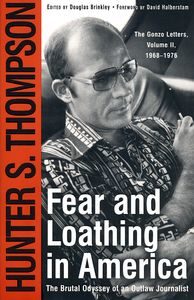
Fear and Loathing in America: The Brutal Odyssey of an Outlaw Journalist, Hunter S. Thompson

[Cover]

Simon & Schuster, 2000 (2006 paperback reprint), 756 pages, C$21.00, ISBN 978-0-684-87316-9

This second volume of Hunter S. Thompson’s letters takes us to Thompson’s most memorable years: 1968-1976, spanning not only the eight years of the Nixon/Ford administration, but most of Thompson’s best-know work.  Gonzo journalism was born in 1970 with “The Kentucky Derby is Decadent and Depraved”, with Fear and Loathing in Las Vegas written not too long after, eventually published in the middle of the 1972 presidential campaign that Thompson was covering for Rolling Stones and eventually ended in Fear and Loathing ’72: On the Campaign Trail.  Add to that the continuing echo of Hell’s Angels (1966), his candidacy for Aspen’s Sheriff position, Thompson’s increasing fame and the crystallization of his reputation as a hard-living journalist and you end up with a fascinating eight years.

What editor Douglas Brinkley has done with this second volume of letters is similar to the work accomplished on the first volume of Thompson letters (The Proud Highway), with a few differences.  For one thing, there are quite a bit more contextual notes to explain passing allusions, which reflects Thompson’s gradual accession to national affairs.  The other difference is that the book reprints a number of letters sent to Thompson, including a number of dark and angry missives from Oscar Acosta, the “Chicano Lawyer” often mentioned in Thompson’s seventies work that was so famously parodied in Fear and Loathing in Las Vegas.  It’s easy to see the rough nature of their friendship, and even easier to see how it breaks down to mutual hostility.  Other notables whose letters are included are Tom Wolfe, George McGovern, Katharine Graham, Pat Buchanan, Jann Wenner, Gary Hart and Jimmy Carter.  There are also, unusually, snippets of Thompson prose that don’t seem to have been reprinted anywhere else –including fragments about his influential experience in Chicago during the 1968 Democratic Convention, where he got caught in riots and beaten up by policemen.

Many of the notes and caveats about The Proud Highway also apply here: This is the closest we’ll ever get to a Thompson autobiography, especially as it details on a quasi-weekly basis what Thompson is working on.  (Alas, reading the book as it details numerous projects that Thompson never finished is enough to make one wonder about What Could Have Been –am I the only one who thinks “Guts Balls” could have been a splendid Palahniuk-like story?)  It’s a very, very long book, and the low density of content will make it of interest to dedicated Thompson fans.  There are minor revelations here and there, but rest assured that those have already been cherry-picked by the recent wave of posthumous Thompson biographies.  A few photos, some never seen before, are inserted between each year’s worth of letters.

A few things do evolve, though: Thompson’s worries about money never completely disappear, but Fear and Loathing in America takes place after his move to Woody Creek and the relative peace of mind that a stable home base provided to him.  At the same time, though, Thompson’s prose style finally solidifies in the aggressive gonzo style that he would keep until his death in 2005: the strong-willed but polite southern gentleman of his formative years has ceded place to an obsessive writer whose invectives become legendary.  It’s also worth nothing that, perhaps due to the increased panoply of communication devices available to Thompson as the seventies go on, the bulk of the book takes place before 1975, and the lengthy “here’s what I’ve done lately” letter updates are increasingly replaced by letters regarding specific issues.

It all neatly sets up the much-awaited third tome of the series: The Mutineer has been promised for years by the Thompson Estate, and was pushed back from October 2009 to June 2010 as I was reading this second volume of letters.  Who knows what awaits in Thompson’s correspondence between 1977 and 2005?  We’ll find out in a year or so… assuming the book isn’t pushed back even further until then.

Harry Potter and the Half-Blood Prince (2009)

[Poster]

(In theatres, July 2009): By the time this sixth instalment of the Harry Potter story rolls in, it’s about as critic-proof as it can be: By now, everyone knows how much they like the series and when they’ll catch the next instalment(s).  For reviewers, there isn’t much else to do but comment on the ongoing story and how well the film does as a movie.  The good news this time around is that the direction is generally well-handled, the story holds up for those who haven’t read the book (aside from a few early missteps) and the film feels too short rather than too long, although much of this impression is given by the absence of a few recurring characters.  The big problem with the film, on the other hand, is how abruptly it veers from fluffy teenage high-school drama (With kisses!  And jealousy!  And hormones!) to dark fantasy verging on horror.  There’s a lot more blood in this instalment, and if the first 90 minutes amble loosely in teenage romance territory, the last half-hour suddenly shifts gears, ditches all attempts at humour and races to a major death.  It’s true that the Potter series has been on a steady “darker, more adult” arc since the first volume, but the shift is more noticeable this time around, and maybe not handled as well as it could have been: as usual, read the book to get the full story.  Still, chopping down a fan-favourite 600-pages book in a coherent film is a tough assignment, and perhaps the most amazing aspect of the series so far is how well it holds up as an ongoing whole story: We’re not yet done with the series, and it’s already a landmark piece of cinema.

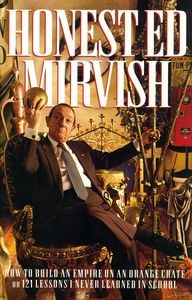
How to Build an Empire on an Orange Crate, “Honest” Ed Mirvish

[Cover]

Key Porter, 1993, 220 pages, C$21.95 hc, ISBN 1-55013-506-6

If you have never been to Toronto landmark store “Honest Ed”, don’t miss a chance the next time you’re in the area: It’s worth a trip to the Bloor/Bathurst intersection only for a visit.  (It’s a lot more interesting than another trip to the Eaton Centre!)  Once you get past the flashy facade that sports 23,000 light bulbs (go at dusk for maximal impact), there’s the store itself: four floors of merchandise organized in a crazy organically-grown fashion, where stairs, basement, an overpass and crooked floors all work together with the bombastic signage, showbiz relics and deeply discounted prices to produce a multi-layered experience quite unlike anything else in the world.  Even once you think you’ve seen it all, you will end up confronting the cuckoo clock… and you will remember that moment forever.  (Usually with an “OH MY GOSH WHAT IS THAT?”)  Such an accumulation of effects can only exist because the store has existed for decades, constantly adding more details and reflecting the passions of its owner, Ed Mirvish.

Honest Ed continues to thrive today years after Mirvish’s death in part due to the impression that his personality has left on the store.  Fortunately for everyone, it’s possible to re-live the Mirvish experience thanks to his autobiography, How to Build an Empire on an Orange Crate.  Growing up poor in Toronto in a family of American immigrants, our narrator learns his first business lessons from the family store, before going from one venture to another and eventually founding his own store.  His discovery of the discount merchandising model isn’t obvious, but once perfected the formula becomes hard to resist.  Past the autobiography of his early years, the book’s second quarter section becomes a succession of anecdotes about doing business as “Honest Ed”.  His flair for flashy gimmicks (such as a 72-hours dance marathon for which Mirvish gladly paid store closing fines) becomes a rich source of stories for the book.

The third quarter details Mirvish’s increasingly diverse activities beyond his store, most notably buying two theatres (one in Toronto, the Royal Alexandra, the other one on London, the Old Vic), expanding their scope in a line of restaurants to feed their King Street theatre patrons, and building a third theatre (the Princess of Wales) in Toronto.  Mirvish approaches those ventures with no preconceived notions, and apparently upended much conventional wisdom along the way.  The last quarter of the book is a series of “121 lessons I never learned in school” that riff on anecdotes about the store, the theatres, the restaurants or the rest of Mirvish’s life.

As you may expect from such an eccentric character, the book itself is a joy to read with well-written anecdotes, fast pacing, a triumphant attitude and deliciously accessible prose.  Paul King (A Toronto Star reporter who passed away in 2008) is credited in the acknowledgements as having provided “invaluable help in penning and polishing this story”, and a good chunk of the book’s appeal is surely his.  Mirvish himself is a curious mixture of self-humility (“I was the only adult raised by my wife and our son.”) and cocky self-confidence: like the best of books in the “business inspiration” category, his autobiography leaves readers with the sense that nothing is impossible.  There’s an authenticity in Mirvish’s voice, however, that impossible to fake: I ended up reading How to Build an Empire on an Orange Crate the same week that I read Donald Trump’s Think Like a Billionaire and the contrast between Mirvish’s likable persona and Trump’s all-bombast all-self-promotion all-greatest shtick couldn’t have been more enlightening.

The only exception to the book’s overall geniality and accessibility comes in the odd little moments where Mirvish goes off on rants about government, taxes and regulations.  It’s to be expected, of course: Mirvish’s often-successful fights against city hall are part of Toronto lore, and it’s hard for any entrepreneur to be all that well-favoured toward government taxation or oversight.  But his small-c conservative rhetoric is shockingly naive and may put off a few left-leaning readers.

Otherwise, it’s a great book that has the merit of having been written just at the right time to herald Mirvish’s greatest successes.  The Old Vic theatre was sold to a theatre trust in 1998 and while the end of some of his early King Street restaurants is acknowledged in the book, all had closed down by 2000.  Mirvish himself passed away in 2007 to much local mourning, but his legacy continues: Honest Ed is still open and busy, while his theatres are still in business in the middle of a revitalized Entertainment District that Mirvish jump-started by purchasing the Royal Alexandra.

How to Build an Empire on an Orange Crate is currently available on amazon.ca, but with a shipping estimate of one to two months.  It may be better to schedule yourself on a trip to Honest Ed to pick up copies of the book there.  You can’t miss it: excluding the kids’ books, it’s pretty much the only book on sale in the entire building.

(And if you do go to Honest Ed, turn to your left upon exiting the store and walk down a few meters down Markham Street.  Not only will you see a bit of the “Mirvish Village” local artistic enclave, but you will also find yourself at the front door of The Beguiling, perhaps Canada’s finest comics and graphic novel bookstore.  When I’m in Toronto, I visit Honest Ed’s for the atmosphere… but it’s at The Beguiling that I spend serious cash.)

[August 2009: There’s no Business Like Show Business... but I Wouldn’t Quit My Day Job is Mirvish’s second book (also ghost-written by Paul King), and it focuses strictly on theatre anecdotes.  Good, funny stories with nary a political point in sight... but it works better if you know a lot about 1960-1990 theatre legends.  ]

The American Zone, L. Neil Smith

[Cover]

Tor, 2001, 350 pages, C$38.95 hc, ISBN 0-312-87369-7

Complaining that L. Neil Smith uses his novels to indulge in libertarian propaganda is a bit like commenting upon the kinkiness, depravity and foul language in Chuck Palahniuk’s work: While true, it’s not exactly a new or enlightening observation.  Smith has long been a writer of explicitly-libertarian fiction, and if the result can be unreadable or silly, he can occasionally manage entertaining novels whenever he soft-pedals the rhetoric.

Perhaps his best novel to date remains The Probability Broach (1980), an action/adventure tale in which private eye William “Win” Bear discovered a gateway to another dimension where libertarian ideals had triumphed.  My fond memories suggest that the book managed an ideal balance between robust ideology and non-partisan entertainment: It was obviously a libertarian novel, but one that didn’t actively work to annoy whoever wasn’t in complete agreement with core libertarian principles.

The American Zone may be a direct sequel to The Probability Broach, but the years in-between the two books haven’t improved or softened Smith’s tendencies to discuss libertarianism in the middle, the side, the top and the bottom of his fiction.  It features Win Bear a few years after the events of his previous adventure, now solidly established in his new community.  Not that everything is utopian in Bear’s new world: The opening of the dimensional gates has created a new type of immigration, and not everyone can cope well with the freedoms of the “Gallatin Universe”: The titular American Zone is a Colorado urban ghetto where refugees from Bear’s United States tend to congregate when they can’t cope with the rest of the world.

Keep in mind that there are plenty of differences between Bear’s new and old worlds.  In the Gallatin Universe, the “North American Confederacy” is loosely presided over by an ape (uplifting being common, there are also a few dolphin characters), all levels of government are ineffectual by design and (this being an American libertarian utopia) there are guns, big guns, and beautiful guns everywhere for everyone.

But whereas The Probability Broach was a fun romp for all, with concepts that you didn’t necessarily had to buy into in order to enjoy the rest of the tale, The American Zone is a lot more shrill and dismissive of alternate viewpoints.  If you think that putting guns in the hands of everyone may not be a perfect idea, then you’re fit to be laughed at and dismissed.  One of the lasting impressions left by The American Zone is how angry Smith seems to be at whoever disagrees with him.  Grudges about Geraldo Riviera, Ralph Nader, the Clintons, Nixon all lead to so-called amusing passages in which analogues of those characters are ridiculed –which seems particularly curious in the case of the Clintons, since they only came to prominence years after the narrator left their universe.  (Not to mention the improbability of finding such characters in a parallel reality in which, say, Denver doesn’t exist.)  Even Canadians are targeted twice in similes, first as the narrator eats breakfast and feels “as contented as a Canadian” [P.64] and then later as a villain acts “complacent as a Canadian”. [P.136]

(This would be an ideal place in which to re-establish that as a French-Canadian working for the government, I consider Libertarianism to be a philosophy by aliens, for aliens.  Our world, simply put, doesn’t work like that, and no amount of folksy narration of a utopia whose rules have been stacked in favour of libertarianism can convince me otherwise.)

If you do manage to put ideology aside to look at the actual narrative workings of The American Zone, well, there isn’t much to gnaw upon.  The best SF ideas are carried over from the previous book, although there’s a little bit of interest in the description of how parallel universes travel is disrupting the way the citizen of the Confederacy live.  A novel on this topic would have been interesting, but The American Zone is really more interested in letting a feisty grandma explain why she should have energy handguns in her personal arsenal.

That’s not necessarily awful (despite my political objections to Smith’s novel, it’s not exactly difficult or unpleasant to read), but it leads nowhere, and that’s where The American Zone falters: Despite a gorgeous Martiniere cover, it feels hollow the moment you’re not already a libertarian.  It preaches to the choir, leaving the rest of the SF congregation looking bored.

The Talbot Odyssey, Nelson DeMille

[Cover]

Grand Central, 1984 (2006 mass-market re-issue), 543 pages, C$9.50 mmpb, ISBN 978-0-446-35858-3

A generation after the end of the Cold War, the past already feels like an alternate universe: With the advantage of hindsight, we now understand how weak the Communist forces were, even at the height of the great transatlantic eyeball-staring contest.  It’s strange, after seeing the way Russia imploded after the end of the USSR, to read about all-powerful Soviet forces and the valiant attempts by US secret forces to keep them in their places.

Nonetheless, that’s what we get with The Talbot Odyssey, a deeply paranoid throwback to the Cold War that survives even today in bookstores because it was an early novel by someone whose reputation continues to sell books.  At the exception of his brand-new The Gate House, this novel marks the end of my effort to read the entire main-line DeMille back-catalogue.  I’m not sure I would have bothered otherwise: Reading about the binary certitudes of the Cold War may be a comfort for those who think today’s world is shaded in too much gray, but it seems increasingly irrelevant.

Still, the Cold War isn’t too much of a bad time to get back to.  After all, the stakes were high and simple: the survival of western civilization against an enemy seemingly determined to enslave America –and presumably provide free single-payer health-care whether Americans wanted it or not.  1984 was one of the last good years of the Cold War: Gorbachev would ascend in 1985, and after 1986’s Chernobyl, the myth of Soviet technological superiority would ring increasingly hollow.  It’s also noteworthy that the closest we ever came to nuclear war was not in 1962, but 1983: Read up on Stanislav Petrov and Able Archer 83 to learn more.

So it’s no surprise if The Talbot Odyssey ends up being a muscular tale of espionage set in mid-eighties New York and Long Island, filled with brutal Soviet operatives, able American heroes, quite a few traitors, and a drawn-out ticking-bomb climax.  It involves the weight of decades of clandestine operations reaching out to the 1940s, tangled family loyalties, multiple identities, high-technology threats and a little bit of romance.  The backbone of the tale is about the unmasking of a deep mole in the US intelligence community and the hero is a policeman whose traits echo most of DeMille’s latter protagonists, but the only thing you really need to know is that it’s a superb late-period Cold War thriller, one that fully uses most of the plot mechanics of the genre and seldom hesitates to liquidate its own characters.  One of the book’s standout sequences is a drawn-out torture scene in which a fairly sympathetic character comes face-to-face with a double-agent: it’s a terrifying sequence, and it ends on a spectacular note.

The cast of characters is large and not always clearly distinguishable and the book’s opening third meanders quite a bit in an effort to establish everyone’s complex lineage and relationships.  No surprise, then, if The Talbot Odyssey feels like a meaty saga rather than light entertainment: This is one book that’s perfect for long flight or other uninterrupted reading moments.  It’s a bit of a backhanded compliment to say that it’s a great book for its time, but there’s really no other way to explain that a novel like this couldn’t be written today: The overdone ruthlessness of the Soviets would be a tough sell now, and we know from our own history that the threat that weighs on every characters’ shoulders has not come to pass.  Quite a bit of the novel plays upon genre espionage conventions, and so we get almost every trick in the thriller source-book except for hidden twins –perfect for a mid-eighties marketplace in which nearly every single suspense novel dealt with Communist spies, but not so much today when a “historical” novel would have to stick closer to accepted facts.

Nonetheless, it’s a heck of a read and another good entry in the DeMille oeuvre.  By now, it has acquired a comfortable patina of quasi-alternate reality, and can be enjoyed not as a possible story, but as a fine example of once-possible genre fiction.  It almost makes one nostalgic for that kind of fiction, when America-the-virtuous was a credible proposition, and there were implacable enemies up to Western Civilization’s standards.

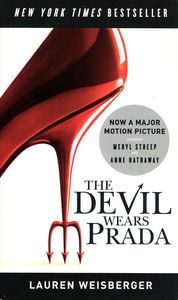
The Devil Wears Prada, Lauren Weisberger

[Cover]

Anchor, 2003 (2006 movie tie-in mass-market re-issue), 432 pages, C$10.99 mmpb, ISBN 0-307-27555-8

By now, nearly everyone even remotely interested in this kind of story has seen the 2006 movie adaptation of The Devil Wears Prada, featuring an icy Meryl Streep as the implacable editor Miranda Priestly and Anne Hathaway as her much-abused assistant.  This may actually work to the novel’s benefit, given how newer readers will have no trouble imagining Streep’s iceberg-blonde terror enunciating each one of her zingers.  (Speaking as a guy, there are also worse things than picturing Anne Hathaway as the narrator of a 400+ page book.)

But The Devil Wears Prada was a book well before it was a film, and going back to the source provides, as usual, a deeper and more immersive experience.

The bare bones of the story remain the same: In New York, a studious young woman looking for a writer’s job is almost accidentally hired as a personal assistant for the editor-in-chief of the top fashion magazine on the planet.  She knows the job will be hell, but reasons that she’ll be able to name her reward after a year on the job.  But little does she suspect that the job will change her more quickly than she expects…

Basically a boss-from-hell story, The Devil Wears Prada clearly suggests real-life kinship with Vogue magazine, and much effort has been spent elsewhere explaining the similarities between Priestley and Vogue’s editor-in-chief Anne Wintour.  That kind of what-real-what-isn’t inner-baseball, however, will be better left to true enthusiasts of the New York fashion scene: For the rest of us, it’s a look at an alien culture that can spend as much time worrying about fashion accessories as others worry about their mortgage.  Meanwhile, our narrator is stuck answering to every whim of her boss, no matter how insufficiently detailed they may be.

There’s some irony in that even though The Devil Wears Prada can be classified under the fluffy chick-lit banner (featuring a romantic plot involving a young woman deluged under the more superficial aspects of contemporary life), it quickly finds itself a spot alongside The Nanny Diaries as an indictment of the New York upper set.  Although focused on fashion, the story does feature a modest amount of class-warfare goodness in showing how the rich are not necessarily any saner than the rest of us.

Fans of adaptations mechanics will find much to like in comparing both versions of the story: The novel, of course, has the advantage of detail as our narrator explains the inner working of a modern fashion magazine, and the political wars in-between the covers.  On the other hand, the movie cleverly balances the impact of both lead characters and provides both depth and sympathy to the boss-from-hell: Two of the film’s best scenes show the consequences of Priestley’s behaviour and how she recognizes herself in the young protagonist of the story.  Those may be obvious screenwriting-101 fixes, but those details add a lot to the overall dynamics between the characters and tone done the petulance of the book’s narration.  The film is perhaps a bit better at showing how close to the dark side our protagonists finds herself after a few months on the job, which makes things a bit more interesting than the boiling-kettle drama in reading the book and wondering when Miss-perfect narrator will finally crack under the pressure.  (When she does, however, it’s a thing of beauty.)

Given the singular nature of the New York publishing scene and the even stranger character of the fashion scene, it’s a relief to find out that the prose style of the novel is accessible and even compelling.  The episodic nature of our narrator’s plight is a series of one absurd incident after another, and it’s not such a big issue if the plot emerges only late in the story.  Some of the dramatic arc is contrived and depends on a narrator who’s essentially oblivious to what’s going on around her, but it’s fair to point out that the novel is less about the plot than an accumulation of wacky incidents in the world of fashion.

For an escapist novel aimed at wannabe fashionistas, it’s a minor amazement that The Devil Wears Prada keeps having an impact even six years after its release.  Not only did the film do good business (and led Streep to yet another Oscar nomination), but it’s an open question whether the upcoming documentary The September Issue, which features Vogue and Anne Wintor front-and-center, would have existed in its current form without the increased attention given to Wintour after The Devil Wears Prada.  Not bad for “just a chick-lit novel”…

Public Enemies (2009)

[Poster]

(In theatres, July 2009): Depression-era Chicago, gangster Dillinger, early days of the FBI, Marion Cotillard as a moll, Michael Mann directing: What can possibly go wrong? Plenty of things, actually, starting with Mann’s increasingly ugly fixation for digital filmmaking: Public Enemies often looks cheap and out of control: a night-time shootout looks as if it’s been filmed on video by amateurs, the handheld camera is constantly used without reason, while several other scenes are insufficiently lit. Meanwhile, though, there isn’t much going on in the tangential and confused script: scenes come and go, but there’s little attachment to the characters, what they’re doing or where they’re going. Among other things, the story touches lightly upon Dillinger’s extraordinary popularity at the time, and messes up the chronology for several members of the Dillinger gang. Johnny Depp and Christian Bale star, but neither of them show the skills they’re best known for. The result is an overlong mess, and an uninvolving one… especially given the elements the film could draw upon. This is the third substantially-digital film by Mann, and after Collateral and Miami Vice, it’s clear that he’s getting less and less successful with each of them. What’s going on?

Defusing Armageddon: Inside NEST, American’s Secret Nuclear Bomb Squad, Jeffrey T. Richelson

[Cover]

Norton, 2009, 318 pages, C$31.00 hc, ISBN 978-0-393-06515-2

Considering the anti-terrorist rhetoric of the past decade, it’s easy to be paranoid about America’s ability to counter nuclear terrorism.  After all, the Bush administration managed to convince peace-loving Americans to invade a nation without a viable WMD program in part because, in the oft-quoted words of then-NSA Condoleeza Rice “we don’t want the smoking gun to be a mushroom cloud.”  In the years since 9/11, “dirty bombs” and “suitcase nukes” have entered the vernacular, along with a low-grade paranoia that any high-school student with a working knowledge of E=MC2 could be a sleeper agent.

Fortunately, there are watchdogs out there.  We don’t often hear about them because reassurances rarely sell newspapers, but elements of the US government do exist to react whenever there’s a nuclear threat against the nation.  In Defusing Armageddon, Jeffrey T. Richardson tackles the history and achievements of the Nuclear Emergency Support Team (NEST), an organization of experts whose mandate it is to answer whenever someone rings the nuclear alarm.

The first surprise of the book is the context that made the creation of NEST so necessary.  After a preface that acknowledges an impressive bibliography of fictional work mentioning nuclear crisis scenario (from Thunderball to The Peacemaker, with mentions of Tom Clancy’s The Sum of All Fears, Broken Arrow and Michael Connelly’s The Overlook), Defusing Armageddon tackles the real post-WW2 history of nuclear incidents in North America, and the result can be just as hair-raising as the fiction: The history of the organization so far includes missions of nuclear extortion threat evaluation, as well as radioactive material detection and containment.  If the White House receives a letter saying “answer our demands or say bye-bye Boston”, NEST’s number is at the top of the list of people to contact.

This happens more often than you’d think.  The book’s appendix provides a list of 103 nuclear extortion threats between 1970 and 1993, and the first few chapters detail quite a number of them.  From high-school students to disgruntled employees, NEST has helped identify and apprehend quite a few would-be nuclear terrorists.  Richelson’s descriptions of attempted extortion plots are alternately depressing and hilarious, their lack of consequences being no match by the thought that there would be so many attempts at it…  For those with an interest in techno-thrillers, this chunk of the book is a real highlight.

The next big moment of Defusing Armageddon comes in Chapter 3, which studies NEST’s response when a nuclear-powered Soviet satellite, Cosmos 954, re-entered the atmosphere and disintegrated over northern Canada in 1978.  The following search effort (“Operation Morning Light”) made sure that no significant nuclear debris presented any lingering threat, and the mechanics of the operation are fascinating in their own right.

After those first few chapters, Defusing Armageddon becomes less gripping as it studies the fallout of the fall of the Soviet empire (and unsecured depots of nuclear material), the new challenges of a post-9/11 security environment and the organisational changes that replaced NEST’s initial “Search” acronym to “Support”.  The narrative of fascinating details in the first third of the book gives way to a more conventional organizational biography, although occasional discussions of technological capabilities will reward those looking for background information.  Readers of Andrew and Leslie Cockburn’s similarly-themed One Point Safe will find both confirmation and explanations about such events as the botched “Mirage Gold” training incident and the remarkably successful “Sapphire” nuclear evacuation operation.

Unlike the Cockbuns, however, Richelson is a scholar more than a storyteller, and the less glamorous sections of Defusing Armageddon illustrate that while the book is impeccably well-researched (over 50 of the book’s 300 pages are notes and sources), it’s not always as interesting to read as it should be: The writing style is dense, and Richelson’s access to many of NEST’s current and former employees hasn’t always translated in an accessible narrative on the page.

Nonetheless, Defusing Armageddon is a fascinating book.  Generally non-partisan and non-paranoid despite its catchy title, it’s a lucid explanation of real anti-terrorism efforts with a significant pedigree of effectiveness.  It’s engrossing reading for national security buffs, and it’s even sure appeal to those who think it’s been a long time since Tom Clancy’s last novel.

Web Site Report – June 2009

June 2009 was a huge month for www.christian-sauve.com, probably its single most important month since the site became a dot-com in 2002.  In a manic blaze born out of boredom, I completely redesigned the site, not simply updating the sorely-outdated visual look, but crammed about nine megabytes of flat HTML content into a WordPress-powered dynamic architecture.  (While, in the process, going from about 250 static pages to 2,700 dynamically-generated ones.)  The more curious among you will find a summary of the process in the last section of this report, but in the meantime do enjoy the last Web Site Report of the non-dynamic era, since I’m completely updating the methodology of those reports next month to reflect the new architecture of the site: Goodbye Urchin, hello Google Analytics!

1. Mmm. Numbers…

One last time, my prickly “Urchin” web stats engine tells me that…

Report for: christian-sauve.com, June 2009
Total Visitors      7,147
Total Pageviews    25,812
(Corrected total   12,155)
Total Hits         32,295
Total Bytes Transferred    477.8MB
Average Visitors Per Day   238.23
Average Pageviews Per Day  860
(Corrected average    405)
Average Hits Per Day       1,076

The “corrected” numbers take out the CSS, robots.txt, PDFs, mis-filed graphic files (ICO, GIF, JPG) and other non-public files mistakenly considered “pages” by the statistics pre-digestion engine. All numbers are up from last month, but a good chunk of that is a consequence of the architecture switch and my own testing of the site.

Meanwhile, Google Analytics is a bit savvier in telling me that I only had 650 visits and 1,471 pageviews.  Visits down; pageviews up, in keeping with the expected consequences of the redesign.

According to Urchin, our top ten most popular pages are

/index.html                     966
/texts/free-movie-tickets.htm   316
/reviews.html                   241
/about.html                     225
/writings.html                  208
/texts/solaris-explanation.htm  204
/links.html                     199
/search.html                    170
/contact.html                   146
/francais/index.html            138

Little change here, just some re-ordering. (My redesign took place on June 27, too late to have an impact on the rankings.) Meanwhile, Google Analytics says…

1. /index.html 192
2. /reviews.html 139
3. /texts/solaris-explanation.htm 126
4. /francais/index.html 38
5. /the-contact/index.html 32
6. /essays/index.html 29
7. /the-reviews/index.html 28
8. /the-about/index.html 20
9. /writings.html 19
10. /reviews/2003/books03k.htm 17

This is a bit different from the usual results, and I can already see some of the new-template files sneaking onto the top-10, not so much as evidence that new visitors are flooding in, but as a consequence of the top-level site testing.

If you care about such things, (and it is fascinating stuff!), here’s a look at browser statistics for the month (by visitors), as provided by the clever gerbils at Google Analytics:

Browser This Month Last Month
1 Firefox (all) 212 230
2 IE 7.0 127 212
3 IE 8.0 65 (not counted)
3 IE 6.0 63 67
4 Safari (all) 68 47

The sudden jump in IE8 numbers is heart-warming, but I won’t rest until IE6 disappears from this list.  (Since the new site looks really really weird in IE6, the process may accelerate next month.)

I should mention once again that as of next month, I’m going to use Google Analytics are the primary source of data, and maybe look at the Urchin stuff for fun: With the new dynamic architecture, Urchin is becoming more technically useful than analytically valuable, and trying to extract useful data out of it is going to be just too time-consuming.  Fortunately, I have used Google Analytics for long enough that I won’t be too disturbed by what I’ll be seeing.

2. Where do these people come from?

According to Urchin, our top five sources of referrals (in visitors) were

google.com/search	474	(486)
live.com/results.aspx	109	(94)
www.google.ca/search	104	(80)
google.com/books	49	(51)
google.co.uk/search	47	(64)

As you may expect by now, Google Analytics has a slightly different view of the situation:

Source This Month Last Month
1. google / organic 410 430
2. yahoo / organic 12 26
3. bing / organic 10 11
4. books.google.com / referral 9 8
5. en.wikipedia.org / referral 9 11

(Lingo key: “Organic” is Google’s way of saying that no one has paid for links leading back to christian-sauve.com on those search engines. “Referral” is supposed to be a direct link to this site.)

Google now lists about 2980 links for “Christian Sauvé”, down from last month. A look at the top-100 results showed no new links of significance.

3. Ohh! Visitor comments!

Plenty of activity in the mailbox this month.  Let’s have a look:

1. Chris from Boston wrote to say…

About 2002 Solaris- a new interpretation which also reveals Andrei Tarkovsky s Solaris (1972) to be genius, and not so self-indulgent! The faux Rheya, and the other “visitors”, are presented as projections of the Crew’s unconscious– but as such they symbolize film itself! These non-human creatures who do not die; who are imperfect copies of actual memories; who are sometimes rejected violently, sometimes loved irrationally; artificial products of advanced technology (moviemaking). Soderbergh, like Tarkovsky before him, is writing about our relationships to film itself (and by extension to the actors, etc, etc) I’m not sure if Lem’s book has the same self-conscious self-references to creative writing and reading- but this idea really opened up a new appreciation for me. I’ve also discovered a ’68 Soviet made-for-TV version- great stuff!

Interesting!

2. Sofie from Belgium says…

Hi! My name is Sofie, I’m 15 years old and I’m from Belgium. We watched  the movie “Solaris” during English class, but I didn’t understand the movie well, especially the end. I was wondering if maybe you could help me to understand the several possible endings, because I already read a lot of different ones. And I have to explain them on my final, but the teacher doesn’t want to explain it to us. My final is the 18th of Juin. Thank you!  Sofie

and then, moments later:

It’s sofie again… :) Where can I see your answer?

I really wanted to help, Sofie, but you didn’t include a return email address.  Given the date of your final, I doubt you’re reading this, but that’s just as well: Everything I’ve thought about the film is in my Solaris Explained article, and I’m not holding anything back. To anyone else: please re-read the article, it’s all there.

3. An anonymous drive-by:

Your interpretations are not scholarly.

Well, as a way of saying “You suck!”, that’s more polite than usual.  Poking around at the server logs to figure out what had so provoked my anonymous correspondent,  I discovered (without any surprise) that a disappointed review of a right-wing political thriller (Vince Flynn’s Term Limits) had once again earned me some nameless name-calling.  For the record, I note that whenever I get a nasty anonymous comment, it’s almost always about a not-entirely-positive review of a right-wing thriller.  What really makes me laugh is that the review essentially says “someone smarter than me will have to review the political implications of this.”  Anonymous commentator’s reading comprehension: Poor.

4. Finally, a chance real-time encounter with a former local SMOF earned me the first real message handled by my new technical infrastructure…

For your SF reading, I suggest that you add Hal Clement and Harry Harrison.  Harry’s Stainless Rat series and “Star Smashers of the Galaxy Rangers” constantly bring tears (of laughter) to my eyes.  And for complete obsure – look for Charles R. Saunders…

They may not have been reviewed at length, but I have read plenty of Hal Clement (Mission of Gravity and others) and Harry Harrison (both works mentioned, and more).  On the other hand, Charles R. Saunders was a new name I should have known!

4. Search Queries Oddities

According to Google Analytics, here are the month’s most popular search keywords:

Keywords Visits
1 solaris explanation 17
2 solaris ending 13
3 christian sauvé 9
4 solaris explained 9
5 the runaway jury john grisham thesis synopsis 8
6 christian sauve 6
7 explain solaris 6
8 solaris movie explanation 6
9 dale brown american holocaust 5
10 solaris 2002 plot 4

Much Solaris again…

Other odd, special or amusing search keywords:

  • “plenty of cleavage” cleavage movie review
  • a movie about a bartender who becomes a hero and is hunted by a past
  • how edible is the book from the christian writer mary backster to hell and back?
  • review of symbolic, technical and audio codes used in the devil wears prada
  • when you trust a person’s word only, is this wrong

Until next time, my name is Christian Sauvé and I remain… obsessed by web statistics.

X. Special section: Site Redesign Notes

I woke up in mid-June with a few new priorities: I was pretty much caught-up in what I had to do, was giving a speech to a few dozen people at the end of the month, and couldn’t stand looking at my current web site.  Taken together, those three elements forced me to do something I had thought about since at least January 2008: Not only redesign the site visually, but convert the content to a database-driven Content Management System.

Picking WordPress was easy given the amount of experience I had with the system, and the just-right capabilities it offered.  But converting 250+ files of HTML code totaling about nine megabytes of data isn’t the find of thing you do in a lazy afternoon.  It’s pathetic to do elementary project management for a personal site redesign, but that’s what I ended up doing, with a real schedule on paper, deliverables, day-by-day objectives and critical paths.  All the HTML data had to be concatenated, then meta-tagged, corrected, normalized and exported to a format that could be automatically imported in a WordPress database.

I ended up doing things I wasn’t planning on doing, in ways I hadn’t even imagined.  I never could have finished the project without the industrial-strength text editor NotePad++ and the latest version of Microsoft Excel: Both applications covered for the other, but it’s Excel’s string-manipulation capabilities and ability to combine data in an XML template that really saved the day.  I ended up reverse-engineering the WordPress XML format and then generating files to import 2,500+ items back in the system.  The really dull stuff?  Adding the date meta-data that was until then implicit in the HTML filenames, and converting my MOVIE TITLES to semantically-rich Movie Titles.  There weren’t many programmatic ways of solving those issues.  Also annoying?  Finding out that being 90% accurate in entering meta-data over a dozen years is far from being good enough when that means hundreds of corrections over a thousand-items database.

It’s fair to say that my ambitions for my visual design were much, much higher than what I ended up applying.  But the bulk of the redesign time budget went to the data formatting, with the “fun” visual design ending up “good enough” early on.  There was a lot of tweaking (save for the commenting module code blatantly taken from the default Kubrick template, most of the template for this site was written from scratch), but it sort of came together.  I only tested with last-generation browsers: this is my personal site, and I don’t really care if IE6 blows up for visitors sad enough to be stuck with it.

Overall, the project took about forty-to-fifty hours, spread over four-hours weekdays and twelve-hour weekend days.  As an occasional web designer, I would have turned down that particular commission if it had come from an outside client.  On the other hand, there’s little in WordPress that scares me now that I’m done.

I have opened comments on nearly all items: I wonder how long it’s going to take until I regret it.

Very little content didn’t make it from the old to the new architecture.  What disappeared were usually essays I now strongly disagreed with (including one explaining why this site wasn’t a blog!), or collections of mini-reviews I couldn’t fit in the new site architecture, necessarily more rigid than the old one.  I really wanted to review my older reviews to remove the more embarrassing ones, but simply didn’t have the time.

I felt pretty proud of myself for finding a way to automatically integrate posters and book covers to my reviews, but plans to provide scans of all book covers and movie posters quickly disappeared once I realized how many of them there were (2,500+) and how long it would take to generate every graphical item even if I was on a fully-automated process.  (Basically: five minutes per book cover, two minutes per movie poster. If everything went well.)  I compromised by including full imagery for everything reviewed since January 2008… and will provide images from now on.  I hope, though, that my server space and bandwidth will be able to accommodate all of that new data.

What else should I note?  Well, XAMPP worked superbly as a local development web server. Facebook was useful to send a “new site” announcement to my usual network. I’m still learning The GIMP –now that’s another full-time project not to attempt in the middle of a major redesign!  I had some trouble with my host in installing WordPress, but nothing we weren’t able to handle after a few emails back and forth.  I had a lot of trouble sleeping during the twelve days of the project: Hot temperatures, heightened stress, lots of sugar and a head boiling with ideas.  But the site was more or less ready on-time, the speech went well and the project management worked more or less as planned.  Hopefully, future redesigns won’t be so difficult!

Expect a lot of changes in the statistics next month: More pages, but smaller pages: I can’t really predict what will be the impact on Google referrals, especially since I won’t remove the majority of the old static pages until August 1st.  We’ll see…