Book Review

  • The Rhesus Chart (The Laundry Files 5), Charles Stross

    The Rhesus Chart (The Laundry Files 5), Charles Stross

    Ace, 2014, 368 pages, C$31.00 hc, ISBN 978-0-4252-5686-2

    One of the hidden benefits of having taken a bit of time away from reading favourite authors in the past three years is that, suddenly, I had two Laundry Files novels to read back-to-back.  Ha!  Take that, interminable wait in-between volumes!  Go away, unfulfilled addiction to one of my favourite ongoing series!  Hello, instant gratification!

    At first glance, fifth volume The Rhesus Chart looks like a romp.  Discussing the series on his blog, Charles Stross has announced that while the first four volumes of the series had been homages to spy thrillers, the next three-book cycle would take on aspects of urban fantasy.  So it is that The Rhesus Chart starts off modestly with series narrator Bob Howard discovering a nest of vampires set in London’s financial district.  Now wait: Has someone said “vampire”?  In the Laundry universe?  Why yes: While the novel begins with “everybody knows vampires doesn’t exist”, Stross ends up doing some fancy foot-tapping in order to justify their existence within the framework of the series, and it works pretty well.  When investment banking quants end up thinking a bit too much about the nature of new fiscal instruments, they end up ridden by extra-dimensional parasites that demand consumption of human blood for quantic-cognitive purposes.  When Bob discovers what they’re up to through data mining, he declares an emergency, loads up for bear and…

    …and that’s when, mid-way through, The Rhesus Chart takes a most unexpected and delightful plot detour, letting go of the expected fang-hunt in favor of something far more in-line with the series’ satiric approach to occult intelligence.  I’m sitting on my hands not to say more, but I’ll add that right after I was openly musing (in reviewing The Apocalypse Codex) that The Laundry Files was worth reading for world-building more than plot, here is a novel that brings plotting back to the forefront.  Characters in The Laundry Files are far more competent and reasonable than would be expected from similar urban fantasy series, and Stross doesn’t miss an occasion to poke fun at other vampire fiction (most notably by featuring a vampire-hunter demonstrated to be even worse than the vampires).

    Throughout, The Rhesus Chart keeps up the fine (and sometimes dizzying) game of spot-the-references, blending geek jokes with pop-culture references, technical wizardry and genre references.  I suspect that The Laundry Files is a narrowcast series: very enjoyable to those who happen to fall within the parameters of its premise, a bit less comprehensible to others.  As a whole, the series is steadily getting grimmer even though The Rhesus Chart certainly seems to be a bit more comic (at times) than its two predecessors: Stross indulges in lame bureaucratic humor in describing how the Laundry forms a committee to deal with vampires (or PHANGs, as they are designated), but scores a few smiles in describing vampires using trendy software development methodology and project-management techniques to figure out what’s happening to them.

    Some plot threads are launched that will hopefully pay off in future installments (including a new cat, and a conversation that suggests that Bob’s relationship with Mo is of high interest to the upper management of the Laundry).  The editing is a bit slack in that the same plot points seem hammered home a few times (although, to be fair, the plot does get so convoluted at times that it seems as if even the narrator isn’t too sure what’s happening and why) and the usually heavy-handed exposition risks alienating those who aren’t already fans of exposition, although few of those will have made it to the fifth book of a series that delights in its exposition.

    Then there’s the ending, which turns The Rhesus Chart from a romp to a significant installment in the series: The vampires bite where we least expect, several recurring characters die and one of the most comforting relationships in the series is badly damaged.  Some of this could have been predicted from the overall series arc: other than the typical Campbellian plotting tropes, narrator Bob has, as demonstrated in the ways the narration has progressively gotten away from him, grown significantly in power and now knows too much to remain the sole viewpoint.  In order to grow, The Laundry Files needed to shake up some of the foundations of the series, make Bob more miserable and find itself a few other narrative entry points.

    It’s that kind of willingness to upset the status quo (as also shown most spectacularly in the conclusion to his initial Merchant Princes cycle) that makes Stross an interesting author even when he’s cold-bloodedly engaged in the mercantile tradeoffs of a continuing series.  The Laundry Files could have stayed in stasis, featuring Bob Howard fighting the newest tentacled evil-of-the-book, but The Rhesus Chart show that Stross is actively reshaping his series as he goes along.  Keeping in mind that the series started from what was meant to be a one-off short novel and that Stross’ game-plans keep evolving as he goes on (with a seven-book cycle now planned to hit nine volumes), this is a series that’s going to be worth reading for a while.

  • The Apocalypse Codex (The Laundry Files 4), Charles Stross

    The Apocalypse Codex (The Laundry Files 4), Charles Stross

    Ace, 2012, 336 pages, C$27.50 hc, ISBN 978-1-937007-46-1

    Of all the ongoing SF&F series out there, I have to rank Charles Stross’ The Laundry Files as one of my favourites.  It seems specifically designed to appeal to my strange mix of computer knowledge, public-service career, fascination for Lovecraftian horrors, liking for spy thrillers and penchant for geeky comedy.  I’ve been a fan since the first small-press hardcover edition of The Atrocity Archives, and I’ve been fascinated by how the series has evolved from a one-shot singleton to a series with an accelerating plot spanning multiple volumes.

    The fourth installment of the series, The Apocalypse Codex, picks up a few weeks after the rather grim conclusion of The Fuller Memorandum.  Narrator Bob Howard is back in service (somewhat) after being abducted by a strange cult and re-possessing his own body, acquiring some curious necromancer powers along the way.  Still shell-shocked by the events, Bob find himself promoted to middle-management early in the novel and is asked to supervise two independent contractors as they go to Colorado in order to investigate a curiously effective preacher.  Operating deep in enemy territory, Bob will have to discover how far his powers go, avoid detection and somehow… manage.

    The Apocalypse Codex clearly runs along the same lines as The Fuller Memorandum: It further marginalizes Bob as the narrator (by making him discuss events at which he wasn’t present, effectively switching between first and third-person narration), returns to plot threads introduced in previous volumes, maps out some of the things previously left unsaid and further explains the multiverse in which The Laundry Files are set.  While the set-up of the book may look like another mad-cultist romp at first, it is set against the ticking clock of Case Nightmare Green and eventually leads to a confrontation between Bob and a few past horrors, at a time when he is better equipped to deal with them.

    A good chunk of the book is a Peter O’Donnell / Modesty Blaise homage, featuring a new character named Persephone Hazard and her trusty side-kick.  If you’re a North-American with no knowledge of Blaise, don’t worry: the character is interesting enough in her own right, and would make a perfectly good narrator should Bob find himself unavailable at some point.  The tone of the novel does remain consistent with the rest of the series, blending some humor with deep horrors.  (Despite the extraterrestrials brain parasites being featured here, the most repellent horror of the novel has to do with non-supernatural forced human reproduction…)

    A distinguishing feature of The Laundry Files (by happenstance at first, and then more deliberately) has been the way the series has steadily pivoted away from its one-shot origins into a series capable of sustaining a longer duration.  We see this further at work in The Apocalypse Codex by the way it lowers the idea density of the series and heightens the ongoing subplots.  I was initially apprehensive about the televangelist premise for two reasons: first, it seemed a bit ordinary and second because televangelists seem to be easy targets for SF writers usually writing from a non-Christian viewpoint.  This second doubt eventually went away once it became clear how thoroughly Stross had researched and presented his subject: The novel’s televangelist isn’t as evil as he is thoroughly manipulated by monsters beyond his imagination, and Stross is careful to provide detailed explanations about how his doctrine differs from the usual, to the point of giving a sympathetic voice to a pastor able to explain the quirks of the cult’s interpretation of scriptures –especially the titular codex.

    This being said, my first set of doubts weren’t entirely assuaged: As The Laundry Files slow down for the long haul of a planned nine-book series, it’s normal for the freshness of the first few volumes to be normalized and taken for granted.  This isn’t exactly the best of news for those who read for world-building rather than plot, but it is to be expected.  The Apocalypse Codex does contain quite a bit of imaginative details (including some frightening descriptions of what the American occult services are willing to do) to placate series fans, and the personal growth of Bob’s character is also becoming interesting now that he’s evolving out of the lowly-sysop/operative into a more challenging manager/case-officer.

    Astonishingly enough, I can’t help but note the way Bob’s career seems to run in parallel with mine, adding another layer of personal interest in the series: When I picked up The Atrocity Archives in 2004, I was a lowly techie much like Bob, toiling away in a public service bureaucracy at the lowest difficulty setting.  A decade later, I ended up reading The Apocalypse Codex at a time when I’m knocking at the doors of middle-management, taking on a small team and trusting them to do the right thing.  When Bob muses over his own career growth and responsibilities, let’s say that resonates –and this despite the thankful lack of necromancy, otherworldly horrors and brain parasites in my own line of work.

    So it is that I suspect that I will remain a fan of The Laundry Files for quite a while yet.  The Case Nightmare Green ticking clock is as effective an overarching plot device as I can imagine, and with every installment, Stross proves that he can make the series evolve at its own rhythm, deepening and extending his universe as needed.  The Apocalypse Codex is strong work from a clever writer, and it just happens to push most of my power chords as a reader.  Onward to The Rhesus Chart!

  • Double Star, Robert A. Heinlein

    Signet, 1955, 256 pages

    The first stop in my modest 2014 Heinlein-Hugo-Winning-Novel reading project is 1955’s Double Star.  Written after Heinlein had become a first-rate SF writer but before he hit his all-time highs, it won the 1956 Hugo Award for best novel.  In the list of top Heinlein novels, it usually gets forgotten behind Starship Troopers, Stranger in a Strange Land and The Moon is a Harsh Mistress.  Still, re-reading it today, roughly twenty years after I first encountered it, I’m struck at how well it exemplifies the best of early-era Heinlein and much of the SF genre at the time.

    For one thing, it’s short: Written at a time when typewriters ruled and serial magazine publication was still very important, it barely exceeds 55,000 words.  (Contemporary adult SF genre novels are around 100,000 words.) As a result, it can be read quickly and, perhaps most importantly, it can focus on the essentials of the story it wants to tell.

    It’s not that original a story: In a now-alternate future where much of the Solar System has been colonized and humanity has encountered alien races on Mars and Venus, a down-on-his-luck actor gets hired for a very special job: impersonate an important politician for a crucial event, given how the real politician has been abducted.  This “simple” assignment soon stretches out to include more political shenanigans when the real politician is found incapacitated even as an election campaign heats up.  The conclusion is straight out of the classics (or subsequent homages), but isn’t less effective for it.

    Told through evolving first-person narration (as in; our protagonist often changes his mind during the course of the novel, deliberately reflecting his growth as a person), Double Star straddles two or three worlds at once.  It’s obviously about politics, just-as-obviously about acting but also (while this may be so obvious as to be invisible to genre readers) about fifties-SF notions of the future.  By which I mean that the future explored in Double Star is a reasonably average one by SF’s mid-fifties standards.  It has alien races within the solar system (because no one was certain, at the time, that we could exclude those), system-wide colonization, torch-ships and moon cities.  Of course the technical details are charmingly quaint: video is available on spools of film, the empire has eight billion people scattered throughout the entire system (we recently went just above seven on just this planet) and there’s no information networks beyond news providers.  While Heinlein does include a perfunctory bit of color in his cast of character, gender roles remain firmly steeped in fifties conventions: The only female character of note is the politician’s secretary, and she (of course) is in love with her boss and represents the emotional pole in the story.  As infuriating as this can be, that’s the way most SF of the time envisioned the future.

    So Double Star definitely speaks to a fifties Science-Fiction audience.  But what it tells them is a treatise on reasonable government and the demands of acting as a profession, and that’s worth a few words of praise.  For one thing, our narrator is very much an actor, in his instincts as much as his vocabulary.  There are many clever passages in the novel in which the narrator describes his process “getting in character” either physically or mentally, and they offer a fascinating glimpse into the inner thoughts of an actor.  The details through which he perceives the world are a bit different than the stock engineer/hero protagonist of so much fifties SF, leading to exemplary paragraphs like the following:

    At turnover we got that one-gravity rest that Dak had promised. We never were in free fall, not for an instant; instead of putting out the torch, which I gather they hate to do while under way, the ship described what Dak called a 180-degree skew turn. It leaves the ship on boost the whole time and is done rather quickly, but it has an oddly disturbing effect on the sense of balance. The effect has a name something like Coriolanus. Coriolis?

    The last two words are the point of the quote in which actor-meets-physics, but let’s also notice the confident let-me-explain-complicated-things tone of the entire paragraph, as good an example of the strengths of Heinlein’s writing, mixing technical knowledge (“180-degree skew turn”) with relatable details (“which I gather they hate to do”).  Much of Double Star is written in the kind of prose that can be read effortlessly, from a first chapter that has a rollercoaster of pulp-style adventure plotting to a more wistful concluding chapter that reflects on a life fully lived.

    What’s more interesting than the acting prose icing (and, frankly, what I’d forgotten in the twenty years since I’d read the book) is the political content.  Like most people, our narrator starts with a mild loathing of politicians but, by dint of doing the job, comes to appreciate the details and complexity of it all.  Heinlein does a fine job at portraying politics (which he calls “the only sport for grownups”) as a nuts-and-bolt team effort.  There are enjoyable info-dumps along the way.  It’s simplified, sure, but not as much as you’d think in 55,000 words.  Surprisingly enough for some readers, Heinlein presents the empire as a Commonwealth-style parliamentary monarchy (a far better system than American-style politics, but then again I’m Canadian), and finds a respectable use for a king.  Go ahead and square that with the rest of his best-known bibliography.  At the very least, Double Star still offers something to think about, which isn’t bad nearly sixty years later.

    Dramatically, there is a lot to like as well in the way Heinlein deals with his narrator.  He starts the novel as a fairly unlikable self-important schmuck, but gradually evolves out of his own narrow limits to become a better man… by playing the role of a better man until he authentically assumes the personality.  His puffery is replaced by earned confidence, his cheap rejection of complexity is replaced by hard-won experience and while that may sound like Drama 101, it’s relatively well-executed, especially within a mere 55,000 words.  (Admittedly, some transitions do look easy: Hypnotism plays a big role in one of his fundamental evolutions, and another is driven by merely hitting the books for a few days.)

    It all amounts to a remarkably effective novel even today.  I propose it as a particularly polished example of fifties SF (indeed, it was selected as one of the nine representative novels of the genre and era by no less than the Library of America) and a good blend of influences within that genre.  It’s an ideal approach vector for anyone interested in Heinlein: It doesn’t carry much of the baggage of his later novels, and has a better chance to seduce on length and wit alone.  After re-reading it, I reaffirm its spot on my list of Alternate Hugo winners (or in this case, actual Hugo winners) and am feeling quite a bit better-disposed toward the next title in my Heinlein Re-Read Project.

  • The Last President, John Barnes

    The Last President, John Barnes

    Ace, 2012, 400 pages, C$31.00 hc, ISBN 978-1-93700715-7

    As of mid-2014, John Barnes has written thirty-three books and I have read twenty-two of them, with eight more somewhere in my to-be-read stacks. (What I’ve got left to read quickly gets into his early-career juvenilia and obscure titles long out of print.) I mention this as a feeble claim to authority when I say that when it comes to Barnes, I have come to expect the unexpected.  He’s one of my favourite SF writers despite/because I’m never too sure how I’ll react to any given book.

    As I’ve written elsewhere, there are good Barnes novels, there are bad Barnes novels but there are no dull Barnes novels.  Over the years, I have become convinced that he is a bit bored, disillusioned and maybe even disappointed with the genre SF readership.  How else to explain the constant subversion of expectations, the nose-tweaking, the genre-hopping to be found in his bibliography?  Reading Barnes is like being dared to go past hidebound genre expectations, even when he’s demonstrably working within the traditions of Science Fiction.

    The price to pay for liking such an unpredictable author is that, from time to time, he ends up writing a novel that doesn’t require assessing as much as explainingThe Last President, third book in the Daybreak series and arguably the concluding volume in a trilogy, in one of those: With the wrong expectations, it’s a dud, but with the right expectations it becomes half-way interesting.

    It almost goes without saying that the rest of this commentary will include complete spoilers for the end of this book.  There are no other ways to discuss it.  For reasons that will soon become clear, that this is a novel (heck, a series) best spoiled rotten from beginning to end, as readers prepared for what Barnes has in mind have better chances of appreciating what he is trying to do.  I’m going to write two further non-spoiler paragraphs and then I’m going to delve deep into the keys to The Last President.

    What about a few general thoughts about the book?  It’s written cleanly, although some of the Midwestern geography gets esoteric without a map.  Long-time Barnes readers will note that after a Daybreak Zero that was generally exempt of sexual violence (one of the author’s recurring motifs), we get a far-too-rough-sex scene just in time to make us lose sympathy for a character who is then promptly killed.  Barnes has written elsewhere about how this third book was written more closely to his vision for the series than the first two heavily-edited ones, and while this does show in smoother pacing and scene transitions, it’s not a radically different reading experience.

    Last non-spoiler stuff: What makes this Daybreak trilogy interesting, as far as catastrophic slides into post-apocalyptic mayhem are concerned, is the titular concept of “Daybreak”: the idea that a substantial number of humans would execute a variety of plans designed to make human civilization regress hundreds of years in the past and ensure that we’d stay there.  That’s Nightmare Fuel stuff as far as I’m concerned, and I suspect that it’s a reason why, despite my overall distaste for Barnes’ goals in writing the series, it has occupied such an unusually large space in my thoughts since I’ve finished the book a few days ago.

    OK, on to the good spoiler-full stuff: The Last President concludes this Daybreak trilogy with a downbeat tone exemplified by two overlaid let-downs:  The protagonists of the trilogy lose their bid to rebuild the United States of America, and Daybreak is revealed to be a creation of aliens determined to destroy human civilization.

    Whew.

    Let’s tackle the aliens first.  As far as science-fictional ideas go, “paranoid aliens kneecap human civilization before it causes them trouble” is a pretty good one.  Alice Sheldon’s “The Screwfly Solution” still gives me the notional heebie-jeebies, and buried deep into my files is the manuscript of a (bad) novel using that exact same premise (even down to the “next step is them coming here to finish the job” send-off which also figures in The Last President)  But a good idea doesn’t necessarily mean an appropriate idea, and its use as a definitive answer for Daybreak isn’t nearly as compelling as I thought it would be when I first supposed it while reading the first volume.  Daybreak is a lot scarier as a purely human creation, arising in the collective unconscious as a response to the contemporary environment.  It’s also more appropriate to have human protagonists fighting another human creation: making it come from aliens takes it deep into “unfair” territory, and comes close to trivializing the struggle against Daybreak when the deck is stacked so obviously against civilization.

    But, you know, cool idea –well-presented if perhaps revealed a bit too late like the cherry on a sundae.

    Still, it becomes a forgivable weaker point when compared to the other big let-down of the novel: the idea that the forces of civilization (as represented, perhaps pretentiously, by the attempts to keep the United States government intact) are served a resounding defeat in their efforts to fight back against Daybreak.  Not to put a fine point on it, they spend roughly half the book winning battles and spanking Daybreaker hordes, only to be ambushed by authorial fiat and lose for the rest of the novel, until the United States are no more than a handful of separated fiefdoms.

    That’s quite a bit more problematic than aliens, especially as the conclusion of a trilogy.  Genre readers have been conditioned to expect the pot at the end of the rainbow, so to speak.  We read fiction for the hardships, but also with the expectation that something will be a bit better at the end despite the terrible prices paid along the way.  This is especially true the longer the work: I don’t particularly care if a character dies at the end of a short story: I haven’t had time to attach myself.  But a trilogy requires a far bigger investment in time, and my expectations of a reward go up correspondingly.  So when I tackle a series that starts with the apocalypse and sets out with the stated goal of keeping the United States together, it’s kind of, oh, a massive disappointment when the ending consists of characters shrugging and telling themselves that at least they tried.  The book doesn’t end in defeat as much as in dramatically lowered expectations, and a bit of hope for the bits and pieces left.  (There’s also a bit of dramatic irony in how Daybreak is ultimately dismantled not by the cleverness of characters fighting for peace, order and good government, but by the ruthless plans of a back-wood dictator going for a power-grab.  Let’s put the worst facets of humanity against each other and see who wins…)

    But before climbing the barricades of outrage, let’s take a moment to second-guess this first reaction and double-check that my expectations as a reader were the same as those with which Barnes wrote the series.  Because the piece of information that is essential in understanding the Daybreak trilogy is this: Barnes is an iconoclast, and he’s not entirely unsympathetic to the destruction of civilization as he describes in his series.  As he writes on his Amazon page:

    I like writing on all sides of an issue, and in this case it was particularly easy because fundamentally, I’m a Luddite; if I could figure out a way to make Daybreak happen and send us all back to steam trains and biplanes without killing a few billion people, I would be sorely tempted, but at the same time I recognize that emotional response as idiotic…

    I couldn’t be any less sympathetic to this point of view (I really, really like civilization) but I’m trying not to take it personally: Barnes’ entire bibliography, as fascinating and varied and exasperating as it can be at times, is filled with examples of him writing to get some reaction out of his readership.  It’s no exaggeration to write that, as far as this trilogy’s characters are concerned, Barnes is Daybreak in the most literal sense, especially when, on his blog (and elsewhere; Barnes hasn’t been shy in discussing his series), he admits that…

    …the reason for engineering the Seven Nations Future in such a complex way is surprisingly simple: I wanted a huge canvas for all kinds of adventures, and it took a pretty big story to set that up. I wanted to contrive a dieselpunk kind of world that would never be wiped out by computers and nukes, as was the interwar era where so many of my favorite pulp adventures took place.

    So there’s the important takeaway, and key to the series so far: this Daybreak trilogy was never about readers seeing characters winning the war against the Daybreakers, regaining their iPhones and rebuilding a modern civilization: it was about Barnes setting up a fictional playground for further adventures.  The deck was stacked against the defenders of civilization from the onset, both from Barnes’ affections and from his ultimate goals.

    I can respect the series a lot more now that I know this.  I also expect that in the later grand scheme of things, after Barnes has had time to write further novels in this universe, the initial Daybreak trilogy will be regarded for its true nature: the opening cycle of a much longer Seven Nations Future series.  I’m still not too sure, mind you, that a trilogy was the best way to go: A novel could have low-balled the sensation of betrayal, while a long-running unified series à la Song of Ice and Fire would merely see the first three books as prologue.

    But so it goes with any Barnes novel, which aren’t usually to be read unless we’re committed to a bit of a struggle and soul-searching about expectations.  I’m amused to see that The Last President, as of mid-2014, has an average Amazon reviews ranking of 3.5 stars, but those reviews are widely scattered across the five stars spectrum: Such a novel ends up getting reactions all over the map, and that’s the way Barnes seems to like it.  Given that this review is roughly twice as long as my usual ones, you can gather that I have engaged with the novel to an unusual extent, that that I still haven’t made up my mind as to whether or not I liked it.  What’s confirmed, though, is that I’m eagerly waiting for the next Barnes novel with no other expectations than being surprised.

  • Science Fiction: The 101 Best Novels 1985-2010, Damien Broderick & Paul di Filippo

    Science Fiction: The 101 Best Novels 1985-2010, Damien Broderick & Paul di Filippo

    Non-Stop Press, 2012, 288 pages, $14.99 tp ISBN 978-1-933065-39-7

    As someone who rather enjoys reviewing science-fiction novels, I’m not exactly the friendliest target audience for a book such as Science Fiction: The 101 Best Novels 1985-2010 (henceforth 101 Best SF Novels 1985-2010). I’m not a librarian looking to stock up my collection; I’m not simply a reader looking for a few new book recommendations. I am, in some distant ways, a colleague of Broderick and di Filippo in the Grand Community of SF Reviewers, fact-checking them and trying to find out whether they did their jobs correctly.

    And then there’s the question of canon-making.

    Books like 101 Best SF Novels 1985-2010 are essential in the formation of a continuing genre SF canon. They point at novels that should become part of the genre’s continuity, present an updated view of the genre’s last few years and can influence what we think of the genre by claiming novels that did not emerge from the SF genre conversation, but may come to influence it someday. David Pringle’s introduction explicitly sets 101 Best SF Novels 1985-2010 as a successor to his own Science Fiction: The 100 Best Novels, 1949-1984 and in doing so sets it up as part of a critical continuity. Much as the previous volume was used to stock up libraries and influence reading choices, this one also attempts to present a certain vision of the genre’s latest quarter-century.

    Dispending right away with some essential statistics and credential-building: 101 Best SF Novels 1985-2010 does indeed proposes 101 novels for consideration as the best of that 25-year period. (The complete list is available here.) I have read roughly 57 of those novels, depending on your definition of “read”. If you look through my Alternate Hugo list of favourite SF novels, you will find that I too think the best of about 20 of the 101 novels, and that I also quite like 16 more. The rest, well, does reflect a certain critical consensus.

    But moving beyond pointless shelf-measuring contests, 101 Best SF Novels 1985-2010 is remarkable for the way it tries to redefine the Science Fiction genre in at least two ways. For one thing, this is a very inclusive list. Authors only get one entry on the list, which means that some entries act as general discussions on the entire body of work of an author (the entry on Orson Scott Card’s Ender’s Game includes commentary on Speaker for the Dead, for instance), and also allows more authors to make it on the list. You can see how this may skew the result: My own list of “best SF novels of 1985-2010” would probably include five Charles Stross novels, for instance, but Broderick/di Filippo only (rightfully) select Accelerando.

    They also reach out and claim novels that may not conform to a strict definition of SF. This isn’t merely going and claiming The Hunger Games trilogy as an explicit bid to bring YA back to SF (even though the book itself has significant flaws as science-fiction, Broderick/di Filippo make the point that it’s the kind of work that escapes the self-referential tendency of genre SF), but also going and claiming works such as Perdido Street Station, Temeraire and Zero History that are great books, but are usually more closely aligned with other genres rather than SF.

    Fortunately, there is more to 101 Best SF Novels 1985-2010 than just a list you can look up elsewhere on the web: Much of the real value of the book is in the (sometimes frustratingly short) commentary offered on all listed novels. Broderick/di Filippo are professional reviewers, and their commentary is usually able to highlight what makes each novel special, and why they deserve to be read. There’s an attempt to present broader trends through the lens of each selection. The sum of each entry ends up forming a set of broad opinions about the state of the genre from 1985 to 2010. It’s a broad set of opinions, and it isn’t immune to the kind of silliness you get when trying to develop 101 critical approach vectors to tight deadline: in other words, don’t be surprised to find a lot of very strange assertions in the text of the book as it overreaches and states things that may not sustain scrutiny. But that’s what you get for explaining 25 years of SF in 101 750-words segments.

    Broadly speaking, it does occur to me that the selection of 2010 as the last year of this roundup is going to be more significant than simply the end of a quarter-century. As you may recall (Bob), 2010 marked a second post-recession year, the introduction of the iPad, the consequent explosion of the eBook market and the beginning of major changes to the publishing industry. (Including more and more authors taking control of their backlist and publishing them as eBooks –who’s going to check how many of those 101 novels are available as eBooks, and will be in a year?) 2014 is still far too early to tell where we’re going to end up, but the rise of eBook self-publishing as a viable commercial alternative means that the next 101 Best SF Novels 2011-2035 is going to look very, very different from the 1985-2010 installment, which may represent the last hurrah of a genre with well-defined boundaries defined by the traditional book-publishing industry.

    And that’s fine. Part of canon-making such as listing the 101 best novels of 1985-2010 is allowing us to define the past and prepare ourselves for the future. No one knows how the genre will evolve in the best few years, but it can depend on solid foundations to find its way.

  • Daybreak Zero, John Barnes

    Daybreak Zero, John Barnes

    Ace, 2011, 400 pages, C$33.50 hc, ISBN 978-0-441-01975-5

    While I generally agree that all novels should stand upon themselves and require as little contextual knowledge as possible, there are exceptions. John Barnes has always been a surprisingly challenging author (his repertoire of authorial motifs often includes sexual violence, repellant protagonists, deliberate antagonism of his core-SF audience, tragic endings, and at least one novel in which the entire universe surrounding the protagonists changed every few pages) and in his case, I believe that as much external knowledge of the work is usually preferable.

    While Daybreak Zero may look like a bog-standard post-apocalyptic second-volume-of-a-trilogy, at least one piece of information may help in understanding it. [August 2014: Actually, two pieces of information may be best, but after reading the third volume of the trilogy, I’ve moved the second item to the review of the third volume. As a hint, though: The trilogy was never meant to restore civilized order, but to set up another series.)

    So: keep in mind that the book was the result of a somewhat unfriendly editing process. The story, simply put, is that Barnes was attempting a sprawling post-apocalyptic trilogy in his usual in-your-face fashion at a new publisher. (After years and dozens of novels published by Tor, this was Barnes’ first experience with Ace) Conversely, Ace wanted a safe and comfortable SF trilogy with clear heroes, despicable antagonists and a focused storyline. Add to that the industry context (falling sales during a recession, mid-list writers being squeezed out of the industry, the 2010 sea change in ebooks as signaled by the quick uptake of the iPad) and you can see how a novel like Daybreak Zero could be affected. As he writes on his too-infrequent blog…

    So the first two books were chopped way, way, way down, with me trying to keep them sprawling and ambiguous and undecided and interesting, like the world, and the editor trying to narrow them down to one-hero-one-problem-on-one-side like movies-on-the-reader’s-forehead. One way we frequently compromised was that I got to have some of the material left in but with scenes shortened

    So that probably explain the stop-and-go pacing of Daybreak Zero, which takes a break to tell us how a scoutmaster was able to survive an all-inclusive apocalypse, while setting up traitorous plot developments as quickly as it can knock them out in the next scene. There’s a bit of discontinuity to the book that could have been smoothed out with more breathing room. (Not helped along by a structure that takes place almost all “in real time” with quick little scenes that offer little opportunity for time-skipping such as “for the past three weeks, our characters had done this…”) A surprising amount of stuff takes place off-screen, or so quickly on the page that it may have not been there at all.

    I mention this because it helps a lot in forgiving some of the irritants in Daybreak Zero. I had a few others that were my own fault –I read Directive 51 four years ago, and didn’t remember some of the crucial details: So I was all ready with indignant objections that so many people would be part of Daybreak, until I was reminded that it was a self-sustaining memetic system partially prefigured by Barnes’ own One True series.

    Mind you, it doesn’t explain away the novel’s lack of overall plot development: Despite the trips and decisions taken, deaths of viewpoint characters (no less than four of them!), and ominous final developments, the shape of the world as the novel begins is very, very similar to the one it ends with despite pieces being moved on the checkerboard; the third novel, The Last President, should settle how useful this middle volume truly was.

    Still, I’m rather pleased by Daybreak Zero. The entire concept of Daybreak is ingeniously infuriating (although I do hope that its mysteries get cleared up nicely in the next volume), one character gets a terrifying arc from nerdy hero to brainwashed villain and, as is usual with Barnes’ work, Daybreak Zero remains a pleasure to read with plenty of narrative velocity. It doesn’t quite amount to much more than interesting sequences furiously aligned one after another, but that’s part of the problem in second-volumes of trilogies.

    Fortunately, those second volumes also require quite a bit less hand-holding than first volumes. Now let’s see what Barnes intend to do to close the story.

  • Robert A. Heinlein: In Dialogue with his Century: Vol2: The Man Who Learned Better, 1948-1988, William H. Patterson, Jr.

    Robert A. Heinlein: In Dialogue with his Century: Vol2: The Man Who Learned Better, 1948-1988, William H. Patterson, Jr.

    Tor, 2014, 672 pages, C$39.99 hc, ISBN 978-0-765-31961-6

    When the first volume of William J Patterson’s Robert A. Heinlein: In Dialogue with his century appeared in 2010, my review reflected the critical consensus: While Patterson had better access to source material (including the cooperation of Virginia Heinlein) than anyone else and was able to shed light on hitherto-unknown aspects of Heinlein’s early life, the result was burdened in trivia, lacking in any critical perspective and so utterly beholden to Heinlein as to approach hagiography. Still, complete judgement had to be suspended until the publication of the second volume, which tackled Heinlein’s better-known era, his marriage to Virginia Heinlein and his accession to best-sellerdom. Now that the second volume is here, it turns out that… much of the critical consensus about the first volume also applies to the second one.

    The Man Who Learned Better starts in 1948, roughly coinciding with Heinlein’s third wedding and (after a brief detour via Hollywood where he worked on Destination Moon), gradual home-making in Colorado. Much of this second volume presents a detailed minutia of Heinlein’s life, almost day-by-day as he writes stories, attends events, receives visitors and becomes involved in various causes. Eventually, health issues come to the forefront, from the near-death experience he suffered in 1973, to a lengthy period of ill health, culminating in a series of crises that led to his death in 1988. The immensely detailed narrative often borders on the trivial, but the effect becomes strangely hypnotic, almost as if we were living with the Heinleins on a daily basis. Patterson may not have been a particularly gifted writer (see below for a few examples), but the book does have an affecting melancholy to its latter sections, as a couple struggles and copes with health issues that force them to downsize their life before the inevitable end.

    Anyone looking for re-interpretation of Heinlein, or expanded commentary of his work will be disappointed: Patterson is a biographer far more than he is a literary critic, and since he hews so closely to the Heinleins’ point of view, he too regards reviewer as either useless (when they praise Heinlein) or malevolent (when they don’t). Noted critics such as Alexei Panshin and H. Bruce Franklin both turn up as recurring villains, to say nothing about Forrest J. Ackerman. While we get a hint as to what caused the enmity (Ackerman misappropriated Heinlein’s work, Panshin had the annoying habit of making inferences about Heinlein’s character, while Franklin was –horror of horrors- a Maoist), the level of vitriol thrown at these three men is almost ridiculous.

    Still, it’s a useful clue at what the biography leaves out. Reading In dialogue with his Century, one gets the impression that Heinlein towers over everyone else. That he is never wrong. That he never changes his mind even as the country moved leftward. (Making a mockery of the title “The Man Who Learns Better”) That everyone who went against him was a simple-minded villain. This somewhat charitable viewpoint can’t quite paper over the fact that Heinlein, by all accounts, was kind of an arrogant jerk. (There’s a better word that rhyme with …hole, but it goes against the PG-rating of this site.) Contemporary accounts of his behavior make it clear that if Heinlein was a member of your family, he’d be the insufferable blowhard uncle who’s always right, always willing to harangue family members for their political opinions and usually ends holiday gatherings by leaving early after having insulted everyone. It’s this dimension of Heinlein’s personality that has so fascinated fans for decades, and it’s that aspect that gets the shortest thrift here.

    It really doesn’t help that Patterson, being an ardent fanboy, doesn’t just idolize Heinlein (the introduction starts with “Mr. Heinlein”, always a bad sign for a biographer), but seems more than willing to co-opts Heinlein’s opinion into the current right-wing mindset. So it is that Heinlein-extended-by-Patterson gives us gems such as the Baltic states being enslaved by the USSR because they didn’t want to “do what must be done”, unlike the Scandinavian states (has Patterson ever looked at a map?) [P.198]. Such overreach of contemporary political opinion over historical events were easier enough to accept in the first volume of the biography which discussed a time too far away to be controversial, but it proves harder to tolerate with more contemporary events and figures.

    Furthering the problem is Patterson, graceless style. There are moments so clumsily written that they jar any reader out of the narrative. Take, for instance, this paragraph about a visit to Rio de Janeiro…

    …they drove up Corcovado mountain to see at first hand the monumental Christ the Redeemer status overlooking the steep hills over Rio –and, what the Heinleins may not have realized they were overlooking, Rio’s favelas, some of the worst slums in the world, so legendary in their poverty, violence, and crime that they are still being used as the setting for many “shooter” video games. [P.105]

    …and tell me how we can justifiably go from an account of a 1950s trip to a faintly reprobate mention of contemporary video games. Worse yet is the following:

    …During the course of the operation, Heinlein received blood transfusions collected from five anonymous donors. Since Robert had an uncommon blood type (universal recipient – Ginny had the even rarer universal donor type), it was almost certain that his life had been saved by the efforts of the National Rare Blood Club he had come across while researching I Will Fear No Evil. [P.320]

    As written, this makes almost no sense: Heinlein did have a rare blood type (AB+, roughly 3.4% of the population) but as a near-universal recipient, he could have received blood by nearly everyone –hence instantly debunking the assertion that his life had been saved by the National Rare Blood Club. (Notwithstanding the above blunder, the two chapters covering Heinlein’s year-long involvement with Blood donations reveal much about one of Heinlein’s most underrated life achievements, and stand as a highlight of the book.)

    Insufficiently copy-edited, the book also contains a number of typos and small annoying mistakes. Even my casual read of the text showed typos such as “Candian”, or “crities” (this one quasi-maliciously incorrect, as it refers to a section of Alexei Panshin’s web site), or more seriously “November 23, 1963” as the date of JFK’s assassination, when it actually took place on November 22nd.

    I hope that my exasperation with the text comes through. In details and in larger interpretation (or rather a lack thereof), In Dialogue with his Century is an immensely well-documented book that nonetheless seems to avoid commenting on the man at its center. Patterson seems to know everything about Heinlein but understand quite a bit less. To see this, the work of two lifetimes, result in a biography that falls substantially shorts of the gold standard of the genre is an exercise in frustration. This biography should have looked at its subject sympathetically but not uncritically. Even today, Heinlein does not need hero-worshipping –he needs someone willing to do what Heinlein himself couldn’t bear to do, which is to explain who he was. Readers can work from inferences (it’s no surprise that a trained military officer would later turn out to be particularly paranoid about threats to US hegemony) but for a biography claiming high that Heinlein avoided simplistic reductions, the fawning uncritical look at Heinlein seems unworthy of the subject. On related matters, we get some information in this volume about Leon Stover, first chosen biographer to Heinlein (and who was later removed from the project by Virginia Heinlein for “unauthorised” enquiries) but little about Patterson’s involvement itself.

    Still, it’s a heck of a scholarly work. There’s a lot of stuff in this second volume (from a scholarship aspect alone, I expect it to be nominated for a Hugo next year… even if the book really isn’t as good as it could have been), and I hope that it will become a reference for anyone writing a better biography. It’s also a tremendously rich book to discuss: My list of notes and items of interest from the book easily contains twice as many things I have the time to write about, and as a reviewer this is the kind of book that I love to discuss endlessly, largely because it isn’t perfect and could be improved.

    I’m also saddened to report that Patterson died barely a month before this second volume was released. For all the faults we can find with The Man Who Learned Better, his death leaves the ensuing conversation about Heinlein without a crucial voice, and without someone to receive and collect information that could have been raised during this discussion. (As Patterson himself writes in the appendix to his second volume unearthing new information about Heinlein’s early years, “the good stuff” invariably comes out shortly after publication.) Still, Patterson does leave in his wake a massive work of scholarship that will hopefully inspire others to further examination in Heinlein’s life.

    I also suspect that this biography will act as another lightning rod in the current fracture within the SF field, the old-guard of fans trying to preserve the memory of Heinlein against younger, more progressive and far more diverse fans. In the old-guard’s minds, In dialogue with his century is an attempt to prove that Heinlein is still of relevance today; that his fiction remains exemplary of what SF means to do, and that his philosophy is still valid. In claiming the good old dodge “I didn’t change my mind, everyone else did”, In Dialogue with his Century moves goalposts, but also servers to illustrate the difference between this old school and the new guard: The old school sees “the country moving to the left” as a sorrowful conclusion, whereas the new guard will perceive older men like Heinlein being naturally left behind.

    As far as I’m concerned, I expected this second volume of Heinlein’s life to mark a capstone of sorts to my own dealing with Heinlein. While I found him tremendously influential as a teen and young adult (I’ve been reading his novels since I was nine), I have recently, through various experiences and life changes, come to accept his dwindling relevance to today’s readers: While I still hold tremendous affection for his work, I accept that he will, from now on, be read mostly as a historical writer: even in the SF field, where his influence is unparalleled, I see younger viewers rejecting his novels and claiming other (often newer) writers as relevant. And that’s fine: the genre is not stuck in amber, and we need to move forward. Isn’t it enough to realize that his place in history is assured?

    But something happened in reading The Man Who Learned Better: I felt some jitterbug energy coming back, compelling me to go and re-read some of his fiction. So it is that I’m embarking (even with my limited time) on a modest re-reading project: Heinlein’s four Hugo Award-winning novels, from Double Star to The Moon is a Harsh Mistress, stopping by Starship Troopers and Stranger in a Strange Land for completeness. We’ll see if they’re dated, if they can’t stand contemporary social standards, and if they are as I remembered them. I haven’t read them in twenty years; now is the time to revisit them.

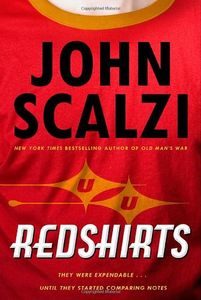
  • Redshirts, John Scalzi

    Redshirts, John Scalzi

    Tor, 2012, 320 pages, C$28.99 hc, ISBN 978-0-765-31699-8

    Geez: As recently as three years ago, I used to read (nearly) all Hugo-nominated novels as a matter of course –sometimes even before they were nominated. Now it takes a year before I get around to reading the one Hugo-winning novel. Life changes. Stuff happens. I’m busy. Insert your favorite excuse here.

    It’s not even as if I had any particular reluctance to pick up John Scalzi’s Redshirts: I’ve been reading Scalzi since the original hardcover of Old Man’s War, have the rest of his novels on my shelves and find him to be a highly enjoyable entertainer. His work tends to be slighter than I’d prefer, and not every one of his novel works (I’ll argue that Zoe’s Tale, as charming and readable it can be, is almost useless from a narrative standpoint when put alongside The Last Colony.) but he is, book-for-book, one of the most reliable professionals in the business today.

    But I’ve been taking a break from reading in general for the past two years, and it’s only now that I’ve got the time for Redshirts. I will admit that my enthusiasm for the title was tempered somewhat by the plot summary, concerned as it is with the fate of expendable people in a suspiciously Star Trek-like future. The titular “Redshirts” expression is an old Star Trek fandom joke (as in “if you’re wearing a red shirt, you’re in trouble!” –because you will die in the first act as a way to heighten suspense) and I wasn’t too sure what Scalzi would be able to bring to the concept.

    For a while, it looks as if he doesn’t do much more than bring his usual witty dialogue and light touch to the table. As five new crewmembers board the Starship Intrepid, the in-jokes fly thick and low: everyone aboard is terrified to volunteer for away missions, lousy science seems to be the order of the day, and none of our witty five new crewmembers have any clue as to what’s happening. It’s not unpleasant to read, but it’s not much above dozens of years of trek in-jokes and banter. In fact, at that point, Redshirts seems to be a sub-standard comic Trek take-off, unwilling to dig deeper in the inanity of Trek’s premise and markedly less amusing than what one would expect from a comic romp. Andrew Dahl and the Methods of Rationality this isn’t.

    But wait… because there’s some serious weirdness ahead. It quickly becomes clear that something very strange in happening aboard the Intrepid whenever events start taking on dramatic qualities. People act differently, not quite understanding why they do. Logic flies off the window, taking with it what a professional team should know. Ominous warnings are given about The Narrative. People die, following a logic that our heroes desperately try to understand before they, too, suffer the same fate.

    Before long, things turn severely meta and Redshirts finally becomes more interesting than the simple Trek commentary promised on the back-cover. Without spoiling anything explicitly, let’s just say that Scalzi revisits territory previously explored in Agent to the Stars, and questions of personal identity similar to The Ghost Brigades. The novel ends with philosophical questions about our relationship to fiction. Redshirts concludes quickly, leaving time for three codas that prove unexpectedly moving as consequences to the novel’s events are explored, further developing our understanding of the wreckage left behind by protagonist heroics. Redshirts gets more and more interesting throughout, eventually showing (among other things) why it’s not a bad idea for someone with a degree in philosophy to be writing science-fiction.

    There are highs and lows along the way. Much of the writing is Scalzi’s usual mixture of snark and wittiness, which works well in blog posts but occasionally feels misplaced on the page. Many of the lead characters can’t easily be distinguished (this is played for laughs once, but it more often smacks of Scalzi-writes-one-kind-of-character-really-well. There are significant issues with willing disbelief in the middle third of the novel (including mentioning Star Trek by name), that are eventually papered over by the rest of the story. But, to its credit, Redshirts is rarely less than compelling to read: it’s got a lot of that elusive “reading fun” that so many other novels fail to achieve. Don’t be surprised to finish it within days even if you are a slow or busy reader.

    (I’m not quite as convinced it should have been a Hugo-award-winning novel, but I’ll leave that rant for another time.)

  • Neptune’s Brood, Charles Stross

    Neptune’s Brood, Charles Stross

    Ace, 2013, 336 pages, C$27.50 hc, ISBN 978-0-425-25677-0

    I grinned when I heard that Charles Stross’s Neptune’s Brood earned itself a Hugo nomination: Stross’s brand of densely-packed imaginative Science Fiction may not be to everyone’s liking, but it’s certainly a favorite flavor of mine. Stross is able to meld SF’s traditional core strengths with contemporary social sensibilities to produce SF that’s both recognizably in-genre, while reaching out to integrate new ideas and social inclusiveness. I welcome any excuse to read his books, especially when they take the form of a Hugo nomination.

    Loosely set thousands of years after the events of Saturn’s Children, Neptune’s Brood features a vast post-human diaspora settled on multiple worlds. Despite the lack of faster-than-light travel, technology has progressed sufficiently that people can be beamed from star to star… as long as the required infrastructure is in place. But even without the troublesome aspects of sending meat-flesh across interstellar distances, space colonization is hard. As Stross explains in an enjoyable series of explanatory passages, building a colony from scratch requires a ruinously expensive starship, dozens/hundreds of years of hard work in building laser transmission and reception infrastructure, and thousands of very specialized people working together. There’s no way to do that without incurring astonishing amounts of debt, and how do you do that across interstellar distances and years of separation?

    The solution, ingeniously posits Stross, is to develop “slow” money, algorithmically created in much the same way emerging digital currencies currently are, that are not subject to the same kind of fluctuations as “fast” money used in day-to-day transaction. Slow money, of course, is different from fast money: a single slow dollar converted to fast money is enough to make an individual rich for years.

    Having built a space opera on a physically-accurate economic framework, Stross then proceeds to deliver on of his usual thriller yarns, featuring an endearing heroine specializing in the history of frauds and on the trail of a massive financial con. Despite the heavy economic content, Neptune’s Brood is heavy on thriller plot mechanics, traditional SF devices and amusing set-pieces: By mid-book, we’ve been hanging with skeletal bots, zombie queens, space pirates and genetically-modified mermaids. Stross is clearly having fun, and it’s this blend of economic/futuristic speculation and out-and-out comic thriller sensibilities that make Neptune’s Brood so enjoyable.

    Seasoned SF readers will, as usual, find much to like here. Stross understands genre SF completely and fluently plays with typical concepts, subverting a few of them and faithfully upholding others. The way Stross manages to present a vivid interstellar civilization despite the limitations of STL is intriguing (even though he still had to get rid of unmodified humans to do so), and the conceptual economic model her proposes is the kind of work other authors will, or should, adopt as part of their far-future toolbox. Anyone looking for SF speculation probably won’t find any better book this year.

    As a long-time Stross reader who often peers over the author’s keyboard as he reveals aborted projects and odd sources of inspiration, it’s good to see his “Space Pirates of KPMG” pitch resurface after being deep-sixed as a sequel to Iron Sunrise. Neptune’s Brood will feel very comfortable to anyone who loves Stross’ far-future speculations (the indebtness to Saturn’s Children and the Eschaton series is obvious, but there’s shadows of Accelerando and Glasshouse in here too, and the criminal/financial theme finds resonance with the Halting State / Rule 34 universe as well.)

    I’m not completely blind to the novel’s faults. It’s part of the point of Neptune’s Brood that travel between systems is slow and expensive, but that limits the amount of space-opera scenery we get to see during the trip. There’s also a certain familiarity to the caper-and-thriller plotting that undercuts the originality of the premise; I recall having some of the same reactions upon Saturn Children‘s release. Finally, perhaps more importantly, the narrative ends more abruptly than expected, with nary a denouement to release readers after the climactic so-there.

    But those are relatively small quibbles in a strong SF novel in the classical mold, with enough speculation to keep core-SF readers happy, and enough thrilling action to satisfy adventure-minded readers. Stross remains at the top of the SF game and my reaction to Neptune’s Brood reaffirms why I should always make time on my schedule for his novels even as my leisure time has shrunk.

  • Ancillary Justice, Ann Leckie

    Ancillary Justice, Ann Leckie

    Orbit, 2013, 410 pages, C$17,00 pb, ISBN 978-0316246620

    I went into this novel with the best of intentions.

    For one thing, Ann Leckie’s Ancillary Justice has, in the first few months of 2014, accumulated an impressive shelf of honors. In between winning the Nebula, BSFA, Clarke, Locus (First novel) awards and getting a much-remarked Hugo nomination, Ancillary Justice has become one of the best-received debut novels in the SF field since Paulo Bacigalupi’s The Windup Girl. As someone who’s always on the lookout for the hot new SF writers, Ancillary Justice earned a spot on my to-read list early on, and cemented its acquisition the moment the Hugo nominations were announced.

    So, to repeat: I went into this novel with the best of intentions.

    And to be clear: I think Ancillary Justice is a good novel.

    Thus, the above being said: Wow, I had a hard time getting into the book.

    Ancillary Justice is billed as a far-future space opera, and that’s eventually correct. It involves a future in which a vast empire has conquered a good chunk of the galaxy, via AIs being incarnated in repurposed human bodies (the titular ancillaries), a leader splitting herself into multiple instance in order to rule the empire, fancy weapons, big starships, space stations and the rest of the hardware that is expected of space operas.

    But it takes a while to get there: As Ancillary Justice opens, we’re stuck with the lead character on a cold isolated planet, nursing an old acquaintance back to health after a coincidental encounter. Flashbacks to nearly twenty years earlier progressively fill in the back-story of our protagonist, an AI fragment seeking justice for what happened to her and her ship.

    So it goes for a long time. A really long time. I’m not the dedicated omnivorous reader I used to be, and novels that don’t immediately grab me are now far more of an annoyance than they were before. But even by my previous standards, Ancillary Justice takes forever to develop into something that I’d consider interesting, and even longer to become compelling reading. By the end of the novel I was all-in, but it felt as if much of the novel was build-up while waiting for something to happen.

    I’m not going to pretend that this personal reaction should be considered a universal assessment. I know, for instance, that I’m really not interested in the kind of gender-recoding that Leckie commits to in the early pages of the novel (the protagonist can’t easily distinguish between genders and doesn’t really see the difference, so everyone is labelled female), and I have a similar lack of interest into many of the elements (songs, multiple temporal strands, fine prose, etc.) that give personality to the novel. Much of what specifically attracted other reviewers to this book were lost on me. I had to wait 40% in the novel before the back-story became clear, and 80% until the present-day action became earnestly interesting. I suspect that this may make me a bad reader; I’ll be the first to admit that I’m not reading with the same concentration than I used to. I am, mind you, a bit surprised at the tenor of the acclaim that the book received: Pacing issues aside, Ancillary Justice makes competent use of well-worn tropes, but I found the idea density to be a bit on the low side for space operas.

    Thus I come away from Ancillary Justice with the sense of having done my duty as a genre SF reader, but not as having had any fun. This doesn’t make Ancillary Justice any less of a success as the novel it meant to be: it’s written competently, put together with skill and is a self-assured contemporary representative of the genre. It’s not a bad nominee for the Hugo. But as for its impact, I remain underwhelmed.

    Ah well; you can’t love them all.

    [August 2014: Ancillary Justice has won the Hugo Award, sweeping whatever awards remained to be swept.]

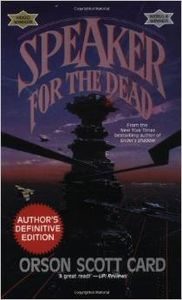
  • Speaker for the Dead, Orson Scott Card

    Speaker for the Dead, Orson Scott Card

    Tor, 2009 revised reprint of 1986 original, 416 pages, $C9.99 mmpb, ISBN 978-0812550757

    Having re-read Orson Scott Card’s Ender’s Game shortly after seeing its film adaptation, I was struck by an irresistible impulse to re-read the sequel as well: I would seldom have the original fresher in mind, and it would allow me to revisit Speaker for the Dead much as I revisited Ender’s Game, twenty years after first reading it.

    Looking at my 1994 notes about both novels, it’s clear that nineteen-year-old-me liked Ender’s Game a great deal better than Speaker for the Dead. Despite being directly linked, they are very different novels. In Ender’s Game, protagonist Andrew Wiggin is a teenager struggling to make it through a series of desperate battles. In Speaker for the Dead, he’s a mid-thirties man trying to atone for his early crimes by living a life of peace and civility. The age-gap between this older Wiggin and me now is almost the same as the one between Ender’s Game Wiggin and me twenty years ago. As a result, I’m not really surprised to find out that I liked Speaker for the Dead a lot more now than I did then.

    It’s also easier, in some ways, to figure out why Speaker for the Dead was such a hit back in the mid-eighties: It features a blend of far-future extrapolation, clean prose, exceptional characters, anthropologic mystery, a world-weary hero, galactic portents, as well as an exploration of colonialism, scientific ethics and the consequences of abuse. I’m not going to pretend that the mid-eighties were a particularly innocent and naïve era, but I will suggest that a number of those themes had not yet been explored then in the way Card dares tackle them, with heartfelt earnestness or blatant emotional manipulation. Looking at the field back then (which was reeling from the cyberpunk wave and perhaps looking for a bit more humanity in its flagship titles), it’s easier to understand why Speaker for the Dead would go on to sweep all awards and earn a place as one of the decade’s defining SF novels… even if it hasn’t aged particularly well.

    But before digging into the novel’s problems, let’s spend at least a paragraph praising what works. Because there’s a lot of stuff that’s actually quite good here: Card may have earned a disgraceful reputation as a right-wing homophobe since his eighties heydays, but he’s a skilled writer, and at its best Speaker for the Dead can indulge into easily-digestible exposition (such as when a AI’s inner workings are explained), emotionally resonant sequences (such as when our protagonist does speak for the dead), intricate science-fictional mysteries (such as the riddle behind the alien lifecycle that so baffles the characters) and the technical challenge of spinning a tale with multiple family members and twice as many other characters. Speaker of the Dead takes place in a future with hundreds of planets separated by slower-than-light travel but united by instant communications, and it doesn’t take much more than a few consequent extrapolations to make core-SF fans giddy. The prose is easily digestible, Ender is an exceptional character (and as much as teenager-me wanted to be Ender’s Game tactically brilliant Ender, thirty-something-me would like to have Speaker for the Dead Ender‘s gift for empathy and effortless soothing.) and you can recognize how the novel hits many of SF’s power chords.

    But one thing that thirtysomething-me does quite a bit better than teenage-me is question core assumptions of a novel. I don’t suspend my incredulity so easily, and I’m willing to suggest that contemporary Science Fiction is quite a bit better at building a more credible model of reality compared to eighties-era SF. Where I’m going with these caveats is how flawed Speaker for the Dead can feel once you apply more complex models of reality. So it does tackle colonialism –but in ways that seem incredibly manufactured, always from the oh-so-repentant perspective of the white colonial rather than the colonized (a crucial difference now far more common.) (And I’m not even going to talk about the ridiculous passage in which all aliens really do is aspire to starflight, and will flip over themselves if they don’t.) It does tackle victimization by domestic violence, but feels compelled to blame the victim a little bit for not caring enough about the aggressor. It does feature scientists at work… except that a quick look at what they do suggests that they have no understanding whatsoever of the way science truly works. (Or, perhaps more appropriately, not as much that they themselves aren’t very good scientists, but that the entire scientific establishment of the book’s universe is considerably dumber than one of today’s least-competent review boards.) And for all of the wizzy-bang flavor of its universe separated by distance and time, this society three thousand years in the future feels almost too comfortably contemporary –down to a number of planets settled by people speaking today’s languages apparently unchanged. And the inconsistencies… I’m somehow led to believe that Ender has never turned off his link with his AI super-friend Jane even as it’s suggested early during the novel that she’s got to sit around and wait decades every time he takes an STL star-ship trip. The instant he does turn off the link in real-time –blammo, instant unfriending. And how about the ableism late in the novel…? Or, heck, the very strange aside about Calvinism?

    Oh, I’m not going to thoroughly tackle the novel’s flaws in order (If you want to, I would rather suggest Wil Wildman’s incisive and hilarious series of posts.) But once you start poking and prodding at Speaker for the Dead‘s assumptions, a lot falls apart. And if something hasn’t really aged well in thirty years, it may be primarily Speaker for the Dead‘s almost smarmy self-assurance that it knows best. Since then, we’ve seen far better examples, writing from better-informed perspectives and achieving far more nuanced goals.

    (It’s also worth mentioning as a flaw that, for all of the historical acclaim that Speaker for the Dead got, it leads straight to third volume Xenocide, which earned far fewer friends either then or since. No, I won’t be pursuing my re-reading odyssey any further.)

    So it is that Speaker for the Dead nowadays feels far less formidable than it did upon publication. Distance isn’t everything: I believe that the novel contains a number of unforgiveable shortcuts that make it now far less palatable to better-informed, more world-aware audiences. It’s still worth a read for those who are interested in the historical evolution of SF, but I’m not sure that the novel is worth just an entertainment read today –too many flaws, too many vexing presumptions, too many annoyances to fix. But that’s what revisiting books is for –sometimes they improve, and sometimes they don’t.

  • The Wolf of Wall Street and Catching the Wolf of Wall Street, Jordan Belfort

    The Wolf of Wall Street and Catching the Wolf of Wall Street, Jordan Belfort

    Bantam, 2008 reprint of 2007 original, 528 pages, $C19.95 tp, ISBN 978-0553384772

    Bantam, 2011, 480 pages, $18.00 tp, ISBN 978-0553385441

    After watching Martin Scorsese’s hilariously excessive biographical movie The Wolf of Wall Street, it’s tough not to reach for the two books that inspired it all. Legendarily corrupt Wall Street bad-boy Jordan Belfort loves few things more than self-promotion, and it it’s in light that the movie serves as the trailer for the books that seek nothing more than tell us how special Belfort was and continues to be.

    And if the preceding paragraph has a bit of a skeptical edge, keep in mind that enjoyment is not a close relative of credulity.

    The basics of Belfort’s story are these: He’s a gifted young man who, somewhere in the late eighties, realized that brokers made money out of stock transaction commissions, and that nothing, legally speaking, forced brokers to have their client’s best interest at heart. Once you couple that flash of evil genius with top-notch sales techniques, it’s a relatively easy step to building a company built on selling sub-standard stock to wealthy clients rather than enriching said clients. From there, pump-and-dump schemes are only a short ethical distance away. Profits from the sales accruing to the owner of the firm, you can see how Belfort allegedly made something like forty-nine million dollars on his best year. That, in turn, enabled Belford to indulge in an unchecked succession of drugs (most notably, but not exclusively, qualuudes), prostitutes, lavish decoration and increasingly ludicrous vehicular damages. (damaging cars you can understand, crashing helicopters you can imagine, but losing a yacht is mind-boggling enough.)

    But chances are that you’ve seen the movie (a solid box-office performer and a critical favourite) and already know all of this. The point being that if the film is a heightened version of reality, the books aren’t necessarily documentary material. Oh, sure, Belfort has a much harder time in the books than in the film: Scorsese and his screenwriter Terence Winter voluntarily messed with the usual bad-boy-gets-comeuppance narrative to maximize the fun-and-game phase and to gloss over the arrest-and-jail time. Nearly all of Catching the Wolf of Wall Street is spent somewhere inside the judicial system, awaiting trial or experiencing prison. Belfort may have lost his money in both versions of the tale, but the books are quite a bit harsher in pointing out the personal toll of seeing his marriage break up, and feeling his kids grow away from him.

    This being said, let’s not minimize the can-you-top-this?! tall-tale quality to both the film and the books. Belfort is a born raconteur, and his life of incredible anecdotes is carefully heightened through engaging narration, carefully chosen details and melodramatic inner monologues. As a Hunter S Thompson fan, I was amused for find a definite Thompsonesque resonance in Belfort’s world-weary omniscient description of drugs and their effects. The books are frequently hilarious and always fascinating, taking us in places where the average middle-class reader will never be able to afford. Hearing Belfort complain about the million-dollars decoration of his former house is… special.

    I keep discussing “the books” as if they were one unit, and there’s a reason for that: While the first book is easily better (newer, funnier, fresher) than the second (which does spend a lot of time re-hashing the same life), it’s telling that the film draws inspiration from both, using the more detailed explanations when available. The first book is certainly more entertaining, as it (like the movie) spends very little time detailing the judicial proceedings against Belfort. But the second book uses the structure of a series of interrogations to double back and fill a few holes in Belfort’s life, from his early experiences in business to more ludicrous stories of drug abuse. There is some evidence in the author’s acknowledgements of both books to suggest that Belfort initially wrote a very long narrative that was then re-structured in two separate volumes –the best advice is to read them both back-to-back for the best experience, despite the strong repetitiveness.

    But reading even one of the two books raises a really vexing question: Is Belfort truly sorry for defrauding so much money, of is he sorry he got caught? There’s no doubt that Belfort believes himself to be exceptional (in fact, there’s little doubt that, lack of ethics put aside, he is exceptional in remarkable ways), and the overblown quality of his narrative can’t escape a dastardly “Ain’t I a stinker?” twinkle whenever he tells us about his worst moments. Still, some of his excuses in the book feel forced, the kind of things you read in depositions and probation requests and other official documents in which repentance is socially expected. Belfort may truly regret the actions that led him to so much personal turmoil, but the gleeful anecdotes in the books suggest that he wouldn’t change much save for the parts that got him indicted.

    As a reader, that leaves us with the mixed feelings of being entertained and repulsed at the same time. Wolves are beautiful but have no place in civilized society, and if Belfort’s books can truly teach us something, it’s a glimpse into the minds of those dangerous high-fliers who think their exceptionalism is an excuse to grab what they can.

  • Ender’s Game, Orson Scott Card

    Ender’s Game, Orson Scott Card

    Berkley, 1994 paperback revised edition of 1985 original, 352 pages, C$7.99 mmpb, ISBN 978-0-812-55070-2

    It’s hard to overstate the prominence of Ender’s Game as one of the major novel in the Science Fiction genre. It swept the major awards of the field upon initial publication in 1985 and hasn’t stopped selling in the three decades since then. It’s one of those rare SF novels that nearly every serious fan has read, and it has found a substantial audience outside the genre. It’s a perennial favourite of SF academics, a part of the US Army course curriculum and has been translated in nearly all major languages. Now that it’s a movie, it’s likely to replace Dune as my perennial favourite for demonstrating the reach of media SF compared to written SF. (As in: In any given room, more people will have seen the averagely-successful movie than will have read one of the best-selling SF novels of all time.)

    And with that success has come a substantial backlash, reinforced by the widely held perception among the most progressive wing of SF fandom that author Orson Scott Card has since become a conservative right-wing homophobe. (Vulture has a nice timeline of the controversy.) There is now a vigorous number of essays criticizing the novel from various points of view: John Kessel’s Creating the Innocent Killer remains a landmark, but for a comprehensive look at the various self-contradictions and outright puzzlers of the novel, I can’t recommend highly enough Will Wildman’s vastly entertaining and insightful Ender’s Game read-through. And I’m sure that there’s plenty of accumulated wisdom somewhere in the 7643 reviews that the book (merely 179 of them one-star) has accumulated so far on Amazon.

    I first read Ender’s Game as an older teenager, and it’s fair to say that almost exactly twenty years later, I don’t quite have the same perspective on it than I did back then. I picked up the book shortly after seeing the movie adaptation, and unlike my mid-nineties read-through, I immediately started second-guessing the basic premise of the novel. Ender’s Game appeals to smart teenagers because it tells them that they are special, and so are inevitably ostracised by normal people, and that being so exceptional gives you the right to kill your tormentors as long as you feel bad about it. This is the kind of power-fantasy that explains the book’s success… and that seems toxic once you graduate from high school. Given my life’s journey so far, I’m increasingly dubious (and headed toward repulsion) of fantasies of exceptionalism. The bedrock of Ender’s Game plot machinations are that the end justify the means, that it’s OK to systematically abuse a boy if he’s the only chance that humanity has at surviving. But that only works as a narrative conceit. The real world doesn’t require such harsh premises: smart people are everywhere, and it’s hard to imagine a situation where a single exceptional person could save the world. In reality, many people are suitable for even the toughest assignments, and they usually succeed because of systems, teams, procedures and support mechanism that do much to distribute expertise among capable groups. (Yes, I work in an office.) Exceptionalism is a sure road to exceptions and abuses of power. We don’t need exceptional people to save us: We need structures so that we never get in a situation where we need saving by exceptional people.

    But never mind that for a moment: Broad ideological objections aside, Ender’s Game does remain a highly enjoyable read. Card has a gift for prose narration that remains easily readable while hitting ambitious emotional targets. His handling of incluing is as good as it gets (as you can see from the use of technology that is never explicitly explained, but fits the plot naturally while surviving twenty years of innovations) and he manages to render a compelling internal monologue for his characters. As strange as some of the novel’s plot points can be, their handling feels right –the sequences where the teams of soldiers-in-training go in combat are exhilarating, and there is some strong emotional material in the conversations that Ender has with his sister.

    It’s also worth underlining how ironic the novel seems to be from beginning to end. Ender may be a savior of humanity, but he needs to be made alien to everyone in order to do so. His greatest triumph remains his biggest mistake, and for an entire novel thirsting for xenocide, Ender’s Game seems positively devastated when humans triumph over their opponents. Ironies pile upon each other in a rich blend that makes it hard to dismiss the entire novel as being much of this and some of that.

    Still, Card’s contemporary reputation as a right-wing homophobe being what it is, it’s amusing to spot in a 1985 novel the various kernels of what would later define him among a certain audience.

    • Sexism? Try the bit where girls are said to be less aggressive than boys due to centuries of evolution:

    “All boys?” “A few girls. They don’t often pass the tests to get in. Too many centuries of evolution are working against them. (Chapter 3)

    • Jingoism/religionism/birthism? I was gobsmacked by the bit where the French (in their “arrogant separatism” ) are bashed for daring to speak French rather than “common” language –in the same novel where the Poles are praised for chafing against anti-Catholicism (and, more importantly, anti-birth-limits) restrictions. Have a look at this:

    His name, Ender quickly learned, was Bernard. He spoke his own name with a French accent, since the French, with their arrogant Separatism, insisted that the teaching of Standard not begin until the age of four, when the French language patterns were already set. (Chapter 5)

    versus

    Your father was baptized with the name John Paul Wieczorek. Catholic. The seventh of nine children. (…) Your father denies his Polish ancestry, since Poland is still a noncompliant nation, and under international sanction because of it. (…) [Your parents] haven’t really given up their religion. They look at you and see you as a badge of pride, because they were able to circumvent the law and have a Third. (Chapter 3)

    • Zionism? There’s a few paragraphs dedicated at explaining why Jews make the best generals (and this despite a Jewish character called by a slur and demonstrated to be not very good at the stuff.): it starts with

    “Since the I.F. was formed the Strategos of the military forces had always been a Jew. There was a myth that Jewish generals didn’t lose wars. And so far it was still true.” (Chapter 8).

    • Racism? There’s a bit where the kids trade the n-word and then laugh about slavery, which ends with

    “Alai grinned. “My grandpa would’ve killed you for that.”
    “My great great grandpa would have sold him first,”
    . (Chapter 6)

    [This bit apparently isn’t to be found in the latest editions of the novel.]

    But there’s something even more amazing (not) to be found in a contemporary reading of Ender’s Game: For an author often accused of homophobia, you’ll find quite the opposite in the novel. In fact, it doesn’t take much imagination to read protagonist Ender as a gay, and the events showing him his true preferences in bonding with other boys while having ambivalent non-romantic feelings about girls. In a better universe, a slightly-revised version of Ender’s Game has become beloved for showing a positive role model for young gay teenagers. In this world, oh well. Moving on.

    Perhaps my biggest reaction to a second reading fifteen years later is how rough the novel can feel at times. The world-building is a bit shaky around the edges, the plots points handled more arbitrarily than needed. A close reading of the text reveals astonishing contradictions, and push buttons that readers may develop later in life. I still think (as documented in my big list of Alternate Hugo Winners) that Ender’s Game is one of the novels from 1985 that everyone should read, but I now have to temper this assessment with a few warnings (and maybe move Sterling’s Schismatrix to the top spot). This, too, feels like the passing of the years more than any change in the novel itself: I’m not the same reader than I was twenty years ago, and my then-tendency to see it through uncritical fannish lenses has been eroded away (and even more so lately that I’m reading far less SF and am so not as completely immersed in its privileged assumptions.) So it goes; much like the plot of Ender’s Game requires an innocent ready to be molded into a destroyer of worlds, it strikes me more than ever that Ender’s Game is deliberately optimised for less-jaded readers. Which may very well explain its massive appeal: there are far more innocents out there than stone-cold readers.

    [April 2014: Reasoning that I’d never get as good an opportunity while the original was still fresh in my mind, I re-read “parallax” novel Ender’s Shadow, which explores the same rough timeline from the perspective of ‘”Bean”, a minor character in Ender’s Game. Here we see Card’s attempts to patch the holes in Ender’s Game with fifteen years’ insight and second guesses about the first novel. Nearly every dicey plot development in Game is explained in Shadow as part of a masterful plan by someone even smarter than Ender. It often reaches ludicrous levels of disbelief (especially once you factor in Bean’s age) but there is some compelling material here and there, especially in getting another, better hit of the same kind of excitement about Battle School training. There are some major contrasts between both novels, though, and some of the issues in the previous novel simply can’t be explained away. My advice: If you’re going to read Ender’s Game, have a quick look through Ender’s Shadow while events are still fresh in your mind. Browse quickly over the parts with Sister Carlotta and Achilles, and focus on the parallax view of Ender as from other viewpoints.]

  • Inventory, The Onion A.V. Club

    Inventory, The Onion A.V. Club

    Scribner, 2009, 256 pages, C$24.00 tp, ISBN 978-1-4165-9473-4

    Seven ideas gleaned from reading the Onion’s A.V. Club Inventory

    1. The web’s lowest-common-denominator excuse for content has finally crossed over to the paper world. Oh, I jest, but only barely: For one thing, books of lists have a long pedigree (From David Wallechinsky’s The Book of Lists series to David Letterman’s books of Top Ten Lists). For another, while Buzzfeed.com has recently perfected the idea of using lists as cheap ways to grab viewer eyeballs on the web to a science, the folks at The A.V. Club have been at it for years, delivering weekly lists of pop-culture trivia. Inventory is a collection of their best lists, along with some original material all wrapped up in pleasant page design.
    2. Pop culture is hopelessly tribal: Since The A.V. Club is entirely dedicated to pop-culture, expect the lists in Inventory to focus on movies, TV, music or (more rarely) books or video games. Of course, since the lists delve deep into minutiae, their interest is likely to be proportional to your own knowledge of the area. I’m generally knowledgeable regarding movies, a bit less so regarding books or video games, and sort-of-lost in TV and music (it’s a vast universe, and one can’t be expected to know everything) and my interest in the lists was generally proportional to my expertise in the area. Some of the music stuff was dreary and pointless enough to make me skip to the next list; other lists about movies, video games or books felt far more interesting. Inventory is a buffet; take what you want.
    3. At their dullest, lists are wastes of meaningless trivia: Especially if you have no perceptible interest in the central focal point of the list. “Songs about taking the bus?” Meh. “Songs under 3 minutes.” Really? I don’t need a list of movies about specific things when I can just go get one from IMDB.com
    4. At their best, lists are a decent way to chunk a larger thesis: Beyond trivia, well-conceived lists become something else: Some of the most remarkable material in Inventory end up building an argument through an accumulation of examples, or a categorization of the same. “Approaches to DVD commentary” isn’t a list as much as a systematic breakdown of how directors approach their DVD commentaries. “Videogames that outraged a nation” paints a capsule history of how videogames pushed the envelope throughout their history. And “Manic Pixie Dream Girl” practically codifies a trope that illuminates a certain kind of self-indulgent filmmaking. All a far more satisfying than listing songs about public transit.
    5. Talking about Pop Culture is a waste of time… unless you enjoy it: Reading Inventory, it’s hard to avoid the ghastly realization that the book is essentially useless. That lists of trivia are useless. That pop-culture itself is useless. Why, then, does it compel us so much? Perhaps because, as the very name implies, that pop-culture is the glue that binds us to our own self-chosen subcultures. Discussing shared interest is fun, not for the things themselves but for the sentiment of belonging to a group with someone else. Inventory is clearly meant for the cyber-fluent quasi-hipster: The “Heaven/Hell” bits clearly identify the audience as young(ish), urban, progressive and multi-media literate –although classifying Coke as Heaven and Pepsi as Hell is a good way to get on my list of pretentious posers. In keeping with the “Inventory is a buffet” thesis, the most interesting pieces of the book are those that most closely align with our own projected persona.
    6. Parents of toddlers trying to get back into reading could do worse than beginning with a book of lists: Let’s face it: toddlers require less attention than infants, but they don’t like to be ignored for more than a few minutes. A book of list, easily digestible in chunks of 2-3 minutes, is ideal for reading in such circumstances: Even trivial interruptions don’t feel as annoying when they happen on the eighth item of a meaningless list. Plus you can hand over the bookmark for the toddler to play with and not feel too concerned about losing one’s place in the book.
    7. There’s not need to go all the way to a top-10 when you’ve said enough.
  • Save the Cat!, Blake Snyder

    Save the Cat!, Blake Snyder

    Michael Wiese, 2005, 195 pages, ISBN 978-1932907001

    If you feel that most Hollywood movies these days all feel the same, well, you may have a point: As a recent Slate article explained, writing for blockbuster movies has become a highly structured process and many writers are following the “beat sheet” as explained in Blake Snyder’s Save the Cat!

    Hollywood, as you may guess, hasn’t waited until recently to codify script-writing. Syd Field’s classic Screenwriting has been telling budding screenwriters what to do since the late seventies (Dared by a friend to “do better”, I wrote two screenplays in the mid-nineties faithfully following Field’s formula), and Robert McKee has been giving his story seminar since the early eighties, leading to a massive book version of his theory, Story, in 1997. And that’s just the tip of the iceberg: in addition to stacks of how-to manuals on bookstore shelves, screenplay-writing seminars are nearly everywhere in Hollywood. Most of them champion strong structure, admonish writers to show rather than tell, emphasise the importance of sympathetic characters and try to impress upon novices the importance of theme.

    But Blake Snyder’s book manages to stand out even in a saturated environment. For one thing, Snyder (unlike Field or McKee) was a working Hollywood screenwriter prior to his death in 2009. His filmed output is admittedly meager (a largely-forgotten 1994 kid’s comedy called Blank Check, and the widely-derided 1992 Sylvester Stallone vehicle Stop! Or my Mom Will Shoot!) but Snyder reliably sold his own original scripts to studios during the nineties “spec craze”. Not coincidentally, Save the Cat! is focused on a single thing: writing a script that sells. Everything else is secondary.

    It also means that everything else is slave to the “write to sell” mantra. In Snyder’s world, there are no surer arbitrators of taste than studio checks and box-office numbers. Save the Cat! memorably goads idealistic cinephiles by dismissing Memento out of hand –the oh-so-wonderful writing gimmick of the film being irrelevant given how little money the film made. (Of course, savvy cinephiles will be prompt to point out that Memento not only made a profitable twenty-five million dollars out of a nine million production budget, but also it led writer Christopher Nolan to a career that now includes four movies having grossed more than two hundred million dollars. But, you know: that’s the art of trolling film nerds.) Snyder, writing from his perspective inside the red-carpeted ivory towers of Hollywood, has little use for art when structure and cute epigrams can do the job.

    Still, it’s easy to be sucked into Save the Cat!‘s focused charm. Snyder writes using more recent examples than either Field or McKee (in a strange coincidence, it even discusses an in-development film, Ride Along, that finally debuted on screens at the same time I was reading the book, nearly ten years after publication), and can rely on a long personal history within Hollywood to give anecdotes and glimpses at the writer’s life. It’s redundant to say that it’s written to sell itself: even non-screenwriters who just want to learn more about the business of writing movies will be entertained by the entire book.

    For those cinephiles not yet ready to let go of the same story-driven idealism that led to oddballs such as Memento, it’s worth wondering if Snyder’s book represents a distillation of all that is wrong with Hollywood. The Slate article mentioned above amply demonstrates what contemporary filmgoers already know: blockbuster screenwriting has become even more formulaic as of late, and Snyder’s “beat sheet”, which specifies the script page on which twists and turns should occur (don’t worry, it’s not new: Field’s theory pretty much had the same prescriptions for acts) is an easy way to sell a story to risk-averse studio executives.

    But as a movie reviewer, I’m not completely outraged by the thought that nearly everyone in Hollywood is using the methods suggested by Blake and others. For one thing, originality is overrated: execution is what matters, and the modern blockbuster is often far more interesting for its action-driven set-pieces than for its overall plot. For another, the structure found in Save the Cat! is a reliable way to ensure at least a minimal level of quality.

    Oh, stop laughing: the beat-sheet structure provides a structural safety net for screenwriters, and while it may process every single premise into a conveyor-belt of similitude, it often prevents far worse material from making it on-screen. I may not share the current craze for all things adapted-from-comic-books, but the truth is that nerd-favorite properties cost a lot of money to film, and if banging out a script according to Blake Snyder’s beat sheet is the way to green-light risky prospects, then we’re better off with competent scripts for actual movies rather than perfect scripts for non-existent films. Furthermore, one suspects that conventional success finances artistic risk-taking. Directors use the profits of a franchise entry to get a green-light for their passion projects, studios take the profits from one comics-adapted blockbuster to finance those mid-budgeted original screenplay. The Dark Knight directly leads to Inception, and we get two awesome films out of the deal.

    So it is that despite Snyder’s monomaniacal drive to sell, I’m not quite ready to dismiss his methods out of hand: Save the Cat! offers a revealing look beyond the scenes of Tinseltown, and I got quite a kick out of it as a film reviewer… even though for a while I may be a touch too competent at spotting the story beats as I see movies unspool. But the magic of movies are that they work even if you know everything about how they were made. So it is that if Hollywood wants to use story scaffolding such as Save the Cat!, then let them knock themselves out: I’ll be waiting to see if the result is worth the trouble no matter the path it took to get there.