Frank Sinatra

  • The Tender Trap (1955)

    The Tender Trap (1955)

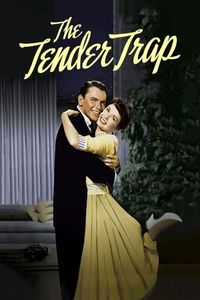
    (On Cable TV, December 2021) Even from sixty-five years later, it’s easy to see the hook of The Tender Trap. No, not the catchy title song that became a Frank Sinatra signature tune, but the concept of a proto-sex-comedy opposing legendary womanizer Sinatra with pure-as-snow Debbie Reynolds in a battle of the sexes on the way to matrimony. Sinatra plays the bachelor of many men’s dreams, with a high-paying job allowing him to afford swanky clothes and a killer Manhattan bachelor’s pad. Such is his appeal that when a friend decides to leave his married Midwestern life behind, he immediately heads over there to crash as he figures out what to do, and takes advantage of a few female friends feeling neglected by the protagonist. Said protagonist is only too happy juggling numerous conquests, except when one of them, an ultra-organized monogamous gal (Reynolds), seems worth giving up everything. It’s all pleasant enough in a Mad-Men-inspiration vein — even for a film explicitly dealing with an unrepentant bachelor and a wayward husband, the tone is so resolutely restrained that it seems almost likable. There’s an interesting line to draw from The Tender Trap to the more freewheeling sex comedies of the 1960s — in fact, many viewers may have trouble believing it’s not a 1960s film. Sinatra is just as compelling as usual, and there’s a rather good scene in which Reynolds, then Sinatra, then Reynolds again take on the title song, each time making it richer and more interesting in its delivery. David Wayne (looking a lot like Daniel Craig!) is also a highlight as the married man taking a holiday — although the film certainly does not dwell on what he’s up to when he takes one of his friend’s regulars on late-night dates. It’s all quite amusing (as long as you can buy into the fantasy of a Manhattan playboy, that is), bolstered by Sinatra and Reynolds at their most charming and some clean crisp 1950s colour cinematography. The Tender Trap certainly paved the way for more daring films to follow, and fits comfortably in the string of New York City-set sex comedies of the following decade and a half.

  • King of Cool (2021)

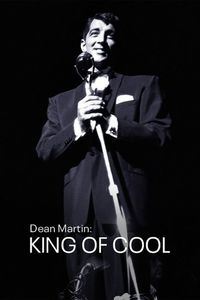
    (On Cable TV, November 2021) It took me a while to understand the true appeal of Dean Martin. Not because he wasn’t remarkable — his leading-man presence in well-known films such as the original Ocean’s Eleven is obvious even today, and few people won’t have heard at least one of his crooner songs. But the more you dig, especially in material that hasn’t been as well-preserved as his classic movies, the more you discover the true breadth of his achievements. That he was Jerry Lewis’ straight-man partner in their comedy duo days is something that isn’t as prominent now than seventy years ago (especially given the evanescence of cabaret comedy), but then you have plenty of lesser-known films to show the effectiveness of their act. There are plenty of films and songs to testify as to his careers as actor and singer, but his remarkably long-lived variety show is now best remembered for the celebrated “Tony Martin and Frank Sinatra Christmas Special.”  Oh, and he was a leading member of the celebrated Rat Pack, alongside Sinatra and Davis. In other words, Martin did a lot and had at least four separate careers that would have been enough for anyone else. Trying to put this in a single documentary is a lot, but the filmmakers behind King of Cool do about as well as anyone else could have been expected. (One could quibble as to whether Steve MacQueen is the King of Cool, but the film explains that this was a moniker bestowed upon Martin by none other than Elvis Presley.)  Taking a largely chronological approach to Martin’s life, the film chronicles his early days as the son of Italian immigrants (and whose mother tongue was not English), his early days as a boxer, his struggling debut as a cabaret act, the spark of his partnership with Jerry Lewis, the factors that led to their breakup (simply put: Lewis hogging too much of the spotlight), his reinvention as a boozy crooner in the footsteps of Joe. E. Lewis (albeit with practised casualness and apple juice in the glass), his family life across three wives and several children, and his later years, as they included a reconciliation with Lewis. It’s quite a bit and King of Cool does best when it focuses on the nuts and bolts of his career, testimonies from contemporaries and more recent celebrities (including some surprisingly poignant material from RZA) and testimony from family members. There’s a good line in there about how death gives back the dead person at their best rather than the sometimes-sad old person they have become. Where King of Cool overreaches is in trying to find the hidden key to a man who was far less of a boozy cool crooner than his persona became — in trying to find the “Rosebud,” they end up with a dish representing family, which is not bad but presented with perhaps a bit too much enthusiasm to be credible as the answer. Still, it’s a good thing that the documentary could capture the recollection of several people who knew him or people associated with him (including some effective moments with Lewis’ son). It goes without saying that this is not a documentary fit to question its subject: as a friends-and-family thing, it doesn’t poke too much as Lewis’ tumultuous marital history nor portrays him as anything but a victim of Lewis’ solo ambitions. But so it goes in that subgenre — the film becomes a pointer to more in-depth material rather than an in-depth analysis. Even then, there’s a lot to like in the result — Martin was indeed the King of Cool, and the contact high of even a quick overview of his career is still impressive.

    (Second viewing, July 2022) Hmmm. The good thing about King of Cool is that it made me interested enough in Dean Martin to read more about him. The not-so-good thing is that now that I’ve dug deeper into the topic (most notably through Karina Longworth’s magistral ten hours You Must Remember This podcast series on Martin and Sammy Davis Jr.’s careers), I’m far less impressed by the documentary’s deceptive conclusions. I should not be surprised. Movie biographical documentaries are highly selective at best, and often hagiographic by their nature. When you’re building something on footage of friends and family reminiscing on camera, there’s a built-in incentive to be nice about the subject of those fond memories. No one will accept sitting down to talk about their father if the documentary is going to be a warts-and-all piece. (It gets worse when the family produces the film.) All of this to say that asking for second opinions about Dean Martin blows up the “family man” narrative offered in King of Cool. Martin was in many ways an admirable figure — not all that interested in partying to excess with his Rat Pack fellows, consciously not drinking even as he played up a boozy crooner, a savvy investor who eventually provided generational wealth to his children after making some terrible financial decisions early in his career, and someone who — being King of Cool — always maintained a distance between his true self and his public persona. Alas, that same distance could mean that Martin was aloof and uninterested in deeper connections: Other biographical sources highlight the carefully metered time he’d spend with his kids, then retire to watch TV alone; the many romantic dalliances amounting to nothing; the rift with Jerry Lewis being partially a reflection of his reluctance to communicate; the inglorious final years of Martin’s life in which he preferred television and alcohol to his family. Very little of this makes its way to King of Cool, with some omissions looking like deceptions — after their infamous on-air telethon reunion late in their lives, it took months if not years before Lewis and Martin regularly spoke again, for instance. And its concluding idea of the key to Martin’s character being a baked dish representing family seems even more like a stretch born out of desperation by filmmakers trying to provide an emotional climax. Make no mistake: Dean Martin was a fascinating figure defined by his cool. But going to the end of that idea means going to some darker places that this documentary is not interested in exploring. It’s selling us a romantic, glamorous image of a figure that’s far more interesting with his flaws than some sanitized family-man portrait. It’s an entertaining portrait, but it should be approached as a stepping-stone to a more thorough understanding of Dean Martin.
  • Marriage on the Rocks (1965)

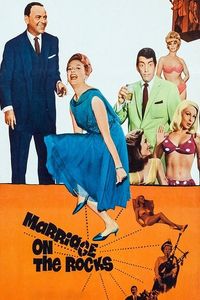
    Marriage on the Rocks (1965)

    (On Cable TV, September 2019) While almost forgotten today, Marriage on the Rocks offers the still-amusing spectacle of seeing Frank Sinatra and Dean Martin as romantic rivals — the first one married, the second proudly single but still pining after the other man’s wife (played by Deborah Kerr). An attempt to transpose the 1930s comedy of remarriage in the 1960s, the film gets kicking in high gear when Sinatra’s character and his bored wife accidentally divorce while in Mexico, and she uses the episode to make him squirm a bit. Contrivances happen, and soon enough she’s just as accidentally wedded to her old flame. Don’t fret — there’s not even a suggestion of inappropriate hanky-panky here even as Sinatra’s character takes the accidental marriage in stride, moves out and encourages his friend to take his place as the head of the household. Comedy is often found in aberrant human behaviour and there’s plenty of that at play here, as the characters experience offence, revenge and counter-revenge. It ends a bit abruptly, but happily. Of course, the fun here is in seeing old Rat-packers Sinatra and Martin banter as friends and then rivals. Among minor amusements is the fact that Sinatra’s daughter Nancy plays Sinatra’s character’s daughter, and a pre-Star Trek DeForest Kelly is seen in a minor role. Marriage on the Rocks is hardly a perfect film — it has some curious lulls, and the style of the film seems stuck in that curious mid-1960s period where the studios were creatively exhausted and beginning to see the possibilities offered by New Hollywood, but not yet ready to make the jump. At times, Marriage on the Rocks feels tamer than the 1930s comedies of remarriage despite its 1960s setting, not quite able to take on the naughtiness of the (innocuous) sex comedies of the time. One suspects that any film featuring the biggest two Rat Packers simply could not get away with racier stuff — their audience was older and less forgiving than the teenage hordes that would redefine American cinema a few years later.

  • The Joker is Wild (1957)

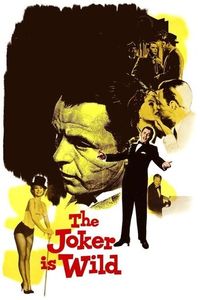
    The Joker is Wild (1957)

    (On TV, September 2021) In comparing actors with character, there are few better natural matches than having Frank Sinatra play a comedian/singer (real-life figure Joe. E. Lewis) who gets involved with the mob and then struggles with alcoholism through a rocky marriage. No, Sinatra was not an active mobster or a non-functioning alcoholic, but his public image as a booze-swinging rat-packer and whispered rumours about his private life made him—and still make him—an ideal choice for the role. After a perfunctory opening in which the mob takes revenge on him and damages both his face and his voice, The Joker is Wild does get more interesting as the lead character claws his way back to crowd approval. Several nightclub sequences have us sitting in the audience for some comic banter and choice songs (including the classic Sinatra number “All the Way”) — it would be considered long if it wasn’t for the appealing time-travelling aspect of watching a Sinatra show. As a drama, The Joker is Wild tends toward repetitiousness — See Lewis become more famous, see him struggle with alcohol, see him struggle with his wife, and then repeat the cycle a few more times. But it works more often than it doesn’t, and few films have done as good a portrayal of stand-up comedy as a self-destructive exercise, as the on-stage patter painfully mirrors personal troubles: there’s an excruciating sequence in which a severely inebriated lead struggles to get through a show, his jokes about excessive consumption not fooling any member of the audience. It’s too bad that the film, made while Lewis was alive, can’t conclude on much more than a semi-fantastic oath to get his life in order (he never completely did) — the anticlimax is real, but isn’t as bad as it would have been had The Joker is Wild been a straight-ahead narrative. Instead, the high points are the performances, not necessarily the story. And Sinatra is very, very good in those moments.

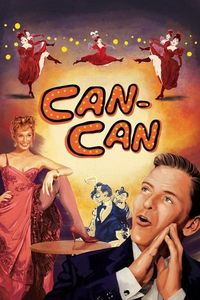
  • Can-Can (1960)

    (On Cable TV, September 2021) I never knew how badly I wanted to see a movie scene in which Frank Sinatra chats with Maurice Chevalier until I saw it right there in Can-Can, and it’s only one of the reasons why I liked the film so much. A classic 1950s musical that was released just ten weeks into 1960, it’s a mixture of familiar and fun Cole Porter songs, Sinatra crooning alongside Chevalier and Louis Jourdan, Shirley MacLaine dancing up a storm, and some delightfully chaste French debauchery as filtered through American Francophile sensibilities. MacLaine plays a Can-Can club owner trying to stay ahead of police raids against “lewd and lascivious dancing,” and having to pick between a lawyer (Sinatra) and a judge (Jourdan) while an older judge (Chevalier) is there to provide sage advice to all. It’s a lot of fun to see Sinatra and Chevalier, two crooners initially separated by decades and an ocean, chat about the meaning of love in Paris — if the scene didn’t exist, someone would have had to invent it. Jourdan is also quite good, singing and dancing pleasantly. Still, perhaps my biggest surprise of the film is liking MacLaine quite a bit as she credibly sings and dances — although I suspect that the long wig had a lot to do with it as well. The tone of the film is this kind of pitch-perfect blend between suggesting bawdiness without showing it (Khrushchev being easily impressed, there’s very little that’s risqué here) and falling back on an American’s idea of the relaxed French attitude toward love and marriage. It’s quite a bit of fun, and the soundtrack can rely on a few songs that can still be recognized. I’m fast running out of 1950s musical to see, but Can-Can is a decent addition to the corpus.

  • Step Lively (1944)

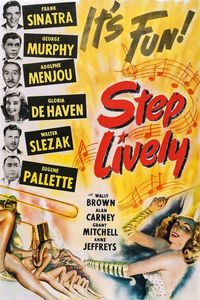
    Step Lively (1944)

    (On Cable TV, May 2021) As a remake to the Marx-Brothers 1938 comedy Room Service, the 1944 Frank Sinatra vehicle Step Lively was not necessarily doomed to failure. Absent the Marxes, it’s clear that the remake will not be the same kind of comedy — and Sinatra’s ability to do verbal humour isn’t the same as Groucho Marx. (Ironically, those two would later co-star in Double Dynamite seven years later.)  Fortunately, the script was heavily retooled, largely reverting to its Broadway theatrical roots, absent the specific Marx flourishes. And it works rather well — the base story is something that can more effectively be told as a low-octane charming comedy rather than an out-and-out vaudeville special, and it’s in that vein that Step Lively can best exploit the talents of pre-icon Sinatra. There is a bit of a mismatch between young Sinatra and the world-weary fast-talking role he’s meant to play, but this is tempered by modern viewers’ knowledge that Sinatra would eventually become (as “Chairman of the Board”), the kind of character he was portraying here. Some of the supporting players (notably George Murphy, Wally Brown and Alan Carney) are meant to be funnier and usually are, leaving the straight man reacting and the straightforward singing to the lead. While Step Lively won’t rock anyone’s world (well, other than Sinatra fans), it’s a pleasant enough watch and an interesting point of comparison with the zaniness of Marx-style Room Service.

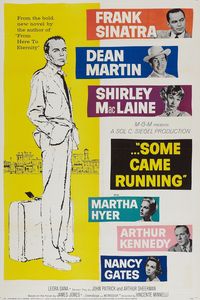
  • Some Came Running (1958)

    Some Came Running (1958)

    (On Cable TV, May 2021) For a rather low-key drama, it’s interesting to see how often Some Came Running comes up in classic film discussions. The facts are that this is a film directed by Vincente Minelli and adapted from a doorstop best-selling novel, that it starred Frank Sinatra, Dean Martin and Shirley MacLaine, that good chunks of it were shot on location in a small middle-America town and that it was an example of widescreen colour cinematography at a time when Hollywood dramas usually went for black-and-white Academy ratio. That last factor does help explain the film’s longevity, as it remains more accessible on modern widescreen colour displays than many of its contemporaries. The story is small-potato stuff, as a writer-turned-veteran (Sinatra) returns to his hometown after a long absence, with a loose woman (MacLaine) in tow, and reunites with his brother (Arthur Kennedy), later befriending a likable gambler (Martin). While the original novel is reportedly 1,200 pages long, this stripped-down adaptation fits everything in slightly more than two hours and seems almost lackadaisical in its drive to the ending. But a host of reasons explain why the film stuck in the popular imagination. For one thing, it got five Academy Award nominations (including MacLaine’s first). It was the first screen pairing of Sinatra and Martin, prefiguring the Brat Pack series of movies they’d do together. Its location shooting comes complete with wild tales of fans mobbing Sinatra, wild nights of partying with Martin, and made such an impression that you can still tour Madison, Indiana to see the shooting locations. Minelli’s widescreen colour direction was much admired among fellow directors. None of this really improves the middle-of-the-road impression left by Some Came Running, but sometimes it’s instructive to realize why a film endures… especially if it doesn’t have to do with its quality.

    (Second viewing, On Cable TV, August 2021) It’s almost a subgenre of American cinema: the small-town drama –usually adapted from a novel– in which a prodigal son returns after some time spent away, usually in the military or in a big city that has changed him forever, and how he realizes he can’t come back home. (On the flip side, you have the Hallmark romantic Christmas comedy in which the prodigal daughter returns home, rekindles a past romance with a local hunk, and realizes she can stay home forever.)  Some Came Running is both exemplary and distinctive in how it clearly plays with the building blocks of the genre, but brings a few unusual things along – such as having Shirley MacLaine as a floozy accompanying the protagonist, or how the protagonist rolls up the military aspect, the writerly aspect and the spent-time-in-a-big-city aspect into one character. Frank Sinatra is quite good in the lead role, with a smaller-than-expected part for fellow rat-packer Tony Martin. The small-town aspect is convincingly portrayed (TCM has a lovely companion piece detailing the mayhem caused when Sinatra and Martin stopped into Madison, Indiana for a few weeks of shooting), but the film itself often feels like a collage of elements not necessarily fitting together: by the time even local gangsters get involved, it’s as if the narrative has grown bored with the whole “can’t come home again” theme and reached for more exciting genre elements as trick shots. Some Came Running is watchable without being particularly memorable, but then again, it’s in good company in its subgenre.

  • Double Dynamite (1951)

    Double Dynamite (1951)

    (On Cable TV, May 2021) Let’s skip to the essentials:  Jane Russell, Groucho Marx, and Frank Sinatra, together in the same film. No matter the results (and there’s a clear case to be made that Double Dynamite is far less explosive than its title), there’s an interesting clash of sensibilities right there. Of course, it would help if the three stars of the film actually played up to their personas. But part of the film’s problem is that it’s a comedy that thinks it can get mileage out of its stars acting off-persona. Why have Jane Russell, if she’s going to be this mousy character? Why have Sinatra as a meek bank teller? Marx is much closer to his established persona, but it’s worth noting that this was a film he did solo, in-between the end of the Marx Brothers’ film run and the career renaissance he experienced as a TV personality. As such, he is coasting on his specific charm without much of anything to back him up. (There’s something similar at play with Russell and Sinatra as well — Produced in 1948 and released in 1951, Double Dynamite slightly predates both stars’ fully-developed personas of their mid-1950s career peaks.)  I don’t want to suggest that Double Dynamite is a complete waste of time: it’s amiable enough, satisfying enough, happily-ending enough with two musical numbers with Sinatra and sufficient Groucho bon mots to make any viewer happy. But it’s nowhere nearly as good as you could expect.

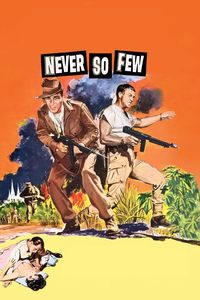
  • Never so Few (1959)

    Never so Few (1959)

    (On Cable TV, April 2021) The 1950s were a victory lap when it came to Hollywood movies and World War II. Even absent the propagandist imperative of the war years, studios kept revisiting the conflict in generally heroic tones, praising the American soldier and considering the war as a series of adventures. You can see that tone at work in Never so Few, which explores an understudied facets of war (the Burmese theatre) in a way that evolves from slight comedy to revenge thriller. It is, at the very least, heavy on stars with Frank Sinatra and Gina Lollobrigida in the lead roles, and notables such as Steve McQueen, Charles Bronson and Paul Heinred in supporting roles. In an attempt to throw everything in its expansive two-hour running length, there’s a depiction of troops in wartime and a mission behind enemy lines, but also a shoehorned romance and a travelogue as well. It works, but just — Never so Few isn’t some kind of forgotten classic or anything: it’s worth a look if you like the cast, or if you want another illustration of another corner of WW2, but it’s not always as compelling nor as consistent as similar films from the era.

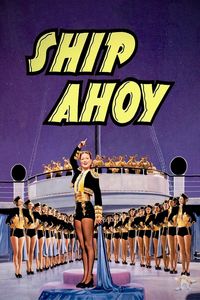
  • Ship Ahoy (1942)

    Ship Ahoy (1942)

    (On Cable TV, January 2021) The combination of Eleanor Powell’s tap-dancing talents and Red Skelton’s rubber-faced comedy must have been an irresistible commercial prospect in the early 1940s, and Ship Ahoy mostly delivers on that promise, with a few extras on top. The best of those, to me, has to be Virginia O’Brien in a strong supporting comic role, her deadpan singing being limited to one sequence. (But what a sequence: A romantic ditty first performed straight by a young Frank Sinatra, reprised with heartfelt romantic humour by Skelton, and then mercilessly skewed by O’Brien’s usual flat singing and sarcastic interjections: “Wow!”)  Surprisingly enough, Skelton keeps a lid on his worst tendencies, even conforming to the demands of a romantic lead role (as a hypochondriac writer) rather than overindulge in comic showboating. The plot itself gets ingenious at times, with Powell’s character being duped into taking a piece of high technology out of the mainland states to the benefit of foreigners, being kidnapped, then alerting US agents by tap-dancing Morse code. One more highlight is a substantial performance by legendary big-band leader Tommy Dorsey and his orchestra as the source of many of the film’s musical numbers. While I’ll agree with those who point out that Ship Ahoy is a lesser effort than the second Powell/Skelton collaboration I Dood It (a Skelton catchphrase that you can hear as a line of dialogue here), there are enough bits and pieces here and there to make it great fun to watch—I never get enough of O’Brien anyway, and this film does let her do more than just a novelty song.

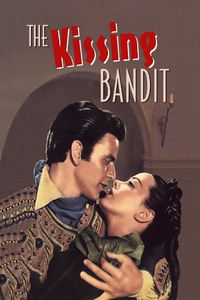
  • The Kissing Bandit (1948)

    The Kissing Bandit (1948)

    (On Cable TV, September 2020) Movie history is not kind to The Kissing Bandit: It’s recognized by Wikipedia as “one of the least successful musicals in MGM history,” and “an acknowledged low-point in the careers of Frank Sinatra and Kathryn Grayson.” Is it such a terrible film, though? Of course not. While almost obscure these days, it’s quite entertaining to watch if you’re a fan of Technicolor MGM musical. Gorgeously shot against California mountains with very colourful costumes, the film clearly doesn’t take itself too seriously. The premise alone does a lot of mileage out of blending Robin Hood with Zorro as a Boston-educated young man comes back to 19th-century California to take over his father’s inn, only to discover that he’s expected to step into his father’s true occupation: leader of a masked gang, otherwise known as “the Kissing Bandit” for his habit of, well, kissing female victims. That premise wouldn’t fly today for obvious reasons, but even then—the film seems determined to minimize any unpleasant connotations this may have: our hero spends nearly all of the film shying away from any kissing, and the film spares no means (opening titles joke, comic sound effects, overacting) to let us know that this is a big broad comedy and nothing bad is ever going to happen. A young Sinatra with relatively long hair does well in the lead role, while Grayson is simply lovely as the governor’s daughter. Still, I’m burying the lead here because the single best reason to watch the film as far as I’m concerned is a single number toward the end of the film that has two of my biggest MGM crushes, Ann Miller and Cyd Charisse, in billowing dresses dancing a number with none other than Ricardo Montalban—whew! Let’s not argue that The Kissing Bandit is a great film—it has trouble with tone, and the rather promising opening act somehow doesn’t quite lead to a satisfying middle before the film picks up again toward the end. But it’s fun, funny and offers some great Hollywood stars doing some singing and dancing. Its relative obscurity may even mean that even fans of the era haven’t seen it yet.

  • The Man with the Golden Arm (1955)

    The Man with the Golden Arm (1955)

    (On Cable TV, April 2020) From the first moments of The Man with the Golden Arm, as we see Saul Bass’s opening titles and director Otto Preminger’s name, we’re reminded of the later Anatomy of a Murder and promised a serious taboo-breaking black-and-white drama. The film does not disappoint. It features Frank Sinatra as an ex-convict who’s struggling with not relapsing into drug addiction. That’s unusual enough as a topic matter for 1955, but what sets the film apart, even today, if that it treats addiction like a disease, and the addict as a victim. The humanization of the protagonist is made easier through Sinatra’s sympathetic screen persona, in a role that wouldn’t have been the same with any other actor. (Also notable: Kim Novak, and Arnold Stang’s great performance as a friend of the protagonist.) While it does take some time to get going, The Man with the Golden Arm does offer a fascinating atmosphere of low-down mid-1950s Chicago, with smoke-filled card joints, strip clubs (sort of) and seedy apartments. What the film does better than many others, then or since, is showing how difficult it can be to break out of a bad past, transforming the story from a crime thriller to a social drama. Sure, Sinatra and/or Preminger’s name will draw viewers in, but the story itself is quite engrossing once you give it a chance to put all of its pieces in place.

  • Take Me Out to the Ball Game (1949)

    Take Me Out to the Ball Game (1949)

    (On Cable TV, March 2020) Part of the fun of watching Hollywood history is seeing talented performers getting paired up even when the match isn’t quite harmonious. Frank Sinatra—brilliant singer. Gene Kelly—terrific dancer. Both of them together? Well, you have to see Take Me Out to the Ball Game how they play together… and having Esther Williams as the female lead doesn’t hurt either. A prestige song-and-dance show from MGM (in Technicolour!), it blends its leads’ skills with America’s sport and the usual trappings of musical comedies. The highlight is the theme song, but there are a few good moments elsewhere too: Esther Williams inevitably dips into a pool at some point, and while director Busby Berkeley’s imprint on the film is faint (he only shot a small portion of it, and the rest was reportedly completed by Kelly and Stanley Donen), there are still traces of it in the finished product. On the other hand, there’s some weird stuff as well: the references to suicide and pedophilia in the middle of an upbeat wolf-whistling song are a bit off-putting to say the least. Also not quite as controlled for twenty-first century viewers: double standards in how a determined woman is portrayed compared to the equally persistent male characters. Ah well—this is from the late 1940s, after all. Still, a muddled average and no high peaks means that Take Me Out to the Ball Game suffers in comparison to other Sinatra/Kelly vehicles like On the Town and Anchors Aweigh. They can’t all be perfect. In this case, it still means we get Sinatra singing and Kelly dancing.

  • Ava Gardner, la gitane d’Hollywood: les années espagnoles de la Comtesse aux Pieds Nus [Ava Gardner: The Gypsy of Hollywood] (2018)

    Ava Gardner, la gitane d’Hollywood: les années espagnoles de la Comtesse aux Pieds Nus [Ava Gardner: The Gypsy of Hollywood] (2018)

    (On Cable TV, August 2018) Made-in-France TV documentary Ava Gardner, la gitane d’Hollywood: les années espagnoles de la Comtesse aux Pieds Nus has both a breathless title and a somewhat tight focus on Gardner’s years in Spain during Franco’s dictatorial regime. While there’s clearly some affection for Gardner here (expressed either through interviewees who met her over there, or star-struck commentators), she does get excoriated for her indifference to the authoritarian regime that welcomed her, and her lack of awareness for the role she played in realpolitik between the United States and the Spanish government at the time. A secondary axis of focus for the film is in describing how Gardner was possessed of a beauty that outstripped her ability to deal with it. Coming from modest rural origins, she was celebrated as a world-class beauty but it was a life-long struggle for Gardner to come to grip with what it meant and not being exploited for it. A third area of interest consists in her tumultuous marriage with Frank Sinatra, although there’s a lot left out of that segment. The rest of Gardner’s life and career gets perfunctory but disappointing mention—her apprenticeship in the studio system prior to The Killers, her stardom years, her twilight decades before her 1990 death in London all get comparatively short thrift here compared to the Spanish years. It’s not uninteresting (especially as an occasion to learn more about Gardner), but the film ends up being unsatisfying: It’s focused on too narrow a period in her life when there’s an incredibly rich career barely mentioned. I suspect that much of Ava Gardner, la gitane d’Hollywood’s shortcomings come from its origins as a time-limited TV documentary and ready access to Europe-based sources more familiar with Gardner’s Spanish years—but there’s a lot of material left untouched if anyone else wants to make a better Gardner biopic.

  • Guys and Dolls (1955)

    Guys and Dolls (1955)

    (On Cable TV, August 2019) I remain amazed at how some movies can produce some consistent reactions for decades. If you look at contemporary accounts of Guys and Dolls prior to its release, the themes are similar: “What? Joseph L. Mankiewicz directs a musical featuring Jean Simmons and Marlon Brando? What craziness is this?!”  Considering that neither Mankiewicz, Simmons nor Brando ever went back to musicals after this one-off, you can get the exact same reaction well into the twenty-first century. Of course, we now have fairly entertaining stories of rivalry on the set between Brando and co-star Frank Sinatra, the latter of which was not impressed by Brando’s mumbling or singing deficiencies. (I’ll agree with Sinatra on this one.)  Guys and Dolls, seen from today’s perspective, is not entirely as slick as other musicals of the era—and Brando has the double disadvantages of not being in his element either as a singer or a comedian, his mumbling quickly becoming annoying. Sinatra is far more comfortable in going from song to jokes. The cabaret numbers are fun: I enjoyed the “Pet me Papa” cat-girl number a bit too much. Mankiewicz does relatively well in helming the production: The introduction is great, the conclusion makes good use of its impressive Times Square stage and the dice gambling scene is not bad either. The result is a bit too long at 150 minutes, but Guys and Dolls did scratch my itch for a lavish musical … and I look forward to future generations of cinephiles also asking themselves what Brando was doing in a musical.