James L. Brooks

  • Mother (1996)

    (In French, On Cable TV, August 2022) I keep watching James L. Brooks films thinking that I should enjoy them more, and Mother is not an exception to this feeling. While writer-director-actor Brooks takes on more difficult material than others, and often goes for sly irony over easier ways of making people laugh, Mother feels like many of his other films in that it fails to satisfy. It already starts on a shaky note, as a freshly divorced Science Fiction writer drives from Los Angeles to San Fransico to regroup at his mother’s place. (Amusingly enough, the driving montage is set to a remake of Simon and Garfunkel’s “Miss Robinson” with on-the-nose plot-reflecting lyrics.) Except that he doesn’t like her, and she often doesn’t think all that highly of him. Brooks and Debbie Reynolds have some fun playing off a dysfunctional mother/son relationship, and that’s much of Mother for you: bickering over trivial details like the detestable petty characters they are, until it’s time for the climax. When that climax comes, it almost feels like an insult: he discovers she once was an aspiring writer; he understands she dislikes him because he reminds her of her dashed literary aspirations and having had their epiphany, they part as new friends. If that’s a bit not enough for you, let’s just say that the film plays this absolutely straight, and adds in an adoring fan of the writer as a romantic envoi. And Brooks is supposed to be a wry, subtle writer? Have I missed anything? Watchable yet kind of infuriating, Mother strikes me as too much of the dumbest Hollywood pap. Strike another “I don’t think so” in Brook’s filmography.

  • Broadcast News (1987)

    Broadcast News (1987)

    (On Cable TV, March 2020) This almost counts as a second viewing of Broadcast News for me—I distinctly recall seeing the last half of it sometime during the 1990s and being both impressed by the film’s intelligence and disappointed at the somewhat sad ending. But half a film isn’t the same as the entire one, and watching this in middle age doesn’t hit quite the same as an older teen. One thing remains constant, and it’s that Broadcast News still captures the organized madness of TV news like few other films: writer-director James L. Brooks uses the medium’s fundamental tension (entertainment versus substance) as an engine through which to propel a romantic triangle and a series of thorny ethical crises. Holly Hunter is the rock on which the film rests, as a news producer attracted to two very different reporters—William Hurt as the pretty-boy anchor, and Albert Brooks as the solid but prickly expert. (Meanwhile, Joan Cusack is very cute in a supporting role, and owns a flashy action sequence in the first act. Oh, and Jack Nicholson has a cameo as, well, pretty much that universe’s equivalent to God.) It’s all very clever and witty—filmmaking for middlebrow adults able to tolerate a bit of theatrics in order to illustrate a more subtle point. I liked Broadcast News even more this almost-second-time around now that the ending doesn’t strike me as particularly sad, just appropriate.

  • Terms of Endearment (1983)

    Terms of Endearment (1983)

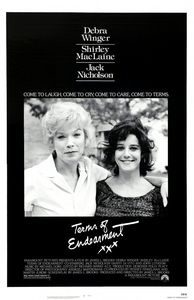
    (In French, On Cable TV, May 2017) Get your hankies out, because Terms of Endearment is here to make you sob as hard as you can. The story of a relationship between a mother and her daughter spanning decades, this is the kind of slice-of-life movie where mundane details add up to epochal drama. The weight of the passing years heighten the sweep of the drama, but it’s not all wall-to-wall dourness as the film does reach for comedy under writer/director James L. Brooks. Some of the film’s most memorable moments are very funny, although they do take on a more sombre quality knowing how the film ends. Shirley MacLaine and Debra Winger both turn in best-of-career performances as the mother/daughter duo, with Jack Nicholson, Jeff Daniels, Danny Devito and John Lightgow all delivering good supporting roles along the way. It’s a kind of A-list picture that big studios don’t make anymore (although you’ll find similar material in independent films) and while it still works today, it’s a kind of movie made for a specific audience—I didn’t respond all that deeply to it, but I suspect that’s because I fall outside its target demographic.

  • How do You Know (2010)

    How do You Know (2010)

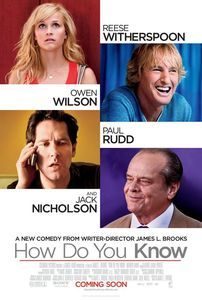
    (On cable TV, April 2012) Watching well-made romantic comedies is so effortless that making them seems easy… and then you find one that doesn’t quite work as well as it could. On the surface, How Do You Know isn’t a hard movie to like: It has four good actors in the lead (Paul Rudd is charming as the co-protagonist and Owen Wilson is almost hilarious as a clueless baseball player but the film’s highlight is that Reese Witherspoon is aging really well –I can’t recall her looking any better), appealing characters, quirky details, a few big laughs and a somewhat witty script. Shot to glossy perfection in the streets of Washington DC, it’s the kind of film fully steeped in movie-magic, fit to send audiences in a feel-good trance. And yet… it never quite clicks. The dialogues, even from the first few scenes, seem willfully scattered. The scenes go on for longer than they should, and no amount of character charm nor scene-setting can excuse the tepid rhythm. While How Do You Know earns a few credits for avoiding the more obvious clichés of romantic comedies, it doesn’t quite replace those clichés with anything remarkably compelling. The look at the struggles of an aging female athlete seems eclipsed by the look at the idiocy of an aging male athlete, while the corporate malfeasance plot doesn’t quite boil at any point in the story. It all amount to nothing much; at best, a pleasantly eccentric but forgettable romance. But then, looking up the film’s production information, you find out that it cost $120 million, almost half of which was spent on five key salaries… and the film goes from unobjectionable to incomprehensible.  Really, writer/director James L. Brooks? Did you really need Jack Nicholson to play his same shtick for that amount of money? How Do You Know feels like the kind of low-budget romance given to hungry up-and-coming directors for a quick release a modest box-office… not blockbuster budgets and massive audiences: there’s nothing here to warrant more attention. No amount of “Eh, it was all right” can recoup those losses.