Sidney Poitier

  • Something of Value (1957)

    (On Cable TV, February 2022) Substantial roles for black American actors were rare during the 1950s (or, for that matter, in any decade preceding the 1970s), but there were occasional exceptions for films that were explicitly set in black environments… or for a few emerging actors such as Harry Belafonte or Sidney Poitier. Poitier doesn’t have the lead role in Something of Value—that would be Rock Hudson as the son of a white settler in Kenya. Poitier plays his close friend against a backdrop of colonialism, questioning allegiances and a buildup of violence that comes to dominate the last act of the film. Something of Value has the hallmarks of the progressive films of the time—while it’s a white-told, white-focused story that goes overseas for exoticism and showcasing its white lead, it does grapple with uncomfortable questions in as much honesty as was allowable at the time. There’s a small corpus of such pictures and while they don’t feel all that progressive today, they were nonetheless how Hollywood reached out for inclusivity and prepared itself for more dramatic changes in representativeness decades alter. Poitier, to be fair, is the film’s highlight—he’s second-billed, but his performance as a Kenyan trying to decide where his allegiances lie is the crux of the film’s moral questioning, and his self-assured performance remains a highlight when compared to Hudson’s character. Otherwise, though, there are limits to the effectiveness of Something of Value. Adapted from a novel, the film remains beholden to non-cinematic choices (although one final sequence does raise the suspense considerably by endangering a child). Evocative location shooting helps the film have an interest of its own, although it’s limited by the black-and-white cinematography that feels like a wasted opportunity. Something of Value is the kind of film you watch for social issues rather than cinematic entertainment and as such it’s a welcome title but not one you’ll ever rewatch.

  • Cry, the Beloved Country (1951)

    (On Cable TV, February 2022) I’ve been spending some time this February digging into Black Film History—Cable TV channels tacitly programmed black films all month long, and while I had a good grasp at the essentials (I also wrote an essay on the topic during the month), it was an occasion to rediscover the more obscure ones. One notable subcategory I was able to discover are the fairly rare movies featuring black leads during the 1950s—a time with few notable performers, and even fewer films featuring them in roles with deep characterization. Cry, the Beloved Country (from British producer-director Zoltan Korda, brother of naturalized British movie mogul-propagandist Alexander Korda) is a noteworthy footnote in that both lead roles are played by black actors, and no less than Canada Lee and Sidney Poitier. There’s a catch, though: the film had to go overseas to find a subject matter that would allow such a thing. Looking erringly prescient, it heads over to South Africa to talk about apartheid, looking very early on about the impact of such a policy on both white and black characters. The production history of the film is stomach-churning in itself—given apartheid, both lead actors had to pretend to the authorities that they were the director’s indentured servants to be admitted in the country, where they shot the film in near-guerilla conditions. It’s not an easy of a fun film to watch: the subject matter is difficult, and Korda doesn’t go for feel-good material. But it’s an amazing film in its own right—the last of Lee’s career, and one of Poitier’s first—thereby acting as a passing of the torch. Poitier was a self-assured presence even at that stage of his career, and there’s considerable interest watching him this early. I can’t say that I liked Cry, the Beloved Country, but it earns a spot in my version of Black Film History—and isn’t it the point to celebrate such successes?

  • Paris Blues (1961)

    (On Cable TV, February 2022) Few filmographies are as rock-solid as Sidney Poitier’s work in the 1960s, and Paris Blues is certainly a great, if lesser-known, entry in the list. Like a few other Hollywood films of the time, it goes overseas to make a point about American racism—this time to Paris, where two expatriate best buddies (played by Poitier and Paul Newman) have fun playing jazz music… until two vacationing American women (Joanne Woodward and Diahann Carroll) lead to a reconsideration of their lifestyle. The richness of the film means that you can appreciate it in many ways. There’s the jazz angle, obviously, with Louis Armstrong even dropping by briefly for a cameo. There’s the romantic aspect of it, with an attractive cast of lead characters against the strong Parisian atmosphere—and some romantic conflict bubbling into wider societal considerations. There’s the matter-of-fact interracial friendship between Newman and Poitier’s characters—still a rarity in American cinema at the time. There’s the strong discussion of American racism, obviously, with two characters arguing about whether it’s best to live a happy life abroad in Paris’ relatively accepting environment, or go back home and become an activist despite the unpleasant consequences. While Caroll looks stunning here, Newman and Poitier competing with each other to see who’s cooler means that the clear winner is the audience. But even if you strip all of those qualities, Paris Blues still remains a story about two young men figuring out what they want out of life and measuring facility against achievements. I didn’t expect much from Paris Blues (and I maintain that its Parisian décor would have been much more effective with colour cinematography), but director Martin Ritt has an underappreciated success here: perhaps not as striking had the story retained the interracial romance angle of the original novel, but still a quietly effective piece of work that acts as a lead-in to the more engaging material that would follow later during that decade. I’m also noting a strong kinship between Paris Blues and the 1950s Italian dolce-vita Hollywood-on-the-Tiber subgenre, which may be enough of another incentive to watch the film. No matter why, it’s worth a look.

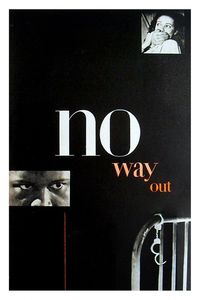
  • No Way Out (1950)

    No Way Out (1950)

    (On Cable TV, June 2021) It’s almost amazing to realize that No Way Out was Sidney Poitier’s feature film debut, because it already shows the characteristics and the persona that would transform him into a movie star during the following decade. Here, he plays a black doctor confronted with a deeply racist criminal as a patient (Richard Widmark, fully playing up his cad persona) that he nonetheless has to treat. A mysterious death ends up causing no end of troubles for the young doctor, and the film keeps exploring racism in a way that still resonates today. Written and directed by the legendary Joseph L. Mankiewicz, No Way Out is well-written and well-structured — a joy to watch despite the tough subject matter. Poitier is already exceptional and the script’s naked racism still rankles today.

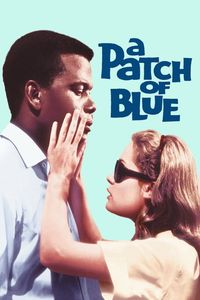
  • A Patch of Blue (1965)

    A Patch of Blue (1965)

    (On Cable TV, April 2021) There’s a completely unsubtle romance at the core of A Patch of Blue — a literal illustration of “love is blind” in which a blind white girl falls for a black man. For 1965, this was courageous stuff, but what saves the film for modern audiences is the utterly likable performance from Sidney Poitier, who carries the film without missteps even at this early stage of his career. The cast around him is quite good as well—Elizabeth Hartman is suitably sympathetic as the blind girl, while Shelley Winters is striking as her incredibly unpleasant mother. The narrative isn’t much—and for all of its progressive intentions, the film isn’t allowed to go very far—but the acting is great and the individual scenes avoid hammering the already-unsubtle nature of the narrative. It doesn’t take much more than that to transform A Patch of Blue from what could have been an overbearing Oscar-baiting film into something quite watchable.

  • They Call Me Mister Tibbs! (1970)

    They Call Me Mister Tibbs! (1970)

    (On Cable TV, May 2020) The nice thing about They Call Me Mister Tibbs! is that anyone with the slightest amount of 1960s movie literacy will know exactly what they’re getting—a further adventure with the protagonist of In the Heat of the Night. Sidney Poitier once again plays Tibbs, this time in his urban element. Employed in San Francisco, Tibbs investigates the death of a prostitute and uncovers a run-of-the-mill set of suspects, lies, and telling details about circa-1970 big-city crime and consequences. While Poitier is as great as always, the film itself plays like a middle-of-the-road crime movie of the week, with decent but not particularly impressive narrative and production values. This many not be as much of a problem as you think: Watch this film alongside Dirty Harry (also set in San Francisco, also during the early-1970s) and They Call Me Mister Tibbs! will strike you as somewhat more realistic and less grim as many of the urban decay crime movies of the era. It’s clearly a few steps down from the first film (and arguably not even related except for the title, considering the differences in characterization) but it’s not necessarily all that bad. The period detail may even make it a bit more fun today than back then.

  • Shoot to Kill (1988)

    Shoot to Kill (1988)

    (In French, On Cable TV, March 2020) While Shoot to Kill doesn’t really manage to get above its B-movie intentions, it does have a few things going for it. The most obvious one is the setting, as this criminal chase thriller takes us far from the urban skyline of San Francisco all the way up north to the Rockies, eventually crossing the border into Canada and finally ending in Vancouver. The Canadian content doesn’t stop there, as Shoot to Kill is an early effort from Ottawa-born director Roger Spottiswoode. The unusual nature of the film’s setting is bolstered by interesting casting, whether it’s a rare late-career role of Sidney Poitier, Kirstie Alley looking her best, or Bart the Bear doing his usual thing. The least one can say is that Spottiswoode manages to put all of the ingredients together competently: Shoot to Kill moves forward steadily, does well with its budget and comfortably executes the buddy-movie thriller template it’s given. It’s certainly watchable, even if it falls into the glass-half-full-or-half-empty neverland of middle-of-the-road films that are both better and worse than they could have been.

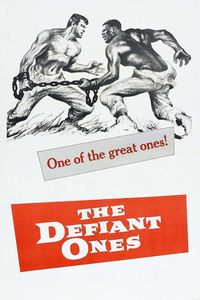
  • The Defiant Ones (1958)

    The Defiant Ones (1958)

    (On Cable TV, February 2020) I know, from 2020’s vantage point, that Tony Curtis has played a number of dramatic and unlikable roles in his career. But there’s a good reason why his performance as a racist criminal in The Defiant Ones is still surprising: Even today, well after the end of his career, Curtis is far better remembered as a funny romantic protagonist than anything else. His enduring renown for comedy makes his performance in The Defiant Ones still compelling: In this socially-minded Stanley Kramer film, he plays an unrepentant white racist who finds himself chained to a black man (the excellent Sidney Poitier in one of his earliest performances) while escaping a chain gang. There’s little surprise as to where the film’s overall dramatic arc is going, but some of the details along the way are interesting—the portrait of the American South, with its heavily racist atmosphere and punitive justice, is asphyxiating and almost alien. The film is at its strongest in leaning upon its literalized metaphor of two races chained together, finding a way to get past their animosity for a common goal. The stark black-and-white cinematography works in favour of the film more often than not, leaving all the space necessary for the actors to show their skills playing off each other. By contemporary standards, The Defiant Ones can feel a bit rough on messaging, but is not really any less effective for it.

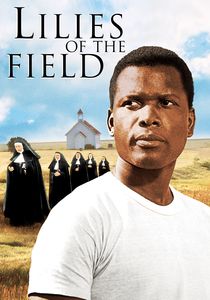
  • Lilies of the Field (1963)

    Lilies of the Field (1963)

    (On Cable TV, August 2019) Sidney Poitier won his Oscar thanks to his performance in this film and it’s easy to see why—playing an itinerant handyman who comes across an eccentric group of nuns during his travels, he is the glue that holds the film together. The nuns are not only recent immigrants unable to talk much English: they need help building a chapel, and their leader is unusually skillful at persuasion. Before understanding what he’s getting into, our protagonist finds himself spearheading the construction of the chapel, helping the nuns despite their inability to pay him. There’s clearly a construction narrative at work here as we see the chapel take form, but Lilies of the Field wouldn’t half as interesting without the off-beat nuns and how they somehow convince the protagonist in doing their bidding. Meanwhile, Poitier plays the cool, bemused outsider (the nun’s antics wouldn’t be half as funny without his reactions), immensely relatable to the audience. The black-and-white cinematography makes good use of outdoor locations, with the desert helping to create a white backdrop useful for composition. In some ways, I’m amused that script can be seen as a constructive take on the “stranger comes to town” western premise. Still, the draw of Lilies of the Field is Poitier, charismatic and relatable at once. It’s thanks to him if it’s still so entertaining today.

  • To Sir, With Love (1967)

    To Sir, With Love (1967)

    (In French, On Cable TV, June 2019) 1967 was an extraordinary year for Sidney Poitier, but while we readily remember In the Heat of the Night and Guess Who’s Coming to Dinner, fewer will remember the third of his movies that year: To Sir, With Love. This time, he’s off to London as a teacher in a tough school, befriending local hoodlums and wayward girls after the initial hostility. The same super-teacher movie has been made and remade many times since then, but two things help To Sir, With Love remain interesting fifty years later—Poitier’s performance, obviously, but also the street-level view of London in the mid-1960s, as the film confronts the rise in teenage rebellion. The film itself is definitely on the side of the establishment—as the protagonist befriends his charges, he lifts them toward notions of respectability and good manners, helping them fit in society. As such, you can see the film as deeply conservative, but that too is in the tradition of that kind of movie. To Sir, With Love is a film about the revolution but not a revolutionary film—as such, it may have aged a bit better than the trendy New Hollywood movies that followed slightly later. For Poitier, this is a great role—he gets to whip up a few youngsters into shape, befitting his image as the capable, nearly unflappable black man. There’s a lot to unpack in this persona, as it was the only one allowed to him at the time, but that’s a discussion for another time, and about his other two movies of 1967.

  • Guess Who’s Coming to Dinner (1967)

    Guess Who’s Coming to Dinner (1967)

    (On Cable TV, January 2018) It’s not a failure if some social-issue films don’t work as well now than at the time of their release—sometimes, the world moves in the direction advocated, and as a result the film looks as if it’s been outpaced by the future. So it is that the central conceit of Guess Who’s Coming to Dinner (a white girl bringing back a black fiancé home for her parents’ approval) doesn’t quite have the same charge fifty years later. And that’s quite all right. This being said, let’s not take this for a condemnation of the work from director Stanley Kramer, or by Spencer Tracy, Sidney Poitier, and Katharine Hepburn. After all, the film finished shooting six months before Loving v. Virginia actually legalized interracial marriages across the United States. But it does feel a bit stuffy, all the way to a conclusion that boils down to an intensely paternalistic “Father has thought about it and will let you crazy kids do whatever you want” conclusion. It’s not quite fair to dismiss the film in such a way (and indeed, Guess Who’s Coming to Dinner’s ending gets far more potent once you read about how Spencer Tracy died two weeks after shooting his final scene and final film with long-time co-star Katharine Hepburn) but it is definitely a reflection of its time, and time has moved on.

    (Second Viewing, On Cable TV, October 2018) As I suspected, revisiting Guess Who’s Coming to Dinner after watching a handful of Spencer Tracy/Katharine Hepburn movies has significantly improved my opinion of the film. This was a partial re-watch, focusing on the scenes featuring Tracy and Hepburn, and it affirms that Guess Who’s Coming to Dinner is a terrific victory lap for Tracy, whose kindly-father persona here acts as a capstone to a career that saw numerous pairings with Hepburn at various moments in their careers. It’s easy to imagine a shared backstory for their characters that includes bits and pieces of Woman of the Year or Adam’s Rib, and that’s when context can become crucial in seeing what the fuss is about a particular movie. If you de-emphasize the racial message and focus on the Hepburn/Spencer couple, this film becomes a satisfying epilogue to a shared on-screen career, well worth watching if you’re familiar with the rest of the Hepburn/Tracy filmography.

  • In the Heat of the Night (1967)

    In the Heat of the Night (1967)

    (On Cable TV, November 2017) Whenever I tackle an older film, I usually curse my lack of knowledge of the era and my imperfect understanding of the context surrounding the film. But in the case of In the Heat of the Night, I’m actually proud and thankful that I don’t have a deep understanding of the pervasive and violent southern racism that the film portrays. Built around a murder mystery in small-town Mississippi, In the Heat of the Night is really an issues drama, as a competent police officer from Philadelphia is semi-voluntarily asked to help with the investigation. The legendary Sidney Poitier stars as “They call me Mister Tibbs,” a gifted cop whose skills are dismissed by the locals due to his skin colour, and who gets into increasingly violent confrontations with those who wish he’d go away. The murder mystery is perfunctory, but it definitely takes a back seat to the social issues illustrated throughout the plot. Thankfully, there is some good character work along the way that helps make the film more than simply a moral lesson—The protagonist has significant flaws (pride, mostly) that are pointed out by other characters, and the lead sheriff’s (Rod Steiger) evolution from stone-cold racism to honest admiration is handled organically. Colourful minor characters help establish the torrid atmosphere of a southern town in the middle of a heat wave. Competent filmmaking, headed by director Norman Jewison (a Canadian, one notes), make much of the film look and feel just as compelling as it was back then. From a contemporary perspective, much of the movie, and the locals’ reaction to the protagonist, defies comprehension and almost approaches caricature—I’m glad to live in a world where that stuff isn’t as acceptable any more. In the Heat of the Night is a Best Picture Oscar winner and it’s easy to see why—even today, it blends genre entertainment with a strong social conscience, through compelling performances and good production savviness.