Taraji P. Henson

  • What Men Want (2019)

    (On TV, April 2022) This is going to sound reactionary (and I’ll assume the consequences for it), but I find it striking that when telepathy comedy What Women Want came out back in 2000, it was seen as an attempt (however imperfect) to make the pressures imposed on modern women more understandable to men, effectively becoming a film about female empowerment. So, logically, a gender-flipped remake called What Men Want should take a look at the pressures affecting modern men and make them understandable to women, right, right? Haha, of course not – Even in following a woman who can hear men’s thoughts, the script has been rejigged so that the female protagonist gets everything she wants from overhearing evil men’s evil thoughts. There is no exploration of modern masculinity here – a few jokes about what men don’t want others to know (including a closeted gay male, naturally) but otherwise the deck is rigged against our female protagonist and the mind-reading thing is about her triumphing over the (misogynistic, discriminatory, racist, sexist, systematically oppressive, etc.) system. As usual in gender-flipping premises, there’s no real pretence at equality here – it’s blunt-force male critique without nuance, subtlety or even compassion. Maybe we’ll get to something looking like true equality in a few decades. Given that this review is so far right out of the reactionary right-wing playbook (I swear I’m progressive… but I get annoyed sometimes – in a world moving away from unipolar white maleness, equality is a multi-way street), you could be forgiven for assuming that I disliked What Men Want. But I actually didn’t – it’s hard to resist Taraji P. Henson when she’s in full outsized-personality mode, as she is here playing a sports agent with difficult clients. While What Men Want sports the broadcast-by-BET-channel stamp, this film is a full step above the (rather endearing) low-budget made-for-BET movies that regularly air on the channel – it’s got decent production values, an acceptable script (notwithstanding the previous 200 words of cranky kvetching), name actors and a sufficient budget to meet its ambitions. It’s rough on the edges, but the dialogue occasionally has a good quip or two. The pacing is controlled well, and even a few dumb script tendencies (such as over-explaining what’s happening, or being suspicious convenient as to when our protagonist can or can’t hear men’s thoughts) aren’t enough to extinguish the overall good fun of the exercise. This is meant to be a comedy, after all, and it nails the breezy tone essential for it. Erykah Badu seems to be having a ton of fun playing a psychic with some psychedelic assistance, while director Adam Shankman is an old hand at keeping it all under control even if some odd extraneous subplots still distract from the core of it. While I do have a lot to say about What Men Want’s shortcomings, it’s pleasant enough to watch – but don’t expect anything particularly memorable. Well, except for the wedding scene.
  • The Family That Preys (2008)

    The Family That Preys (2008)

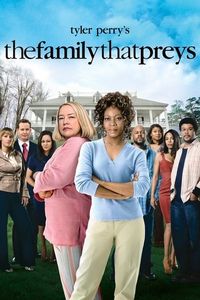
    (On Cable TV, October 2021) Anyone wondering about Tyler Perry’s early-film-career strengths and weaknesses (not that there’s been much of a change since then) can always have a look at The Family that Preys, a middle-of-the-road effort that does feature the usual highs and lows of his film work. On the good side, we have a heartfelt look at black characters, with an emphasis on female characters. There are effective sequences supporting a strong sense of humanist morality, religion and family. There’s often (but not always) a clear-cut distinction between good people and bad ones, with the virtuous getting their rewards at the end. He manages to attract very interesting acting talent, and his flair for populist entertainment is far better than most other filmmakers, especially in playing to his specific audience. His penchant for melodramatic plotting (in the neutral sense of the expression) makes for easy, sometimes even engaging viewing—it’s easy to sit down and be swept in the story, even as blatantly plotted as it can be. On the other hand, his excesses are also here—a lack of a clear theme that leads to an unwieldy, sprawling structure that barely sits down to work out its own ideas. The writing is not very elegant (that “memory card” bit is, wow) and the points it makes are not subtle at all. Even the film’s striking moments (such as a man slapping his adulterous wife, portrayed as justified, or a homeless person being revealed as very important) seem very calculated. The caricatural nature of the antagonists is often too broad to be credible (the adulterous son even booking the same hotel room as his adulterous father!) and you know within moments who you’re dealing with—a woman putting down her man’s dreams is obviously up to no good, right? And yet, The Family that Preys rather works if you’re willing to be forgiving. The cast certainly helps—Kathy Bates effortlessly dominates the film as a matriarch, and her rapport with a splendid Alfre Woddard is one of the film’s highlights even if their subplot seems contrived and out-of-place. Sanaa Lathan is wonderfully detestable as the female villain, while pre-stardom Taraji P. Henson plays her good sister, Robin Givens has a striking smaller role and Perry himself has a small role as a construction worker. The ending is a lot of righteous fun to watch, as people get what they deserve from an old-school moralistic standpoint. Blunt but crowd-pleasing, Perry’s films are far more interesting than their critical reputation (largely forged by movie critics outside his intended audience) would suggest. I’m having a surprising amount of fun going through his filmography, even when the films are less than wonderful.

  • I Can Do Bad All by Myself (2009)

    I Can Do Bad All by Myself (2009)

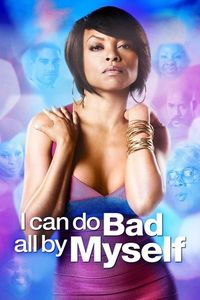
    (On Cable TV, September 2019) Well, it finally happened — five movies into my Tyler Perry project, I’m actually enjoying them. To be fair, I Can Do Bad All by Myself was the first film from writer-director Perry to earn generally positive reviews, and one in which Madea’s presence became more than an irritant. It’s easy to see that, even with a rather predictable story, the film is executed with increasing skill. The added musical dimension can be tangential at times, but it does give ample chance for Mary J. Blige and Gladys Knight to shine in supporting roles. Still, the spotlight here is on a pre-“Empire” Taraji P. Henson as a self-centred, self-destructive nightclub singer who learns better after she takes responsibility for her sister’s three kids and realizes how terrible her boyfriend is. The dramatic arc of the film’s subplot is familiar, and so are the small-c conservative values that Perry espouses. I Can Do Bad All by Myself is rather fun at first (Tyler’s performance as Madea has a pair of very good scenes, even if the tone is a bit off at times) and then increasingly poignant as the comedy of the film gives way to the drama. Perry may be predictable and ham-fisted, but it’s coming from a heartfelt place and that does much to give life to the results even with its imperfections. I’m ready — bring in the next Perry movie and I’ll watch it without hesitation.

  • Think Like a Man Too (2014)

    Think Like a Man Too (2014)

    (On Cable TV, June 2019) The entire gang from the original Think Like a Man is back for more in its sequel as they all head to Vegas for a wedding. Things obviously don’t go as planned, as both the men and the women have their own bachelor/ette party adventures on their way to the wedding. To its credit, Think Like a Man Too knows how much to keep from the original film, and how much variety to include. The change of scenery to Vegas suggests not only new sights and subplots, but new familiar clichés to follow. The tone of the film also shifts slightly—while the emotional growth of the characters does find a few new areas to explore, the couples are well established already and so Think Like a Man Too strikes out for a lighter, more superficial but also more obviously comic tone. Director Tim Story has fun playing with music cues [interrupting the background score for comic effect, or indulging in a full-blown music video set to Bell Biv DeVoe’s “Poison”—probably the series’ comic highlight and a strong musical moment in a film with a great soundtrack] and his direction is deservedly flashier this time around: with its ensemble cast’s worth of subplots, the film packs quite a lot of stories in its 106 minutes. Plot-wise, the film indulges in familiar Vegas excesses, but seems to breathe more easily now freed of the shackles of the self-help book that inspired the first film. Still, the fun of the film is spending some more time with its sympathetic characters, whether it’s the boys or the girls. Michael Ealy has been bumped up to leading man, with Kevin Hart being used just a bit too much in his over-the-top persona and Dennis Haysbert having a very funny minor role. Distaff-side, Taraji P. Henson and Jenifer Lewis seem to have the most to do, although you’ll be forgiven for staring at Meagan Good, Regina Hall or Gabrielle Union. Shallowed but funnier than the original, Think Like a Man Too offers just enough of the same and just enough new to be a worthwhile follow-up to the original. I watched both back-to-back, and still liked everything about the series after four continuous hours.

  • Hidden Figures (2016)

    Hidden Figures (2016)

    (On Cable TV, September 2017) While I’m convinced that revisionist works such as Hidden Figures are essential in making full sense of history (which doesn’t rely solely on the majority-status figureheads, but also the unnamed masses actually doing the work), I can’t get rid of a feeling of annoyance when the fiction proves to be more revolting than the reality. I am, of course, showing my white privilege when I point out that Hidden Figures manipulates historical facts to make life seem even more terrible for its black female protagonists. (The entire washroom subplot, as infuriating as it is, never happened in real life.)  Still, there is a lot to like in what Hidden Figures actually does. “Coloured computers” packs so much wrongness in two words that it’s almost a relief to see a movie sidestep the heroics of The Right Stuff to show who was behind much of the mathematical grunt work. It helps that Taraji P. Henson, Octavia Spencer and Janelle Monáe make great heroines, and that capable white actors such as Kevin Costner and Kirsten Dunst are (for once!) relegated to support roles. (Meanwhile, there’s Jim Parsons being Jim Parsons—for all of the acclaim that he’s gotten for Sheldon Cooper, the more I see him in other venues the more I’m seeing him in the same role.)  The historical recreation of NASA’s early days (dramatic inaccuracies aside) is also impressive, and Hidden Figures more than finds its way alongside The Right Stuff and Apollo 13 as essential movies for space program enthusiasts. Which makes the inaccuracies worse, in a way—I’d settled for a less dramatic film if it meant a more accurate one: it’s not as if the basic story wasn’t inspiring enough…

  • The Karate Kid (2010)

    The Karate Kid (2010)

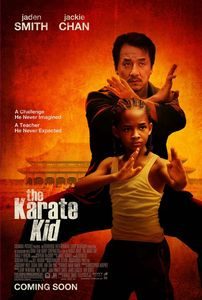
    (On TV, May 2017) The 1984 version of The Karate Kid is such a cultural fixture that any attempt to remake it was doomed to irrelevancy. This being said, this 2010 remake does try its best, most notably but relocating the action in China where our hero involuntarily immigrates when his mom gets a new job. The change of scenery does much to renew a movie that largely recycles the original film’s structure: The look inside modern China can be interesting at times, as well as highlighting the fish-out-of-water nature of the protagonist. Unfortunately, that same basic decision does have its drawbacks: it removes the quasi-universal nature of the backdrop for American audiences (although, and this is significant, it does open it up to Chinese audiences), making it much harder to empathize with the high-school trials of the (significantly younger) protagonist. It also weakens the impact of Mister Miyagi’s teachings and makes a mush out of the protagonist’s attempts to fit in. Essentially, it transforms the universality of the first film into a very specific situation, and sabotages itself along the way. It doesn’t help that at eleven or twelve, lead actor Jaden Smith looks far too young for an archetypically teenage role. While it’s nice to see Jackie Chan in a decent American movie role, he doesn’t have much to do—far more judicious is seeing Taraji P. Henson in the “mom” role, greatly expanding the original character. To be fair, this Karate Kid remake is decently executed: anyone who hasn’t seen the 1984 film is likely to be moderately satisfied by the result. But for those pesky viewers with fresh memories of the original, this remake has too many small issues to enjoy.

  • No Good Deed (2014)

    No Good Deed (2014)

    (Netflix Streaming, October 2016) What happens when you drop two good (even underrated) actors in a generic formula film? You get something that’s worth watching even if the film itself is almost entirely forgettable. After all, it doesn’t get more hackneyed that a home-invasion thriller in which a dangerous escaped criminal fixates on a woman left alone at home—during a storm, no less! But, with some capable directing and Idris Elba and Taraji P. Henson arguably slumming in the lead roles, No Good Deed becomes almost watchable despite a blatantly predictable plot and much nonsense along the way. I’m really not fond of the way that the film ends up tying both the aggressor and the victim together—it’s a far scarier concept to imagine just a random criminal—but I’ll allow it in the spirit of hackneyed plotting. Elba is far too good to play one-dimensional criminal, but he does it so well that it’s hard to be mad at him. Meanwhile, Henson has a far more interesting role as the victim who ends up protecting her children while fighting back at the aggression, even when it moves away from her house. No Good Deed isn’t much more than B-grade exploitation filmmaking, but thanks to its lead actors it remains compelling throughout, which is a great deal better than other movies of its ilk.