Month: July 2021

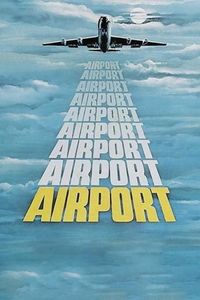
  • Airport (1970)

    Airport (1970)

    (On DVD, July 2021) The big irony about Airport is that even if it’s credited with launching the disaster movie boom of the 1970s, it’s not quite a disaster film through and through: Adapted from a thick procedural novel from the legendary Arthur Hailey, it spends more than an hour and a half detailing the professional and personal struggles of an airport manager during a particularly trying snowstorm. Launching an ensemble cast’s worth of subplots, Airport does gradually build the suspense of its impending disaster, but it remains quite an intimate affair compared to the excesses of its later imitators. For much of the first hour, it remains a remarkably sedate affair. Our airport manager (a solid turn by Burt Lancaster) struggles with a status-seeking wife, a bickering brother-in-law (Dean Martin, playing a playboy pilot), protesting homeowners and that’s all before the film starts, because in the opening moments a pilot error blocks the airport’s main runway even as the snow piles up. Plenty of other subplots are brewing as well — including a charming elderly stowaway (Helen Hayes in an Oscar-winning role), a cigar-chomping maintenance chief tasked with resolving the problem of the stuck plane (George Kennedy in a delightful role — no surprise that he reprised it in the three sequels), and, most crucially, a psychotic engineer with plans to bring down a plane over the Atlantic (Van Heflin in his last role, really not looking as trim as he was twenty years earlier). The all-star ensemble cast is something that other disaster films would reprise with gusto (indeed, watching all four entries in the Airport series is like getting a reunion of classic Hollywood celebrities) even if the formula would eventually be tweaked to bring the disaster earlier in the film. It’s amusing to see the hostile reviews that Airport got upon release, even as it topped the box office for weeks: By 1970, the New Hollywood was getting all of the critical attention, and holdovers like Airport were treated with disdain even as audiences lapped it up. Decades later, Airport’s filmmaking style has become the standard, meaning that it still plays rather well once you get past the slow opening. It’s clear that Airport often gets dinged for the excesses of its successors — the sequels are progressively wilder, cheaper and dumber and that’s not mentioning the other disaster films of the decade—but it’s best seen as a slow-burn suspense film with a still-realistic execution. It’s hardly perfect — the dialogue is often ordinary and there are scenes with as bad a case of “as you know, Bob,” as I can recall seeing—but it’s quite entertaining in its own way, and almost charming in its insistence on sticking to tried-and-true formulas.


  • Koyaanisqatsi (1982)

    Koyaanisqatsi (1982)

    (YouTube Streaming, July 2021) I already knew from watching films like Samsara that I have to approach non-narrative documentaries differently. It’s best to be in a receptive mood, to minimize distractions, to stop trying to make it all make sense, and to essentially give yourself up to the film. While Koyaanisqatsi has given rise to a small number of similar films featuring strong imagery with non-existent narration, it does remain legendary for a number of reasons: A provocative juxtaposition of striking images teasing meaning even when there is none; an anthemic score by Philip Glass; and an increasingly striking time-capsule aspect to capturing American city life circa-1980. The effect remains just on this side of hypnotic, even if the formula has been reused many times since there. Working with technical means that would now be considered primitive at an age of 4K cameras with built-in time distortion effects, director Godfrey Reggio accumulated years of interesting footage into a generally coherent whole, moving from depictions of nature to that of life in Los Angeles and New York City in the early 1980s. There’s no narration, but in the tradition of Man with a Movie Camera, you do get some mileage out of juxtaposition of sequences. Some of the effects feel sophomoric — comparing city streets with circuit boards is not as clever as it once was, and the film’s end text suggesting “life out of balance” is similarly too blunt. I’m not sure I was following the script when the film created feelings of wonder and amusement at bustling city life, cars self-organizing into a flow of traffic, humans self-directing without collisions and industrial production processes all working to plan. Still, the film always has a striking image to offer, so it can be appreciated on a surface level without getting into the confused themes. One thing that’s hard not to notice is how the film becomes increasingly dated the closer it gets to the human. Scenes of nature are timeless; long shots of cities could have been filmed recently; medium-scale material suffers from car styling; close-ups are irremediably dated to 1980, although in a rather charming way — there’s a juxtaposition of a disco dance floor with a primitive videogame that almost says it all. Glass’ score is so well known at this point that it acts as a hype song: by the time the trumpets of “Pruit Igoe” come rolling by to sights of intentional explosions (which can be interpreted as renewal rather than simple destruction), it’s as close as the film comes to a fist-pumping action scene. In other words, Koyaanisqatsi still works really well, even if there are now TV and streaming channels dedicated to offshoots of this kind of filmmaking. It’s a compelling package, and something as different from classic filmmaking as can be.

  • Making Monsters (2019)

    Making Monsters (2019)

    (On Cable TV, July 2021) It’s amazing how many horror films fail to answer even the one essential question — namely, “why would I care?” As Making Monsters begins, for instance, we’re stuck with a couple of obnoxious social media influencers — him as the star repeatedly pranking his fiancé (and somehow people watch that twice a week?), her as the muse and victim. When they head to a remote church and strange things start happening to them, we are apparently supposed to care… which really doesn’t work. By the time we head from one social-media-age cliché to another (which is to say that they are INFLUENCERS now unwilling subjects of a DARK WEB snuff reality series with subscriptions paid in BITCOIN and filmed via WEBCAMS,) we have lost our interest a long time ago. Truly ugly cinematography playing off the early-spring bleak coldness of a rural area certainly doesn’t help, and neither does limiting the cast to a handful of people — most of them fodder or killers. Even if the film does have to good sense of making the right character (that is, the least-objectionable one, no necessarily the most sympathetic one) the focus of the climax, it’s far too little too late. While Making Monsters does have its moments (you’ll be hard-pressed, I suspect, to find a reviewer that doesn’t mention “the pitchfork moment” because wow-bleurgh), they fail to be put together into something resembling anything other than horror movie fans making a gross movie — which can be guessed from how many of the scares are barely justified later on. From the title onward, it could have been a far more daring thematic examination of (indeed) how social media is making monsters of ourselves, but I don’t think that even occurred to writer-directors Justin Harding and Rob Brunner. There’s little wit or humanity in Making Monsters, and even fewer reasons to care.

  • Embryo (1976)

    Embryo (1976)

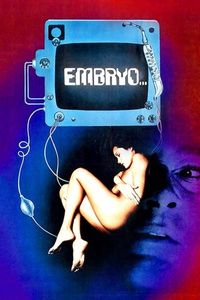
    (On Cable TV, July 2021) Once, just once, I’d like to see a film about the artificial creation of humans that wouldn’t result in the creation turning homicidal. But Embryo is largely a blunt-force horror film and that’s what creatures do in horror films. Rock Hudson (!) stars as a grieving veterinarian who, through the first act, comes to manipulate a human embryo with a fast growth serum. Moments later, here grows a young woman played by Barbara Carrera, not only a beauty but also a genius-level intellect beating chess champions and a psychopath willing to kill in order to prevent her cellular decay. It predictably escalates from there. It’s all quite familiar, although there it has a 1970s atmosphere that almost makes it interesting. I could easily see a triple bill of this, Coma and Demon Seed for a 1970s medical science fiction/horror marathon. Hudson is not bad and neither is Carrera — with small roles for Diane Ladd and Roddy McDowall as a bonus. Embryo’s turn to horror is cheap and predictable, though, and the “don’t play God” moralism is as basic as it comes.

  • I’m No Angel (1933)

    I’m No Angel (1933)

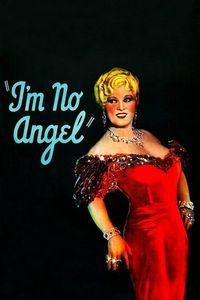
    (On Cable TV, July 2021) There are star vehicles, and then there’s I’m No Angel featuring Mae West — few other films have been shaped so thoroughly by the personality of their lead actress. Some context may be useful to understand why: Mae West got to Hollywood rather late at nearly 40, but with a fully formed stage persona from bawdy performances in New York City. She had the good fortune of making her entry in movies during the very brief period of time, the Pre-Code era, where Hollywood was testing the limits of what audiences were willing to embrace in terms of risqué content. Already an accomplished writer and an independent-minded performer, it made sense for West to make her own movies, especially as producers were courting her commercial potential. Hence I’m No Angel, a film in which Mae West, in full Mae West persona, is the centre of attraction as she dispenses her brand of saucy dialogue, has other characters fawn about her, and is unquestionably the one who’s always right. It’s a measure of her star power that you can add, “Oh, and Cary Grant is also in the film” as an honest afterthought. As a Pre-Code film, it’s probably the purest capture of Mae West’s stage persona, more so than She Done Him Wrong. (Indeed, I’m No Angel was one of the movies that was used as justification for the Production Code that started to infantilize American cinema the following year.)  It helps that West is indeed an intriguing character — she may not strike twenty-first century viewers as a remarkable beauty, but the attitude is still impressive in its own right. The truth about star vehicle is that some of them are amply justified.

  • Come Live with Me (1941)

    Come Live with Me (1941)

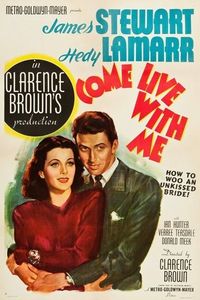
    (On Cable TV, July 2021) The casting in Come Live with Me is enough to make any classic Hollywood cinephile perk up — Hedy Lamarr and James Stewart in a romantic comedy? Well, yes — she plays a refugee with citizenship issues, and he plays a single writer in search of inspiration. It’s a match made in citizenship application heaven, and he gets enough inspiration to write a book about their non-romance. It’s all complicated by some adultery (surprisingly enough for 1941), but the key driver of the last act is Stewart saying with his usual aw-shucks “Now, it’s perfectly all right for two strangers to get married; they’ve got to know each other before they get divorced!” Blending screwball comedy of remarriage with a far lower-octane style of romance, Come Live with Me is nowhere near any top tier of film — but it has Lamarr looking beautiful, Stewart ably playing a romantic lead at the height of this romantic-premier era, and that’s more than enough to check off the essential boxes of what the film must deliver.

  • The Killers (1964)

    The Killers (1964)

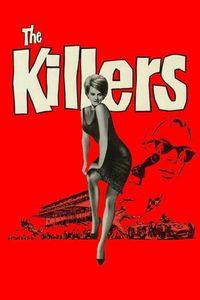
    (On Cable TV, July 2021) As far as remakes of classic movies go, this 1964 take on The Killers has the right idea — take an intriguing premise, develop it in a different direction and throw in a decent amount of talent behind and in front of the camera. The original is good in a classic noir mould, but this remake aptly adapts the story to the sixties: colour cinematography, far more permissive attitudes toward sex and violence, and a lingering amorality that is best exemplified in how the killers become the protagonists moving the story — resulting in what some call the first film of the neo-noir era. Directed by Don Siegel, a veteran filmmaker who would go on to become one of Clint Eastwood’s favourite directors, The Killers is capably handled throughout, especially during its rather overlong pit-stop in the world of professional racing. But it’s the casting that still gets some attention — Lee Marvin is quite impressive as the lead killer, but it’s Ronald Reagan who entertains the most in his last and only villainous role, slapping his moll and gleefully saying, “I approve of larceny” — unlike earlier performances, he here looks enough like his 1980s image that it’s even funnier. It all wraps up into an overlong but entertaining thriller with some great 1960s period detail. As far as remakes go, I approve of this take on The Killers: different enough to be entertaining even when you know where it’s going.

  • Growing the Big One (2010)

    Growing the Big One (2010)

    (On Cable TV, July 2021) I’ll admit it — Growing the Big One ground me down. It’s obvious even from the short TV Guide blurb that it’s a low-budget Hallmark movie, and I normally wouldn’t be interested. But it kept showing up on Cable TV channels — being an innocuous Canadian production, it’s a boon for channel programmers looking for some of those sweet CanCon credits, and that probably explains why it still regularly shows up on listings more than a decade after production. Upon seeing it show up once again, I sighed, recorded and watched knowing that I would finally be able to start ignoring it again. Predictably enough, there aren’t many surprises in the result: faithfully following the now-famous formula of Hallmark holiday movies, Growing the Big One follows a career woman (played by Shannen Doherty) as she heads back to a small town, gets her hands dirty in the community (in this case, growing a gigantic pumpkin) and finds the love of a bland but good man. It plays according to the usual beats, protecting sensitive audiences from being surprised at anything. The pumpkin-growing aspect could have been interesting, but it’s handled with twee romanticism that prevents any interesting details from being highlighted — I would love for an engineering-minded film to take on the same subject, just to see the difference. The narrative contrivances, stock characters and formula-driven plotting do lead to something mildly entertaining — by playing it safe all the way, the film ends up with something that few will deem bad… but this is really not a film meant to stick in mind as anything but “that pumpkin-growing movie.”  At least I’ve seen it, so Growing the Big One will release its hold on me.

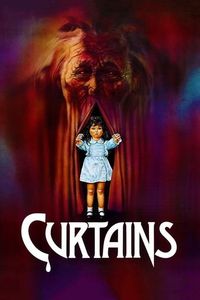
  • Curtains (1983)

    Curtains (1983)

    (On Cable TV, July 2021) By 1983, the first wave of slasher horror movies was already on the decline — overexposed and repetitive, the genre was clearly going through all sorts of permutations in a feeble attempt to freshen an already stale and limited genre. So, it’s not that much of a surprise to find something like Curtains coming out at that time — an attempt to set a slasher in the world of acting, and blend in some ironic comedy based on the theatrical world. The plot, so to speak, has six actresses competing for a role at a director’s mansion and, obviously, being killed one by one. Conceptually, Curtains is slightly more ambitious than an average slasher — it’s aimed at slightly older audiences, thematically tries to make parallels between the auditioning process and the accumulating deaths, and even tweaks the usual lone-killer formula. But it’s still a slasher, and the film’s higher ambitions tripped on a famously troubled production that led to the film being shot months apart in two halves (referred to as “Acts” in the closing credits) by two directors: Richard Ciupka and then producer Peter R. Simpson. Still, even if all of this weirdness behind and in front of the camera may be more intriguing than the average slasher, it still fails to deliver a better result — Curtains is still about women being graphically killed in a nonsensical plot, and there’s a hard limit to how enjoyable variations on the same tripe can be.

  • The Caller (1987)

    The Caller (1987)

    (On Cable TV, July 2021) The life of an avid cinephile is not always fun — watch too many bad movies in a row, and you’ll start wondering why this is the hobby you’ve chosen. As you make your way out of the list of classics and start working on the rest, you’ll start fearing that you’ve seen all there is to see — that the future is going to be a parade of similar plots, clichés, undistinguishable characters and few surprises. But then there are movies like The Caller to give us hope all over again. To be clear, The Caller is not a big or perfect movie: It’s very nearly a theatrical piece, chiefly concerned with an elaborate cat-and-mouse verbal joust between a woman living alone in a house and a mysterious stranger who intrudes upon her life during one evening. It doesn’t take all that much time for a mysterious fog to permeate the film — the way the two speak to each other is not normal, and there’s clearly more than we’re seeing to their relationship. They overtly speak of murder and give each other points for seeing through their deception. The following day, their intricate dance continues with even more unexplainable exchanges and abnormal behaviour. It’s all compelling stuff, and the repartee here is quite good. The cast is minimal, but Malcolm McDowell brings his usual menace to the role, while Madolyn Smith looks beautiful and gives as good as she gets in the dialogue. You can keep guessing throughout the entire film (I still like my theory of this being extreme role-playing between a kinky couple), but I almost guarantee that when the finale hits, you’ll be still be amazed at it all. Now, I don’t think that the film makes a whole lot of sense when you factor in the conclusion, but there’s a lot more to it than the twist, and even knowing the twist is not enough to distract from the enjoyable moment-by-moment acting joust. The Caller may not even be a particularly good movie but it’s something rarer: a surprise, an original and a reassurance that the world of film is vast and will always contain something new.

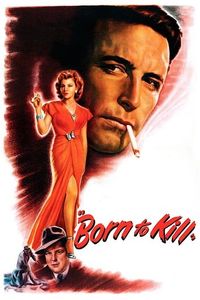
  • Born to Kill (1947)

    Born to Kill (1947)

    (On Cable TV, July 2021) As Eddie Muller pointed out in his TCM Noir Alley introduction to Born to Kill, there’s a fantastic gender-flip at the heart of the film—Lawrence Tierney playing a cold-blooded killer corrupting two good (?) women on his way to more power, and mercilessly eliminating the obstacles in his way. Even by the standards of film noir, Born to Kill plays rough — the body count accumulates, no one gets what they wanted and there’s a clear air of moral decrepitude over the entire thing. (Contemporary accounts of the film reveal negative aghast reviews, successful efforts to ban the film from further distribution, and the film being used in the defence of a young man accused of murder —further evidence that nothing is new under the sun.)  While Tierney gets the lead role and Claire Trevor does her best to follow him into crime, my favourite character is probably the Private Investigator played by Walter Slezak as a jovial but amoral force of chaos with an impact on nearly everyone. Director Robert Wise ended up with a chameleonic career following his debut here — but I don’t think any of his later films were as gleefully dark as this one. For jaded twenty-first century viewers, Born to Kill amounts to a nice period piece that narratively goes from Reno to San Francisco, but thematically delves deeper and deeper into darkness with the stylish flair of classic noir.

  • Time for Ilhan (2018)

    Time for Ilhan (2018)

    (On TV, July 2021) Like many Canadians, I’ve been following Ilhan Omar’s career ever since she got elected to the US Chamber of Representatives in 2018. In an American landscape often divided between the right, far-right and moronic-right, it’s refreshing to see someone espouse values more similar to Canada than the usual American rhetoric. For a representative of a Minnesota district, she’s an incredibly visible politician for at least two reasons: First, as a transformative candidate (“The first Somali-American Muslim woman to be elected for state office in America”), she has become an obsession for the crazy-right wing. For another, she does have a history of making statements that go outside American orthodoxy and can be twisted into something enraging to, again, the crazy-right wing. (In Canada, she would be a fairly average NDP candidate.)  She’s a very interesting figure, and I welcome the thought that she’s going to remain part of the political landscape for a while — although time will tell the kind of legacy she’ll accumulate. In any case, Time for Ilhan takes us back to the 2016 campaign, in which she ran for a state district seat in Minnesota, facing long odds by going against an incumbent of 43 years. Much of filmmaker Norah Shapiro’s film is a pure campaign documentary, deep down in the trenches of local politics as she vies for the primary nomination and relies on a small campaign crew. This is not a documentary about her election to national office in 2018, but it’s a really good insight into her character. She does come across as charismatic, intelligent and empathetic — the obstacles along her way are clearly outlined, so the entire thing becomes an uplifting story of overcoming formidable odds. Some of the politics get rowdy, and even more so after her election as a crazy-right-wing smear campaign marks her as a figure of national interest. The 2016 election obviously has wider resonance considering the outcome of the presidential race, but the film ends with a kaleidoscope of non-traditional candidates running and winning elections, gradually shifting the American political landscape. Barely three years old, the documentary is already being left behind by subsequent history: Since its release, Omar has gone to national office, divorced, remarried for a third time, been the target of racist attacks by a sitting American president and said very many things (not all of them smart) that have led to right-wing outrage, while the third candidate in the 2016 democratic primary that she won later replaced her as state representative. (If you’re feeling that everything is on fast-forward: Yes.)  So do take a few minutes after Time for Ilhan to update yourself on what’s happening with her — we’ll probably get a follow-up documentary at some point.

  • La loi du nord [The Law of the North] (1939)

    La loi du nord [The Law of the North] (1939)

    (On Cable TV, July 2021) Following a viewing of Canadian Pacific immediately by a look at La loi du nord was probably a mistake, as it gave me a double dose of Canadian cultural appropriation by two different cultural hegemons: late-1940s Hollywood western clichés in the first case, late-1930s French exoticism in the other. Keep in mind that Canada occupies a strange place in the French-European imagination — often a wild frontier compared to the rigidity of French society, sometimes a gateway to the American continent, except in accented French. French-Europeans still consider French-Americans as cute colonials with a funny patois (I’ll tell you about my Paris trip some other day) and you don’t have to scratch deep to find hilarious misconceptions, such as igloos being a common type of dwelling in Quebec. As bad as those clichés are, they were far worse in the 1930s, and La loi du Nord clearly plays with those ideas. The plot has something to do with a New York businessman murdering his wife’s lover and escaping to the wilds of Canada, but viewers on this side of the Atlantic are likely to be more fascinated by how the country is portrayed by the European filmmakers (director Jacques Feyder being of Belgian origins). Perhaps the most interesting thing about the film is that it features no French-Canadian accent and some curiously atypical mountains — something explained by how the film features only European actors… and was shot in Scandinavia. Eh. Plotwise, much of the film serves as a tragic romance between the belle of the film and three different suitors, with a rather tragic ending. Even in dispassionately looking at the film without commentary on Canadian cultural appropriation, it’s really not a great, and probably not even a good film — La loi du Nord tepid, badly justified and even more badly paced. But it’s good for a laugh or two.

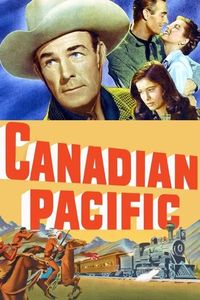
  • Canadian Pacific (1949)

    Canadian Pacific (1949)

    (On Cable TV, July 2021) The nice thing about the cultural appropriation debate is that unless you’re a white male Los Angeles-based filmmaker (and even then…), I can guarantee you that there’s at least one movie out there that takes your culture and gets it wrong. Even Canadians, so undistinguishable from Hollywood types as to silently invade their ranks, can point to a rather remarkable body of work from major studios treating Canadian history in weird and inappropriate ways. The Rose-Marie films (especially the first one) remain among the worst of those Hollywood-takes-on-Canada films, but Canadian Pacific does have a loopiness of its own. Never an attempt to create a Canadian western, it’s more like the screenwriter got hold of a children’s Canadian history book and thought it would make a different first act to an otherwise unremarkable western. Never mind the history of the Canadian Pacific Railway — an entire set of Canadian values are quickly thrown overboard as our hero (Randolph Scott) shoots down trappers, “Indians” (no relation with First Nations; all relations to Hollywood racist clichés) and fur monopolists and you’ve got the usual Western tropes playing out north of the border. The lower-cost colour cinematography (in Cinecolor, whose investigation will take you down a rabbit hole of alternative colour systems) does better justice to authentic Canadian landscapes than a black-and-white version would have. Alas, by the time the film gets down to business once it’s done explaining how Canadians are so different from Americans, it quickly becomes a very ordinary western, whose lack of qualities makes cultural appropriation even worse. Canadian Pacific may be worth a few laughs, but those laughs quickly stop once it starts portraying First Nations people as cruel and childish — get that out of here. I do believe that there’s a great movie to be made about how Canada united itself through two contiguous steel tracks — but it’s going to be made in Canada, and it will reflect the values of this nation rather than the dubious ones of another.

  • Dream Lover (1986)

    Dream Lover (1986)

    (On Cable TV, July 2021) There are times when, as a film’s credits roll, I have to remind myself of why I wanted to watch it in the first place. Was it the premise? The lead actor? Some kind of weird filmographic project I’ve latched on? Not surprisingly, these kinds of questions usually emerge at the end of a very specific category of bad movies — those so insignificant that their reason for existing is unclear. In Dream Lover’s case, the end credits answered my question — this is a film from well-regarded Alan J. Pakula, whose 1970s paranoia trilogy (Klute, The Parallax View and All the President’s Men) remains a classic. But while Pakula scored a few hits through a nearly thirty-year career as a director, his filmography is not consistent, and Dream Lover is probably going to end up in his lowest tier by the time I’ll be done with his filmography. As suggested by the title, this is a film that deals heavily in dreams as plot devices, which (to seasoned filmgoers) means that it’s not going to make a single shred of sense. Indeed, as our heroine dreams of killing someone and being abused, the film goes so often for shocking dream sequences that viewer interest disappears maybe a third of the way through: when anything and everything can happen, when dubious pseudo-psychiatry justifications are used instead of narrative logic, Dream Lover becomes more grating and overlong even at 104 minutes. The script was written by the film’s producer, which is seldom good news — without narrative oversight, it careens from one fantasy sequence to another. I’m not fundamentally opposed to dreamlike films — I mean, there’s Inception and Dreamscape and much smaller films like the audacious (if not entirely successful) Canadian title Come True. But those better movies have some energy, wit and imagery to them, and Dream Lover doesn’t. It’s just one thing after another until we’re done, and very little of it sticks despite the potential of the premise. It comes across as substandard de Palma except without, well, anything that made de Palma so revered. On the upside, there’s now one less Pakula film on my list of films to watch, although if the remaining ones are all at the same level, I’m not going to have a good time.