Travel: Maritimes 2025
Another summer, another road trip—but longer, farther and more ambitious than in previous years.
July 2025 was another good time to hit the road and go visit parts unknown. But the way there was rockier than expected.
For one thing, this wasn’t the July 2025 trip we were planning a year earlier. Following our successful week in and around Boston in July 2024, our plan was to return to Boston, then follow it up with a long weekend in New York City a few weeks later. That plan gradually became untenable, as the American government became overtly hostile to Canada throughout 2025, all the way to declaring economic war on my country. In between resurgent patriotism and increasingly grim news coming every week about border crossings, we abandoned any plans of going south of the border for the foreseeable future. (A good thing too—by the time July 2025 came around, the United States was imprisoning Canadians and had opened its first concentration camp.)
Which meant one logical destination within driving distance—the Maritimes! (Going west is only a good idea if you’re ready to drive two full days west of Toronto to get to the Prairies.) Often marginalized, the Eastern provinces are nonetheless a destination filled with natural highlights and historical depth. Not that the plan was easy to wrangle—in trying to match holidays with my sister and her family, there was some give and take: My plan to drive to all four Maritime capitals in a week was nixed by everyone as too exhausting (including my teenage daughter, henceforth referred to as “Junior Navigator”), whereas their plan to spend many days at the beach was far too sedate for me. Hence a compromise of sorts: My sister’s lackadaisical holidays would begin before ours; Junior Navigator and I would join them for the middle portion of their holidays; and they would head home after us. During our time with my sister’s family, Junior Navigator would spend more sedate holidays with them, while I would do extensive day trips largely by myself. Two cars, two drivers, one plan! (…and one ulterior motive I’ll discuss in the conclusion of this travel report.)
But there was an element of suspense as to whether this was a workable plan at all, as my thirteen-year-old car began showing its age in the weeks leading to the holidays. Just as I was planning on getting the car to the garage for an inspection in the week before the planned holidays, one of my afternoon commutes turned unusually exciting when my car’s serpentine belt snapped and I had to nurse the car over three kilometres and three rolling stops to make it home. (But at least I got plenty of reading material along the way as the car kept throwing a rapid succession of error messages I had never seen before.) One towing trip, two garage appointments and a four-figure repair bill later, the car was ready for the holidays… maybe.
But what’s a holiday without at least a little frisson of something maybe going wrong?
Day One—Thursday, July 10—From Ottawa to Rivière du Loup
Our first day began with some excitement at 9:00, as stopping for gas at the corner service station established that I had left my credit card at home. Lucky in my unluckiness, I paid cash and quickly headed back home to retrieve the crucial piece of plastic. Two lessons here: don’t put the credit card in an unusual place during trip preparations, and make sure to stop nearby for a full tank of gas.
From a strict tourism perspective, there is very little to say about this first day spent driving from Ottawa to Rivière-du-Loup—this was almost entirely familiar territory for us, as I have often driven from Ottawa to Montréal, Trois-Rivières and Québec. We have our familiar stops and our regular haunts; we know where the restaurants are; we have seen the sights many times. Oh, there’s often something new (the thing-to-watch over the past year has been the expansion of Autoroute 50 near Mirabel to a four-lane highway) but otherwise this is very familiar territory for us. Our first stop was, as usual when on our way to Québec/Lévis, three hours into the trip in restaurant-rich Berthierville for lunch—although this year we let go of our A&W standby to get lunch at La Belle Province. While I was scarfing down smoked meat Poutine and Junior Navigator ate a cheeseburger, she decided that she would eat something different at every meal of the trip.
But despite having often driven it, the day’s road was not completely known to us. One unusual thing for this trip was our GPS suggesting a route through small country road rather than the 640/40 junction east of Montréal. Considering how much I dislike that terrible junction and the measly 250 m you get to make a crucial merge, I shrugged and took the detour—it wasn’t that much more pleasant to follow a convoy of slow cars, but at least it was different. The other unusual wrinkle was to switch from Autoroute 40 (north of the Saint-Lawrence) to Autoroute 20 (south of the river) by driving the often-seen but never-taken Pont Laviolette and Autoroute 55. There too, some work is taking place to expand the segment to a four-lane highway near the 20 Junction. (Alas, the jeep in front of us was so fascinated by the work that they slowed twenty kilometres under the speed limit while gesticulating all the while.)
The other unknown was venturing east past Lévis. While I had once attended a robotics summer camp in La Pocatière as a high-schooler, my adult driving had never gone significantly past Lévis, so the stretch of highway from Lévis to Rivière du Loup was brand-new. Unfortunately, while you would think that nearly two hundred kilometres of unfamiliar road would have something interesting to show… you’d be wrong. The way east of Lévis is very, very dull—straight, largely surrounded by trees, with occasional glimpses of the Saint Laurent barely visible at car height. There are no significant cities or landmarks (even La Pocatière is far away up the hill) and besides two bare-bones rest stops, there isn’t much to see. It’s not ugly, it’s just boring. Even the ever-present construction doesn’t bring much excitement.
This dull stretch of road clearly combined with a too-aggressive driving schedule made me unusually tired by the time Lévis rolled past. Our second stop, five hours into the trip, was at one of those bare-bones rest stops to scarf down some snacks, walk around and see from my weather application that we were heading right into a storm. The rain briefly enlivened things along the way, but otherwise… it’s just not an exciting road.
After some 640 kilometres, we rolled into Rivière du Loup at 4:30 p.m. and checked in at L’Universel, one of Rivière du Loup’s most prominent hotels—which says something considering that roughly a fifth of the city seems to be a hotel, motel, inn or some other resting place. You need to understand that Rivière du Loup’s primary reason to exist, especially in the summer, is being a way station between Montréal/Québec City and destinations eastward, whether we’re talking about La Gaspésie or the Maritimes: Tripadvisor lists 54 places to stay in a city of 20,000 people, which is a lot. It’s an ideal place to stop for the night considering that it’s at the edge of a normal family’s endurance for a day spent driving from Montréal, and it’s at the junction of the Trans-Canadian highway leading from Québec to New Brunswick. (Amusingly, Rivière du Loup is the only Canadian city to have been struck by an American nuclear bomb.)
L’hotel Universel is very favourably located at the western edge of the town, which makes it unusually accessible for anyone driving down the Trans-Canadian Highway. It’s a slightly old-school hotel that wants to keep all visiting families inside its walls for their overnight stay: It’s got an expansive restaurant, a full spa, a gym, a big indoors pool with water slide, a basement arcade, a launderette, conference space to host events and a confusing floor plan that betrays several rounds of expansion. The rooms are serviceable, and having so many amenities means that you can easily waste half an hour just looking around and playing a few games in the arcade (as Junior Navigator and I did).
Still, we had enough time to spare for a visit in Rivière du Loup itself. While my description of the city can seem dismissive so far, there are a few great things to visit if you’re on your way to somewhere else. Junior Navigator consulted a map of the city and we headed to, in succession:
- The Parc de la Croix, which offers a great view of the city from its upper portion. (Rivière du Loup very distinctly has a lower section and an upper section.)
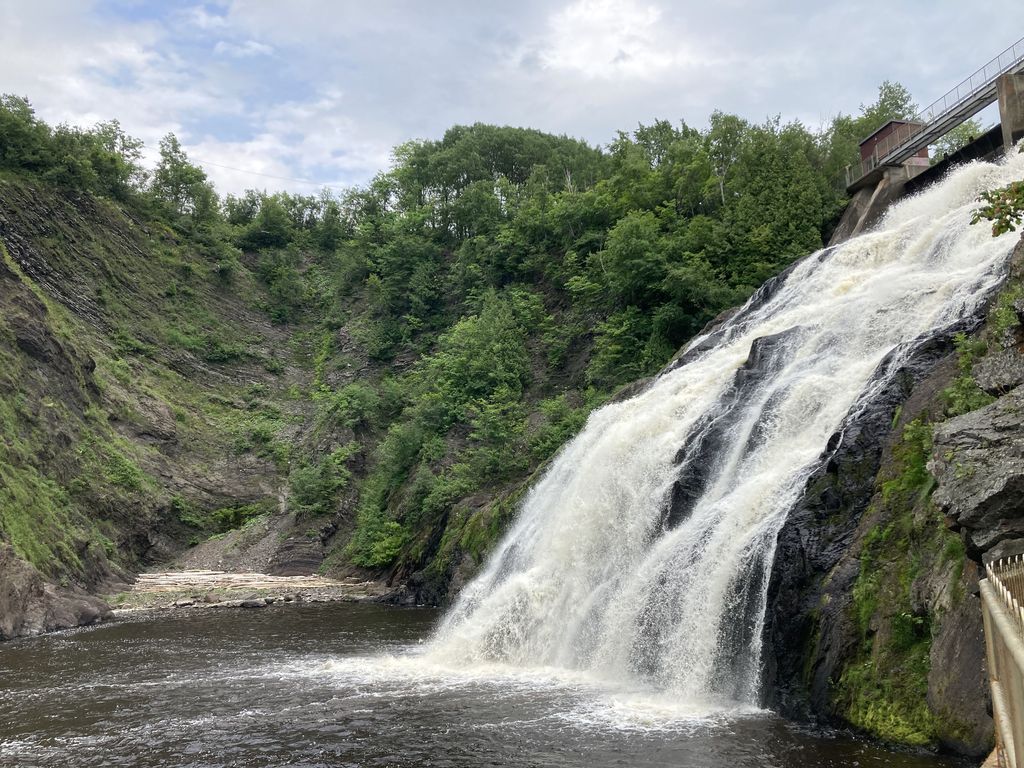
- The Parc des Chutes, which gives a great view of the titular River’s main 33-meter falls. The park is far, far bigger than just the falls, but we didn’t have the time or patience to walk through its 9 kilometres of hiking trails. Warning: As of July 2025, Waze does not know where that park is and will instead take you into the vicinity of the Parc de la Croix. Try “Centrale de Rivière-du-Loup” instead.
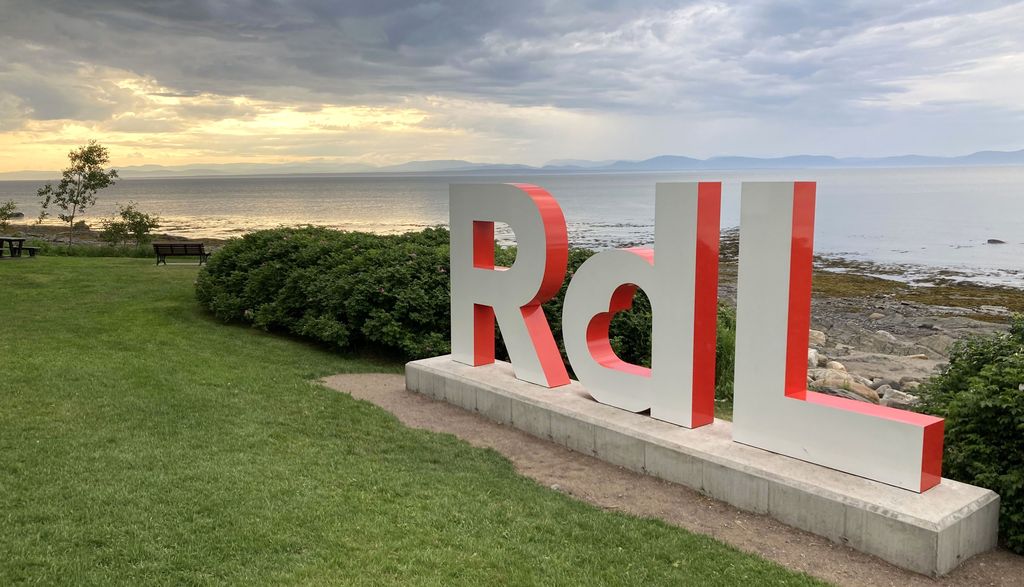
- Finally, the best for last: The Parc de la Pointe, which offers a spectacular view of the Saint Laurent, and plenty of opportunities to walk the waterfront and take in the washed-up seaweeds, smoothed rocks and strange river-shaped formations. It’s also where you’ll find the photo-magnetic “RdL” installation.
Along the way, we drove through Rue Lafontaine, Rivière du Loup’s old commercial strip filled with quaint boutiques and small restaurants. Then there’s the other main strip: Boulevard the l’Hotel de Ville, which (especially in its west end) has the expected Canadian Tire, Groceries and Walmart you could expect from a layover city. While I had heard about Walmart’s policy of allowing RVs to stay overnight in its parking lot, I had never seen such an eloquent demonstration of this practice before Rivière du Loup, as dozens of RVs gradually ate up the farther reaches for the parking lot while we stopped there to purchase the following day’s breakfast.
We ate supper at Dixie Lee, an Eastern-Canada regional chain restaurant that specializes in fried chicken. Not feeling the chicken thing, we ordered a cheese pizza and a sample platter of fried food and were… disappointed. It’s hard to screw up a pizza, but they did: the thing was a three-quarter crust with an anemic amount of cheese as a condiment. The fried food was slightly better, but the pizza left a bad impression, especially for the price. We did not stop at Dixie Lee again during our trip and, in fact, may never stop there ever again.
We went back to our hotel room shortly before dusk, and I briefly read before going to sleep fairly early. This would become a recurring theme during the trip: mindful of having to drive lengthy distances for several successive days, I did my best to go to sleep early as so to wake up gracefully and fully rested. Ironically, one of the books I brought along was Murray Carpenter’s Caffeinated, a non-fiction exploration of caffeine in 2014 America. I say “ironically” because I tend to avoid caffeine in my everyday life, with the exception of lengthy road trips like this one during which I dose my caffeine with near-scientific precision. The nice thing about consuming caffeine for a specific purpose is that it still produces an effect on relatively small doses: A can of Dr. Pepper consumed before noon will get me going until the evening, and still get me to sleep for a full eight hours. (And tapering off the caffeine over a few days after the trip means that I avoid most of the headache that comes with the withdrawal.) All of this to say that Dr. Pepper’s Blackberry variant was my late-morning drink throughout the trip.
But caffeine is morning stuff. Evening-wise, I was a good boy and went to sleep earlier than Junior Navigator did.
Day Two—Friday, July 11—From Rivière du Loup to Moncton
As would be the norm during the entire trip, we left the hotel at 9:00. This time, we headed south-east, on Autoroute 85. This stretch of the Trans-Canadian highway gradually gets into hillier terrain before reaching the Québec/New Brunswick border and becoming Highway 2 linking Edmundston, provincial capital Fredericton and our destination—Moncton.
As much as Autoroute 20 leading to Rivière du Loup is boring, Autoroute 85 leading to Edmundston is gradually exciting. The farmland gradually becomes hillier and before long you’re driving through sweeping vistas of the northern Appalachian Uplands. Adding further interest is a significant effort to keep large mammals away from the highway through a lengthy set of fences and tunnels under the highway. (As the sign says, “In case of intrusions, dial 511”) What’s also really interesting (not often positively, mind you) is that Autoroute 85 is currently being rebuilt to become a four-lane highway from beginning to end—an effort twenty years in the making. Evidence of roadwork is everywhere in the southern half of the leg to Edmundston and the last few remnants of the old road being replaced eloquently testify as to the necessity of this upgrade. Everything should be completed by late 2026.
Our arrival in New Brunswick was marked by a staid provincial sign welcoming us… and a very large sign announcing the presence of an Irving gas station, which is very funny if you’re aware of the saying that “Irving owns New Brunswick.” The landscape keeps being interesting well into New Brunswick, as Highway 2 (which is a four-lane road throughout the entire province) follows the St. John River until well after Fredericton. This, combined with the dwindling Appalachian uplands, means that the highway is often between mountain and river, with some very nice views along the way.
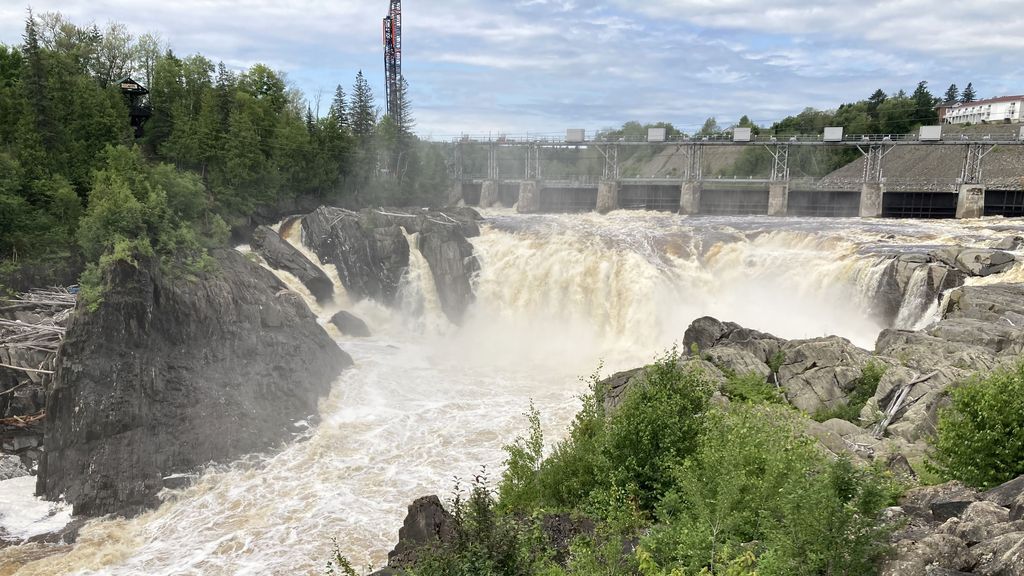
Our first stop of the day, after two hours of driving, was in Grand Falls. The original intention of this stop was resupplying at a large grocery store, but signs along the way convinced us to go take a look at the titular Grand Falls Visitor Centre and we were glad we did—the falls are spectacular enough, and they’re showcased from a very nice rest stop with expansive visitor information and a small gift shop.
After some more hilly driving, the mountainous landscaped tapered off gradually as we entered Canada’s “Potato County,” where a good chunk of Canada’s potatoes are grown. (Prince Edward Island, as we’ll see later, is a province famous for its potatoes, but this workhorse area of New Brunswick produces roughly 3/5 of PEI’s tuber output.) Many of the potatoes grown here are used in two famous Canadian brands—McCain fries and Covered Bridge Chips.
All of this was explained at our second stop of the day, in “French Fry Capital of the World” Florence-Bristol’s rather wonderful Potato World museum/restaurant, which combines education with fried potatoes. The museum is short and interesting, covering everything from the origins of the potatoes, its harvest and modern farming techniques. When you’re done educating yourself, stop by the restaurant for your choice of fries and seasonings. Junior Navigator had Outbacka Fries (Cheese and Bacon) while I had a very satisfying fully loaded Potato World Poutine. Don’t be afraid to order the small size—the portions are big. As of July 2025, the gift shop had souvenir shirts with a big honking typo praising its “Hertiage of Farming.” But awkward touches like those make these kinds of roadside stops worth it.
Our next stop in Waterville, Potato County, was more a pilgrimage than a tourist stop. Sometime during the pandemic, our local grocery store tentatively started carrying Covered Bridge chips. I was so taken by them that I ordered a big sampler box by mail, and have been a fan ever since. Let me put my cards on the table: Covered Bridge chips are the best on the market. They roast their Russet potatoes (with skins!) a bit darker than usual to give them a wonderfully more pronounced taste and their choice of seasonings is exceptional. In other words: I had to stop at their headquarters. Or rather what’s left of their headquarters: In 2024, a fire destroyed their main factory building and while production of the chips was outsourced (with no perceptible dip in quality), the publicly accessible portion of the company is currently a double set of trailers acting as a gift shop. They are rebuilding, though—the cashier described how the new facilities (to be completed in the next year) will include a restaurant, gift shop and factory tours. (I shared that in the Ottawa area, a fire similarly destroyed the St. Albert factory, but the rebuilt facility was better than ever with a restaurant, shop and self-guided tour area.)
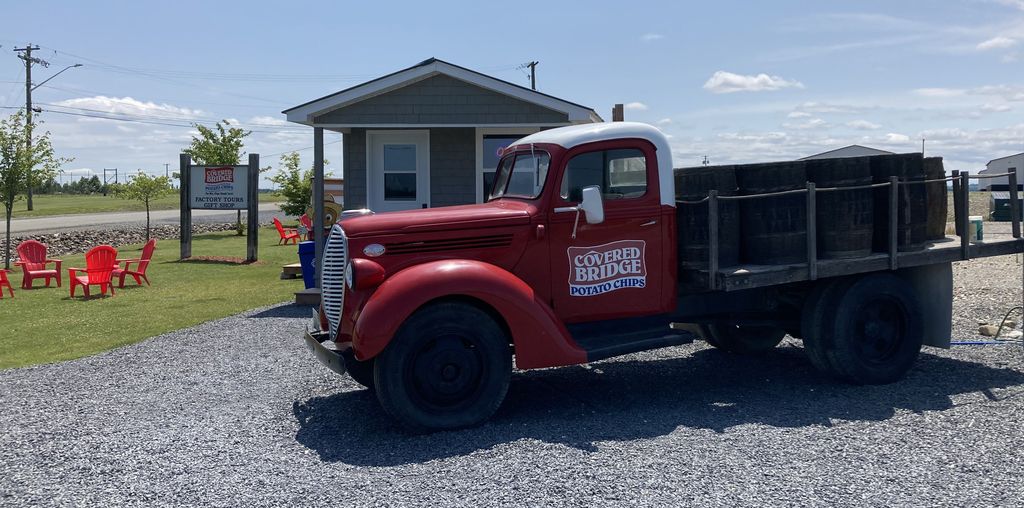
While the trailer doesn’t inspire much confidence from the outside, the inside is a full gift shop with all Covered Bridge varieties, plush mascots, various tchotchkes, and a chip bar allowing you to season plain chips to your taste. Constrained by the requirements of a road trip, I still brought back three bags of chips, a plush lobster with a Covered Bridge hoodie, a small bag of plain chips (worth eating by themselves) and a few photos.
While we were in the area, the presence of the “World’s Shortest Covered Bridge (24 feet)” at the Covered Bridge stop convinced me to drive the few kilometres to the “World’s Longest Covered Bridge (1282 feet / 390 metres)” in nearby Hartland, over the St. John River. We were lucky not to have to wait before driving into the one-lane bridge (which is admittedly cool to drive through), and our detour extended to making our way back to Highway 2 through the more modern bridge that complements the now-historical covered bridge.
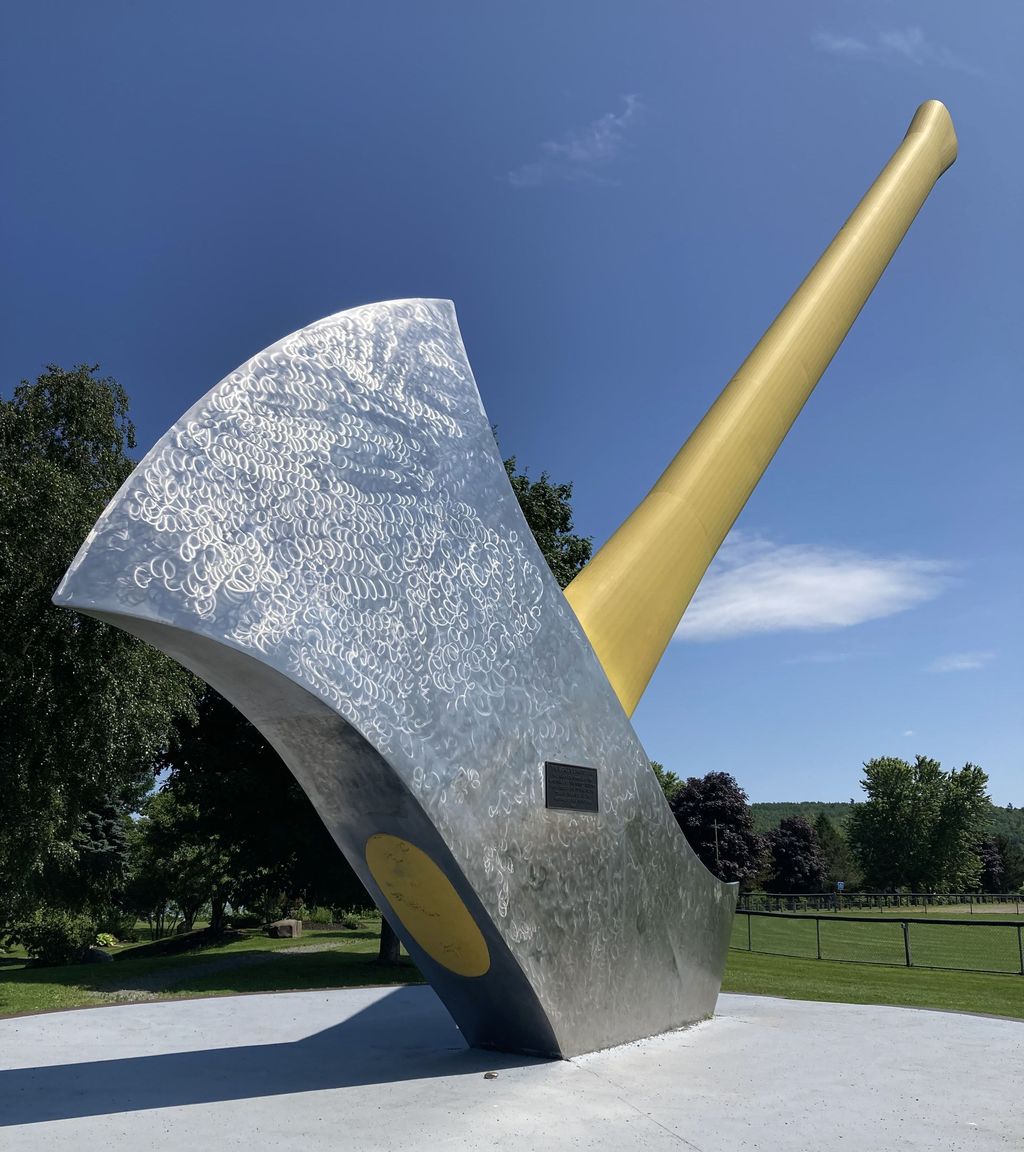
Slowly leaving Potato Country behind, we followed Route 2 as it changed direction along with the St. John River. Once the river bends to generally flow east rather than south, it leads to the provincial capital Fredericton’s metropolitan area. But before we could stop downtown, there was one more sightseeing opportunity: “Forestry Capital of Canada” Nackawic’s “World’s Largest Axe,” which is exactly what it says: A 15-meter-high axe sculpture and photo opportunity.
(Readers of this travel log will notice that we stopped at a few of “world’s biggest this-or-that” roadside attractions—this being the first time we drove through the Maritimes, I relied a lot on Large Roadside Attractions of Canada as a planning guide—not necessarily as destinations, but as stops whenever our itinerary came close to those attractions… after making sure to double-check in Google Maps Street view whether the attraction was worth the trouble.)
But if the axe is the attraction (and it is quite remarkable—unlike a lot of “big” roadside attractions, this one is actually big enough to impress), the park surrounding the axe is worth the small detour from route 2—it’s a perfectly serviceable rest area with washrooms, a small shop (I got ourselves two slushes), a great view of the river and a lot of parking space—the park is host to events such as the Big Axe Beer Festival, which was scheduled a day later and already in the advanced installation stage by the time we visited the park.
The only less-than-interesting part of stopping by the Axe is that the way to get there from Route 2 was slowed down by a bridge down to one lane due to construction, and two-way roads that feel much longer when you’re stuck behind a slow-moving RV.
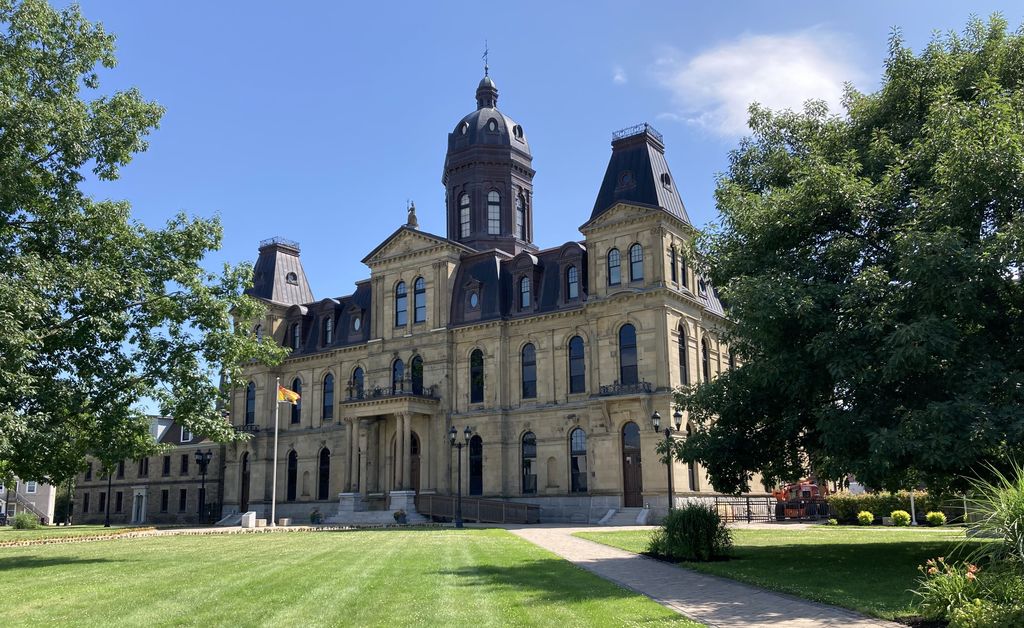
After a short break, we were back on Route 2 to the Provincial capital—Fredericton. Visiting the city was not on our list of things to do that day (I had pencilled it for the return trip), but we did head straight downtown for one quick photo opportunity—the provincial legislature, which happened to sit in the city’s densest area and gave us an excuse to walk around Fredericton’s most urban block before our parking meter ran out.
We had frequently stopped between Grand Falls and Fredericton, but the next stretch of the road was not so eventful—150-kilometre driving through the northern section of the Gagetown military base, crossing the St. John River and then driving through farmland and forest.
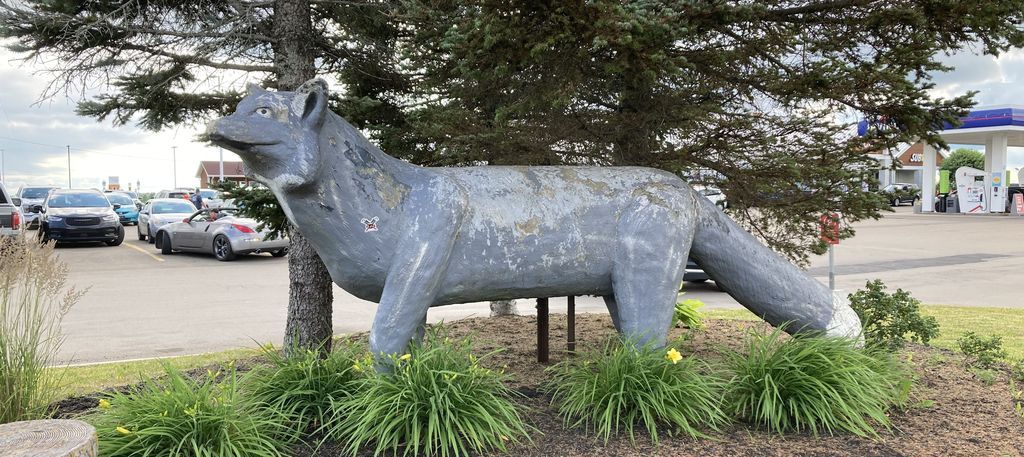
We had one last stop for the day before getting to Moncton—a gas-and-snack stop at Salisbury’s Big Stop rest stop. One of the many Irving everything-you-want-from-a-rest-stop throughout New Brunswick and elsewhere, the Silver Fox location was serviceable in all ways except one—the “World’s Largest Silver Fox” is a substantial disappointment—the pictures suggest a decent sculpture, but the reality is much uglier than pictured. At least there were enough snacks in the nearby Circle-K convenience store to make up for it.
After that, it was a short drive to our home base for the next four days—the Four Point Moncton, a relatively new (2015) hotel built just north of Moncton’s peripheral cluster of big stores and chain restaurants. The hotel itself isn’t that special, but it is comfortable and up to what we can expect from a vacation hotel. The location, on the other hand, was pretty good—we were within a few minutes’ drive of the Mapleton Shopping Area with plenty of familiar restaurants, grocery stores and shopping chains. After quickly surveying the hotel and meeting with the other half of the family, we all went to the nearby grocery store to purchase breakfast, then followed it up by supper at Kelseys. (Where, alas, a live singer made conversation near-impossible.)
After that: back to the hotel room and early sleep for me.
Day Three—Saturday, July 12—Moncton
Of the trip’s seven days, Day Three was the only one planned without a lengthy drive. The idea was to stay close and visit Moncton. (My own plans for extensive day trips being known, this was “the compromise day” with activities for the entire five-person crew.)
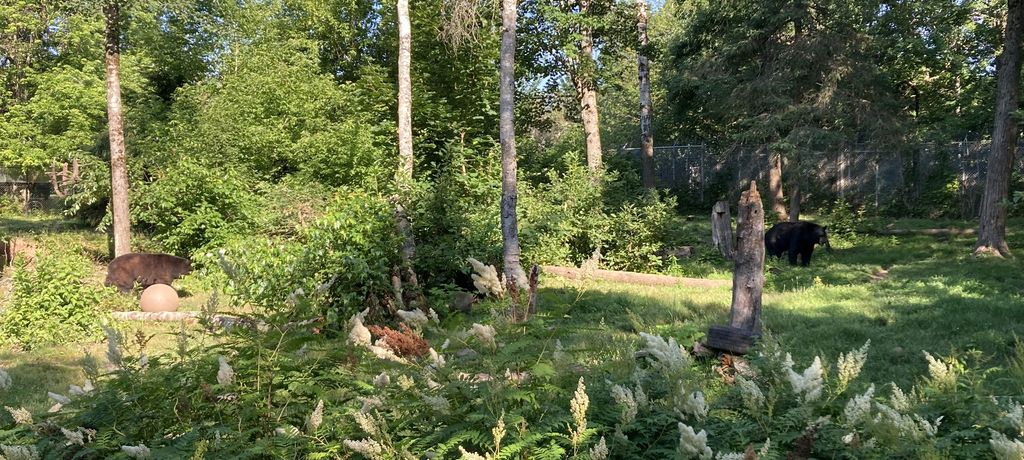
We started with a sure crowd pleaser—the Magnetic Hill Zoo, a small but very accessible zoo that features a surprising variety of animals. Not dissimilar to the Toronto Zoo but far easier to walk, the place wasn’t too crowded (yet). Considering that our past two visits to the Toronto Zoo had us skipping an entire area due to exhaustion and crowding, the Moncton Zoo does have a lot of charm. The junior navigators certainly enjoyed their visit, and we got a few good pictures along the way. The temperature was warm but not overly hot (another difference from Toronto!), and the animals looked well cared for. We were in-and-out in two hours without rushing anything.
Even though Moncton is famous for its “Magnetic Hill,” we skipped it — It was Saturday, and we weren’t looking forward to waiting in line. Plus, I had already seen the video. (The other Moncton highlight we missed due to bad scheduling was the Tidal Bore, and I’m more bitter about that one.)
Instead, we headed closer to downtown and Resugo Place. It’s an interesting building—it acts as a regional museum, an interactive play zone on Moncton’s transportation history, a temporary exhibition space (in summer 2025, dedicated to local street poet Gérald Leblanc—an oddly affectionate tribute), a visitor’s centre, a creativity space for kids and a gift shop for all of your Moncton-related shopping needs. Impressively enough, the inner entrance of the Moncton Museum section is the façade of the old City Hall, dismantled when the building was torn down and then meticulously reassembled. It’s all well worth a stop.
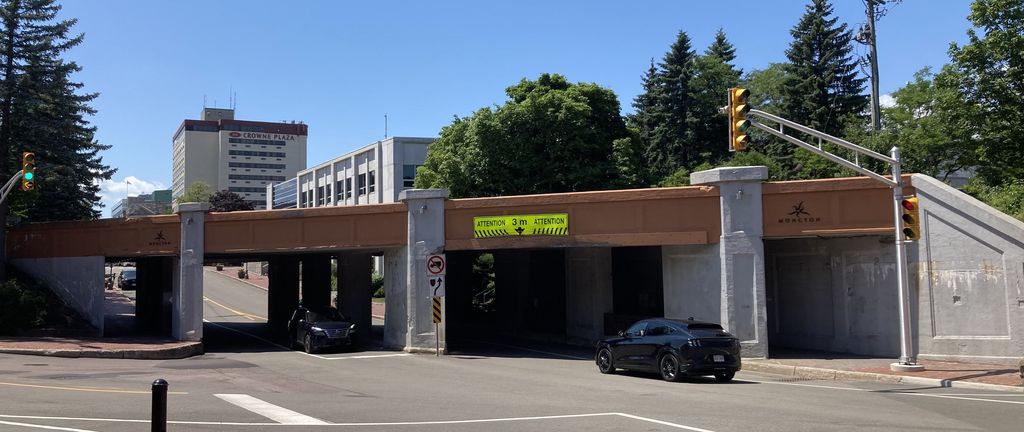
By the time we were done with Resurgo Place, it was high time to go explore something less high-minded. While the rest of the group headed for the nearby Champlain Place shopping centre, I took the opportunity to walk to Moncton’s Main Strip to take in the downtown core. I was hoping to catch the core of the weekend’s Atlantic Nationals car show, but that was due to not understanding the event’s schedule—while a vehicle display was planned for Main Street, it was for the evening—the main event during the day taking place at a park a fair distance from downtown. But don’t cry for me—the walk through the downtown core (from Assomption to the painted subway overpass) was fun by itself and worth the half-hour detour. Furthermore, exotic cars were a constant backdrop to our trip, whether it was driving throughout the city, or seeing so many interesting cars in the hotel parking lot every evening.
After that, I rejoined the rest of the family over at Champlain Place (technically in Dieppe rather than Moncton), using iPhone tracking functions to find them in the mall. There’s nothing much to say about the mall itself—it’s almost entirely undistinguishable from countless Canadian malls in terms of shops and style. But it was air-conditioned, familiar and I dropped a few dollars at the nearby bookstore for two discounted books, one of which I would complete before returning home.
By the time we were done, our day in Moncton was pushing late afternoon. It was time to head back to Mapleton and consider our options. We ate at East Side Mario’s and split up—the junior navigators heading back to the hotel with my sister, with my brother-in-law and me heading to the movie theatre to catch a showing of F1. (An event in itself—while going to the movie theatre was a twice-weekly thing for me during the 2000s, I’m down to one, maybe two theatrical experiences per year these days. There was considerable amusement and consternation from the family that, after turning down numerous opportunities to go to the movies with them in the past few months, I would pick F1-in-Moncton of all things. But, hey—if I’m going to the theatre, I want something big and spectacular and F1 fit the bill.)
Once the movie was over (I liked it!), it was time to go back to the hotel, read some more and go to sleep early. Tomorrow, after all, would be a long day alone on the road.
Day Four—Sunday, July 13—Prince Edward Island
By nine o’clock, I was back in the car—alone, as it turns out. My plan to visit Charlottetown was not greeted by any enthusiasm by anyone else, so I decided to do it alone—not that it was much of an imposition to anyone, considering that they were all gleefully headed to the beach, and I was just-as-gleefully looking forward to a solo road trip.
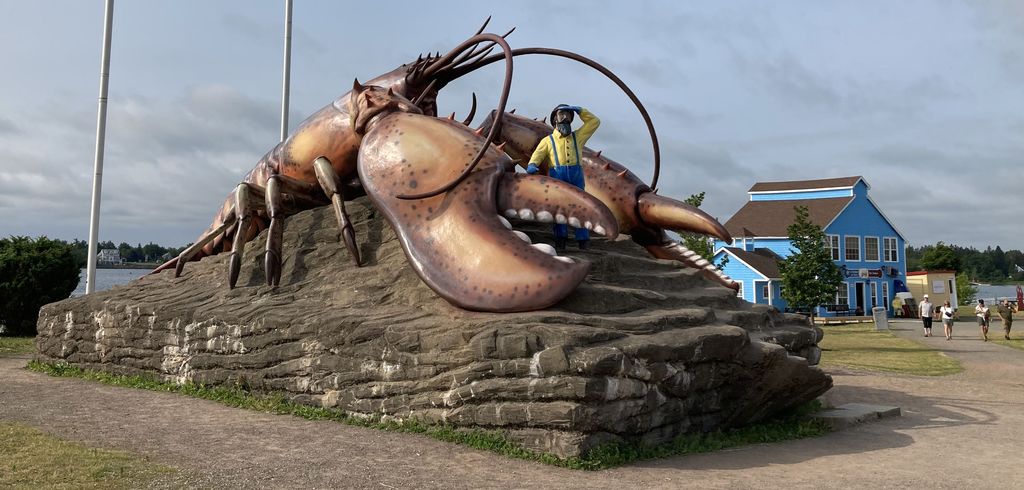
The way to Prince Edward Island did have one landmark or two along the way. By nine thirty, I was in Lobster Capital of the World Shediac, more specifically taking in the majesty of The World’s Largest Lobster—a 90-ton steel-and concrete installation featuring exactly what’s promised to passing tourists. The installation is beautifully set near a bridge, and has a full set of tourist amenities, including a visitor’s centre, washrooms, gift shop, ice cream vendors and such. Unmissable. (And indeed, the rest of the family would visit it an hour later on their way to the beach.)
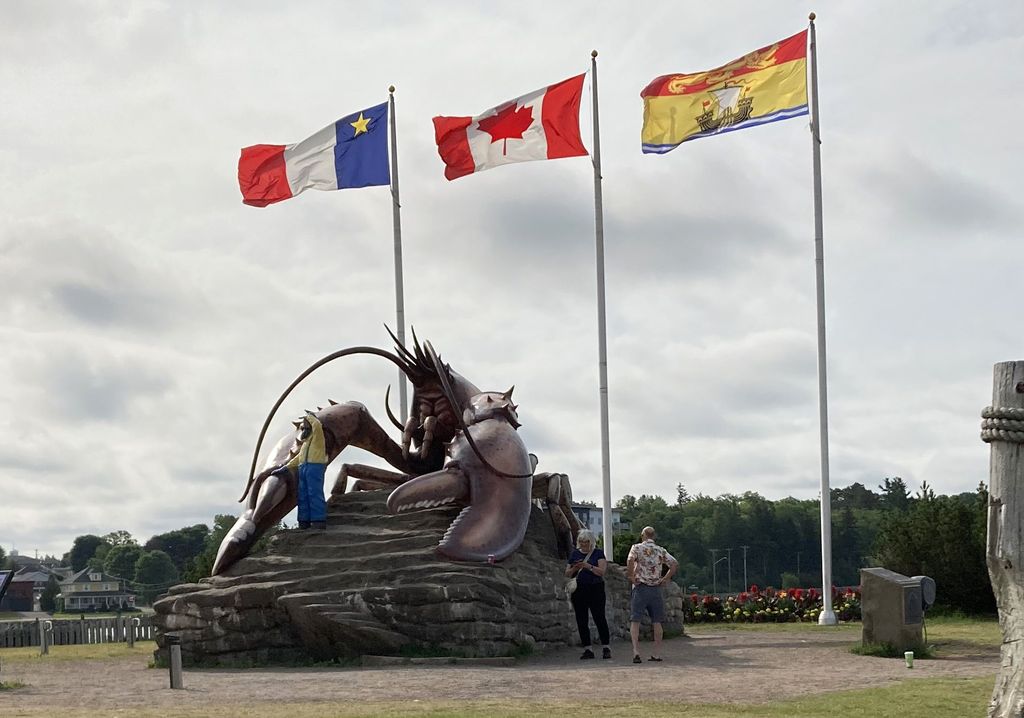
Of course, our visit to two of New Brunswick’s biggest roadside attractions raised the question: What would happen if the world’s biggest lobster met the world’s biggest axe? Would it result in a chopped-up lobster, or a fearsomely well-armed lobster?
But wait, there’s more to see in Shediac! Specifically, a large rooster sculpture on the other side of town—not quite unmissable, but a good excuse to drive through downtown and see just how the city loves its lobsters and how it never misses a chance to showcase it. There’s lobster imagery everywhere in case you missed the town’s biggest claim to fame.
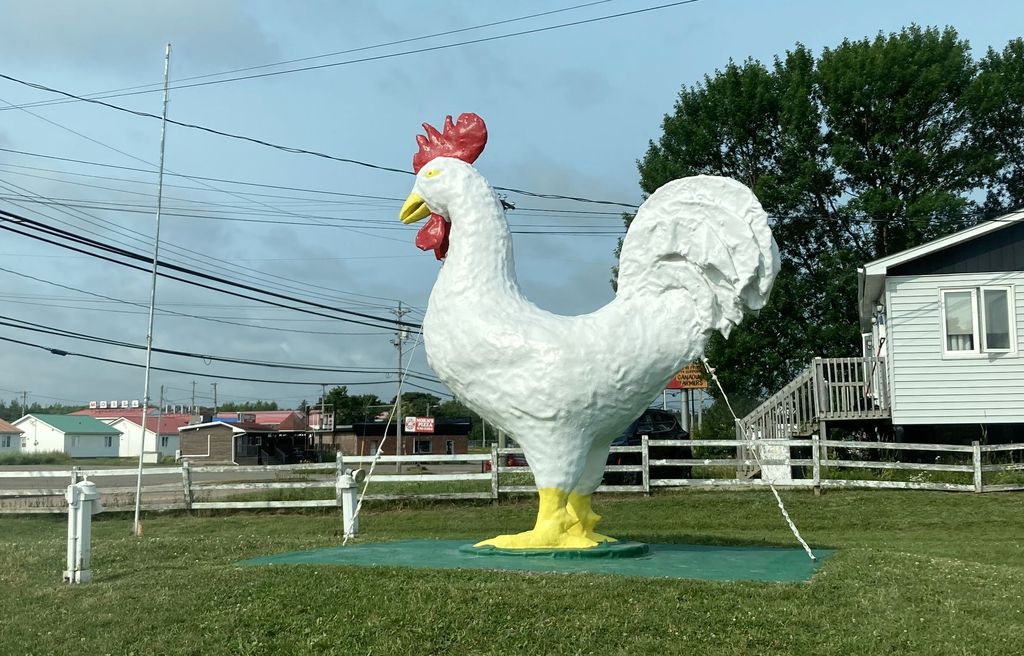
After that, it was a rather featureless drive to Confederation Bridge, through uneventful two-lane roads in rural country—although the big waving potato in front of Blue Roof Distiller was a welcome bit of levity and a portent of many more potatoes to come.
Then it was Confederation Bridge, one of Canada’s proudest achievements of recent decades. Built in the 1990s at a cost of one billion dollars, it’s a nearly thirteen-kilometre-long bridge that finally linked PEI to the mainland. You will pay for the privilege, though—coming back cost me $50.25, although the rate was lowered to $20 barely three weeks after I made my trip. The experience of driving the bridge is claustrophobic and exhilarating at once: it takes more than ten minutes to drive the two-lane bridge, but Prince Edward Island, barely glimpsed through blue haze at the beginning of the trip, gradually becomes more colourful and welcoming as you cross the bridge. In order to allow big ships to cross under the bridge, its middle section is raised and driving down that raised section gives a wonderful first view of the province.
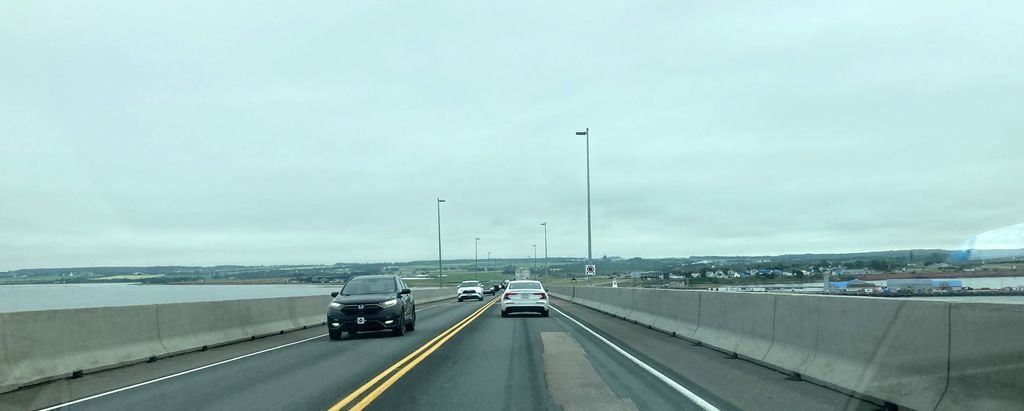
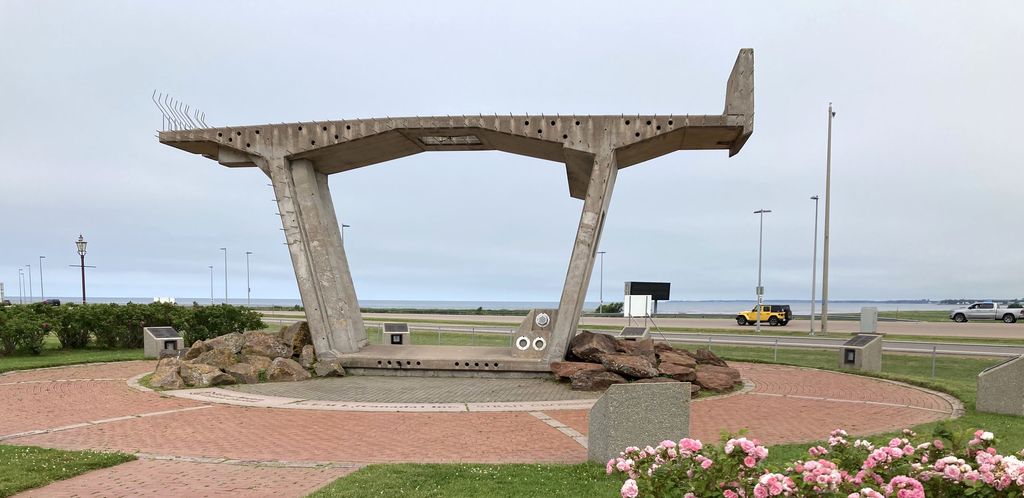
My first stop after the bridge was the Borden-Carleton Visitor Information Center, which feels like a small village specifically made for tourists, with its central visitor centre surrounded by a cluster of restaurants and gift shops. My interest in the place laid elsewhere: the Confederation Bridge Monument, which soberly tells about the construction of the bridge and features a scale replica (still big!) of the bridge’s girders. Engraved bricks set in the ground around the girder feature the names of those who built the bridge.
Then it was off to Charlottetown via Route 1. Amusingly, one of PEI’s most distinctive features was dramatically showcased early during the trip, at the exchange between the road leading to the bridge and Route 1 itself—a big chunk of the exchange was recently redone, and the freshly moved ground was bright red rather than dull brown. Thanks to a quirk of geography, much of PEI’s dirt is reddish due to high iron oxide (rust) and once you see it, it’s hard to avoid. Dusty cars in PEI are red, and the contrast often seen between the rows of potato plants and the red sand made the island look even greener.
PEI’s Highway One is often a two-lane highway going through small villages, so it’s useful to be patient on the way to Charlottetown. One unusual fixture was seeing NEW POTATOES signs at unattended roadside stands telling you that, for a modest amount left in a box, you can pick up freshly grown potatoes.
This being said, I did have one planned stop on my way to the capital: Car Life Museum, a roadside attraction roughly halfway between the Confederation Bridge and Charlottetown. It, frankly, looks terrible from the outside—directly accessible off the highway (just brake and roll into the red-dirt parking lot), it doesn’t have any of the polish you may associate with high-end museum. It feels like a big shed, and that’s because it is a big shed—albeit a big shed with some really interesting things in it.
What I was able to gather from the museum is this: A few decades ago, a PEI family known for repairing, racing, buying and selling cars decided to open a museum featuring their collection. And so Car Life is exactly what it looks like from the outside—a big shed in which they parked vehicles. The museum is one linear experience, as a central passageway takes you past bumper-to-bumper cars, then comes back to the entrance. Everything is dusty, the signs were visibly made over a period of several decades and everything has the musty charm of a cabinet of automotive curiosities.
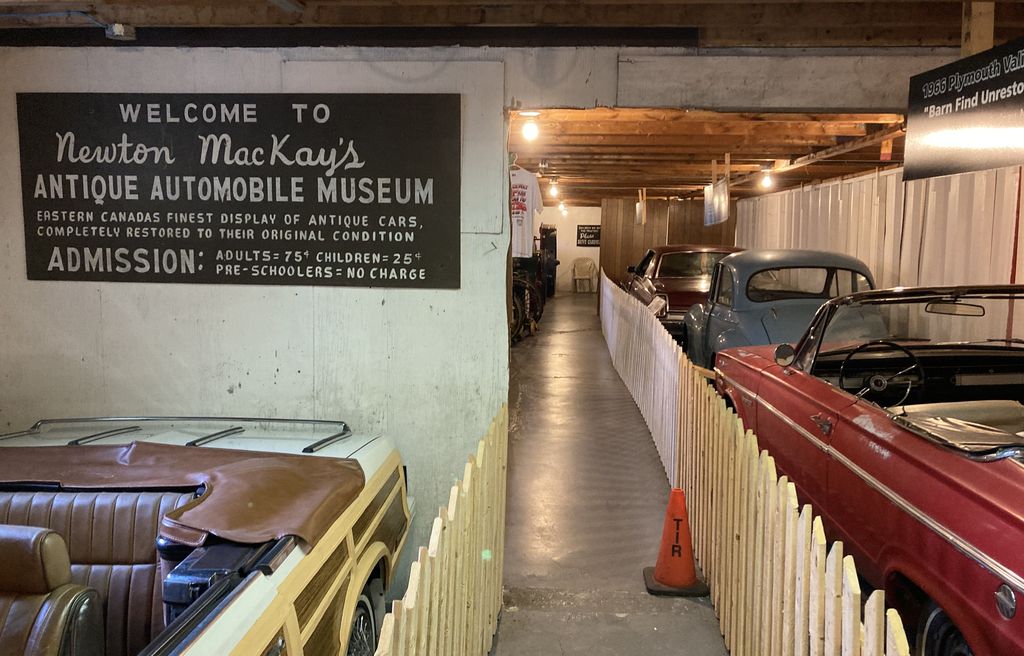
But what curiosities they are! Even I, not much of a car guy (see above for how I learned all about serpentine belts), could appreciate the oddities on display: A Ford Model T, a Maritimes-made Brecklin, an enormous 1959 Cadillac Eldorado with the tallest fins ever featured on a car, the first car to ever cross the Confederation Bridge and, of course, the jewel of the collection—one of Elvis Presley’s Pink Cadillacs. (They’re very proud of it—and you’ll hear Elvis music throughout most of the visit.) It’s nearly a thousand square metres of automobiles, farm equipment and odd finds—at least one car was literally found in a barn, which is something I thought only happened in videogames.
But here’s the thing: There isn’t a funniest or funnest museum on the Island. The information plaques are often wryly amusing in a parochial old-school way, and the sheer lack of polish of the entire place is immensely charming. The look at past cars can be revelatory (we complain about the size of modern pickup trucks, but 1950s cars were just as big, with no benefit to the passengers) and the entire thing is like being stuck in a garage of decades past. Car World has, in other words, a lot of personality and that’s really not a bad thing when measured against bigger but staider museums. I liked it quite a bit, although I suppose that your mileage will vary a lot.
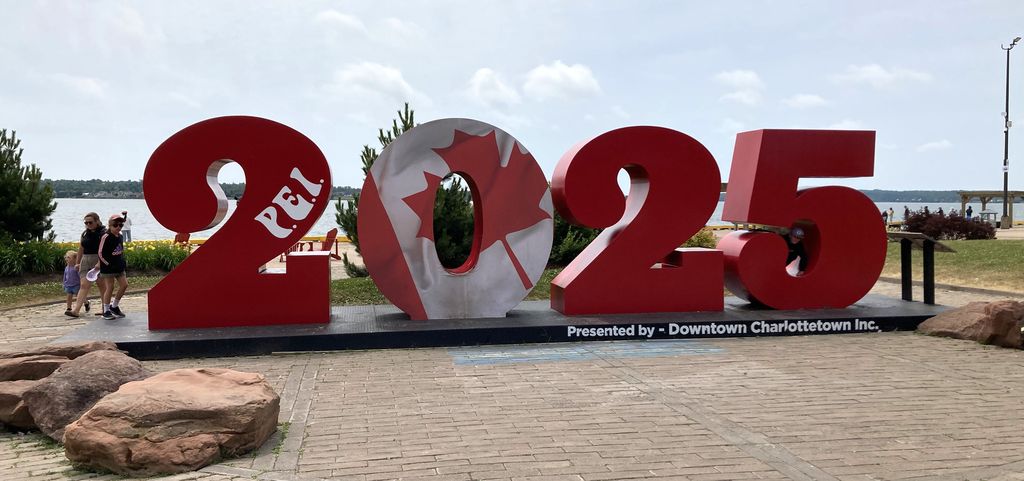
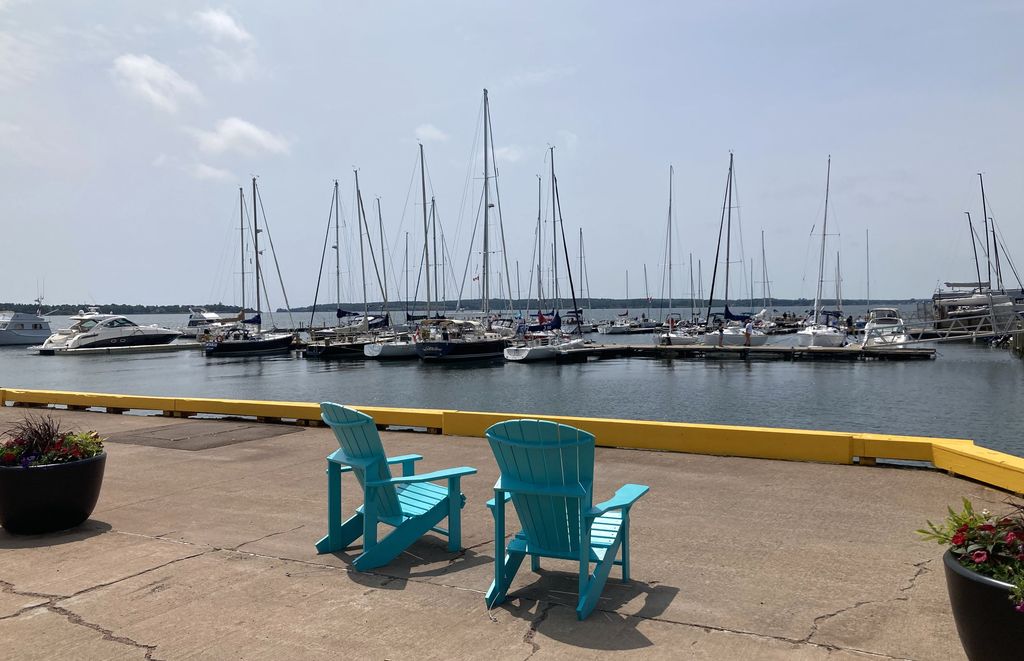
After a short chat with the cashier (I was the only person visiting the place at that time in the morning), I continued my way to Charlottetown, eventually making my way down its main commercial strip (Queen Street) to park on Queen’s Wharf. Sadly, no passenger liners were there that day—but I got pictures of the 2025 sign, the Love-Lock sculpture, and made my way via the Boardwalk to Peakes Quay with its assortment of gift shops and restaurants.
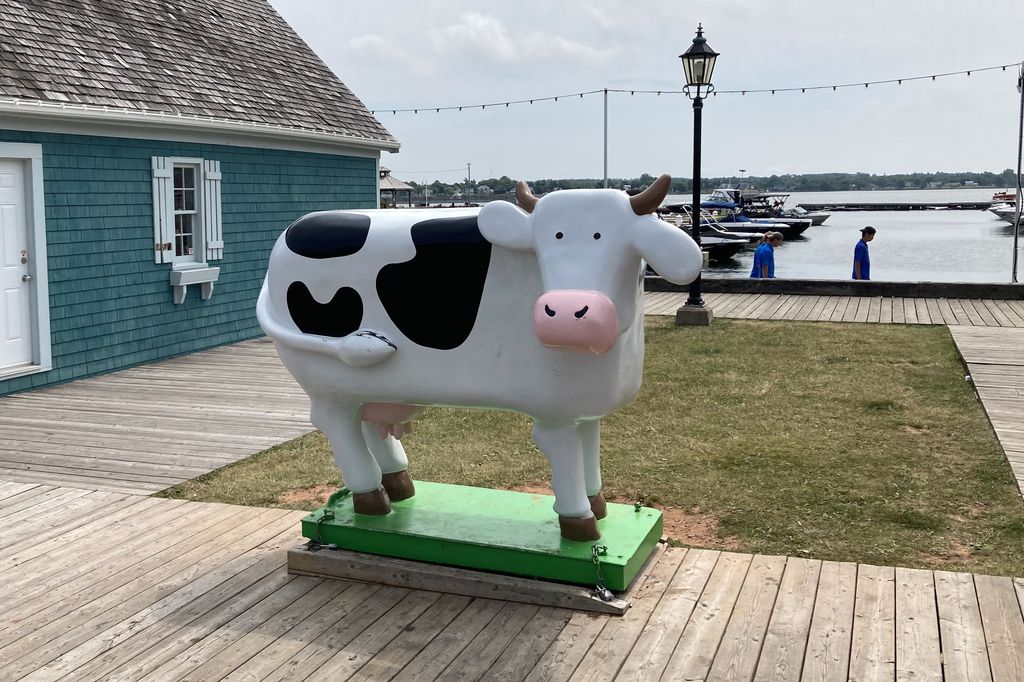
It was high time to sample one of PEI’s most distinctive institutions: Cows Creamery, which was founded on the Island and has since expanded to a dozen locations in Canada. Cows is distinctive not only for its great ice cream, but its uddely charming cow-based branding, with colourful graphic design and cheeky puns. (They’re on par with Ben and Jerry in many ways.) I got myself a Nanaimo Bar milkshake and sipped on it while waiting for a clear shot of the nearby fibreglass Cows mascot. (It took half a milkshake for that to happen, in between the grandma and her kid playing under the cow, and the loud twentysomethings who rode the cow sculpture for a few pictures of their own.)
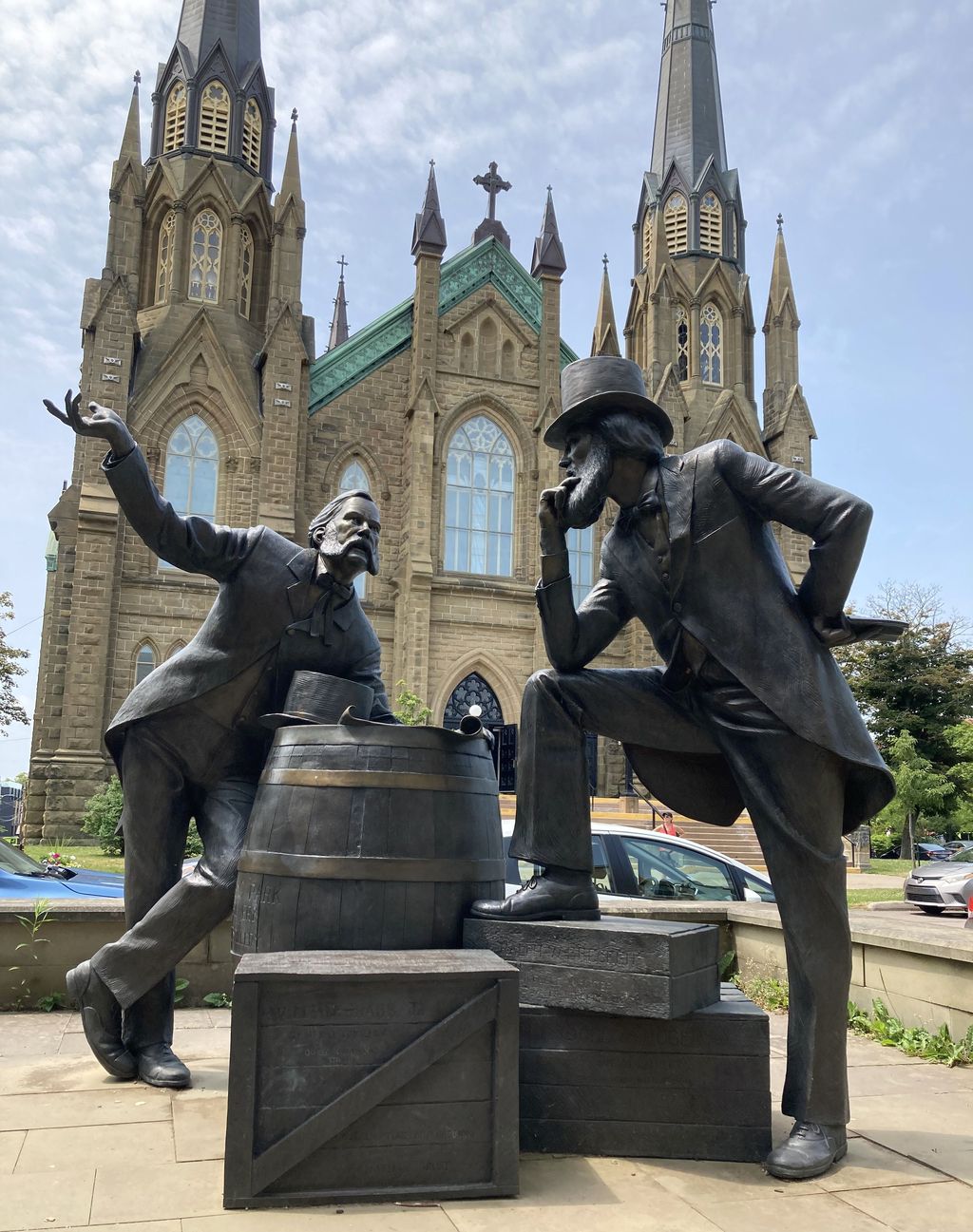
After that, I nursed my milkshake as I made my way uptown for some quick sightseeing. My goal was the provincial legislature (currently under construction), but the unexpected highlight of my walk was St. Dunstan’s Basilica, a magnificent Gothic-style church complemented with an amusing Bronze Sculpture of two John Hamilton Grays in front.
Otherwise, I ambled around downtown, withdrew some cash from an ATM, took in the Confederation Center of the Arts, nodded in approval at the block of Queen Street with two used bookstores and one comic book shop, and went back to the car. It wasn’t much of Charlottetown, but this was a day about distance, not depth.
Indeed, my next stop was far from any urban centre: I headed north to reach Cavendish, not so much for Anne of Green Gables than for a giant Transformers statue.
How did that happen? It either starts with the last glacial age, or with Canadian writing legend Lucy Maud Montgomery, author of the Anne of Green Gable series. From what I can gather, the town of Cavendish was blessed by both a wonderful beach and for being Montgomery’s hometown. Once thing feeding into the other, the area became a vacation destination for people trying to get more out of PEI than Charlottetown. Beaches provided vacation fun, while the Montgomery tie-ins brought culture and historical relevance to the place. Once you’ve got tourists heading to an area, a predictable kind of tourism logic unfolds—suddenly, you see camping grounds, small cabin resorts, a visitor information centre, then a water park and an amusement park to keep the kids entertained for the day, then at some point the tourist traps and attractions start popping up. Which explains how such a tourist trap staple as a Ripley’s Believe It or Not ended up in 7,500-people-big Cavendish, along with signature attractions such as a bear made out of nails and… a Transformers statue. (Interestingly enough, the on-line pictures of the statue from 2024 and earlier are that of a red-and-blue Optimus Prime statue. By July 2025, the statue had been further customized and repainted bright yellow, probably to avoid trademark issues.)
I did not spend enough time in Cavendish. Not being a fan of beaches, I skipped one of its central attractions, and didn’t necessarily want the full Anne of Green Gables historical tour either. Instead, I enjoyed the (crowded) drive north from Charlottetown to Cavendish, occasionally disobeying my GPS to explore side roads. I stopped at the very pleasant Cavendish Visitor’s Information Center for washrooms and information, then made my way to the Transformers statue (which anchors the Ripley’s Believe it or not odditorium, which itself anchors the blatantly tourist-trappy Mariner’s Cove Boardwalk—not to be confused with the nearby Cavendish Boardwalk), then drove through Cavendish’s main strip of cottages, attraction parks and whatever the small town had put up for the visiting hordes. I don’t really regret not spending more time there (it wasn’t the point of the trip), and there’s a chance I’ll be back in the next few years, part of those visiting hordes with the rest of the family.
Being quick and efficient at sightseeing did put me into something of an interesting situation: having seen all that I had set out to see in Prince Edward Island by 2 p.m., what was left to do? I didn’t really want to go back to the hotel room in Moncton so soon, so I dusted off one abandoned plan and set it in motion—I was going west!
During my research for sightseeing destinations on PEI, I stumbled on the Canadian Potato Museum, but reluctantly rejected it for two reasons—for one thing, it was a second potato museum in three days, and for another it was about an hour away from Cavendish—did I want to drive all that time for another Potato Museum? But looking at a day with three hours to fill, well, the calculus was different. The other thing that motivated a trip to the west coast of the Island, besides seeing more of it, was a brochure I had picked up at the visitors’ centre listing PEI lighthouses…
But first, I had to get there. Driving from Cavendish to O’Leary’s Potato Museum took me across a fair cross-section of the Island’s western half, through Route 6 and Route 2. Most of it was farmland, with a few landmarks such as the Cavendish Farms potatoes research centre, Stanley Bridge, a few small cities and a surprising number of roundabouts. Driving on two-lane roads can be frustrating if stuck behind someone puttering under the speed limit, but the landscape was usually interesting enough not to mind too much.
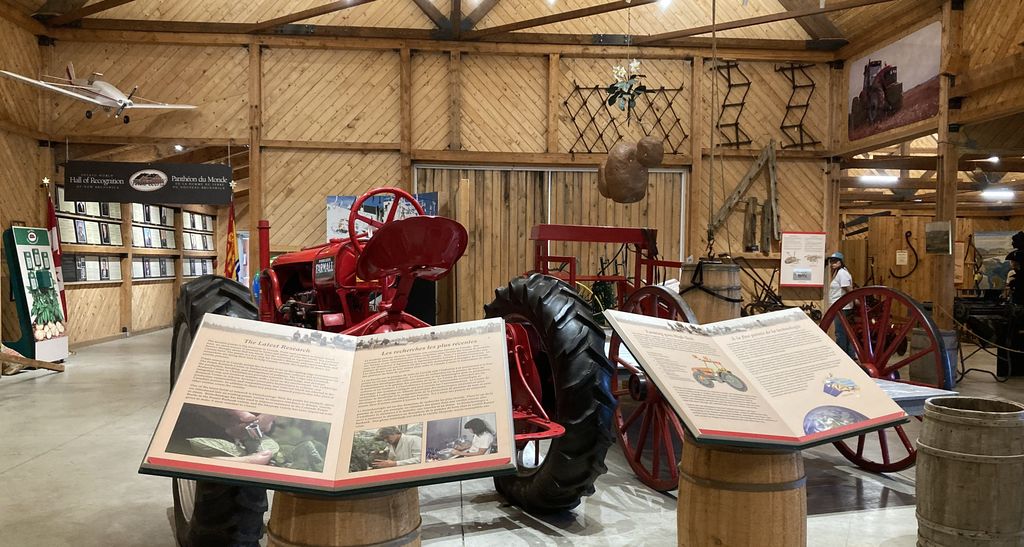
At least the Canadian Potato Museum lived up to the hype—not only does the giant potato sculpture in front of the museum look better than in the photos, the inside of the museum is split into a potato exhibit, a regional museum, a collection of old farm equipment, a restaurant and an extensive gift shop. (Plus a few additional exhibits surrounding the museum building.) The Potato exhibit itself is an interesting gallery that doesn’t feel repetitive even after just seeing Potato World. I spent a fair amount of time absorbing potato-related information, and one of the exhibits that held my attention longest was a loop of Rick Mercer goofing off at the Covered Bridge chips factory. The slick “Amazing Potato” exhibit is complemented by a more rustic counterpart in the hangar hosting several rustic farm vehicles used in the growing of potatoes (including an old manure spreader—which, as an old farm hand, I recognized on sight).
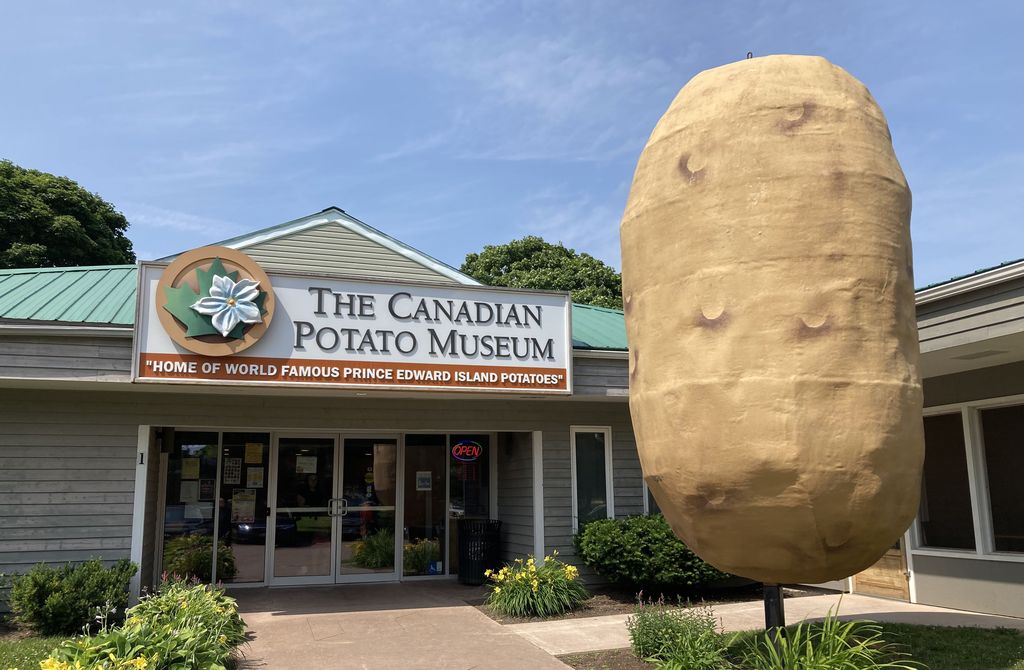
(I was intrigued by how such a high-quality, fully bilingual exhibit could exist at such a remote location, but an information panel discreetly located at the left of the main entrance tells the story of the museum, and how it was transformed from a local museum into the Canadian Potato Museum in 1999, upon receiving the “Amazing Potato” temporary exhibit from Ottawa’s Museum of Science and Technology.)
There is also a rather charming non-potato section to the potato museum, as the local O’Leary museum was absorbed into the whole but remains available for visit. Perhaps its most interesting section is a recreation of an old-time doctor’s office, paying homage to a beloved local historical figure. I browsed the expansive gift shop (considering but ultimately rejecting purchasing a potato plush—I now regret it and will need to correct that next time I’m in the area) but did not eat at the restaurant, still feeling full from Potato World two days earlier.
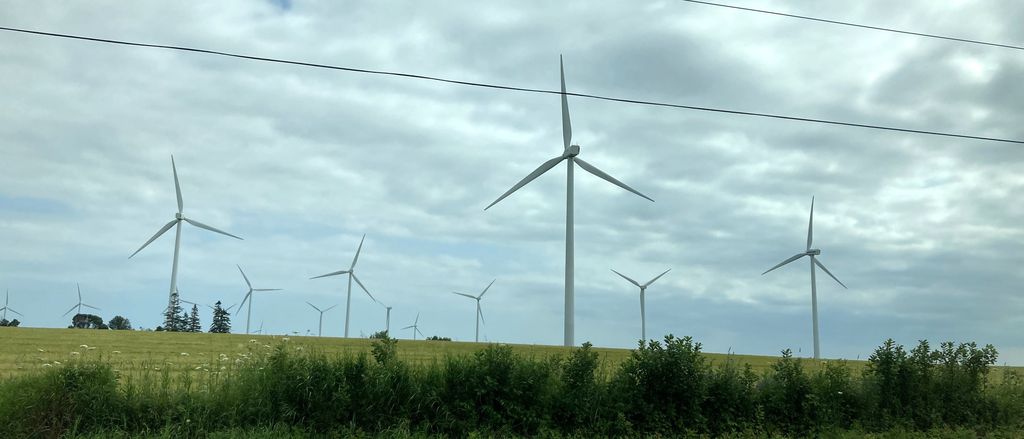
Then it was time to head to my next destination—a lighthouse on the west coast. I have to say that this stretch of road, at the edge of the island, was probably my favourite bit of driving of the entire day—away from major centres, the roads were empty, curvy and picturesque (I smiled when driving in the middle of a windmill field, or near enough the coast to see the sea).
My destination, the West Point Lighthouse Inn & Museum, was well worth the side trip. Unlike many lighthouses on the island, this one has been completely restored and transformed into a fascinating five-story-high museum with an attendant three-star inn for those travellers wanting the whole stay-next-to-a-lighthouse experience. (A niche public, but I presume they’re passionate about it.) If you don’t want to stay the night, you can visit the museum by yourself—a vertical experience that tells you all about the life of a lighthouse keeper and the clever technical tricks used in the business. (I had never bothered to learn until now how they distinguished one lighthouse from another in the dark—in this specific case, the answer is a revolving shade that obscured the light six seconds out of twelve: If a light blinked on and off every six seconds, sailors knew they were looking at West Point.) The “stairs” between the lighthouse’s five floors are more like ladders, but there’s enough to read in between the climbs that you won’t get winded. Alas, I shared the museum during my visit with a large family with vocal kids who incessantly kept repeating how hot it became as they climbed. And blocked the staircases/ladders.
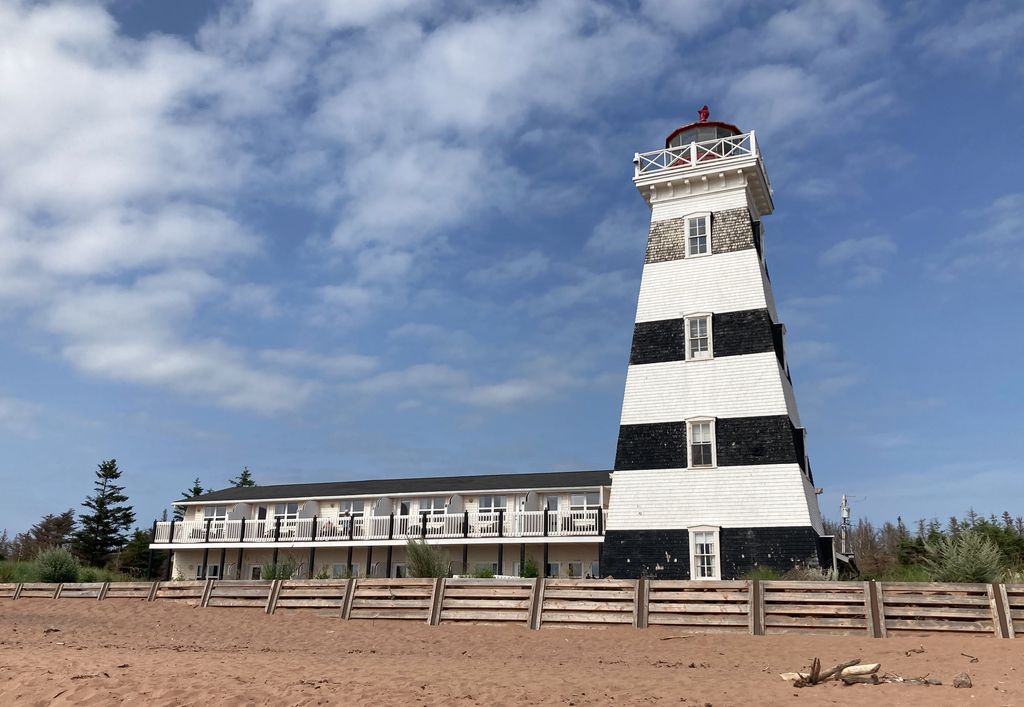
But the lighthouse is worth a visit, and the view from up the five storeys is pretty good from the beach to the inland windmills. It’s probably the highest point for dozens of kilometres around, and I was amused to realize that I was once again following the videogame cliché of unlocking an area by climbing up a tower—in this case, this being my last destination for the day.
After that, it was a few delightful minutes of driving on curvy empty backroads before rejoining highway 2 and going back to the Confederation Bridge. The bridge is still an experience coming back (the $50.25 toll was also an experience), but things got far less interesting once back on the mainland—the way back was forest, forest, and forest, with only some construction to enliven things. I got back to Moncton’s Mapletown, stopped by a Pizza Hut for a small supper, then came back to the hotel room for some reading and an early bedtime.
Junior Navigator came back later during the evening, happy to have spent an entire day on the beach with her cousin and the other half of the family. Everyone enjoyed their day!
Day Five—Monday, July 14—Halifax
The next day was another day trip—but this time with my brother-in-law, who was motivated enough to see Halifax that he was up and ready to go by nine o’clock.
We were clearly not going to see much of Canada’s eastern metropolis in a few hours and we accepted that—the way from Moncton to Halifax is almost three hours of driving, and considering that I wanted to get back before sundown, this gave us roughly six hours in the city. But that’s better than not visiting at all—neither of us had ever visited Halifax, so even a layover-sized glimpse would suffice.
The drive to Halifax wasn’t much to talk about: the forest-and-farmland landscape seldom changed (even the Truro bridge wasn’t as interesting as I had expected) and the GPS efficiently led us downtown, where I parked at a multi-story parking lot without much of a fuss.
The fun began once we were on foot. Not having any mental map of the area, we headed down to the Harbourfront, reasoning that whatever we were looking for—museums, sights, food—would be found near the water. And we were right—within moment, we discovered the outdoors food court and I took care of one pressing need—eating a Halifax-style donair.
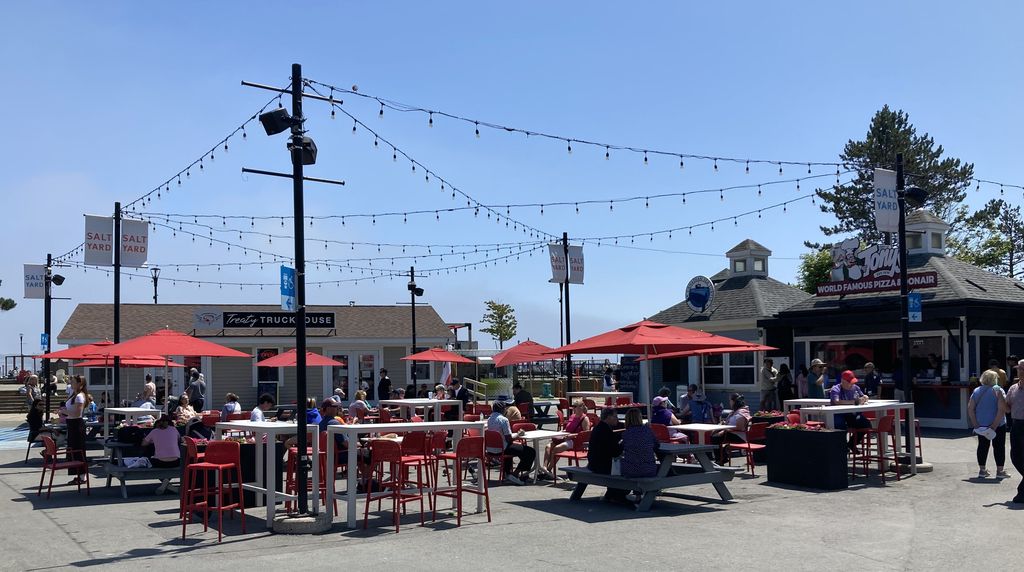
Purists may scoff at the idea of a donair from a Tony’s Donair waterfront seasonal shop as being representative of the true experience, and I don’t care: It was distinctive, and it was good—the tricky balance between meat, garlic and sugar worked much better than most of the imitators. Alas, there is no really good way to eat a street donair—by the time I was done, I had sauce on my fingers, beard (!) and glasses (!!). Fortunately, a public restroom was nearby.
Thus no longer being hungry, we started walking up and down the Harbourfront. Despite the sun, a fog still hung over Halifax Harbour. We certainly weren’t the only ones taking in the sights, but the waterfront is designed to accommodate such crowds and we didn’t have trouble navigating.
After a shopping detour to the very good Strange Adventures Comics & Curiosities, we headed to the Maritime Museum of the Atlantic, a high-quality regional museum focusing on nautical-themed topics. Some of the best exhibits focus on the Halifax Explosion of 1917, large-scale ship models (many of them commissioned by the builders), the Titanic (“While Titanic’s survivors went to New York, all who perished came to Halifax,” we’re soberly reminded), the WW2 Battle of the Atlantic and a slightly out-of-the-way section about the Age of Sail that comes complete with creaking wooden floors meant to evoke the era and a simple but very effective optical illusion putting you inside a ship at sea. It’s easy to spend more than an hour looking at the exhibits—even the overflow section of artifacts is filled with interesting things.
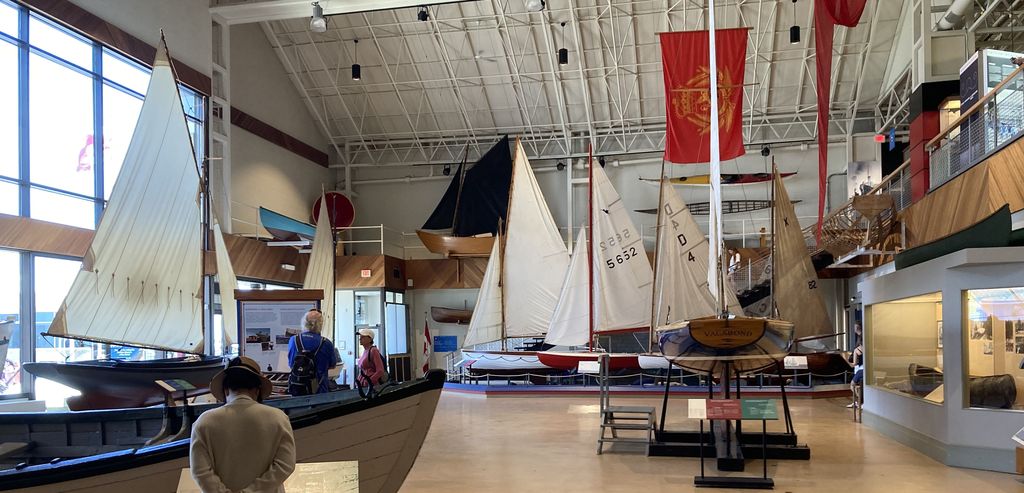
After the Museum of the Atlantic, we headed south on the Harbourfront, taking in the area, stopping for a slush, taking advantage of the bright sunlight (no more fog!), enjoying the atmosphere of people having a good time, and making our way to the Museum of Immigration located toward the south end of the area.
It’s certainly an eloquent choice to locate a museum of immigration on Pier 21 itself—for decades, this was a major port of entry for European immigrants, roughly the Canadian equivalent of the United States’ Ellis Island. There’s also an interesting semantic tightrope arc in having such a thing as an immigration museum at all—how do the curators balance the need to show history in its not-always glorious truth, acknowledge the tricky national choices made through immigration policy, recognize the personal toll experienced by immigrants, serve as national propaganda and still deliver an experience that doesn’t come across as cheaply didactic?
The museum has two permanent exhibits and one temporary one. We picked the temporary one first — “Eat Make Share,” a rather fun exploration of immigration and food in Canada. Of the permanent exhibits, “The Pier 21 Story” felt like the best, as it takes visitors throughout the process through which immigrants landed at Pier 21 from Europe and (if allowed entry) made their way to their destinations elsewhere in Canada. It blends testimonies, re-creations of the facilities, interactive exhibits and a clear narrative in a successful bid to make visitors understand what it could have been like. The second exhibit, “The Canadian Immigration Story,” is more conventional and really interesting in how it navigates between the opportunities and the tension of moving to a new country. (It features a really good anecdote about an immigrant’s experience with mustard that I won’t spoil—you’ll have to go there to find out.)
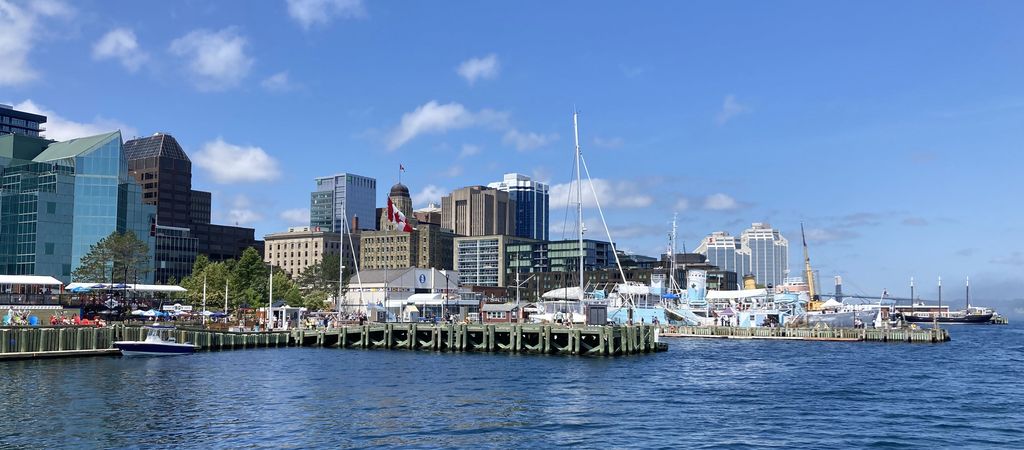
Overall, the Museum of Immigration was more interesting than expected—less preachy, for one thing, and it’s one of those fairly rare museums that doesn’t necessarily aim for a school-age public. It’s one of the nine national museums of Canada for a good reason, and you can feel the weight of the building’s history imbued in the exhibits.
Amusingly enough, Pier 21 is still in use today, albeit as a landing spot for ocean liner tourists. We capped our visit within Pier 21 by a quick amused tour of the boutiques that greet cruise ship visitors to Halifax when they disembark at Pier 21—foodstuff, local art, one interesting bookstore and overpriced tchotchkes to take advantage of tourist dollars—but all high-end and respectable.
Having spent more than another hour in Pier 21, we understood that our time in Halifax was, if not over, then clearly coming to an end: we just had time to schedule a meal before leaving back to Moncton before it got dark. Looking for a place to eat, we were discouraged by the line outside The Bicycle Thief (a perennial recommendation when it comes to Halifax restaurants) and went next door to Sea Smoke, a restaurant focusing (appropriately enough) on seafood. My brother-in-law had himself a very satisfying sushi selection, while I was pretty happy with my Seafood Chowder (Lobster, Haddock, cod, salmon, sweet corn) and a near-indescribable “Salmon + Smoke: Sweet and Salty. Crispy and Savoury. Smoked salmon, leek and cream cheese stuffed cocoa butter cigars, and pistachio.” We sat in the shade, but it wasn’t cold enough for the restaurant to light up the built-in fire pits in each table.
By the time we finished supper around 5:30 p.m., wisps of fog had started coming back to the harbour. Typical Halifax weather, we’re told, but the kicker was this: Fog blanketed the area in the five-ten minutes it took us to stop at Cows for a milkshake and ice cream, only to clear out again by the time we made our way north of the Harbourfront to get back to our parking. (As if to underscore the eeriness of the moment, a sailboat just happened to go past when the fog was at its thickest.)
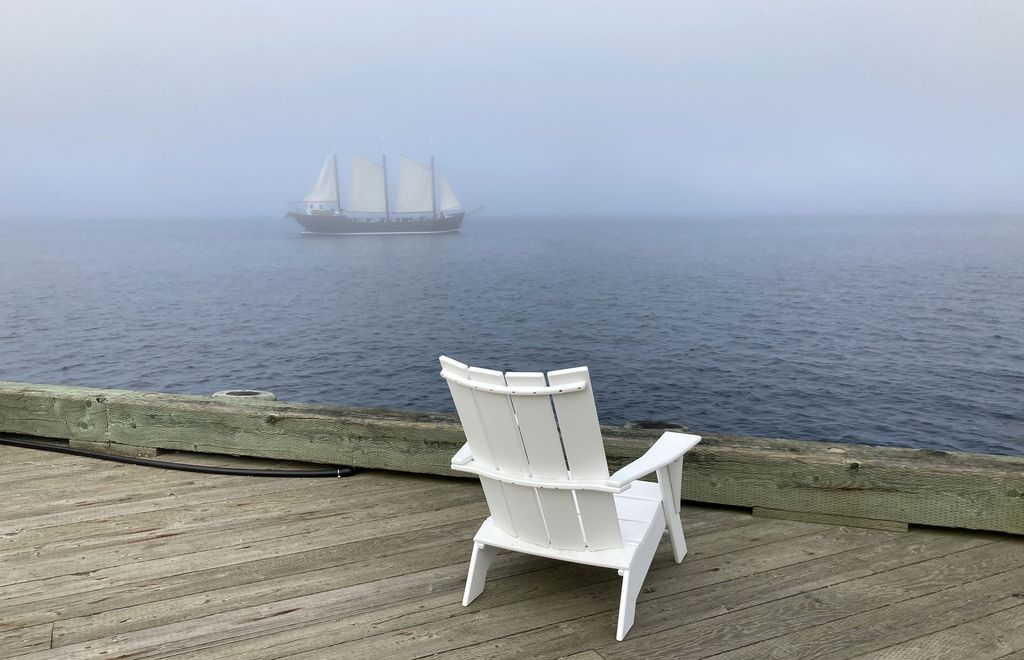
As a punctuation point to our too-short visit of Halifax, this was a pretty good one. The way back to Moncton was enlivened by two driving mistakes—a fortuitous one that took us to the picturesque Macdonald Bridge rather than the MacKay Bridge (which we had crossed on our way in), and a rather hilarious one that made us miss the Aulac Big Stop for the second time of the day. (We ended up not stopping, being neither hungry nor in need of gas.)
Back in Moncton, the Junior Navigators told us about the excellent day they’d spent with my sister going to arcades and beaches and stores and other fun stuff. Another day, another success! Our trip to the Maritimes coming to an end, I did one last bit of shopping tourism and dropped by Sobeys to see if they had any interesting regional brands. (They did, but not many.)
Another hotel night, another bit of reading, and another early sleep.
Day Six—Tuesday, July 15—From Moncton to Rivière du Loup
Let’s face it: Going back home isn’t as much fun. It’s about going back on familiar ground, made even less appealing by how it would take us two days to get there. We packed up our hotel room without much enthusiasm, and were on the highway back by nine.
Still, we managed to squeeze in just a bit more tourism along the way. Our passage through Fredericton had been short on our way in, partially because we intended to visit a few more things on our way back. So it is that we drove a solid 90 minutes of road before taking the exit for downtown Fredericton. Our objective: The Fredericton Region Museum.
As I’ve mentioned before, there is a specific quality to regional museums that you simply can’t get in slick national museums, and the Fredericton Museum has that in spades. Moving through the building’s rooms in an exercise in the familiar, the mandated and the unexpected. Sure, you’ve got the usual exhibits about the history of the region, Acadian history, Loyalist notables, Fredericton’s contributions to the World Wars, famous local citizens, as well as well-meaning rooms about the local First Nations and black experience. Interesting exhibits include a 10,000-year-old artifact, and while much of the museum has an impeccable presentation, there’s also quirky evidence of the museum’s folksy origins—such as documentary quotes crudely printed on a 7.5 × 11 sheet and taped to the wall.
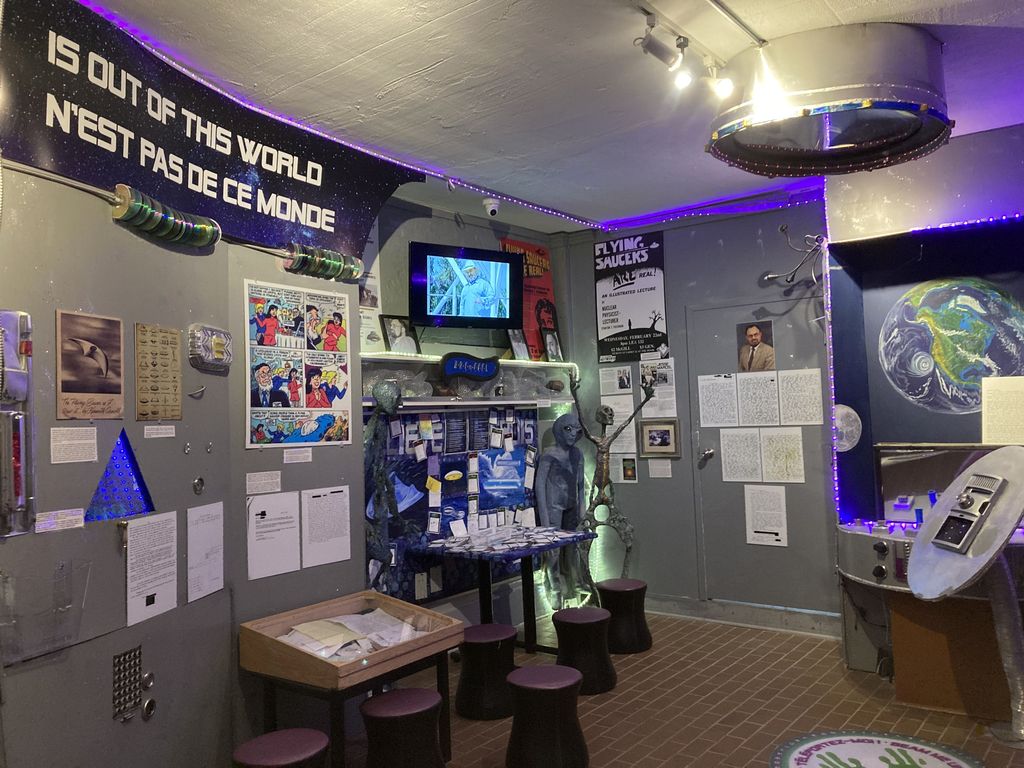
But then there’s an exhibit about the gigantic 42-pound Coleman Frog, a local hoax that has grown into myth. (The museum maintains, deadpan, that it’s real.) As if amphibian nonsense presented as fact wasn’t enough, there’s also an entire room dedicated to Stanton T. Friedman, a Fredericton-based UFOlogist. The exhibit is crammed with a painfully earnest presentation of artifacts from Friedman’s career, complemented with hilariously kitschy representations of UFO-lore aliens. (As recently as 2021, the museum still sponsored UFO seminars.) To someone who’s been eye-rolling at the UFO nonsense for decades, the exhibit was both dismaying and occasionally interesting (Friedman was caricatured in Archie Comics!), but one thing’s for sure—it fits right in with the Coleman Frog, and while both of those things highlight that the Fredericton Regional Museum isn’t an entirely serious institution, it does make the visit more interesting than expected.
The next stop was requested by Junior Navigator—still having some vacation money unspent, she wanted to spend a few hours in the mall, and that’s why we headed to the perfectly serviceable Regent Mall for two hours of air-conditioned shopping and loitering. She got clothes; I got two cheap books from Chapters.
After that, it was another two hours of driving up the St. Johns River Valley all the way to the Grand Falls Big Stop, where we stretched our legs and had yet another look at the usual wares sold in roadside convenience stores. Vague plans to stop again at Potato World or the Grand Falls didn’t survive contact with the day—we were clearly making our way out of tourism mode and well into get-back-home mode. It was a good thing that we rested for a few moments because barely ten minutes after getting back on the highway, as the car was climbing the mountainous Appalachian uplands, a heavy storm hit us out of nowhere—five minutes of substantial rain in safe but less-than-ideal inclined roads. Just as I was wondering if it was a good idea to pull over the next exit and wait it out, the rain eased up almost immediately and the storm disappeared as quickly as it had appeared—this is what happens in mountains, I gather.
That was pretty much the last road event of note for the day. After crossing into Québec, we briefly experienced some of the old two-lane highway for what may be the last time (it’s supposed to be completely replaced next year) and then the brand-new stretch of highway leading us to Rivière du Loup.
Our hotel in Rivière du Loup wasn’t the same as our way in—in an attempt to diversify our knowledge of the city’s hotels, I had us booked as the Days Inn. When it comes to those, sometimes you win and sometimes you lose—and while our stay at the Days Inn wasn’t terrible, it was a noticeable step down from our experience at the Universel (and yet, due to the increasingly high season, cost more). It’s a favourite for bikers (the road-weary kinds, not the criminal kinds) because you can park the bike next to the front door of the motel room. Great Cable TV package and free breakfast, though!
After a takeout meal at St.-Hubert (we weren’t going to try Dixie Lee again), we ate in the room and went to sleep early, lulled by the noise of the room’s struggling AC unit.
Day Seven—Wednesday, July 16—From Rivière du Loup to Ottawa
If you’re expecting a thrilling narrative about our last day on the road, you’re going to be disappointed: The entire way from Rivière du Loup to back home in the Ottawa area was literally going over familiar ground—the way from Rivière du Loup to Lévis was less familiar but dull, Lévis to Montréal was familiar and dull (even a stop at the Madrid 2.0’s MacDonald to taste their seasonal burgers wasn’t much to talk about) and so was the way from Montréal to Ottawa. Junior Navigator listened to music, dozed or texted while I drove on. She also successfully completed her objective of eating something different every single meal during the trip.
The only noteworthy event was stopping by a friend’s new place in Montréal to chat, which meant doing something I try to avoid whenever possible: Entering Montréal during daylight hours, with the completely absurd amount of traffic delays and construction zones. We saw accidents, we saw lanes closed for fun, we saw other cars do dumb driving stunts, we had inexplicable slowdowns and ended up spending two or three hours as long making our way in and out of the island that it would have taken to go around it—another day in Montréal.
But, hey, the important part was getting home safely, which we did shortly after suppertime.
In conclusion…
Having completed another successful summer road trip—and one substantially more far-flung than previous summers, what have we learned?
One of those things is being prouder than ever of being Canadian. The Maritimes may be far away, but they feel like home. As our southern neighbour is making one cruel mistake after another, Canadians stand strong—my money stayed in the country, I have a much warmer feeling about the Atlantic provinces, and the area feels more approachable than it’s ever been—to the point of paying more attention the next time they pop up on national news.
Speaking of which—one of Canada’s proudest accomplishments is its national broadcaster—throughout the trip, I could stay tuned to Radio Canada (or CBC) simply by spinning the dial of my radio: sometimes with regional variations (invariably invaluable in learning about the area we were driving through), sometimes with the familiarity of broadcasts heard at home.
So, what are the essential elements of road trips? A good car, adequate drinks (caffeine soda late in the morning, sugar-iced drinks afterwards), manageable snacks (with some fondness for meat sticks, small Pringles cans, my own custom Party Mix blend1, and some fruits to round it off.) and interesting material to listen to. It’s more fun with a navigator; otherwise, podcasts are a must—the problem with listening to news radio all day long is that by the second or third hour, everything usually repeats itself. Music can help, but not in making the driving any more interesting when there’s nothing else to see.
I have to say that, after stopping so many times at roadside convenience stores over the week of the trip, I was getting tired of everything they had to offer—the snacks, the gifts, the driving aids, even the slushes. Considering that I never stop at convenience stores when not on road trips, that was saying something already: time to leave the road behind for most of the next year and start planning for next summer’s holidays.
What would that look like? Well, other than leaving Newfoundland entirely out of this year’s plan, let me offer you a hint: In one week’s time, I put 3,500 kilometres on the car. That, when unrolled west of Ottawa, is enough to get to Calgary, Alberta. One of the secret goals of this trip, with its accumulation of lengthy drives one day after another, was proving to myself that I could handle multiple consecutive days of driving. If all goes well, you’ll see next year why this was important information. The key conclusions are: no driving after dark, early bedtime, start at nine, and avoid weekends.
Oh, and the car itself? My thirteen-year-old workhorse performed flawlessly without any single hint of malfunction during the trip. Those two last-minute visits to the garage certainly paid off. Sometimes, travel narrative foreshadowing is just a red herring…
- Custom Party Mix blend: As of summer 2025, this is made out of bacon hickory sticks, corn chips with flax, garlic sesame sticks, barbecue corn chips, Hawkins Cheezies cheese puffs, Basse dill-pickle flavoured cashews, Snyder’s of Hanover Pretzel Cheddar Pieces and Tamari almonds. One scoop of everything except the cashews, for which half a scoop is enough. Mix in a big bowl and store in Mason jars. The goal sought here is that every handful should taste different.