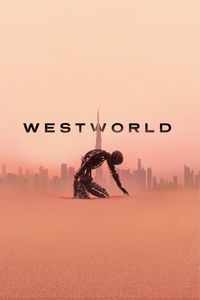
Westworld, Season 3 (2020)
(On Cable TV, May 2020) Obviously, Westworld could never stay confined to the park for more than a few seasons, and so this third season of the series boldly takes us to the outside world, with androids not only exploring it but also changing it irremediably. It’s a bold move, introducing a new main character (played by Aaron Paul) and taking up the issues of control versus self-determination into a wider context. The production design of this third season is exceptional, credibly presenting (through shooting in modern East Asian cities) a future vision of 2040s Los Angeles with automated cars, mood-showing T-shirts and oppressive social control. Wait, where did all of that come from? Yes, that’s where Westworld is showing its seams. Down to the new visual motifs of this season, we’re presented with so many new elements in exploring this future that there’s reason to believe that half of it is being made up as the series goes along rather than being part of a coherent plan. There’s little in the first two seasons to suggest Rehoboam the all-controlling AI, except as a thematic counterpart to the morality plays taking place in the parks. As a result, much of this Season 3 feels half-rushed, half-indulgent. Even though the first two seasons’ ten-episode plans had plenty of fat to trim, this eight-episode series still couldn’t keep the series’ worst pseudo-profound moralism at bay. There’s no baseline depiction of the world under Rehoboam—our sole significant new character is an underclass, which doesn’t give us a good yardstick to judge the philosophical conflict taking place in this third season. It probably doesn’t help that I have somewhat significant differences with the series’ morality so far. I’ve been Team Maeve since the beginning; I see Delores as a villain despite a last-minute contrition; I have trouble seeing Serac as a monster despite the series’ insistence that I should; and most of all, I am terribly unhappy with the series’ “light the match, burn everything up, let the survivors choose” approach to global revolution and eventual human extinction event—the best way to effect social change is to coopt the comfortable middle class, but I’ve given up on the series taking such a reasonable technocratic approach when it can play with its characters becoming gunslingers, ninjas and social revolutionaries. But, of course, we’re midway through a six-season arc with no way of knowing where it’s going (except for increasingly loud hints of an apocalypse coming up). At least there’s enough to keep us interested on a micro level. Everyone is turning in decent work on the acting front (although I’ve never been much of an Aaron Paul fan), and there’s something quietly amusing in the way the series’ actors are constantly given different personalities to play. Still, some character arcs (maybe even the season as a whole) feel like throat-clearing and seat warming before later events. While Thandie Newton is a constant delight, her character seems a caricature of previous seasons. Jeffrey Wright’s Bernard also seems to be biding his time until there’s a real role for him to play, and Ed Harris’s William seems increasingly contrived. This season was clearly all about Rachel Evan Wood’s Dolores, but this is wearing thin when you could reliably predict that none of her many enemies would manage to stop her before The Plan was revealed. The series has good ideas and set-pieces (Williams’s self-therapy session being one of them), even though its reach often exceeds its grasp—the “genre” drug sequence didn’t quite match its potential. Still, and this is significant, Westworld remains insanely ambitious and daring for a flagship cable TV show—It could have contrived a way to remain in the park, but chose a vastly riskier route. I may not love the results as much as I did in previous seasons, but I’m still on-board to see where it takes us next.