Adam Beach

  • Smoke Signals (1998)

    Smoke Signals (1998)

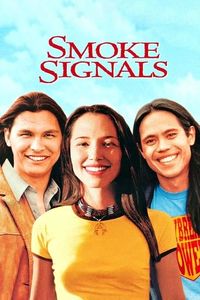
    (YouTube Streaming, September 2021) As of 2021, September 30 is designated in Canada as a National Day for Truth and Reconciliation. A federal holiday but not exactly the kind of day fit for barbecues and celebration, it’s intended as an opportunity to reflect on the relationship, historical and present, between First Nations and other Canadians. I did my part in my own way — self-educating on related topics during the day, and pushing a landmark Native American film to the top of my evening watch list. To be fair, Smoke Signals often felt as if I was cheating — it’s so entertaining and occasionally so funny that it felt like a treat more than self-imposed viewing. Often hailed as the first widely distributed film entirely written, directed, co-produced and starring Native Americans (there were earlier examples, but none were as well known), Smoke Signals takes us on an evocative road trip, as two young men make a trek from Idaho to Arizona to gather the remains of a dead man with a complicated legacy. Adam Beach plays the dead man’s son, an aggressive young man who remembers his father as abusive before he left forever. Sitting alongside him is Evan Adams as a far meeker friend who still sees the dead man as a hero, having saved them (they were told) from a house fire as babies. Leaving the reserve is an adventure by itself, but it’s only the start of a journey that gets both protagonists to confront their own perception of what it means to be a Native American, and discover some troubling revelations about the dead man. Confidently directed with many cinematic moments, Smoke Signals is easy to watch even when it deals with tough issues. The heartfelt story is wrapped in just enough self-aware humour as to make everything easy to follow and enjoy. It’s an American film, but the ground covered here just as easily applies to Canadian First Nations. The insider’s perspective means that the film dispenses with clichés, or engages with them — it feels real and that may explain why the film has aged so gracefully, even nearly twenty-five years later. There’s a reason why Smoke Signals is still a reference in lists of Native American cinema — in fact, the lack of high-profile follow-ups is troubling. Canada has seen a small but worthwhile wave of First-Nation-led filmmaking in the past few years, and if the films themselves can be quite good, it hasn’t led to a breakout hit or cultural reference. There’s clearly some work to be done there too.

  • The Cowboy (2016)

    (On TV, July 2021) While the version of The Cowboy that I saw was presented as a feature-length documentary, I see that IMDB lists the film as a two-episodes series, which does make sense considering the clear change in topic midway through. The entire film is presented as a documentary homage to the western movie genre, and specifically the archetypical figure of the cowboy. It’s produced and directed by Canadian documentarian Derick Murray, which is interesting in how the result shares one common annoyance with Murray’s better-known “I Am” biographical series: it’s utterly uninterested in delivering an impartial take on its topic. If you’re looking for an incisive commentary on the cowboy archetype, go elsewhere because, while The Cowboy will gladly discuss differences between movie cowboys and real-life historical figures, it’s firmly in the “print the legend” camp: there’s no critical re-evaluation of the toxicity of the archetype, its decreasing relevance to a more complex society that values cooperation over self-reliance, or the sometime-repulsive incarnation of American racism through the cowboy. Seeing Adam Beach being present to praise the character of Tonto is… interesting. While The Cowboy is too smart a piece of filmmaking to not at least mention those issues, they’re quickly forgotten as the narrative moves to an overall loving appreciation of its subject. (This too is a characteristic of the “I am” series: they’ll fleetingly mention and minimize the flaws but then rush past it to tell us how wonderful their subject was.)  But I’m probably being a bit too harsh on what remains, in the end, a serviceable documentary. Talking heads (including the always-entertaining Ben Mankiewicz) are interspaced with movie footage to first present a short history of the western genre, and then (in the film’s second half) compare historical figures with their Hollywood adaptations. Many of the people interviewed in the film are part of western appreciation societies or are associated with horse-riding, and that probably influences the tone of the film as well, never daring to stray too far from their enthusiasm for their lifestyle. Seen five years after production, The Cowboy also has odd notes due to the topicality of some of its material. Produced close to the release of Seth MacFarlaine’s western parody A Million Ways to Die in the West (about as high-profile a western film as there has been in 2010s Hollywood), it places an emphasis on that film that seems unwarranted only a few years later. Ah well — I suppose that a play-nice documentary is a better commercial prospect than one that really prods its topic, and The Cowboy does have its moments of insight despite the upbeat tone.

  • Monkey Beach (2020)

    Monkey Beach (2020)

    (On Cable TV, January 2021) We usually talk about movie formulas as being bad things, but an underappreciated aspect of their nature is that to have a formula, you need to have enough examples of something to distinguish the formula. When it comes to underrepresented kind of cinema, the emergence of a formula can be the sign of a healthy subgenre. So it is that, in between Monkey Beach and near-contemporary The Incredible 25th Year of Mitzi Bearclaw (and the inverse of Through Black Spruce), we have an emerging formula: The young indigenous woman leaving the big city to return to the reserve, where her supernatural powers help untangle family problems, sentimental complications and her own maturation. Monkey Beach has a bigger budget and a literary origin: It’s adapted from Eden Robinson’s well-received novel, can boast of some amazing cinematography and can anchor itself to Adam Beach as a marquee name. Grace Dove is quite good in the lead role, with special mention of Tina Lameman’s performance as guiding elder Ma-Ma-Oo. The BC landscapes are gorgeously portrayed, and director Loretta Todd gives the film a strong atmosphere. Unfortunately, the film struck me as more technically successful but not quite as interesting as The Incredible 25th Year of Mitzi Bearclaw: far more leaden in its messages, not as charmingly odd in its presentation and a bit too serious for its own good, Monkey Beach feels like the staider, po-faced cousin of Mitzi Bearclaw. This being said, I couldn’t be happier that there are no less than two movies poking at the same topic in their own way—First Nations cinema in Canada is still too rare, although I’ve seen no less than six such movies in the past six months now that the airwaves are free to present something other than Hollywood blockbusters during the pandemic void. I really would like to see a third and a fourth example of this “back to the reserve” formula: counter-intuitively, there are representativeness and strength in formula.

  • Cowboys & Aliens (2011)

    Cowboys & Aliens (2011)

    (In theaters, July 2011) There’s no real reason to dislike the western/Science Fiction hybrid Cowboys & Aliens, but no real reason to love it either.  It plays surprisingly straight, what with Daniel Craig and Harrison out-gruffing each other on the way to rid the Earth of an alien menace.  The SF elements are weak (Mining gold?  Really?  Did they miss all the asteroids on their way here?), the action sequence lack a certain oomph and the film seems happy just delivering the goods in more or less the same way the audience expects.  Given that even competence is sometimes missing from Hollywood blockbuster, the acknowledgement that Cowboys & Aliens does deliver on its promises should be seen as a compliment.  (If nothing else, you do get both Cowboys and Aliens.  Happy?)  The problem is that there’s little more to director Jon Favreau’s film.  After a thorny first act, everything reverts to unthreatening adventure with a perfunctory finale and the self-simplification of the script is particularly harmful to its SF elements: There’s little rhyme or reason to the aliens’ capabilities except for dramatic effect, and at the point it becomes harder for the viewer to actually form expectations or build any kind of suspense if narrative rabbits are going to be taken out of various orifices.  Interestingly enough, some of the better works comes from supporting actors: Sam Rockwell is once again unrecognizable in an atypical role far from his better-known characters; Adam Beach is earnest and sympathetic; whereas Olivia Wilde manages to carry an element of ethereal difference to her character beyond simply looking pretty.  Oh, Cowboys & Aliens plays well and satisfies base expectations.  There’s just a nagging feeling that the film could have been just a little bit more…