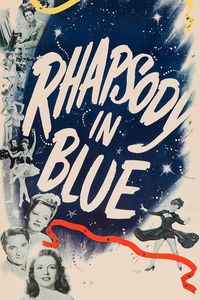
Rhapsody in Blue (1945)
(On Cable TV, June 2020) According to Rhapsody in Blue’s production history, the biggest problem the filmmakers faced was in wringing drama out of George Gershwin’s biography. While his death at 38 was tragic and he had multiple romantic liaisons, the rest of his life was somewhat uneventful—his rise to fame and acclaim being somewhat linear without major setbacks. Accordingly, this old-school but solid musical biography of Gershwin highlights the music (with some numbers notably played at length, something even remarked upon with stopwatch precision by the characters) and downplays the drama to the point of being a bit hazy about the man himself. All characters repeatedly agree, though—Gershwin was a genius, and women loved him. Much of this admiration can be explained by how the film is crammed with real-life Gershwin friends and admirers: Al Jolson (in blackface, inevitably and alas), the always-excellent Oscar Levant (wisecracking as himself, perhaps his favourite role ever) and Hazel Scott singing two rather good numbers in a Parisian nightclub—the first half of her performance in intelligible but probably phonetic French. Meanwhile, Robert Alda is not bad in the lead role. One notes the film as being one more contribution in the “Americans go to Paris for inspiration” subgenre, magnified by the later musical comedy An American in Paris paying homage to Gershwin—and also co-starring Levant. Inevitably, the conclusion becomes an Ode to a Fallen Great given Gershwin’s untimely death. Rhapsody in Blue does make for a nice introduction to Gershwin and his music, although as usual for Hollywood biopics the film does not survive even a quick Wikipedia check. Enjoy the music, don’t worry too much about the facts.