Alan J. Pakula

  • Dream Lover (1986)

    (On Cable TV, July 2021) There are times when, as a film’s credits roll, I have to remind myself of why I wanted to watch it in the first place. Was it the premise? The lead actor? Some kind of weird filmographic project I’ve latched on? Not surprisingly, these kinds of questions usually emerge at the end of a very specific category of bad movies — those so insignificant that their reason for existing is unclear. In Dream Lover’s case, the end credits answered my question — this is a film from well-regarded Alan J. Pakula, whose 1970s paranoia trilogy (Klute, The Parallax View and All the President’s Men) remains a classic. But while Pakula scored a few hits through a nearly thirty-year career as a director, his filmography is not consistent, and Dream Lover is probably going to end up in his lowest tier by the time I’ll be done with his filmography. As suggested by the title, this is a film that deals heavily in dreams as plot devices, which (to seasoned filmgoers) means that it’s not going to make a single shred of sense. Indeed, as our heroine dreams of killing someone and being abused, the film goes so often for shocking dream sequences that viewer interest disappears maybe a third of the way through: when anything and everything can happen, when dubious pseudo-psychiatry justifications are used instead of narrative logic, Dream Lover becomes more grating and overlong even at 104 minutes. The script was written by the film’s producer, which is seldom good news — without narrative oversight, it careens from one fantasy sequence to another. I’m not fundamentally opposed to dreamlike films — I mean, there’s Inception and Dreamscape and much smaller films like the audacious (if not entirely successful) Canadian title Come True. But those better movies have some energy, wit and imagery to them, and Dream Lover doesn’t. It’s just one thing after another until we’re done, and very little of it sticks despite the potential of the premise. It comes across as substandard de Palma except without, well, anything that made de Palma so revered. On the upside, there’s now one less Pakula film on my list of films to watch, although if the remaining ones are all at the same level, I’m not going to have a good time.
  • The Pelican Brief (1993)

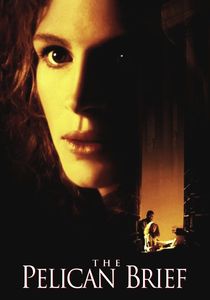
    The Pelican Brief (1993)

    (In French, On TV, March 2019) In retrospect, it does make sense that a straightforward crowd-pleasing novelist like John Grisham would lead to a handful of straightforward crowd-pleasing movie adaptations. I’m not complaining! In fact, I miss those solid, medium-budget standalone thrillers. Take The Pelican Brief, for instance—an average but competent thriller in which a young woman stumbles upon a conspiracy by linking the death of Supreme Court justices to land development shenanigans. If the film has a stroke of good luck, it’s in being able to depend on a few capable actors (Julia Roberts and Denzel Washington, obviously, but also John Lithgow, Tony Goldwyn and Stanley Tucci in a rare role as a terrorist) as helmed by veteran director Alan J. Pakula—who clearly knows how to wring every drop of suspense out of a given sequence. The early-1990s atmosphere of The Pelican Brief is getting quainter and more charming by the day as it reminds us of how difficult it was at the time to get any kind of information without the Internet: the movie would be about an hour shorter if they just had access to Google. But then again, maybe that’s the way they’re going to go with a remake: have a blogger spew a joke conspiracy theory that happens to be true, rather than have a law student speculate as in this film. Ah well—I’m not really asking for a remake. This one is good enough.

  • Presumed Innocent (1990)

    Presumed Innocent (1990)

    (In French, On Cable TV, February 2019) I miss 1990s standalone thrillers, and Presumed Innocent is a fine example of the form—adapted from a novel, it drops viewers right in the middle of a complex story and challenges them to keep up. The accumulation of subplots makes things more interesting than the rather simple core premise would suggest, with enough layering of legal system cynicism to provide the gritty atmosphere. I liked the dense beginning far more than the increasingly linear ending, which ends on a five-minute monologue that ends up sucking a lot of punch away from a striking revelation. This being said, Alan J. Pakula’s understated direction does leave full space for the focus to be on the story—this is not a film that would benefit from an overabundance of style. Harrison Ford is OK in the lead role, his stoic persona playing well with a character not prone to bursts of emotion. Elsewhere in the cast, Bonnie Bedelia is not bad as the protagonist’s wife, while Raul Julia is very cool as a top defence lawyer. Still, Presumed Innocent is a plot-driven film rather than an actor’s showcase, and at a time when so few top Hollywood movies run on pure story, it only makes me realize how much I miss it.