Alex Gibney

  • The Inventor: Out for Blood in Silicon Valley (2019)

    The Inventor: Out for Blood in Silicon Valley (2019)

    (On Cable TV, March 2019) I didn’t go in The Inventor: Out for Blood in Silicon Valley cold—I too had been charmed from afar by the rise of Elizabeth Holmes and Theranos, taken in by the photogenic Holmes (seriously; people have been talking about how Jennifer Lawrence was going to play her in a film for years!) and the Silicon-Valley-promises of revolutionary health care. Everyone wanted to believe that it was true. But then I saw the implosion of the firm, the ways it had been overhyped and the deliberate attempts at deception and fraud. Apparently, documentarian Alex Gibney (perhaps the best in the business at this time) assumed that most of his viewers came from the same place, because The Inventor does not merely focus on the events surrounding Theranos’ rise and fall, but explores (more interestingly through interviews with ethicist Dan Arialy) the reasons why such a deception could be effective. The Inventor comes closest to excusing Holmes’s behaviour by suggesting that a well-intentioned lie may have ballooned into something much bigger. But the rest of it doesn’t pull any punches in describing the pattern of deliberate deception (with journalists expressing naked anger at the way they’d been duped), and strong-armed legal coercion at their whistleblowers and critics. They emerge from the film as the true heroes, whereas everything about Holmes seems deliberate, and manipulative—even her deep voice, featured without commentary, seems to have been faked. The direction is quite good, with some cute visual puns (such as cacti used as visual metaphors during a discussion of blood-drawing needles) and a good mixture of styles to present what is essentially a talking-head documentary. Gibney draws widely on pictures and video shot during Theranos’ heyday by none other than fellow documentarian Errol Morris. There’s a thicket of issues tackled in The Inventor that may have gotten a bit more play (perhaps most damningly the failure of the gate-keeping older white men that were supposed to be good judges of character when faced with an attractive younger woman—all of the women interviewed in the film are clear-eyed about what was really going on), but the finished documentary remains a satisfying exposé. Also tackled along the way; the built-in duplicity of Silicon Valley, the Steve-Jobs worship as a substitute for real knowledge; and the false god of disruption. But if you’re fascinated by the brazen lying (at a time when the country is having a truth problem at its very top elected offices), dig deeper in the Theranos story—the stuff that’s not in The Inventor is even more mind-boggling … to a point where Gibney may have been too even-handed in his approach to the topic.

  • Zero Days (2016)

    Zero Days (2016)

    (On Cable TV, July 2017) Documentarian Alex Gibney is almost a national treasure at this point, able to transform complex modern topics in hard-hitting yet compulsively viewable documentaries. In Zero Days, he takes on one of the most fascinating computer security issues of the century so far, which is to say the Stuxnet worm that, in 2005, spread over the planet yet appeared to very specifically target uranium centrifuges used in the Iranian nuclear weapon development program. Throughout it duration, Zero Days patiently describes the way the worm was discovered, its complex peculiarities, what was hidden in the code, and why, piece by piece, security experts identified the United States and/or Israel secret services as likely candidates for the worm’s development. But as Gibney can’t get any official confirmation, he gets mad and, midway through, brings out his own confidential sources: Intelligence Community officers who, concerned with the potential of cyber-weapons, are willing to confirm and explain what had, up to this point, been merely informed speculation: NSA and Israel developed Stuxnet, then Israel made it more virulent and allowed it to escape with little thought about detection. (It probably also ran the more aggressive Stuxnet alongside a more conventional campaign of targeted assassination of Iranian nuclear experts.) Much of this story is familiar to people even remotely knowledgeable about cyber-security (check out Stuxnet’s Wikipedia page for details) but then Zero Days has a final revelation of its own: Nitro Zeus, a set of exploits and plans designed to bring down Iran’s infrastructure. It’s that kind of capability that led the NSA officers to leak details of US operations. It’s also that kind of stuff that should keep you awake, especially now that more leaks have suggested the existence of a Nitro Zeus aimed at Russia … and Russia’s own infrastructure-meddling experiments in Ukraine. Twenty-first-century warfare is not going to be about tanks and missiles, and it’s going to reach people in their own homes. Zero Days is a good primer on how bad it can be. By the time it replays the Obama administration’s happy announcement of a deal regarding the end of Iran’s nuclear program, the implied meaning is far more sinister: The US won its first cyber-war. But there will be others.

  • Going Clear: Scientology & the Prison of Belief (2015)

    Going Clear: Scientology & the Prison of Belief (2015)

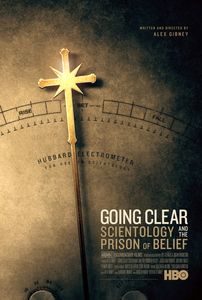
    (On Cable TV, September 2015) Documentary filmmaker Alex Gibney takes on the church of Scientology in Going Clear, and the result is as fascinating as any of his other movies.  Adapted from Lawrence Wright’s book Going Clear: Scientology, Hollywood and the Prison of Belief, it’s a highly critical look at the inner workings of Scientology, featuring a number of disillusioned former high-ranking members of the organization.  After a look at the colorful life of Scientology founder L. Ron Hubbard, Going Clear spends time detailing the recent and current activities of the organization and the reasons why several of its former members have left it.  Along the way, the relationship between Scientology and its star members John Travolta and Tom Cruise is detailed in ways to make us understand how they all benefit from the association.  It’s a slick documentary, although the “dramatic recreation” segments meant to illustrate some of the material is overdone: the interview alone are compelling enough.  Going Clear is builds to a highly critical portrait of Scientology, packaging together a lot of material that has been available for years but seldom presented in such a self-contained form.  Read the film’s Wikipedia article for more details on the ensuing controversy.

  • We Steal Secrets: The Story of Wikileaks (2013)

    We Steal Secrets: The Story of Wikileaks (2013)

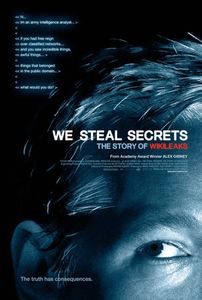
    (On Cable TV, August 2015) You could ask why anyone should watch a documentary about a story that’s both not that old (The Wikileaks saga peaked in 2009-2011), and so well-covered just about everywhere (starting with Wikipedia’s interminable articles on Wikileaks, Julian Assange and Chelsea Manning) that another take on the same events would be redundant.  But Alex Gibney is a top-level documentarian, and he understands that the art of the doc is largely based on selection of material and emotional impact.  So it is that We Steal Secrets structures its material in a way that makes a complex issue relatively clear, and does amazing things in presenting Instant Messenger chats: The use of pauses, selective highlight of text and isolated sentence fragments in exceptionally powerful.  Roughly 30 minutes of the 2-hour film is made of computer-animated segments, providing a visual unity to the film that could have been diffused had it been a straight-up succession of talking heads.  While Assange himself is typically missing from the film’s roster (he’s not really the type to contribute to fair-minded depictions of him or his activities, as proven by his over-the-top reaction to The Fifth Estate and other examinations) and while Manning is obviously absent by dint of being detained, We Leak Secrets thrives on a series of good interview subjects.  While some of the remote psychoanalysis of Assange and Manning is a bit exasperating, most of the talking heads say interesting things –perhaps the most interesting of them being ex-CIA head Michael Hayden, who says things you may not expect from a man of his experience. (The title of the film is his.) Otherwise, We Steal Secrets is generally even-handed, giving voice to dissenting, even fringe opinions, while trying to be as clear as possible about its topic.  Heartbreak is inevitable, especially as the film delves into Manning’s crushing isolation, the actions of Adrian Lamo and, later on, a testimony by one of the woman who accused Assange of sexual impropriety.  I’ve been casually following the Wikileaks story for a while, and couldn’t find inaccuracies in the finished product.  (Wikileaks posted a detailed rebuttal, but Assange’s thin skin is legendary and he’ll be forever unsatisfied by anything short of hagiography.)  I have seldom been disappointed by a Gibney documentary yet, and if We Steal Secrets seems to be his most obvious topic yet, it’s as slick and fascinating as any of his other films.  As a first-pass attempt at history-making, it seems fairer than most… although I believe that the final word on Wikileaks, Assange and Manning is yet to come.  

  • Casino Jack and the United States of Money (2010)

    Casino Jack and the United States of Money (2010)

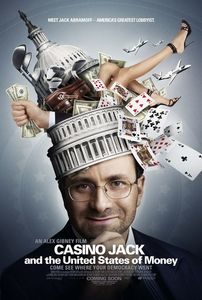
    (On DVD, July 2011) Documentary filmmaker Alex Gibney specializes in films designed to infuriate his audiences, and after such minor masterpieces as An Inconvenient Truth and Food Inc, documentary audiences are back for more with Casino Jack and the United States of Money, a non-fiction piece about the influence of lobbying in Washington… as seen through the story of Jack Abramoff, the most infamous lobbyist of them all.  Abramoff’s sin wasn’t being a lobbyist: it was pushing it so far beyond the venal standards of Washington as to be caught and reigned in.  As is now the case for many top-notch documentaries, Gibney’s entertaining exposé mixes fictional re-creation (“A documentary?  Why don’t you make an action movie?” says Abramoff in an email; so Gibney obliges by recreating a gun-down that figures somewhere in Abramoff’s checkered history.), talking heads, infographics, press clippings, archival material and a bit of original reporting.  It paints a damning portrait of a man who saw an opportunity to soak his clients and did it.  But Abramoff’s story is far from being the most infuriating aspect of Casino Jack Casino Jack and the United States of Money, given how thoroughly the film suggests, explains and demonstrates the astonishing power of money into the American political system.  Don’t like a law?  Pay lobbyists to call politicians, “explain” the issues to them (via exotic junkets and campaign contributions) and wait for results to roll in.  Call it a quick and nauseating primer into the way politics are conducted in the real-world.  Even cynics may be disgusted to see their worst fears given form.  Abramoff may have done prison time for his crimes, but it’s important to remember that it takes the willing participation of politicians for this scheme to work… and Casino Jack Casino Jack and the United States of Money ends on a somber note, pointing out how quickly the Washington establishment dropped any enquiries into the Abramoff scandal once it was assured that the lobbyist would go away for a long time.  While the brainy subject matter may not make this a crowd-pleasing favourite, it does make another entry in an increasing number of cogent high-quality documentaries tackling real issues.  It makes a compelling (if confusingly-named) double-feature with the docu-fictive Casino Jack, starring Kevin Spacey: Watch the fiction to sympathize with the character, then watch the documentary to get the facts.  In-between showing scenes from Abramoff’s Hollywood feature Red Scorpion and ending on the absurdist note of seeing Don Delay (who willingly built the infrastructure that made Abramoff’s schemes possible) on “Dancing with the Stars”, Casino Jack and the United States of Money speaks for itself and the self-satirizing nature of contemporary American politics.

  • Enron: The Smartest Guys In The Room (2005)

    Enron: The Smartest Guys In The Room (2005)

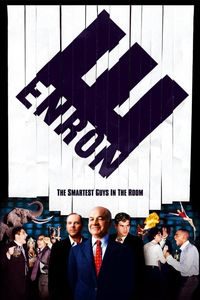
    (On DVD, February 2006) The Satirical journal The Onion once ran a story titled “Americans Would Be Outraged If They Understood Enron Collapse”. Well this it it, the film that ties everything together and does its best to enrage you. Embezzlement, machismo, political connections, lack of auditing, amoral executives, deliberate suffering, culture of excess, refusal to admit responsibility: everything wrong about American capitalism seems to be on display here. Best of all, director Alex Gibney makes sense of a complicated scheme, tracking Enron’s rise and fall in a limpid fashion. As financial vulgarization, it’s top-notch, with both the script and the direction keeping things moving along at a fast clip. But beyond a simple expose of criminal numbers, the film also shows the real consequences for some ordinary people whose pensions were essentially wiped out by the Enron collapse. Make sure you don’t have any Enron business literature left lying around, otherwise you will find yourself burning it in sheer hopping anger. 2005 was another excellent year for feature-length documentaries, and this is only one of the flagship titles.