Alex Proyas

  • The Crow (1994)

    The Crow (1994)

    (In French, On Cable TV, April 2019) Considering that I started seriously watching movies in the mid-1990s, I long thought that I would be unable to see movies of that decade as “dated” beyond the usual technological markers—those are, after all, the films I watched as they were released, as a young ticket-buying adult. In many ways, I still have trouble thinking of the 1990s as a historical period the way I do for earlier decades. But then I come across movies like The Crow, which were intended as such stylish statements of their times that they become the go-to example of what everyone mean when they talk about 1990s movies. Young directors like Alex Proyas, who made his mark through music videos, were not exactly responsible or sophisticated in their use of digital special effects and quick-cut editing—that all leaves a mark. This is even worse in The Crow’s enthusiastic embrace of gothic tropes, both visual and thematic—it’s so goth that its climax takes place atop a cathedral. For Proyas, The Crow is a clear front-runner to Dark City’s nighttime urban landscapes: everything here is dark, grimy, littered—nobody in this alternate reality ever cleans up, and in fact it’s not clear if there’s ever a daytime. The very moody soundtrack, to make matters even more cliché, is exactly the kind of thing that was goth-defining at the time. It’s obvious why The Crow became a cult classic—it feels like the unbridled product of a goth imagination turned up to eleven, even killing off its star Brandon Lee in the process. Oh, it’s easy to become a bit sarcastic about the film, but it does feel heartfelt some of the time. The superhero avenging angel is offset at least once by a scene of welcome humanity and realism with a policeman. Lee’s performance is not bad—and you can see parallels here with Heath Ledger’s Joker. Plus, there’s Bai Ling as an evil character. Even the extremely dated atmosphere has become fantastical and stylish rather than simply old. I can’t say that I liked The Crow all that much, but it does find a place in the list of distinctive 1990s movies—you’re missing out on an emblematic film if you don’t see it.
  • Gods of Egypt (2016)

    Gods of Egypt (2016)

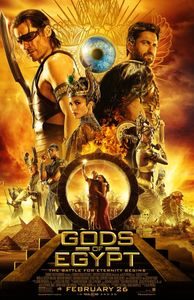
    (On Cable TV, October 2016) I’m already on record as having an odd fondness for big-budget box-office bombs (they may not be good, but clearly there’s a lot to see on-screen), so you would think that I’d be favourably predisposed toward Gods of Egypt … and I was. There’s the added attraction of seeing director Alex Proyas’ work on the big screen for the first time since Knowing, the willingness to tackle a different mythology and a cast of good actors (albeit, as amply noted, overwhelmingly Caucasian—too bad for the wasted opportunity). On paper, Gods of Egypt sounds fascinating. On the screen, however, it’s another matter: From an unexpectedly cheap title card and an interminable opening monologue that throws viewers into the ice-cold pool of Egyptian mythology without a lifejacket, Gods of Egypt seems determined to sabotage itself even when it shows promise. As far as the 140M$ budget is concerned, you certainly see a lot of it on-screen: Proyas’s vision for the film is ambitious and expansive, and some sequences do capture an impressive sense of visual awe. The actors do their best, with Nikolaj Coster-Waldau getting another noteworthy role outside Game of Thrones and Élodie Yung looking fetching as the Goddess of Love (imagine having that on your filmography). In bits and pieces, still pictures and six-second video, Gods of Egypt works well. But when Gods of Egypt tries to piece the images together and paper over its ambitious vision with a limited special-effects budget, the film implodes. It feels unbearably dull, interminable, and conventional even in its unconventionality. By the end, it plays exactly like the countless other big-budget fantasy snore fests that have tried (and often failed) to parlay mythology and special effects into box-office receipts. Bad attempts at quips rival with unsympathetic characters and more lore than any brain can care about in an undercooked script that lays a bad foundation for the uneven special effects. By the end of the film, I was just thankful that it was over. I suspect that another viewing of the film with low expectations may improve my reaction slightly … but to be frank I can’t imagine being willing to spend another 130 minutes any time soon watching Gods of Egypt again.

  • Garage Days (2002)

    Garage Days (2002)

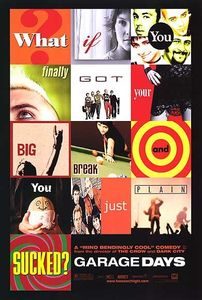
    (On DVD, August 2010) Writer/Director Alex Proyas’s filmography is filled with spectacular SF/fantasy hits, but in the middle of The Crow, Dark City, I, Robot and Knowing, his musical comedy Garage Days always gets short thrift.  That’s a shame given how it features a fun script, good performances, a cool look at Sydney, some great music and Proyas’ typical gift for fast-paced visual storytelling.  Centered on a group of friends involved in a small struggling rock band, Garage Days soon spins out to include romantic complications, quirky supporting characters and the even-popular quest for the “Big Break” so beloved by other similar films.  Things don’t all end up as expected, however, and it’s one of the film’s minor triumphs that it still ends on a great note despite honouring its tagline of “What if you finally got your big break and you just plain sucked?”  Garage Days is a charming film despite its faults (many of them the kind of things you’d expect from a generally low-budget film made outside Hollywood), and it’s a good way to spend an evening.  The occasional flashes of high-concept style are welcome, Kick Gurry is particularly enjoyable as the protagonist and so is the somewhat run-down contemporary look at Sydney’s music scene.  The music is fine, as you’d expect from a comedy about a rock band: the film even features a high-energy concert sequence to the tune of 28 Days Later and Apollo’s 440 “Say What”.  For Proyas, it’s a very different film from his usual dark downbeat visions, and it’s a welcome interlude.  The story, characters and presentation may feel familiar (expect visual parallels with British movie-makers such as Danny Boyle and Guy Richie), but Garage Days is handled with a decent amount of verve, and it may even have something to say about how we don’t need to be rock stars to be happy.