Alexander Korda

  • Marius (1931)

    Marius (1931)

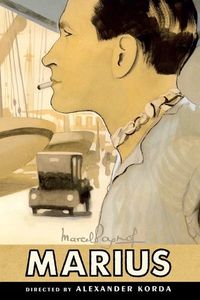
    (On Cable TV, November 2021) Unusually enough, it’s Marius’ remake Fanny that makes the original adaptation of Marcel Pagnol’s play both interesting and disappointing. As a romance set on Marseilles’ waterfront, Marius still carries some appeal, at least for French speakers: the very distinctive accent and slow-paced lifestyle espoused by the characters are still rather charming. Much of the story is set in a small bar overlooking the Mediterranean, and as the characters focus on their small-scale romantic troubles, it makes for an immersive plunge into a quasi-mythical way of living. Alexander Korda became far better-known as a producer, but his directing here is pretty good for the time. Alas, those who have seen Fanny will be disappointed by its progenitor: Not only is Maurice Chevalier missing, but so is the last and more interesting half of the story told more efficiently in the remake. (The explanation for this is that the remake adapts two linked stories, whereas the original only adapts the first.)  Much of the dramatic interest of the remake is replaced by a far more linear and simplistic love story — Marius is not bad, but not quite to the level set by the remake. Still, it’s not a bad watch nor a bad listen if you’re able to distinguish the melodic accent from more traditional French.
  • The Four Feathers (1939)

    The Four Feathers (1939)

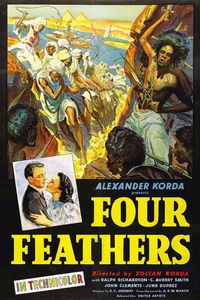
    (On Cable TV, April 2021) British film producer Alexander Korda was well known throughout World War II as an immigrant more British than the British-born, putting together films that sang the praises of the embattled country even when they putatively took place in other historical eras. In this context, The Four Feathers is notable for a few things, starting with an early spectacular use of colour at a time where such a process was costly and difficult to handle — especially in the harsh location shooting conditions that the filmmakers experienced in Sudan. Widely considered the best rendition of an often-adapted novel (most recently in 2002, with Heath Ledger), it’s a tale meant to stir any young man with patriotic fervour, as it shows its protagonist turning away from service, then being labelled a coward (through the titular feathers) by family and friends. The highlight of the film remains the spectacular battle sequences shot in naturalistic colour in the middle of the desert. There’s a kinship here with later films such as Zulu, unfortunately, all the way to the built-in racism and colonialism that we’re asked to espouse as self-evident:  Don’t look too close at the depictions of non-English characters. It’s by an accident of history (albeit not an unpredictable one) that The Four Feathers landed in theatre screens just as England needed a patriotism booster. It’s still, despite quite a bit of disturbingly outdated material, a decent watch.

  • The Scarlet Pimpernel (1934)

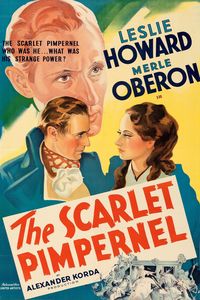
    The Scarlet Pimpernel (1934)

    (On Cable TV, January 2021) There’s a special place for The Scarlet Pimpernel (the character) in fictional history, considering that it inspired the motif of (super)heroes with a hidden identity, preceding Zorro, which preceded Batman. Considering that Emma Orczy’s The Scarlet Pimpernel (the novel) is an adventure tale set at the time of the French Revolution featuring a mild aristocrat-by-day becoming a wild swordsman-by-night, it’s possible to imagine any adaptation leaning on one or two directions, either as a swashbuckling adventure, or as a period costume drama. Unfortunately for me, I was expecting the first and received the second in the 1934 version of The Scarlet Pimpernel. While the film is not devoid of sword-fighting action sequences, it mostly goes in the period drama direction. The costumes and sets are sumptuous, but modern viewers will miss the steady pace of action sequences that more modern adaptations would have been sure to include. It’s not entirely fair to second-guess the storytelling instincts of previous generations—after all, producer Alexander Korda clearly knew what he was doing, and the result was one of Great Britain’s top-grossing films of 1934. But modern viewers will find it impossible to watch The Scarlet Pimpernel and not see where the film could have been pumped up with more action for an even more engaging result—as it is, it feels too slow, too talky and too dull despite a fascinating premise. Oh well—seeing how the Three Musketeers have been reinterpreted in steadily more action-filled ways over the decades, maybe it’s not a good idea to wish for a remake.

  • Churchill and the Movie Mogul (2019)

    Churchill and the Movie Mogul (2019)

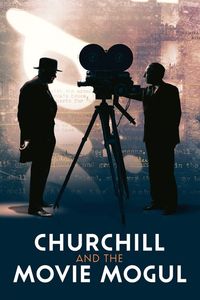
    (On Cable TV, January 2021) The relationship between Hollywood and the Anglosphere governments became unusually close during World War II—Washington and London were all too aware of the potential for mass propaganda tools during wartime, and an impressive number of films were produced in cooperation with the military—as far as I can determine, nearly every branch and sub-branches of the US Armed Forces got their own Hollywood movie between 1942 and 1945. But that’s only the most visible aspect of that wartime cinematic effort: the reality was often more involved than making movies showcasing armed forces. In Churchill and the Movie Mogul, director John Fleet gives an in-depth look at the overlooked relationship between Winston Churchill and British movie mogul Alexander Korda. Perhaps wanting to counter the impact of Nazi filmmakers such as Leni Riefenstahl, Churchill took a deep interest in the power of movies to influence the national mood. In return, Korda admired Churchill enough to hire him as a screenwriter and advisor in the mid-1930s, positioning him to make a significant contribution to the British war effort. Korda’s films are, as demonstrated here, filled with eloquent paeans to British strength of character… even in historical epics seemingly having nothing to do with WW2. (One notes that “historical” nation-building movies are surprisingly common no matter which country you’re talking about—I have a lengthy list just for the United States, Canada and for China as well.)  Churchill and the Movie Mogul is, obviously, a deep cut film: it’s about movies and their relationship to political rhetoric, and Korda is a figure of interest to a dwindling number of film enthusiasts. The documentary itself is fine, but it’s not the kind of topic that creates gripping moments. On the other hand, it does shine a light on a surprisingly involved relationship between two major figures in their own fields, and it cogently tracks the ramifications of that friendship and larger issues when governments become interested in movies, and vice versa. Even given the British focus, Churchill and the Movie Mogul is also a great contribution to understanding Hollywood during WW2.

  • The Private Life of Henry VIII. (1933)

    The Private Life of Henry VIII. (1933)

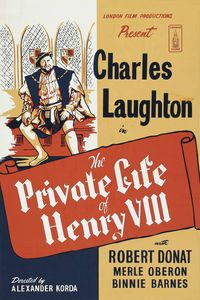
    (On Cable TV, May 2020) Alexander Korda was a foreign-born British film producer who sought glory in many ways, and not necessarily his own personal glory. His filmography is packed with movies that extolled British virtues and crowd-pleasing entertainment that revitalized British cinema itself. He believed that movies could effectively influence minds, and he got an early reward for this belief in The Private Life of Henry VIII when that film triumphed at the box office, and won the first-even Academy Awards given to a non-American film. Later on, the uncouth and gluttonous portrait of Henry VIII as depicted in the film became, unfairly, how newer generations began to perceive the historical character. It certainly helped that the king was played by none of that Charles Laughton, looking quite young at times: it became his breakout role and the one that won him an Oscar. Surprisingly enough, this is a black-and-white historical epic that has aged far better than you’d expect—it’s often a gentle comedy even in the opening credits, as one character is said to be of no interest in being a “respectable lady.” The irreverent touches of humour continue throughout the film, with some moments playing in a very iconoclastic fashion. Better than expected, The Private Life of Henry VIII gets a few honest laughs: the chicken-eating scene is funny, as is the divorce negotiation sequence. The humour partly comes from the early matter of love and marriage in a royal context, partly from the court’s difficulties in adjusting to a difficult king, and also partly because of Laughton’s performance itself. Far less stuffy than a history lesson, The Private Life of Henry VIII clearly reached its audience and continues to do so—but be wary of thinking that this is a historically accurate film.

  • Anna Karenina (1948)

    Anna Karenina (1948)

    (On Cable TV, March 2020) It’s a gift to cinephiles to see so many adaptations of a few classic novels—especially when they’re released within a few years. So it is that Leo Tolstoy’s Anna Karenina had two high-profile English-language adaptations in 1935 and 1948, forever begging for comparative pieces. I won’t quite do that here—not having read the novel is a handicap, and at some point, most black-and-while period dramas sort of blur into each other. Still, a back-to-back viewing of both versions shows that if the British 1948 one doesn’t have Greta Garbo, it does have a wonderful Vivien Leigh in the title role. The rest of it is a very respectable adaptation, once again focusing on the romantic tragedy of Karenina rather than the myriad subplots. (Some of the ensuing plot shortcuts can be confounding, but that’s the way it goes.) Anna Karenina is, in many ways, very Russian: winter, ballet, ill-fated protagonists and a shrug at the capriciousness of fate. I prefer this version to the prior one, what with a better use of exteriors, more confident directing and more expansive storytelling. Some of this reflects technical progress accomplished during a thirteen-year period—but some of it is due to writer-director Julien Duvivier’s approach to the material—and perhaps the influence of crowd-pleasing producer Alexander Korda. There’s some good control over the material, whether it’s the technical aspects of recreating historical Russia, the costumes, or the very good execution of the final scene. This being said, Anna Karenina does remain a costume drama, and one executed with late-1940s means. Modern viewers, if they’re just looking into checking out the story, may want to ease themselves into it by watching the 2012 version—maybe not quite as good as the early ones, but certainly more technically accomplished.

  • The Red Shoes (1948)

    The Red Shoes (1948)

    (On Cable TV, November 2019) What a sumptuous movie. One of the sure-fire highlights of 1940s cinematography, The Red Shoes isn’t just a visual feast from writers-directors Emeric Pressburger and Michael Powell (with MVP Jack Cardiff doing cinematography)—it’s also a rather enjoyable, if melodramatic, meditation on the price of art no matter what kind of art. Creatives of all stripes are liable to get a charge of inspiration from the result, even if they (like me) will look on skeptically at the idea that art is worth dying for. (That’s not true for one simple reason—you can’t create anything more if you’re dead. Full stop.)  But, of course, for most people the film is about ballet, about dancing sequences made even more meaningful by a very sophisticated visual language. Compared to other films of the 1940s (and, indeed, still most twenty-first century films), The Red Shoes is complex and self-assured in the way the visuals work in tandem with the narrative: this is a film worth watching intensely to catch the nuances and interplay between its elements, far more so than other films of that era that do not rely so much on visual material. The complexity carries to other facets of the film, from mixing genres to keeping a poetic ambiguity over some plotting choices. The Red Shoes thus appeals to many audiences for many reasons—the tragic romance, the dancing sequences (which reportedly inspired many young girls to pick up ballet), the impassioned appeal to artistic creation, the ability to diverge from strict realism, the terrific music, the sumptuous filmmaking. Moira Shearer has a one-of-a-kind performance here, and you can argue that despite stories careers, producer Alexander Korda and writers-directors Powell and Pressburger never quite hit the same notes as The Red Shoes does. It’s a cinematic landmark for a reason—and if I don’t quite love it as much as other movies, I can only respect its ambition and its integrity.