
Alia Shawkat

  • Rebound (2005)

    Rebound (2005)

    (On TV, December 2021) I know that filmmaking is a complex, backbreaking, thankless business involving hundreds of professionals doing their best. And yet, the first thing that comes to mind in watching comedy Rebound is how lazy it feels. Lazy in conception, as a famous college basketball coach is fired for ungentlemanly conduct and finds accepting a high school basketball coach position out of desperation. Lazy in how it recycles dozens of underdog sports clichés in building its inept basketball team. Lazy in the jokes it attempts, lazy in the character relationship it builds, and lazy in the formulaic way it goes about its plotting. Lazy in its unimaginative direction from Steve Carr, lazy in its unremarkable execution. Also lazy in the broad choices made by Martin Lawrence in playing the protagonist—although there’s little surprise here. Oh, Patrick Warburton and Megan Mullally show up in short but competent supporting role (while a very young Alia Shawkat makes for a fun teen sportscaster) but that’s stretching to find things to say about a very unremarkable sports comedy aimed at kids. Rebound is not terrible, but it just sits there, merely making the minimum required for entertainment.
  • The Intervention (2016)

    The Intervention (2016)

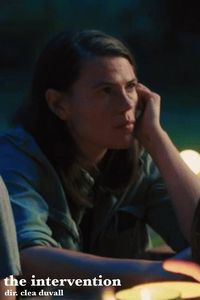
    (In French, On TV, September 2020) There are a few actresses out there that may not be household names, but have attracted my attention one way or another. I make a half-hearted effort to follow what they’re up to, especially when they leave the world of big-budget movies to do smaller movies. The Intervention not only brings together four of those actresses, but is also written and directed by none other than Clea DuVall, an actress whose first decade in the business was filled with roles in big-budget pictures, and then switched to lower-profile projects and TV series. With The Intervention, she works on both sides of the camera and delivers what could be called a Hollywood home movie: a low-stakes drama set in a secluded location, featuring an ensemble cast of characters played by friends and acquaintances. As a strategy to become a writer-director, it’s a clever one: the budget stays low, the friendships between the actresses translate into screen chemistry and the film can be approached as an actor’s showcase without the logistical complication of big costly sequences. The flip side of Hollywood home movies, however, is that they often feel similar: As with a theatrical piece, we get a first half of growing complications, and a second half of detonations. The camera moves in traditional ways, the script is good enough to provide a template, and the focus is on the performances. The Intervention does not escape the mould and, at times, feels like half a dozen other movies. Still, it does have its advantages. It’s set in Georgia rather than in the Hollywood Hills, and the cast is filled with recognizable names. You may not care as much as I do about Melanie Lynskey and Natasha Lyonne (here reuniting with DuVall seventeen years after the classic But I’m a Cheerleader!), or Alia Shawkat and Cobie Smulders, but here they are playing off each other. I found the overall result more interesting than entertaining, but it’s true that I’m far from the target audience for the film. I wish the film could have taken more cues from theatre plays in setting up and then playing off its interpersonal conflicts: there’s a tendency here to pull back from confrontation that I found annoying, but only in the context of wishing for a harder-hitting piece. If DuVall wanted to deliver something softer, then it’s up to her, and The Intervention accomplishes those objectives.

  • Green Room (2015)

    Green Room (2015)

    (Netflix Streaming, November 2016) While Green Room suffers from a slight case of over-hype, it’s not a fatal one. I’d been waiting a while, like many others, for a follow-up to writer/director Jeremy Saulnier’s acclaimed Blue Ruin, and Green Room does have a lot of what made the first film so interesting: sharply observed details, a respectful look at the lower rungs of society and an often-upsetting use of realistic violence. As a punk band gets embroiled in the dirty dealings of a neo-Nazi club in the middle of nowhere, the stakes quickly get deadly as they are locked in the green room and their opponents plan what to do with them. As a genre exercise, Green Room is well accomplished: our heroes are inside, the enemies are outside and there’s no help around. Violent episodes punctuate the film, resulting in a dwindling cast and ever-more inventive story beats. It ends satisfactorily enough, even though the film doesn’t revolutionize anything. Anton Yelchin stars as the headliner of the punk band. Against him, Patrick Stewart is simply chilling as a neo-Nazi leader. Meanwhile, it’s always interesting to see Alia Shawkat have a good role for herself. Still, the star remains Saulnier, who moves his chessboard pieces with cleverness and cranks up a decent amount of suspense when it counts. Now that he has created even more anticipation for himself, what will his next movie bring?

  • The To Do List (2013)

    The To Do List (2013)

    (Netflix Streaming, July 2015) Teenage sex comedies aren’t exactly rare, but what distinguishes The To Do List from the pack are that it dares take the perspective of an awkward but intelligent overachiever who get to set her own agenda when it comes to losing her virginity during her pre-college summer.  Setting the film in 1993 ensures that the answers to her fumbling exploration of the issue aren’t an Internet search away.  (Incidentally, I realized watching the film that 1993 was also the year of my pre-college summer.  Gee, I’m getting old when 1993 earns nostalgia points…)  The film does have a pleasant narrative drive, but it quickly becomes obvious that it’s not even slightly interested in being sexy –merely amusing with a side-order of cringe-worthy.  Aubrey Plaza headlines the film, but while I liked her a lot in other supporting roles, here she seems a bit generic –fortunately, supporting performances from Alia Shawkat and Sarah Steele as the protagonist friend have more personality.  The film’s low-budget is sometimes apparent, and the humor is uneven.  But I really don’t want to be overly critical of The To Do List: The female gaze of the film, written and directed by Maggie Carey, is undeniably more interesting that most American Pie-inspired boys antics and the conclusion seems surprisingly mature given the sub-genre of the film.  It is, in other words, the kind of small-scale film, imperfect and easily overlooked, that’s nonetheless a small success in its own way.  It would be a shame not to see it.