Andie MacDowell

  • At Home in Mitford (2017)

    At Home in Mitford (2017)

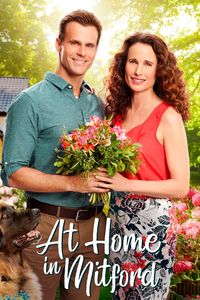
    (On TV, March 2021) How much do I like Andie MacDowell? Apparently well enough to look forward to stereotypical Hallmark TV romantic comedy At Home in Mitford, the kind in which a successful career professional comes back to her childhood small town and goes through the whole romantic-triangle experience. (But not too much lest moral complexity intrude.)  The narrative is familiar—but, as usual, the fun is in the nuts and bolts: MacDowell (magnificent in her late fifties) plays a divorced children’s book writer who goes back to a small town to find inspiration and sell her uncle’s house. Of course, romance walks in under the guise of the local episcopalian priest, who inspires her again, takes care of a boy left without family, is a friend to dogs and in all aspects outshines the real estate agent who would otherwise be the other romantic suitor. The small-town atmosphere of this kind of film is portrayed with enough unrealistic nostalgia to be charming, and no serious problems show up on the way to the ending. It’s interesting that the film plays both of its leads (she in her late fifties, he in his late forties) as at least 10–20 years younger — they have concerns and past histories more typical of late-thirtysomething folks rather than the more interesting romance that people their age would otherwise have. But that’s part of the strong fantasy of those kinds of films — perhaps the only surprise is that it doesn’t take place at Christmas. Is At Home in Mitford a good film? No! Absolutely not! It’s terrible! But it’s comforting, unchallenging and deliberately as innocuous as possible. I am somewhat amused that the most vicious IMDB reviews are from readers of the novel on which the film is based — apparently, it’s got it all wrong.

  • Bad Girls (1994)

    Bad Girls (1994)

    (In French, On Cable TV, July 2020) There were a surprising number of revisionist westerns in the 1990s, each one poking and prodding at various aspects of the classic Hollywood western tradition. The male domination of the genre is clearly the thing that Bad Girls wants to discuss, but there had to be a better way of doing it. With Madeleine Stowe, Mary Stuart Masterson, Drew Barrymore and Andie MacDowell, Bad Girls attempts to upend the usual western clichés by making the prostitutes the heroines of their own stories, taking revenge over bad men. It’s not a bad premise, but the way the film goes about it feels subservient to a male gaze in its execution. (Not to mention rape as a near-omnipresent plot device.) Our heroines are often scantily clad, going for titillation as much as empowerment. It really does not help that the film is executed flatly, with little in terms of wit and grace in the dialogue and situations. Director Walter Scott seems content to play with the images of the genre without doing anything much with them. Even in presenting women as western heroines, the film errs in caricatures. I still think that the premise holds a lot of potential, and I am a bit surprised that a quick search for “feminist western” doesn’t reveal any well-known successors. But Bad Girls doesn’t set much of an example—it simply doesn’t know what to do with its potential, and wastes almost all of it along the way.

  • Ready or Not (2019)

    Ready or Not (2019)

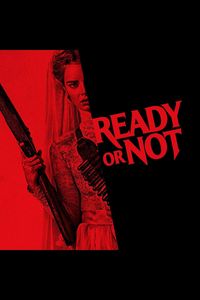
    (On Cable TV, May 2020) While I’m no fan of gory horror in general, I’m quite willing to make exceptions when the film is actually good. Or fun. Or interesting. Ready or Not ends up being all three, and for several good reasons. It’s a kill-the-rich satire, an anti-matrimonial fable, an intense horror film, a funny self-aware genre piece and a terrific showcase for Samara Weaving. The plot has to do with a mysterious rich-family curse that leads them to hunt and sacrifice newcomers to the family through a game of hide-and-seek. Which means that within minutes, our heroine is running inside a vast manor in a wedding dress, trying her best to remain undetected until sunrise. It doesn’t quite work out that way, of course—the set-pieces escalate in intensity with some very welcome comic relief along the way. Nicky Guadagni is a hoot as a mad troll doll, while Andie MacDowell is suitably leathery as the matriarch. It’s all superbly directed by Matt Bettinelli-Olpin and Tyler Gillett of “Radio Silence” fame. What takes Ready or Not one notch above the usual horror film is a sense of nuance, internal strife and a strong presence of the supernatural, remixed in a way we haven’t seen before. It’s gory and profane, but not unreasonably so given the overall atmosphere of the film. It toys expertly with the audience, knowing what they’ve seen before. As for myself, I did a complete 180 on Ready or Not, from a reluctant viewer of the opening to gleeful enthusiasm at the over-the-top finale. Can we spare a moment of mourning for the maids? The theme song is a powerful earworm.

  • Green Card (1990)

    Green Card (1990)

    (In French, On Cable TV, August 2019) Part of the point of casting known actors is to transfer some of the emotional impact of earlier films into a new one, and I certainly experienced some of that going into Green Card. The film, a romantic comedy about two strangers technically marrying for personal gain (a green card for him, a coveted apartment for her) features Andie MacDowell and Gerard Depardieu as romantic lead. While I like McDowell a lot (and not necessarily for her average acting skills), I’m not so fond of Depardieu—although some of this may be tainted from his rapidly declining twenty-first century personal image and reputation. As of 1990, however, forty-something Depardieu could still pass an acceptable romantic lead … but it’s up to the film to convince us of that. And while there’s nothing particularly surprising in Green Card, writer-director Peter Weir does know how to handle a movie. As we move through the expected set-pieces (sometimes with cleverly handled expectations—I defy anyone sitting midway through the piano sequence not to expect his character to be a fraud), the film does play the attraction game savvily. The actors also do their best. MacDowell remains limited in her range (although her character here is written as more restrained), but Depardieu does earn audience sympathies, and having Bebe Neuwirth show up for a few scenes certainly helps. It all leads to a conclusion that does manage to reassure Americans about their immigration system (a few lines have unique relevance in 2019), while providing a sufficiently distinctive romantic climax to keep audiences happy. This is not a particularly good movie, but it plays better than I thought it would, and Depardieu does make it work.

  • Multiplicity (1996)

    Multiplicity (1996)

    (In French, On TV, August 2019) The premise of Multiplicity sounds like a joke gone wrong: Let’s put two of my favourite actors in a single movie, and then add more of the same. That is: Let’s see Michael Keaton married with Andie MacDowell, and then let’s clone more Keatons. (Alas, there’s no cloning of MacDowell, which seems like a wasted opportunity.)  This being a Harold Ramis comedy, things are bound to get funnier, so as our overworked protagonist clones himself first to handle his job and then to handle family duties, things get complicated—especially when he inexplicably doesn’t tell his wife about it, leading to further complications. The added comic touch comes when the clones clone themselves, resulting in a dangerously stupid copy-of-a-copy that provides a lot of comic relief. This being Keaton’s show, he gets to play off four characters often interacting in the same frame (the chest-bump shot is particularly effective), playing off a base character, an exaggerated-macho version, an exaggerated-sensitive one, and a terminally stupid alter ego. The plot frequently doesn’t make sense (with clones seemingly losing knowledge of what they knew prior to their cloning), but this is a comedy meant to play with a familiar SF device, not a rigorous extrapolation. Multiplicity is amiable enough, with enough thematic depths about the multiple roles that we’re all asked to play being literalized in a silly comedy.

  • Saint Elmo’s Fire (1985)

    Saint Elmo’s Fire (1985)

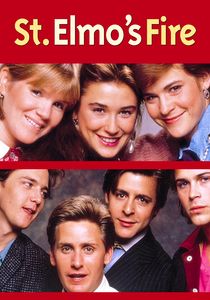
    (In French, On Cable TV, July 2019) It’s one thing to have complex nuanced characters, especially in an ensemble film. But Saint Elmo’s Fire is almost impressive in the way that it features one unpleasant character after another, self-absorbed and terrible to each other. It does start promisingly in its mid-1980s Georgetown setting, as its freshly-graduated protagonists try to figure out life, love and everything else. Alas, this quickly goes nowhere as the characters engage in self-defeating behaviour, do terrible things to each other and can’t seem to learn a single thing. The point of the film, for many viewers, will be the cast and director: A defining work of the “Brat Pack,” Saint Elmo’s Fire features Rob Lowe, Demi Moore, Emilio Estevez, Ally Sheedy, Judd Nelson, Andrew McCarthy and, not quite in the Brat Pack nor all that long in the movie, my own favourite Andie MacDowell, with Joel Schumacher at the helm (and, unusually, as a co-writer). It does feel like an immature teen movie with characters who only happen to be old enough for sex but not anything feeling like human interaction. It’s hard to believe that anyone involved in the film wasn’t aware of the inanity of the script, but if they tried doing a comedy then it’s a complete misfire. Trying to explain the finer details of the film’s plot is begging someone to call you insane. Anyone thinking of watching Saint Elmo’s Fire for the cast may want to reconsider the limits of that intention.

  • Only the Brave (2017)

    Only the Brave (2017)

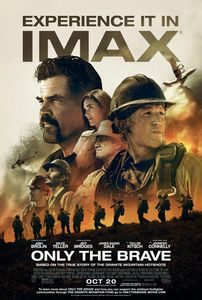
    (On Cable TV, October 2018) Hollywood has a fixation on making inspiring movies out of tragedies, and firefighter drama Only the Brave pushes this habit to the limit, leaving out a few less-savoury details along the way. The real events on which this film is based (and Only the Brave does itself a disservice by not stating this up-front) are tragic: nineteen close-knit firemen belonging to the fire crew of Prescott, AZ, died while fighting a brushfire. What the film insists on doing is to show the dedication, courage and tenacity of the doomed men, their relationships to be extinguished with their spouses, and so on. Everybody is ennobled in death, and the firefighters here are no exception. It’s a familiar script in that regard. What makes the film work beyond the mournful homage is in its execution from visually-strong director Joseph Kosinski. A solid cast headlines the film, with Josh Brolin as the chief leading the men in danger, and capable actors such as Miles Teller, Jeff Bridges, Jennifer Connelly and Andie MacDowell in supporting roles. The way the firefights are shown is also quite compelling—for a medium-budgeted film, Only the Brave has some exceptional special effects (in daytime, outside, wide-screen) to portray men fighting fires in dangerous circumstances. It’s almost certainly the best firefighter film since Backdraft and its earnestness does manage to keep the film going even when it’s not being subtle about what it’s doing. The film does end at the right moment, though: again, the real-life story had a very unpleasant epilogue, with the widows of some of the dead men having to fight the town council to secure benefits. That part is nowhere in Only the Brave, but then again some things are beyond Hollywood’s ability to transform in a noble uplifting film.

  • Four Weddings and a Funeral (1994)

    Four Weddings and a Funeral (1994)

    (On TV, July 2016) Curiously enough, I’d never seen Four Weddings and a Funeral, even despite being familiar with the stream of romantic comedies inspired by its success. Going back to the roots of the subgenre shows a film with the quirks and strengths of a relatively original script trying something its own way … rather than copying what’s been done before. Richard Curtis’s script is loosely structured around, yes, four weddings and a funeral (not in this order), this romantic comedy follows a foppish man (Hugh Grant, in a persona-defining performance) falling for a mysterious woman over a few key events. There’s a refreshing chaos to the amount and nature of the exposition required to set up a film with a core of friends and their acquaintances, and Four Weddings and a Funeral is perhaps most notable for the amount of stuff it doesn’t spell out along the way, trusting viewers to make up their own minds. This, however, can be taken too far: As much as I like Andie MacDowell in general (to the point of tolerating some dodgy line readings), she’s simply not given much to say here and the film feels weaker for being built on such a mystery. You can see how a modern retelling of the film, based on its imitators, would try to streamline the various charming little imperfections of the film—restricting the time continuity of the story to the days of the five events, spelling out subtleties, polishing some of the rough moments. It probably wouldn’t be as good, though: part of Four Weddings and a Funeral’s charm is how unassuming it is, and how it succeeds almost against all odds. That the result was often imitated yet rarely surpassed may be the ultimate compliment.

  • Groundhog Day (1993)

    Groundhog Day (1993)

    (On Cable TV, April 2012) Curiously enough, I’d never seen Groundhog Day until now, nearly twenty years after its release.  It’s one of those films quoted/referenced so frequently that it’s easy to feel as if you don’t need to see the actual footage to know about it.  But that’s wrong in predictable ways: This film hasn’t become a minor enduring classic for no reason: Past its high-concept, Groundhog Day is a solid, well-made movie with an appealing lead character perfectly played by Bill Murray, many small pleasures, terrific scene-to-scene narrative momentum, an eye-catching Andie McDowell, and a deeply satisfying thematic subtext.  Spiritual, funny, thought-provoking and unpretentious at once, it’s a film that clicks on nearly every level.  Its annoyances and contrivances are easily swept under the rug, and what remains is a terrific film even after two decades.  The spiritual growth of the lead character is inspiring, and is enough to make anyone think about how they’d act in similar situations. As a fantasy, it may not be particularly rigorous, but thematically it’s completely satisfying.  Don’t miss it, even if you think it’s way too late to see it.