
Andrea Riseborough

  • Possessor (2020)

    Possessor (2020)

    (On Cable TV, March 2021) Fiction genres are tricky in that they can be as much about content than tone. Science Fiction, for instance, can be about “stories in the future,” but SF can also be about a way to tell a story, with unspoken but strong conventions as to which kind of approach is forbidden. Along those lines, it’s interesting to see something like Possessor pop up, telling us a familiar story of jacked-in assassins taking over other people’s bodies, but doing so in a way that owes a lot more to gory body horror than traditional SF. It’s almost too easy to point out that it’s from Brandon “Son of David” Cronenberg — but with his filmography so far, younger Cronenberg seems to be tackling topics very similar to the earlier films of his father. Possessor is kin to his earlier Antiviral in being put together in a way that’s deliberately off-putting to viewers. A mixture of gore, blood, violent imagery, unpleasant topics, droning soundtrack and actors put in unglamorous makeup, it’s a familiar story told in unfamiliar ways, with a mean attitude and an unforgiving finale. Never mind the assassination plot having to do with a corporate takeover: the core of the film is in the way the lead character is manipulated in getting rid of anything tying her back to humanity. It’s both unpleasant to watch (you’ve never seen Andrea Riseborough look so awful, or Jennifer Jason Lee playing such a falsely-frumpy middle manager, or Tuppence Middleton being put through such a wringer) and unnerving in how it goes from one uncomfortable set-piece to another. The body-snatching assassin thing is almost a common trope, but few other films have consciously looked into the anti-heroic, anti-power-fantasy flip-side of such things. The toll of the job is immense, and the film goes in a very different, almost decidedly noir nihilism in solving the conflict. I’m not sure I’m ever going to see Possessor again, but I’m not at all indifferent to the result.

  • Mandy (2018)

    Mandy (2018)

    (Google Play Streaming, December 2019) Even if Nicolas Cage has proven his capacity to turn in good dramatic performances, he is a megastar because of his uncanny ability to do justice to grander-than-life characters, chewing scenery like the best of them. There’s no doubt that his tax problems have led him to a spiral of smaller, duller roles in recent years, but occasionally, he gets projects like Mandy in which he can showcase the kind of typical performances that ensure his immortality. But Mandy isn’t your typical movie: Blending a revenge story with a highly stylized cinematography in which not a single frame has not been heavily colour-corrected, it’s a quasi-unique film in today’s landscape. Nodding to the 1980s almost as much as in his previous Beyond the Black Rainbow, writer-director Panos Cosmatos concocts a genre story with quasi-supernatural elements that unleash Cage. The story has something to do with a logger taking revenge on a hippie cult after they murder his wife (Andrea Riseborough as the titular Mandy), but the point is in the purpled-hued phantasmagoric imagery, the fantasy art featured in the film and the nightmarish odyssey that the main character takes to exact his revenge. Battling leather-clad demonic bikers, crafting a battle-axe and befriending a tiger, the protagonist reaches an apex of sort during a chainsaw duel featuring a ludicrous blade measurement contest. It ends, as it should, with him bathed in blood. There’s a cross-genre sensibility found in Mandy that brands it as a cult favourite in the making—time will tell if it has staying power, but this is probably the best Cage performance and his best movie in years.

  • Oblivion (2013)

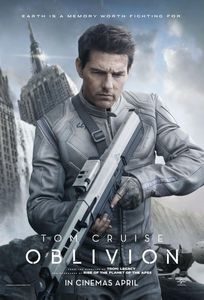
    Oblivion (2013)

    (Video on Demand, September 2013) For all of the nice things I have to say about Oblivion, there’s something just… off in the way it comes together.  The first few minutes don’t quite establish the required suspension of disbelief required for it to work smoothly: The visuals it presents don’t make a lot of sense and the pandering to modern lowest-denominator audiences seems blatant (let’s see: Yankees cap, Football stadium, dog, motorcycle and a cabin in the woods.  Yup, just one regular guy, no wacky sci-fi to see here…)  For viewers used to prose science-fiction Oblivion seems to pivot entirely on a familiar cognitive breakthrough structure, and the way it self-importantly reveals its secrets is a bit annoying, as if it expected audience’s minds to be blown apart by fairly obvious reveals.  The plot doesn’t quite seem to hold together the longer you look at it, and the visuals it shows (combining a ruined New York with what looks like epochal landscape alteration) are so nonsensical as to make anyone’s head hurt.  But let’s focus on the positive for a moment: It’s a science-fiction film that’s not explicitly based on existing intellectual properties, it features relatively original imagery (the “house in the clouds” is particularly nice) and it has the willingness to combine familiar tropes into a somewhat cohesive whole.  For writer/director Joseph Kosinski, it’s certainly a step up from the pretty-but-vapid Tron: Legacy.  Tom Cruise is overbearingly Tom Cruise-ish in the lead role (see “Yankees cap, football, motorcycle” above), but the supporting performances by Morgan Freeman, Andrea Riseborough and Olga Kurylenko bring a bit of balance in the film.  While there’s little that’s objectionably wrong in Oblivion, it doesn’t click either, and that’s a more crucial problem in SF movies than in other genres due to the required suspension of disbelief.  While it certainly looks nice and feels more original than yet another sequel of a comic-book movie adaptation, it doesn’t seem to have enough heft to it, and given the nature of the film’s revelation it’s hard imagining watching this a second time for fun.