Ann Harding

  • Westward Passage (1932)

    (On Cable TV, December 2022) By this time in my film education, I’m such a fan of 1930s Hollywood that I’m a good audience even for mediocre films—I can overlook many problems if the film is charming, and it takes a lot for me to go to “Wait, this is terrible!”  But “a lot” is not impossible to meet, and while Westward Passage begins with a cute sequence in which newlyweds (Ann Harding and Laurence Olivier) encounter a cranky rural inn owner (ZaSu Pitts), the rest of the film sinks fast into sheer loathing. Almost all of the film’s problems go back to the protagonist played by Olivier, a horrible pompous excuse for a writer who callously abandons his wife and child in order to pursue his ambitions. After the charming first sequence (albeit one that does heavily suggest his terrible personality), the film sinks lower and lower in horrifying plot points. They divorce, but he keeps hounding her (and his estranged daughter, even if she has remarried a much better man) years later, until we’re meant to believe that they get back together and this is a happy conclusion of sorts. No. NO. He’s awful and she’s an idiot and whoever brought this thing to the screen should be posthumously ashamed of what they’ve done. Awful dialogue and a lack of panache in Olivier’s delivery do nothing to make his character any more sympathetic—if you turn off the movie in the early scene in which he acts like a petulant child for being unable to sell his writing, you’re making the right choice because it doesn’t get any better after that. But wait, there’s more! Racism and waffling await, with the waffling from the female lead character being probably worse given that it leads to a conclusion that no viewer will believe or like. I rarely go off on 1930s movies like that, but trust me: Westward Passage is worth the venting. Absent Olivier, I doubt it would be remembered at all.

  • When Ladies Meet (1933)

    (On Cable TV, September 2022) The most interesting aspect of pre-Code films is not necessarily the violence or the scantily-clad ladies, but the way they tackle adult, intelligent issues with wit and crackling dialogue. The Hollywood style that developed during that time, fuelled by snarky sophisticated young writers imported from Manhattan and the best that Broadway had to offer, still feels unusually modern, as films of that time cleverly wrestled with independent women, relationships, infidelity, sexual ethics and other topics that would disappear from American cinema until the 1960s (and even then, re-emerging as reactionary bursts rather than more even-keeled subject matters). When Ladies Meet is an exemplary example of pre-Code cinema, as it studies women becoming friends without knowing that one is trying to seduce the other’s husband. Ironies abound, as do snappy dialogue lines and good character work by actors such as Myrna Loy (of course!), Ann Harding and Robert Montgomery. It makes for surprisingly grown-up viewing despite its age—even today, I’m not sure contemporary films can tackle that material without being tempted to score morality points. Pre-Code cinema, in some ways, hasn’t quite been surpassed yet…

  • The Animal Kingdom (1932)

    The Animal Kingdom (1932)

    (On Cable TV, January 2021) Regrettably enough, I had a really hard time staying interested in The Animal Kingdom, even restarting the film midway through in an attempt to goose my interest as my attention kept wandering elsewhere. It does have elements that I like—a Pre-Code era production (with some risqué themes), a protagonist associated with the publishing world, a choice to make between a safe-but-dull romantic prospect and another wild-but-unpredictable one. Myrna Loy is one of the most interesting actresses of the 1930s, while Ann Harding and Leslie Howard are not to be dismissed either. George Cukor had a hand in directing, and the film has theatrical roots that translate into better-than-average dialogue for the time. Still, there’s something to the rhythm of the film, its approach to the material and its audiovisual flatness (which, to be fair, is common to many early sound-era films) that simply had a hard time keeping my attention. When I realized, late in my second attempt to watch the film, that I simply wasn’t going to enjoy it, I also felt that nothing was going to help this time around. The film is in the public domain—it’s not going to take much for me to watch it again eventually.

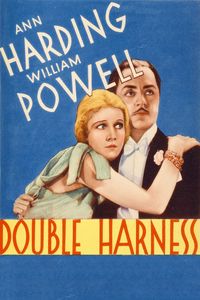
  • Double Harness (1933)

    Double Harness (1933)

    (On Cable TV, April 2020) Wait, wait, wait—you’re telling me that a Pre-Code William Powell film was considered lost for decades until it was brought back from obscurity by TCM? Strange but true—Loaned to RKO by Warners, Powell played in Double Harness and that film (along with five others) ended up excluded from RKO’s film library when its rights were sold back to the producer in 1946, who then did nothing with them. TCM managed to get those films back in circulation in 2007 and the result is yet another treat for Powell fans. The actor doesn’t step away from his persona too much in Double Harness—he plays a playboy manipulated into marriage, and then courted-for-real by his own wife. It’s a sophisticated romance well in-line with other Powell films, and having Ann Harding as his romantic sparring partner is a welcome change of pace. At 69 minutes, Double Harness is short but steadily amusing, and clearly Pre-Code in its faux-cynical consideration of the relationship between love and marriage. It would have been cruel to deprive the world of this Powell film—admittedly minor, but still a Powell film.