Anne Hathaway

  • The Witches (2020)

    The Witches (2020)

    (On Cable TV, June 2021) While I’m not that big of a fan of the 1990 adaptation of The Witches, there’s no question that this 2020 remake is clearly inferior — overdone, bleak and without much charm. I realize that there must be this irrepressible impulse in Hollywood to remake all pre-CGI special effects spectacles, and the corpus of fantasy movies from the 1980 onward must be a prime target. Alas, it takes much more than CGI and twenty-first century actors to recapture the magic that drew audiences to the original. Here, The Witches goes back to the original Roald Dahl novel for much of its inspiration — setting up a fantasy universe in which non-human witches want to kill all kids. It’s bleak, and it gets bleaker once lifelong vengeance is affirmed, protagonists get transformed into mice and there are plenty of violent deaths to go around. The ending is far from the return to normal you’d expect (even if the original novel is even worse), and the framing device (even when bolstered with a racial component) doesn’t add as much as you’d think. You can clearly see why director Robert Zemeckis accepted the project: as is now usual for him, it’s a film that offers nearly wall-to-wall opportunities for CGI flourishes. Unfortunately, it’s also once again the script that doesn’t do much with the top-notch effects. Anne Hathaway is mildly entertaining as the top witch, but once again there’s something too dark in the script that holds back the film from achieving whatever potential it was going for — too dark for kids, too dumb for adults, The Witches seems to live in the nether realm of remakes that should not exist because they didn’t understand what they should be going for.
  • Locked Down (2021)

    Locked Down (2021)

    (On Cable TV, January 2021) …and there it is. Stop the clock! Nine months, almost to the day, after the official March 13, 2020, start to the COVID-19 pandemic lockdown, here is the first movie about it, featuring known filmmakers such as screenwriter Steven Knight and director Doug Liman, likable big-name stars such as Anne Hathaway and Chiwetel Ejiofor, accompanied by big name supporting players such as Stephen Merchant, Mindy Kaling, Mark Gatiss, Ben Stiller, and Ben Kingsley. As befit the topic and historical/production circumstances, some of the actors in Locked Down are only seen via screens: the main plot starts with an examination of life in lockdown, followed by a crazy heist taking place deep inside London’s Harrods store. You can see that there are two movies duelling for attention here: A romantic comedy about a disintegrating couple stuck together in the worst of circumstances, and a caper film taking advantage of extraordinary circumstances for comedy and suspense. One of those movies is clearly better than the other. At first, Locked Down charms: playing on an unexpected set of universally recognizable experiences, it features two highly sympathetic actors going through tough video conferences, bemoaning their inability to go anywhere, and going a bit crazy due to cabin fever. Hathaway with her hair down is simply gorgeous in business top and pajama bottoms (despite a role first meant to be off-putting), while Ejiofor is blessed with the kind of florid dialogue that escapes reality to embrace movie magic. Locked Down could have been better had it focused on their disintegrating marriage and the tangent-filled nature of their dialogue… because most of my lingering problems with the film have to do with the somewhat more plot-heavy second half of the film, as the pair comes up with a plan to steal a precious diamond from the vaults of Harrods. The shift into caper film isn’t so smooth, largely (I suspect) because of the film’s breakneck production schedule: there simply wasn’t enough time or (literal) space to smooth out the film’s intentionally low production values and dubious plot mechanics. The film is quick and slapdash in how it moves its plot pieces around even when it complicates life for itself. (There’s an entire subplot that could have been sidestepped by the protagonist going around saying, “My parents had a weird sense of humour.”)  The result is a last third that gets increasingly ludicrous, and while Harrods makes for a wonderfully original backdrop for a caper sequence, the sequence itself has none of the taut ingenuity that similar films (including, ahem, Hathaway’s own Ocean’s Seven) could feature. Oh, I still liked the result well enough, and the circumstances of Locked Down’s production are nothing short of historic. We’ll be pointing at this film for years as having one of the wildest making-of, from idea to broadcast in seven months—to the point of its premiere pre-empting already-scheduled programming on Canadian Cable channel Crave at a few days’ notice. But the result, while quite likable at times, does come with a few vexing scenes and plot points that won’t make future viewers any more sympathetic to the film. But then again—these are craaazy times, says Locked Down, and it’s perfectly understandable if its characters are not behaving rationally.

  • Dark Waters (2019)

    Dark Waters (2019)

    (On Cable TV, November 2020) Much in the same vein as the Oscar-winning Spotlight (which shares headliner Mark Ruffalo as he settles comfortably in older, heavier, gruffer, more cerebral roles), Dark Waters takes on a big target and humanizes the fight against it. This time, the story begins once a farmer brings evidence of severe animal poisoning to a lawyer used to argue on behalf of Dupont. But, intrigued by the story, he starts poking and prodding at the evidence, eventually unearthing, after a decade of work, an incredible corporate coverup of toxic material dumping. It’s easy to think of similar films (Erin Brockovich also comes to mind), but that doesn’t make them any less relevant every time: we need to vulgarize those stories to give an example of what can happen when the system works. It may work slowly and grind those involved in it (Dark Waters is merciless in describing the toll that such a vast undertaking can take—Anne Hathaway’s character seems included solely to work that angle), but it can work and effect change. The problem is keeping a light on it. Dark Waters, as befit its title, is not a light and colourful film: shot in muted, cold cinematography, it looks serious and important even before any dialogue is said. But it’s successful at summarizing a complex matter of biochemistry and law in a way that doesn’t insult viewers—it makes the complicated accessible, even if we often feel the invisible strings of dramatization work their magic. Ruffalo (who also co-produced the film) makes for a likable low-key protagonist, with some assistance from noted co-activist Tim Robbins (who gets a fine speech that may reconcile a few viewers with the necessary role of lawyers), Bill Pullman, Victor Garber and Bill Camp as the very down-to-earth farmer who initiated it all. I wasn’t expecting to like Dark Waters so much, but found myself steadily engrossed in it. It does have the heft of an important film, but it doesn’t lose track of its requirement to keep audiences interested.

  • The Hustle (2019)

    The Hustle (2019)

    (On Cable TV, February 2020) In theory, the idea of a gender-flipped remake of Dirty Rotten Scoundrel (or Bedtime Story even earlier) doesn’t seem like a terrible idea: The French Riviera as a backdrop, rich idiots getting conned out of their money by quick-witted protagonists, with twists and turns until the credits. But that’s presuming a competent version of such a remake, and one that doesn’t sabotage itself. For instance, the biggest problem with The Hustle is Rebel Wilson—but she’s not the only thing dragging it down. Her usual trashy persona is a strong repellent to creating any sense of affection for the protagonists, and it’s telling that her brand of humour aims much, much lower than her equivalents in the previous films. Meanwhile, Anne Hathaway could have been an interesting foil as a con artist with far better manners, but the problem is that she can’t sell a laugh, and that the script doesn’t write her character wittily enough to compensate. This hints at the overall poor state of the screenplay, which seems to be so satisfied with the idea of female retribution against men that it doesn’t develop any additional reason to be on the protagonists’ side (and then pits both women against each other, undermining whatever it was going for). Several dumb set-pieces further erode any attachment we should have with the heroines—indulging into the worst and basest comedy instincts of filmmakers who obviously can’t handle any kind of sophistication. The Hustle is just one continuous misfire, but one that repeatedly back-pats itself without having deserved any of its self-congratulation. Both Wilson and Hathaway can be effective in other contexts (Wilson being best used as a supporting character, for one thing), but that’s not the case here. At best, The Hustle is a fluffy comedy that you’ll forget the next day, but that presupposes a lot of indulgence along the way.

  • Ocean’s Eight (2018)

    Ocean’s Eight (2018)

    (On Cable TV, January 2019) Like many, I’m not overly happy with the recent tradition of relaunching franchises with gender-flipped casts—it smacks of opportunism, and a cheap way to revive franchises that have otherwise run their courses. But even grouchy me had a hard time resisting the charm of Ocean’s Eight, which resurrects the modern Ocean’s comedic heist franchise with a mostly female cast. Headlined by Anne Hathaway (going back to a sympathetic character after a too-long detour playing out-of-persona unlikable characters), the ensemble cast tears into the usual heist plot mechanics with gusto, with everybody getting a choice moment or two. Plot-wise, this isn’t anything we haven’t seen before, although it should be noted that rather than head for banks or casinos like their male colleagues, the women of Ocean’s Eight head for jewelry at a high-end fashion event … because why not. This enjoyable follow-up has a snappy rhythm thanks to director Gary Ross, and even the post-heist material doesn’t drag on too much despite wallowing in useless complications. (But it wouldn’t be a heist movie if they went for a simple approach.) The ensemble cast is at the top of their game, what with Sandra Bullock going head-to-head with Cate Blanchett, Helena Bonham-Carter throwing in a bawdy French dialogue wordplay that is not adequately translated in the subtitles, as well as younger actresses such as Mindy Kaling, Rihanna and Awkwafina having good moments. It’s not meant to be profound or sophisticated beyond surface appearance, but Ocean’s Eight is a fun heist movie, and I quite liked it.

  • Alice through the Looking Glass (2016)

    Alice through the Looking Glass (2016)

    (Netflix Streaming, July 2018) Considering that I really disliked the 2010 Tim Burton live-action remake of Alice in Wonderland (for being dull and ugly, mainly, but also useless), I really didn’t have very high expectations for the sequel, and in fact delayed its viewing for more than a year before its impending disappearance from Netflix hurried matters along.  To my surprise, I actually liked Alice through the Looking Glass a bit better.  But here’s the crucial distinction: I liked the aspects of the sequel that wandered further from the original, and still disliked whatever linked the film to its predecessor.  I’ll allow that Mia Wasikowska is fine as the lead actress. Otherwise, though, the farther away the film runs with its time-traveling concept, the better it becomes.  Alice through the Looking Glass never breaks out of the increasingly mechanistic nature of 2010s fantasy films, but it does have some fun along the way, playing with grand visuals and peeking at younger (and less ugly) versions of the characters.  Heck, even the story is slightly more original than the usual time-travel stuff. Even the chronological theme does harken back to the Lewis Carroll mathematical games in the original novel.  It’s when the sequel clings to the original that it becomes much weaker.  Johnny Depp’s Mad Hatter is just as annoying as in the first film, Helena Bonham Carter’s character is still grotesque, and what the heck is Anne Hathaway doing with her hands in that role?  Pink’s catchy “Just Like Fire” anthem song makes for a nice single illustrating an expensive-looking end credit sequence but has nothing to do with anything in the film, the series or Lewis’ legacy.  As for the science-fictional devices, forget it – time-travel here is a story device that explicitly positions itself as taking place in an unchanging timeline.  Even the framing device fails to find a satisfying denouement, showing quite a bit of laziness in the story department that fails to properly support the visual aspect of the film.  And I won’t talk about the inevitable tendency of modern sequels to over-explain everything in their entire pocket universe.  I still don’t think Alice through the Looking Glass is a good movie, but at least it’s better than its predecessor, and it offers a few good moments even as the rest of the film drowns it in market-mandatory mediocrity.

  • The Princess Diaries 2: Royal Engagement (2004)

    The Princess Diaries 2: Royal Engagement (2004)

    (On TV, May 2017) There really isn’t a whole lot to say about The Princess Diaries 2: Royal Engagement, other than it does take up the Disney Princess wish fulfillment of its target audience even beyond the high-water mark of the first film (but seriously: a lavish princess slumber party?). The plot is clearly for the kids (this is a movie in which the villain quickly announces himself sotto voice to the audience) and quickly cycles through an episodic series of misunderstandings and dirty tricks. Anne Hathaway stars, making everyone a bit nostalgic for the phase of her career when she could play the bubbly long-haired ingénue: as of 2017, it’s been awhile since we’ve seen her in anything but a series of increasingly dour roles. Also notable is Chris Pine as a love interest, young but already charismatic back then. Julie Andrews gets a few laughs, while John Rhys-Davies doesn’t get much to do but sneer as the villain. Much of the film is tough to review for a middle-aged man, as it’s clearly meant for pre-teen merriment. There’s some lip service paid to deflating the idea of an arranged royal marriage, but it’s almost immediately undercut by the romance between the lead couple. Ah well; everyone goes into this movie for proxy royal thrills rather than enlightenment about the tension between love and duty. The Princess Diaries 2: Royal Engagement is a perceptible step down from the first film, but it should still please those who liked the first film a lot.

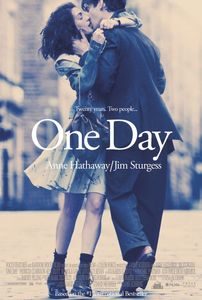
  • One Day (2011)

    One Day (2011)

    (On TV, December 2016) I’m hardly the only one to have noticed that the so-called romantic comedy genre fractured and exploded sometime around 2010, replaced by a multiplicity of takes upon romantic comedy that escaped the asphyxiating constraints of the previous monolithic genre. Films much like One Day, playing both stylistically and thematically with issues far more complicated than the “meet-cute; infatuation; complications; big finale; happily-ever-after” schematic formula that romantic comedies had settled into. One Day takes place over 18 years, skipping ahead for a day from one year to another as our two characters (Anne Hathaway, in her not-annoying phase, and still-featureless Jim Sturgess) nearly get together for a long time. It teases, it plays, it tears its characters apart for no better reason that it’s not quite done with them. Adapted from a book (which seems to be a near-constant in the neo-romance genre), it’s complex, takes place over a lengthier period of time, deals with a wider spectrum of emotions and isn’t necessarily as crazily upbeat as the classic rom-com genre. Similar examples include Dear John, Love, Rosie and others. One Day isn’t particularly memorable—some development are telegraphed well in advance, the film twists and turns too much to become a cultural reference and the bittersweet nature of its ending is unlikely to make it any lifelong fans. But it’s watchable enough … even if you don’t try to make it an integral part of a grand rom-com unifying theory.

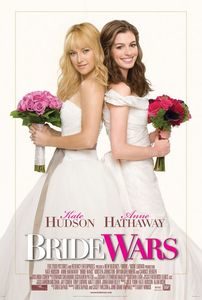
  • Bride Wars (2009)

    Bride Wars (2009)

    (On DVD, October 2016) The premise of “Two best friends turn into competing bridezillas!” seems so high-concept that Bride Wars should write itself without trouble, right? And yet, this is a film that seems so unaccountably full of missed opportunities, dull scenes and odd character moments that it often feels that it’s intentionally shooting itself in the foot. The result isn’t terrible, if only for seeing Kate Hudson and Anne Hathaway return to basic broad comedy. Some of the comic set pieces are amusing, and the supporting performances by Candice Bergen and Kristen Johnson can be amusing. But as the film advances, blind to more comic opportunities, it also turns gratuitously sour (as per the Emma/Fletcher subplot) and so far-fetched that the seemingly happy conclusion feels unearned—even contrived to be unsatisfying. There are so many obvious ways the story could have turned out without arbitrarily going through its checklist of plot points that the final result seems like a lazy patchwork at best, wholly manipulated at worse. Even for the notoriously lax standards of romantic comedies, Bride Wars seems like a misfire, which is too bad given the premise and calibre of the people involved.

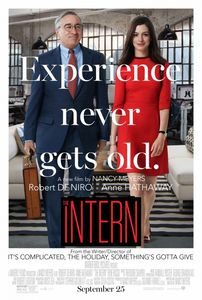
  • The Intern (2015)

    The Intern (2015)

    (On Cable TV, May 2016) It would be far too easy to dismiss The Intern based on conventional expectations. As with nearly all of writer/director Nancy Meyers’s films, this is mild-mannered drama featuring rich white people, with absurdly privileged stakes and a near-absence of conflict. It would be equally easy to expect the worst from Robert de Niro (who, in fifteen years, has completed his transformation from a vital dramatic actor to a walking punchline), be annoyed by Anne Hathaway playing a dot-com entrepreneur or complain about the expected life lesson of “old people have much to teach to the younger generation”. Once you’ve completed your pre-viewing gagging, though, have a look at the film, because The Intern is quite a bit better than expectations would suggest. Perhaps the biggest surprise here is Robert de Niro, who actually manages to turn a good and poignant performance as a seventy-year-old widower returning to work out of sheer boredom. Once the obvious jokes about technology have been made, the film is free to explore notions of old-school masculinity in a modern context, and de Niro makes for a splendid role model given how he’s not asked to parody his usual persona. (One notes that the role was originally planned for Michael Caine.) The script’s gentle rhythm feels like a welcome change of pace for mainstream comedies, and there are a few highlights here and there: Rene Russo pops up as a love interest (ten years younger than de Niro, but that’s still not too bad), a few scenes of physical comedy are funnier than expected and the film does get better as it goes along. There are a few weaker moments, many of them having to do with an infidelity subplot, but The Intern defies expectations by being better than it should have been. It will work better on viewers who are ready for another Meyers film—her style may not be conventional, but her movies often act as breaks from routine. While The Intern may not set audiences ablaze or age very well (the dot-com chatter alone may date the film within a few years), it does what it intends to do and tries to do something easily dismissed but rarely attempted in mainstream Hollywood.

  • Love & Other Drugs (2010)

    Love & Other Drugs (2010)

    (Netflix Streaming, April 2015) Consider me pleasantly surprised: I wasn’t expecting much from this romantic comedy, but Love & Other Drugs has more than enough bright moments to earn a marginal recommendation despite an unsatisfying conclusion.  The two best things about the film, obviously, are the performances by Jake Gyllenhaal and Anne Hathaway, both of whom manage to elevate potentially reprehensible characters into likable romantic leads.  The third best asset of the film is the first half of co-writer/director Edward Zwick’s script, which manages to deliver a witty introduction to the world of pharmaceutical product selling, along with a mature love story that seemingly holds little back.  Yes, this means plenty of nudity.  But more importantly, it also means two protagonists who delight in making their coupling as difficult as can be, negging each other relentlessly and desperately clinging to an unrealistic ideal of non-attachment.  The dialogue is biting, the love scenes have a bit of heat to them, Hathaway looks spectacular (on-par for Hollywood’s idea of terminally-ill young women) and Gyllenhaal plays up his motor-mouth hustler character in a way that’s actually charming rather than infuriating.  But Love & Other Drugs goes awry somewhere past its midpoint, as it struggles with the realization that it has introduced a romance with no possible satisfactory conclusion.  From sharp-tongued comedy, it becomes both a weepy drama about an incurable disease then a routine romantic film with an expected ending.  The credits roll on happy characters, but we viewers suspect a much darker aftermath.  The last-act blend of romantic idealism clashes with the grim advice received by the protagonists and the cynical spirit of its initial scenes.  As much as I enjoyed the first half of the film, it does set up expectations that are impossible to fulfill.  There may have been a better film lurking in the basic premise, one with a more biting denunciation of Big Pharma and fewer emotional dead-ends.  In the meantime, you can always be riveted by the first half of the film, and let your attention wander during the rest. 

  • Les Misérables (2012)

    Les Misérables (2012)

    (On Cable TV, October 2013) A quick trawl through these reviews will reveal that when it comes to movie musicals, I’m a very forgiving reviewer.  I have embraced the musical in its post-Moulin Rouge era and a few disappointments aside, I’m usually fond of the genre.  So imagine my surprise when I found myself annoyed, bored and exasperated by Les Misérables, surely one of the most instantly recognizable examples of the genre to come down the Broadway-to-Hollywood route.  I groaned when I realized that Les Misérables would not only be wall-to-wall singing, but that nearly every song would sound the same and drag on forever.  More than once, I left the living room for errands and came back minutes later to characters expressing the same emotion.  For all of its nice cinematography and convicting re-creation of a troubled period in French history, Les Misérables plods on for more than an excruciating two hours and a half, on a musical register than barely varies from one song to the next. Perhaps my powers of concentration are gone; maybe I’m just picky when I should be forgiving.  And it’s not as if the actors are slacking, given how many of them do well with parts that exceed their signing range. Seeing Hugh Jackman, Russell Crowe, Anne Hathaway, Amanda Seyfried, Sacha Baron Cohen and a thoroughly unglamorous Helena Bonham Carter voice their miserable condition is interesting as in we-haven’t-seen-this-too-many-times-before, but they can’t make the pace move more quickly, or change the film’s intention to make nearly every line of dialogue sung.  (Still, I note that the most memorable performance comes from musical-cast-member Samantha Barks, who makes the most out of a limited role as Éponine)  Les Misérables is lavish filmmaking on the highest level –but it’s annoying for idiosyncratic reasons that I can’t fully articulate.  Upon reflection, through, it occurs to me that I’m fonder of original-movie-musicals rather than straight-up adaptations of existing Broadway shows.  Let’s keep the musicals on Broadway, and use the cinema screen for something that fully exploits cinema as a medium.

  • The Dark Knight Rises (2012)

    The Dark Knight Rises (2012)

    (On-demand Video, December 2012) Is it possible to follow-up a modern classic such as The Dark Knight without making a few missteps in the process?  Probably not, but writer/director Christopher Nolan makes fewer mistakes than most in trying to provide a definitive conclusion to the cycle he launched with Batman Begins: In The Dark Knight Rises, he’s willing to toy with the archetypes of superhero movies (Batman doesn’t make an appearance until 50 minutes in the film), blending it with real-world elements in order to deliver a thrilling, hefty, sometimes-philosophical take on the place of extraordinary people in society.  Christian Bale once again stars as Batman/Bruce Wayne, once again flanked by Michael Caine, Gary Oldman and Morgan Freeman, and this time ably supported by Tom Hardy as supervillain Bane, Joseph Gordon-Lewitt as a capable partner and less-ably by Anne Hathaway as Catwoman.  (Let us be blunt: Hathaway has old-school grace and beauty, but it’s not the slinky-sex-kitten quality that the best Catwomen should have.)  Still, the script is the most interesting element of the picture: it blends real-world markers with superhero crutches (so that we get CIA extraction planes, professional football games and references to social inequality alongside cities cut off from the rest of the world by hoodlums, people dressing up in amusing costumes and a quasi-mythical “League of Assassin”), scratches a little bit to reveal character motivations, re-uses elements of the previous two films to good effect and tells a surprisingly satisfying story despite numerous small flaws.  For anyone else, The Dark Knight Rises would be an impressive achievement: as big and bold as an action blockbuster should be, while handled with a surprising amount of depth, darkness and complexity.  Still, compared strictly to Nolan’s previous two films, it’s a bit of a letdown: the themes aren’t as strong as in The Dark Knight and the ingeniousness of Inception is considerably toned down.  But never mind the comparative let-down: The Dark Knight Rises is an enormously successful film, another example that entertainment doesn’t have to be entirely brainless.  It’s a spectacle with some depth, a daring way to handle an immensely popular protagonist and a subversive way to follow-up its previous two installments.  It easily ranks as one of the good movies of 2012, and it should please even the most demanding fans.

  • Rio (2011)

    Rio (2011)

    (In theatres, April 2011) The possibilities of computer animation are in full bloom in this high-spirited, fizzy, highly enjoyable adventure starring talking songbirds.  The story has chases and romantic comedy plot points that we’ve seen dozens of times before, but they’re executed in such light-hearted fashion that it’s hard to be overly critical.  (Although there are two spitting gags that don’t really fit.)  From the spectacular opening musical number to the closing credits, Rio does honour to its namesake by being as vibrant and colourful as Brazil often feels.  And yet, for a film aimed at kids, it still manages to slip in a few socially-relevant mentions of animal smuggling and poverty in the favelas.  Still, the emphasis is on the animals, and that’s where the vocal performances matter.  Jesse Eisenberg is good as the socially-mystified hero, but his voice is, by now, so closely identified to an nebbish archetype that it can be distracting.  Meanwhile, wil.i.am and Jamie Foxx have the chance to sing a bit, while Anne Hathaway is generally unobjectionable as the other main character.  While Rio gains to points for audacity, it does the now-familiar animated-feature characteristics well: A few fast-paced action sequences, cute anthropomorphic characters, a humorous tone, some singing and dancing and a finale that wraps everything up.  It may not push the envelope like many of Pixar’s films, but it’s good enough to be pleasant and satisfying both to kids and adults.

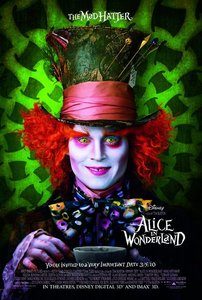
  • Alice in Wonderland (2010)

    Alice in Wonderland (2010)

    (In theatres, March 2010) The good news with Tim Burton is that he is guaranteed to put a vision on screen.  Alas, it may not be the vision you would prefer.  So it is that this loose sequel to the classic Alice in Wonderland is an affront to my aesthetic preferences: At the exception of the oh-so-cute Cheshire Cat, I found the film’s artistic choices ugly.  This is partly intentional; after all, the point of this follow-up is that Wonderland has grown tainted; the magic has fled the land and been replaced by corruption.  {Insert heavy-duty genre fantasy narrative schematics inspired by John Clute here.}  No wonder everything is so repulsive.  The showy use of 3D makes moments of the film look even more incomprehensible and overdone to 2D audiences.  But as hard as it is to ignore Alice in Wonderland’s visuals, the real snore comes from the plot, which feels as Alice filtered through the Lord of the Rings plot template that has informed almost a full decade of genre cinema fantasy by now.  It’s dull, and the overdone shot of the two armies running to clash together has become almost parody.  Alice in Wonderland becomes duller as it goes on, and not even Johnny Depp’s increasingly active Mad Hatter (or Anne Hathaway’s regal presence, for that matter) can do much to redeem the rest of the picture.  It’s a middling fantasy film at best: when “dull” and “ugly” crop up in the same review, there’s little room for favourable quotes.