Anthony Quinn

  • The Secret of Santa Vittoria (1969)

    The Secret of Santa Vittoria (1969)

    (On Cable TV, April 2021) In a film universe of recycled premises, it’s always interesting to find something that has not (yet) been overused, yet remains reasonably accessible. In The Secret of Santa Vittoria, we find ourselves in Post-Mussolini WW2 Italy, in a small village patiently awaiting the arrival of allied troops. Except that… the Nazis have taken a keen interest in the town’s well-known wine, and they arrive in town with the intention of confiscating the entire stock. Except that… the villagers are not idiots, and have taken steps to hide four fifths of the reserve. Except that… the Nazis are not idiots either and have noticed the accounting discrepancy. The stage is thus set for a battle of will between the eccentric new mayor (Anthony Quinn) and the ice-cold Nazi commander (Hardy Krüger). There are many complications, some of them sentimental. Directed by Stanley Kramer and constrained by the tone of the novel from which it’s adapted, the comedy of the film is curiously restrained, sometimes veering into wartime drama with real dangerous stakes. Still, the biggest attraction of the film is probably the setting — the producers worked hard to find a picturesque WW2-style Italian town in the late 1960s, and the proof of their success is found on the screen, with a rather good sense of place and the town fountain acting as a central showpiece for much of the action. You can see how The Secret of Santa Vittoria could have been much funnier if it had tried, but it had something else in mind and it’s hard to argue with the results.
  • Sinbad, the Sailor (1947)

    Sinbad, the Sailor (1947)

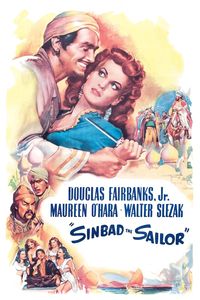
    (On Cable TV, March 2021) Presented as part of TCM’s lineups of “Reframed: Classic Films in the Rear-view Mirror’” of March 2021 (i.e.: Popular films from the Hollywood golden age that, when seen from a contemporary perspective, contain problematic elements that would not pass without criticism today), Sinbad, the Sailor clearly belongs to that category for its stereotypical depiction of Arabic characters and culture. Not only do you have Caucasian Douglas Fairbanks, Jr. playing Sinbad in dark makeup, you also have a festival of clichés in its Arabian setting, lines that would be considered blasphemous to Muslim viewers, fake-Arabic dialogue and cultural misappropriation galore. It’s a lot to take in, but little of it actually distracts from the swashbuckling effectiveness of the film. Shot in lush Technicolor to take advantage of the colourful sets and costumes, it’s an adventure film with lavish production values and a scope to match. Telling us about Sinbad’s “eighth voyage,” it’s a trip featuring villains (Anthony Quinn!), damsels in distress (Maureen O’Hara!), sword-fighting and deliciously florid dialogue delivered with gusto. In other words — yes, it’s dated, but dated in interesting ways… and I’m not the right audience to ask about whether I should be offended by a work of pure fantasy. This is, to be fair, really not Hollywood’s worst offender when it comes to Arabic culture: Have a look at The Thief of Baghdad or any of the versions of A Thousand and One Nights to realize that Hollywood used Middle Eastern settings as a fantasy playground throughout much of its early history. Meanwhile, Sinbad, the Sailor is mildly enjoyable — not a swashbuckler of the highest order, but something reasonably entertaining, with a spirited performance by Fairbanks and plenty of visual delights. Even though it’s not possible to exonerate it, I can think of some far more problematic films.

  • Across 110th Street (1972)

    Across 110th Street (1972)

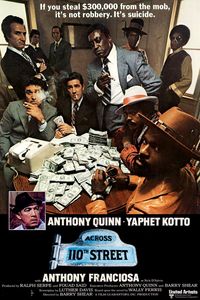
    (On Cable TV, November 2020) If you’re looking for a dark and grimy 1970s crime drama, Across 110th Street is a better choice than you’d expect. While it doesn’t have the gravitas of contemporary New York City thrillers such as Serpico or Death Wish, it’s considerably lighter on its feet, and its matter-of-fact trashiness is more a reflection of the times and place than a lack of ambition. Largely shot on location in Harlem (which wasn’t just a marketing coup, but somewhat risky at the time), this is a story about criminals hitting an organized crime cash drop, and the police trying to catch the murderers before the retaliation begins. The racial element is an integral part of the story, with a racist veteran cop (Anthony Quinn) paired with a younger black policeman (Yaphet Kotto) in order to get anywhere during the investigation. By modern standards, Across 110th Street is not that good of a movie—many familiar elements, unimpressive action sequences, a hackneyed message on racial reconciliation… nothing we haven’t seen elsewhere. But it does have a remarkably effective period feel, starting with its opening theme song, and it moves with a somewhat impressive pacing. Halfway in (or out) of the blaxploitation movement, it’s a bit more upbeat than most urban crime dramas of the time, and not quite restrained by the intentional aesthetic limitations of exploitation films. As a result, it has aged beautifully as a period piece, clearly of 1972 but enjoyable at other times.

  • Viva Zapata! (1952)

    Viva Zapata! (1952)

    (On TV, September 2020) The best reason to watch Viva Zapata is for Marlon Brando, and Marlon Brando is probably the best reason not to watch the film as well. Of course, that statement will hinge a lot on how you feel about Brando playing a Mexican revolutionary through a mixture of a stereotypical accent and quite a bit of mumbling. I pretty much loathed it (in keeping with a surprisingly large chunk of Brando’s filmography), and that’s probably where my review should stop. Alas, there’s more to it. Directed by Elia Kazan, featuring an Academy Award-winning supporting performance by Anthony Quinn and a screenplay by John Steinbeck (plus Daryl F. Zanuck producing), Viva Zapata is no lightweight fly-by-night production: It was intended as a prestige film, and the two things preventing the film from being recognized as an epic 1950s film are its restrained length (less than two hours) and black-and-white cinematography. It surely plays fast and loose with the historical facts—Zapata here is presented as a populist folk hero, illiterate (which wasn’t true) and utterly unremarkable from a political point of view. Worst of all is the somewhat tepid pacing and lack of sustained interest. At least Quinn is reasonably authentic. As for the rest of Viva Zapata—well, can you stand two hours of Brando mumbling? Some think that’s the best thing ever; others will want to claw their way to the exit.

  • Lust for Life (1956)

    Lust for Life (1956)

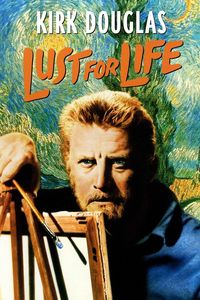
    (On Cable TV, March 2020) Kirk Douglas is quite a revelation in Lust for Life, surprisingly good at playing Vincent van Vogh as a tortured-artist archetype. (And if that’s not enough, you also have Anthony Quinn playing Paul Gaugin, because why not?) His red hair and beard are as striking in Technicolor as the artist’s vivid paintings, even if Douglas’ energetic performance is apparently not quite the right fit for the reserved painter. But let’s be clear—this is a Classic Hollywood biopic movie made in the 1950s by Vincente Minelli—there’s no way it would be melancholic, realistic or even accurate. This is l’artiste as presented to the moviegoing masses as a big weirdo, and it’s enjoyable even if we suspect that’s it’s complete bunk. Production values are high, the acting duet between Douglas and Quinn is quite good, and the paintings are given centre stage, so that’s that. If you’re particularly concerned about authenticity, there are many other Van Gogh movies out there—this one is best taken as an opinionated take on familiar material, with the gloss of a mid-1950s studio production.

  • Alexis Zorbas [Zorba the Greek] (1964)

    Alexis Zorbas [Zorba the Greek] (1964)

    (On Cable TV, December 2019) You can say that Zorba the Greek gets a lot of mileage out of opposing a prim shy Englishman (Alan Bates) to an earthy, lusty, boisterous Greek (Anthony Quinn), but that’s only half-true. It gets as much mileage out of opposing a formidable character (Quinn as the titular Zorba) to a plot that goes in various directions, many of them so melodramatic that they lose their tragic edge. Much of the story takes place in a small Cretan village where our two protagonists are working on a mining project, a village where casual violence and savage behaviour seem to be the norm. The Englishman isn’t ready for such a place; Zorba does better but even he can be defeated by so much traditional madness. But Quinn overpowers the picture as Zorba—his career-defining performance is easily more compelling than the plot, to the point where you can ask if the plot is strong enough for the character. I’m not entirely convinced by the results: the most memorable scene of Zorba the Greek is an unbearably tragic death that would send most characters (and viewers) running away from that bloodthirsty village, but here it’s one more thing on the way of many more things just as bad. Quinn makes the most out of his character, but the film itself leaves disappointed, not quite making a point, not quite delivering a satisfying ending, not quite playing in a specific tonal registry. It remains a landmark of mid-1960s cinema, but it hasn’t aged all that well—the “rural savages” angle smacks of bigotry more than opposing modern values to traditional ones. Plus, well, Irene Papas is so cute that what happens to her leaves a bitter taste—not to mention the end of Lila Kedrova’s performance as well.

  • Union Pacific (1939)

    Union Pacific (1939)

    (On Cable TV, August 2019) I’m not sure how much we twenty-first century sophisticates truly understand the meaning and importance of the first coast-to-coast railway. To put in modern context, it was akin to building the first highway and the first Internet link throughout the country at the same time. The first transcontinental railway (1869 in the United States, 1886 in Canada) did as much to tie the country together as any law. It standardized time, facilitated the mobility of labour, ended the wild frontier, improved the flow of news and information—all things that we now take for granted. We may never be able to fully appreciate that it meant then, but at least there are movies like Union Pacific to make us appreciate the details of how it was done. Focusing on a troubleshooter for a railroad company, this is a film that takes a look at the nitty-gritty of building such a revolutionary endeavour, from shooing away undesirables that prey on railroad workers, to the logistics of keeping such a group of workers fed and productive, to negotiations with the native tribes. Joel McCrea plays the troubleshooter, bringing his usual charisma to the part and helping to humanize a complex subject. Barbara Stanwyck plays the love interest, while you can see (or rather hear) Robert Preston and Anthony Quinn in the supporting cast. But this is director Cecil B. de Mille’s film—an expansive, spectacular subject matter that never misses a chance to stage a large-scale action sequence. While the film does regrettably rely on native attacks as a pretext to action scenes, it does spend more time than was usual back in 1939 showing how those attacks were motivated by the white businessmen breaking their promises to the tribes. Union Pacific is my kind of western—not a celebration of the wild frontier using the usual macho tropes of the genre, but a study in how civilization spread throughout the land and closed the frontier. Some film historians point to this film and Stagecoach as when the Western grew up, but I can only testify as to the interest that it created and sustained over a two-hours-and-fifteen minutes running time: It’s a fascinating railway procedural, and it manages to have a nice human edge to it.

  • La Strada [The Road] (1954)

    La Strada [The Road] (1954)

    (On Cable TV, June 2019) Given that I don’t particularly like Italian neorealism and that Federico Fellini hadn’t yet fully evolved into his more personal expressionist style by the time he completed La Strada, you can probably guess how I feel about the movie. An episodic drama focused on two desperately poor entertainers eking a life of misery on the road with a circus, La Strada is not a film for the impatient. While there is a plot of sorts that eventually distinguishes itself from the individual scenes, it takes a long time between the scenes to get the narrative ball rolling … and you may not like where it’s heading. Anthony Quinn, unusually enough, stars as the strongman Zampanò. Alongside him, Giulietta Masina (familiar from her later role in The Nights of Cabiria) plays the dim-witted long-suffering young girl basically bought by the strongman. I tolerated much of La Strada, but the parts I liked more were those that strayed away from the neo-realist style (into expressionism, into genre suspense). Otherwise, it’s enough to be able to scratch off this film from the umpteenth lists of essential movies on which it figures. One annoyance (or cool find): The five notes of the film’s insistent leitmotif are near identical to the opening of the theme to the James Bond film The Man with the Golden Gun.