Arthur Hailey

  • Airport (1970)

    (On DVD, July 2021) The big irony about Airport is that even if it’s credited with launching the disaster movie boom of the 1970s, it’s not quite a disaster film through and through: Adapted from a thick procedural novel from the legendary Arthur Hailey, it spends more than an hour and a half detailing the professional and personal struggles of an airport manager during a particularly trying snowstorm. Launching an ensemble cast’s worth of subplots, Airport does gradually build the suspense of its impending disaster, but it remains quite an intimate affair compared to the excesses of its later imitators. For much of the first hour, it remains a remarkably sedate affair. Our airport manager (a solid turn by Burt Lancaster) struggles with a status-seeking wife, a bickering brother-in-law (Dean Martin, playing a playboy pilot), protesting homeowners and that’s all before the film starts, because in the opening moments a pilot error blocks the airport’s main runway even as the snow piles up. Plenty of other subplots are brewing as well — including a charming elderly stowaway (Helen Hayes in an Oscar-winning role), a cigar-chomping maintenance chief tasked with resolving the problem of the stuck plane (George Kennedy in a delightful role — no surprise that he reprised it in the three sequels), and, most crucially, a psychotic engineer with plans to bring down a plane over the Atlantic (Van Heflin in his last role, really not looking as trim as he was twenty years earlier). The all-star ensemble cast is something that other disaster films would reprise with gusto (indeed, watching all four entries in the Airport series is like getting a reunion of classic Hollywood celebrities) even if the formula would eventually be tweaked to bring the disaster earlier in the film. It’s amusing to see the hostile reviews that Airport got upon release, even as it topped the box office for weeks: By 1970, the New Hollywood was getting all of the critical attention, and holdovers like Airport were treated with disdain even as audiences lapped it up. Decades later, Airport’s filmmaking style has become the standard, meaning that it still plays rather well once you get past the slow opening. It’s clear that Airport often gets dinged for the excesses of its successors — the sequels are progressively wilder, cheaper and dumber and that’s not mentioning the other disaster films of the decade—but it’s best seen as a slow-burn suspense film with a still-realistic execution. It’s hardly perfect — the dialogue is often ordinary and there are scenes with as bad a case of “as you know, Bob,” as I can recall seeing—but it’s quite entertaining in its own way, and almost charming in its insistence on sticking to tried-and-true formulas.
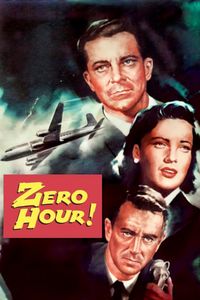
  • Zero Hour! (1957)

    Zero Hour! (1957)

    (On Cable TV, June 2021) These days, Zero Hour! is far better known as the thriller that most inspired the classic spoof Airplane! —but the film’s intricate production history and influence are a far more interesting tangle of names and genres. Thanks to Wikipedia, here’s a summary: In 1955, thirtysomething Canadian writer Arthur Hailey, while flying commercially between Vancouver and Toronto, came up with the idea of a flying crew being incapacitated by food poisoning, forcing a traumatized veteran to pick up the controls to land safely. His script was sold to the then-new Canadian Broadcasting Corporation, which turned it into a successful 1956 live television play named Flight into Danger. That led, a year later, to this American studio remake titled Zero Hour! But it doesn’t stop there — In 1958, the story was novelized as Flight Into Danger: Runway Zero-Eight; in 1971, turned into American TV movie Terror in the Sky. In parallel, Hailey became a writer of international best-selling fame, whose famously long novels offered lavish exposés of familiar industries—the best-known of them being 1968’s Airport, which led to the 1970 film of the same name that launched the disaster-movie subgenre of the following decade… which was spoofed by Airplane! which would launch the spoof subgenre of the 1980s–1990s.   Whew — talk about tangled webs. As for Zero Hour! itself, its viewing experience can feel scattered: While viewers having seen Airplane! will have fits of unintended grinning at seeing the raw material later parodied (down to character names, specific plot points, character dialogue and stylistic devices), the film itself does remain a solid airborne thriller. The late-1950s style makes it just bombastic enough to be good fodder for parody, but it’s also very much in-line with what was done at the time. The special effects shots obviously don’t pass muster these days, but they do add a bit to the period charm of the film. I remain impressed that the film, produced by an American studio, kept the Canadian nature of the film in featuring Canadian characters going to Vancouver on their ill-fated flight. It’s still moderately involving as the thrills escalate and the rather impressive plotting all neatly slots together in a very watchable whole. I wouldn’t expect any twenty-first century viewer to see Zero Hour! and follow it with a first viewing of Airplane!, but that would be an amazing experience. Otherwise, reactions to Zero Hour! are likely to be unintended — giggling in the wrong places, either by remembering the parody over the original, or simply reacting incredulously to the overblown style of late-1950s thrillers. I quite liked it, but I really can’t guarantee the same thing for anyone else.

  • Hotel (1967)

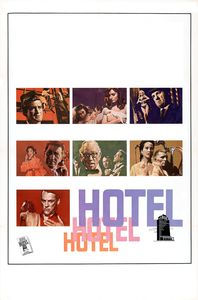
    Hotel (1967)

    (On Cable TV, April 2021) As someone who read almost all of Arthur Hailey’s novels as a teenager, I knew what I was getting into in approaching Hotel: A sprawling, ensemble-cast look at a particular environment, with a narrative built of subplots exploring that environment. Some call it didactic fiction — I just liked the stuff. Now, novels like Hailey’s can’t very well be replicated in film: viewers won’t stand for it in the same way that readers do, and there’s only so many subplots you can fit in a two-hour film (as opposed to, say, a miniseries). So, it’s not a surprise if Hotel-the-film is a markedly simpler thing than Hotel-the-novel, nor if the depths of the docufiction aren’t as satisfying. Accordingly, I got far more fun out of the film’s first half than the second, as the job of the hotel manager protagonist is demonstrated, as the subplots are set in motion, as the film takes some time (even fleetingly) to explore its setting. There’s a beautiful one-shot, for instance, coming out of an elevator into the hotel lobby, tracking the protagonist as he takes care of business, then goes back into the elevator. After that, well, the subplots take over and don’t necessarily converge toward a happy ending, and the hotel itself is not allowed to remain the central character like it did in the book. Still, I liked the final result quite a bit — Rod Taylor brings his square-jawed charm to the role of the hotel manager, Catherine Spaak plays a great femme fatale in very 1960s style, the incredible racism of the hotel owner is a reminder of how far we’ve come in fifty years, the production design is impressive and Richard Quine’s direction has its moments. There probably wasn’t room to fit anything more in the film short of turning it into a TV show (which is still not a bad idea, hint). Fleetingly, Hotel did take me back to earlier days reading through Hailey’s brick-sized novels, and that’s also a plus.

  • Detective, Arthur Hailey

    Berkley, 1997, 595 pages, C$10.99 mmpb, ISBN 0-425-16386-5

    Arthur Hailey is best known for novels that peeked under the surface of familiar institutions to reveal their inner mechanics. Hotel and Airport became blockbuster movies that did much to ensure Hailey’s continuing bestsellerdom. The Moneychangers dealt with banks. Wheels talked about the Detroit auto industry. Overload took on the power-generating industry. The Evening News… well, you get the picture.

    In all cases, Hailey delivered intricately researched novels, seemingly taking more delight in showing us fascinating facts than in building a satisfying plot. You could say that Hailey practiced the technothriller years before the genre was formally defined by Tom Clancy. In almost all cases, the first half of his books -“the guided tour”- was far more interesting than the eventual plot of said novels. But as long as the guided tour was interesting, no one really minded.

    In his latest novel, Detective, Hailey takes us behind the scenes at the Miami Police Department. In doing so, he faces perhaps the greatest creative challenge of his career: If there’s a social institution that’s been explored over the years, it’s police departments. The whole sub-genre of police procedurals, for instance, is based upon describing details of police work. Seasoned veterans of this sub-genre -and, given the popularity of crime-fiction, most general readers- already know most of the essential details; what could Hailey teach us?

    The only way to avoid major problems would be for Hailey to abandon his usual reliance on “the Guided Tour” and, for once, give us a good plot sustained during the whole book.

    Fortunately, he (mostly) manages to do that. Detective plunges in the story in an admirably efficient fashion, as a Miami police detective is summoned at the side of a death-row inmate. In a few deft pages, we’re in flashback city as previous events unfold (sometime in nestled flashbacks) and bring us up to speed in short order. The rest of the novel is smooth going, as elements of the plot are developed effectively and the writing is as compulsively readable as anything else written in the sub-genre.

    I added the (mostly) qualifier because even though Detective is written with professionalism and skill, it suffers from major structural problems by the end of the book. As a crucial element of proof is uncovered, a hundred pages before the end, it essentially concludes any suspense as to the whodunit part of the plot. Everything else is redundant explanation or mechanical conclusion. The final climax seems as contrived as perfunctory.

    Hailey might, in fact, be too professional in his approach; everything wraps up so neatly that it approaches ludicrousness. A minor criminal cannot simply be a minor criminal, but somehow be related in an exotic fashion to one of the book’s character to illustrate some kind or ironic counterpoint. The identity of the murderer can be deduced from a presence at an unlikely point. The fantastically gifted protagonist isn’t “just” a top-notch detective, but also an adulterous ex-priest… convenient…

    It doesn’t matter much, though. Detective remains a good read and a good story. Worth a look, not only for Hailey fans, but also for anyone looking for some effortless entertainment.