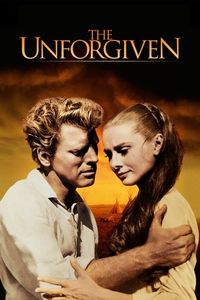
The Unforgiven (1960)
(On TV, September 2021) In the pantheon of revisionist western movies, you could be forgiven for initially mistaking 1960’s The Unforgiven with 1992’s Unforgiven. But while both movies are independent from a storytelling perspective, they do share an intention to question some of the unexamined tropes of the genre. Clint Eastwood’s 1990s masterpiece was a deep meditation on violence that cleverly rifled through decades of doubts about impassible virtuous gunslingers, but if The Unforgiven isn’t anywhere nearly as successful, it does tackle the legacy of racism against Native Americans on film. But the way it gets there, though… can be problematic. Burt Lancaster ably stars as a rancher who learns that his sister (played by Audrey Hepburn) is, in fact, an adopted Native girl. That doesn’t go very well among the white settlers, and it doesn’t take a long time for them to become at odds both with their neighbours and with the Native Americans coming back to claim the girl as their own. It all climaxes in a scene that, for once, feels decently original — that of a dirt house being set on fire as Native Americans ride on the rooftop. The meditations on racism are atypical and rather welcome, considering the state of Native Americans in 1950s Hollywood, but the film itself is far from being as accomplished as one could have expected. Reading about its production history does help explain why, with enough behind-the-scenes drama (deaths, injuries, near-death experiences, and a disengaged director) to make a movie of its own. Suffice to say that the herky-jerky scene-to-scene rhythm of the film may not have been in the initial plans. Of course, there are other issues — as much as I love Audrey Hepburn and the lovely long hair she has here, she’s perhaps not the best pick for a Native American. Her performance bulldozes through objections of ethnically inappropriate casting, but it’s one more thing in a long series of issues with The Unforgiven. Lilian Gish and Audie Murphy are quite a bit better in supporting roles, each of them having a few standout sequences. Meanwhile, Lancaster provides yet another example of how he was willing to use his stardom to enable projects that poked at the kind of leading man he was supposed to play. In the end, The Unforgiven remains a provocative, big-budget revisionist western before it was cool to make revisionist westerns and in that, at least, it has appreciated from the underwhelming critical and commercial reception it got upon release.