Barbara Eden

  • The Brass Bottle (1964)

    The Brass Bottle (1964)

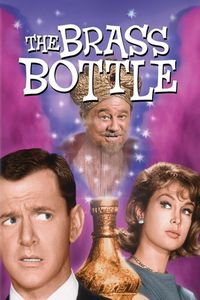
    (On TV, May 2021) I’ve arguably seen the best of the 1960s comedies, so now I’m watching the rest—and there’s plenty to like in the lesser-known movies that amused people at the time. They’re less polished, feature lesser-known actors, strike one-note premises until we’re wrung out and often display jaw-dropping attitudes, but they’re meant to entertain and some of the gags still land. In The Brass Bottle, troubles begin for an architect when he takes possession of an ancient bottle that contains… a genie. A genie who’s curious to understand the world after hundreds of years of solitude, very eager to help his master, not constrained by any law or science, and certainly not limited to a mere three wishes. Seeing Barbara Eden in a supporting role may have you reaching for the nearest I Dream of Jeannie summary and yes: Both works are adapted from the same novel, and it was Eden who played Jeannie in the TV show. But even with those common strands, The Brass Bottle stands as a distinct film. For one thing, the casting is really good: Tony Randall gets a leading role as the architect, the genie is played by a terrific Burl Ives (who reliably steals every film I’ve seen him in) and the beautiful Kamala Devi gets an amusing supporting role as another genie eager to please (but too summarily dismissed from the film). Much of the film’s comedy comes from confronting the unlimited powers of the genie with the moral reservations of the architect, and the very practical consideration in having a magic-using genie in the very rational world of the 1960s. Our genie eventually settles for residential development and stock market investing—to give you an idea of the film’s tone. But then the real world comes knocking, leading us to a cheat of an ending far too close to “it was a dream.”  Still, The Brass Bottle is not meant to be a particularly sophisticated film—I mean, the sequence with the donkey is ridiculous enough on its own—but it still has a few chuckles in the tank, and a rather amusing portrayal of a world fifty years gone.

  • The Wonderful World of the Brothers Grimm (1962)

    The Wonderful World of the Brothers Grimm (1962)

    (On Cable TV, December 2020) An intriguing artifact from one of the corners of film history, The Wonderful World of the Brothers Grimm is not only a George Pal fantasy spectacle, but a rare feature film to have been shot in panoramic Cinerama – a film process that recorded and projected on three separate screens, as to immerse the audience in wraparound experience. No, the gimmick didn’t last a long time, and yes, trying to fit that to a TV screen can lead to some very strange visual artifacts. Still, it’s one of those curios made for technical appreciation as much as for plot: while the story weaves the life of the real Brothers Grimm with short fanciful interpretations of their tales, viewers may be more interested by cinematography that attempts to take advantage of the near-surround screens of the Cinerama process. Some scenes are long wide takes where the camera doesn’t move; others make a conscious effort to move through space to wow audiences. Little of this works on the small screen, but that’s fine – sometime, just seeing what The Wonderful World of the Brothers Grimm tries to do can be entertaining in itself. As for the narrative, well, it’s a clumsy, almost endearing fantasy from times where fantasy tropes literacy wasn’t as commonplace: At least, with fairytales, we’re attaching the plot devices to familiar childhood material. The stop-motion animation sequences remain impressive, while in between Barbara Eden and Yvette Mimieux, at least there’s something more than special effects to see. (Otherwise, there’s a young and sprightly Russ Tamblin playing the hero, with comic relief from a short appearance from Terry-Thomas.) I’m ambivalent about whether to recommend The Wonderful World of the Brothers Grimm as a purely narrative experience – on a TV screen, the compromises of Cinerama filmmaking make it almost impossible to watch without noticing the making of the film more than focusing on its substance. Still, even budding film historians will get a kick out of seeing an alternate future never taken for cinema.