Barbara Rush

  • It Came from Outer Space (1953)

    It Came from Outer Space (1953)

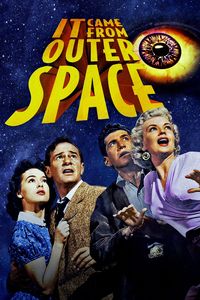
    (On Cable TV, August 2020) The title of It Came from Outer Space is now the stuff of easy clichés and a cheap summation of most 1950s monster science fiction movies. But imagine my surprise when the actual film ends up significantly more thoughtful and less paranoid than the usual examples of the form. Contrarily to other monster films of the time (and there are quite a few similarities between this film and Invasion of the Body Snatchers), the alien turns out to be largely benign, and more interested in repairing its ship than eating humans. The hero is the one who first figures it out and fights for the humans to leave the aliens alone – the conclusion is surprisingly humanistic by the era’s standards, albeit not surprisingly so when you learn that Ray Bradbury wrote the original treatment at the origin of the movie.  Friendly alien stories are now about as commonplace as killer-alien ones, but this was a real revelation at the time, and it does offer a counterbalance to most other well-known 1950s science fiction films. It’s also fascinating that the title of the film (much like the contemporary Them!, far more intelligent than similar films) has been appropriated to represent films that are almost entirely opposed to the lessons of this one. On a technical level, the cinematography is clever (including the use of fisheye camera lenses to represent the alien’s viewpoint), and both Richard Carlson and Barbara Rush make for credible protagonists. Holding up much better than many of its contemporaries, It Came from Outer Space emerges as close to being an essential 1950s science-fiction film.

  • Robin and the 7 Hoods (1964)

    Robin and the 7 Hoods (1964)

    (In French, On Cable TV, November 2018) Now Robin and the 7 Hoods is an interesting curio: A gangster musical, featuring Bing Crosby and the Rat Pack. Adding even more interest to the proceedings, the story is a retelling of Robin Hood in Prohibition-era Chicago. With a premise and cast like this, you can almost be forgiven for thinking that whatever is on-screen is a let-down from whatever idealized movie you could imagine. Depending on your taste, the film is either too talky, too long, not witty enough to fully capitalize on its potential, or to make good use of its long list of performers. Barbara Rush isn’t as good a Marian as she could have been, while we can quibble about the number of songs given to this or that actor/singer. All of this is true—Robin and the 7 Hoods is never mentioned as a major musical, and there’s a feeling that the material could be done quite a bit better. And yet … there are some really good moment in here. The highlight has to be the “Bang! Bang!” number featuring Sammy Davis, Jr. as a gun-crazy gangster shooting up the place. Another great sequence has a speakeasy transforming itself into a religious mission complete with gospel singers. Edward G. Robinson shows up briefly as an elderly gangster, while Frank Sinatra, Dean Martin (a bit wasted) and Bing Crosby (showing up too late) get to croon a few numbers. The colourful portrait of 1920s Chicago is a straight-up cliché, justifiably so in a silly musical comedy. I do wish Robin and the 7 Hoods would have been just a bit better, but I still had quite a good time watching it all. Just the thrill of discovery does account for much of it.