Basil Rathbone

  • The Adventures of Ichabod and Mr. Toad (1949)

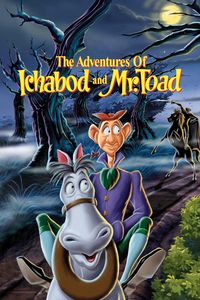
    The Adventures of Ichabod and Mr. Toad (1949)

    (Disney Streaming, March 2021) Like most of Disney Animation Studio’s 1940s output, The Adventures of Ichabod and Mr. Toad is a feature-film-length collection of shorter segments — the 35 minutes The Wind in the Willows featuring Mr. Toad (from the novel by Kenneth Grahame) and The Legend of Sleepy Hollow from the short story by Washington Irving. While I’d be willing to bet that what most people remember from this film is that terrifying shot of the pumpkinhead being thrown at the camera (a shot so good that it became the featured trailer stinger for Tim Burton’s 1999 live-action adaptation), the entire film is far funnier than you’d expect. The first segment, featuring Mr. Toad, is a compelling character study of a remarkable eccentric, while the second makes far more mileage out of Ichabod being a comic character than you’d expect from its sombre set-piece. The animation is quite impressive throughout—featuring a steady amount of physical comedy, and often technically superior to some of Disney’s later features of the 1960s–1980s. It’s pleasant to hear Basil Rathbone narrate the first segment and Bing Crosby narrates the second, with some crooning on the side. There’s some weirdness throughout, though: in-keeping with its production date, the gender roles are dated, and there’s a curious moment in which an overweight girl is meant to be shown as unattractive, which doesn’t match what we’re seeing. Still, The Adventures of Ichabod and Mr. Toad is quite effective, and for Disney historians it’s yet another reminder of the dire straits in which the studio found itself during the 1940s. Fun for the entire family, it stands above most of the Disney anthology films of the era as well.
  • Dressed to Kill (1946)

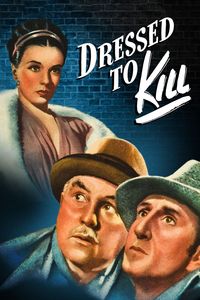
    Dressed to Kill (1946)

    (On TV, May 2020) Given that I haven’t seen any of the previous thirteen films in which Basil Rathbone played Sherlock Holmes and Nigel Bruce played Watson, it’s not that clever to start with the fourteenth-and-final instalment Dressed to Kill. On the other hand, it does such a good job that it becomes a good advertisement for the rest of the series. Moving like a well-oiled machine of people all comfortable with their part to play, it sends Holmes and Watson on a treasure-hunt chase as they compare musical boxes to end up finding government secrets. It’s all very charming in a classical way, with a bit of suspense and humour to make it interesting throughout. The period atmosphere is evocative, and Patricia Morison plays a very capable antagonist. After so many 21st-century takes on Holmes in which he’s essentially a cognitive superhero, it’s almost refreshing to see him in a film where he’s merely very smart. And that’s one of the reasons why, even if Dressed to Kill may be the last of the Rathbone Holmes, it remains a compelling reason to watch the rest of the series.

  • The Personal History, Adventures, Experience, & Observation of David Copperfield the Younger aka David Copperfield (1935)

    The Personal History, Adventures, Experience, & Observation of David Copperfield the Younger aka David Copperfield (1935)

    (On Cable TV, May 2019) As faithful an adaptation of Dicken’s semi-autobiographical novel as could be expected from a mid-thirties Hollywood super production. (Today, David Copperfield would be best handled as a miniseries.)  Great production values, from costumes to sets to then-rare outdoors shots. But the film is perhaps best seen to the semi-amazing cast, including W. C. Fields in a more or less serious role, the incomparable Edna May Oliver in a likable role, and other 1930s notables such as Basil Rathbone and Lionel Barrymore. Directed by George Cukor, showing early prowess handling complex ensemble cast.

  • The Mark of Zorro (1940)

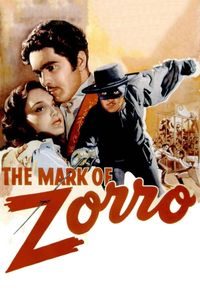
    The Mark of Zorro (1940)

    (On Cable TV, May 2018) In some ways, there really isn’t anything new in The Mark of Zorro if you’d seen, say, the 1998 remake of it or have been immersed in pop culture for the past few decades: It’s a bog-standard story in which virtue triumph over perfidy after a fair amount of sword fighting. On the other hand, there is something to be said about execution, and that’s why there’s no tiring of The Mark of Zorro even if you’ve seen the 1920 version, the 1998 version, the 1980s parody, the Batman origin stories or any of the unacknowledged inheritors of the swashbuckling tradition. Tyrone Power makes for a fantastic hero, Linda Darnell has the whole damsel-in-distress thing locked down, and Basil Rathbone is simply awe-inspiring as a henchman more interesting than the main villain. The closing Power/Rathbone confrontation is a physical tour-de-force that hits all of the classic tropes of swordfights (cut candles, climbing on furniture, witty repartee) in a way that will leave no one unsatisfied. Seriously, if you watch nothing else, then fast-forward to the final sword fight—it will make you watch the entire film. Old and yet still bold, The Mark of Zorro amply justifies its lasting reputation as one of the finest swashbuckling epics of all time.