Bela Lugosi

  • You’ll Find Out (1940)

    You’ll Find Out (1940)

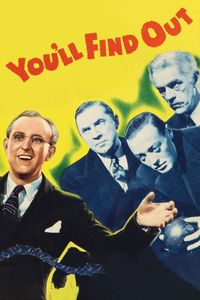
    (On Cable TV, June 2021) I’ve written before about the brief and unlikely stardom of Kay Kyser, band leader and radio personality (as the host of “Kay Kyser’s Kollege of Musical Knowledge”) who, in the early 1940s, got to star as himself in a series of rather charming vehicles before retiring and living to have a long and rewarding pastoral life. Most of his movies rely on his very curious personal charm as a slight, soft-spoken, bespectacled presence in contexts where you’d expect a traditional Hollywood leading man. (Swing Fever is the film that got me wondering, “how is this guy presented as a leading man?”)  Even in a short but outlandish filmography, You’ll Find Out is in the running as one of the weirdest — here, Kyser plays himself as he and his band are invited to an heiress manor to help celebrate her birthday party, and end up discovering a plot against her. While that doesn’t sound too bad, consider that this is a film with supporting roles for Peter Lorre, Boris Karloff and Bela Lugosi — the only time those three legends would share the screen. The film soon takes a turn for the haunted-house occult (how could it be otherwise with that cast?) but don’t worry: it’s all a comedy with a few musical interludes provided by Kyser’s band. One musical number, “I’d Know You Anywhere,” eventually got nominated for an Academy Award. It’s rather fun to watch, and a must-see if you’re a Kyser fan. (If I can become one, I’m sure there are dozens—dozens—of us.)
  • The Body Snatcher (1945)

    The Body Snatcher (1945)

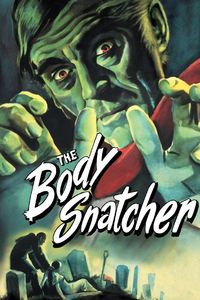
    (On Cable TV, May 2021) For classic horror fans, The Body Snatcher features a mixture of familiar names— infamous murderers/graverobbers Burke and Hare, for one (their infamy extending well into twenty-first-century takes), producer Val Lewton for another, and also chameleonic director Robert Wise in one of his earliest directing credits (and perhaps his first true end-to-end project). But what will get most people’s attention is Boris Karloff and Bela Lugosi in the same film, neither of them playing the monster archetypes they’re best known for. This certainly isn’t their only collaboration, and Lugosi’s role is minor at best — but Karloff is quite good, and more importantly he’s good in a somewhat respectable context: The Body Snatcher is heavy on atmosphere and historical references, helmed by a director who clearly wanted to impress. Even the premise, having to do with murderous graverobbers, is far from lurid monster features. The result is very decent no matter the age of the film: it’s a signpost in the filmography of many familiar names, but it’s also a film that holds up decently as long as you don’t walk in expecting cheap thrills or camp monsters.

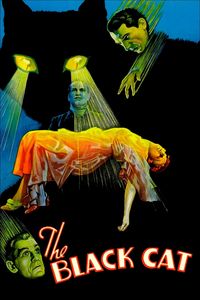
  • The Black Cat (1934)

    The Black Cat (1934)

    (On Cable TV, January 2020) I wish I had a bit more to say about The Black Cat, the first movie that managed to get Béla Lugosi and Boris Karloff as antagonists. It starts as a sympathetic and rather dull film, as newlyweds take a train to eastern Europe—where, as all classic horror movie watchers know, only bad things happen. Out of nowhere, a mysterious man (Lugosi) joins them and says that he’s off to see an old friend. Nobody will be surprised to see that Karloff plays the old friend in question, or that the two men are locked in a mortal struggle. When the couple is forced to stay at the old friend’s home, well, all the bets are off. To be fair, The Black Cat does a lot of mileage on subtlety. As a classic-era horror sound film from Universal, it doesn’t enjoy the notoriety that its contemporaries do—the lack of a distinctively supernatural (and iconic) monster certainly doesn’t help. But, much like the near-contemporary The Phantom of the Opera, it may hold a few more surprises in store than the deeply familiar takes on Frankenstein and Dracula. At the very least, it’s a remarkably short movie (barely 69 minutes), and it’s heavier on atmosphere than one would expect. Perhaps a bit too esoteric for the average moviegoer, The Black Cat is nonetheless an interesting surprise for classic horror movie buffs.

  • White Zombie (1932)

    White Zombie (1932)

    (On Cable TV, August 2019) There’s an undeniable first-mover advantage to White Zombie in that it was, at least to my knowledge, the first feature-length horror film to head to the Caribbean for its zombie thrills. Obligatory precision: These are old-school voodoo zombies and not the Romero flesh-eating ones—meaning that mysterious plants and hypnotic suggestions lead to an undead-like state. In this context walks in a loving couple about to get married, and a local count who covets the woman. It escalates as it should, with none other than Bela Lugosi as the voodoo master doing his lord’s bidding. The atmosphere approaches Caribbean Gothic at times, although that really oversells it: as times, it feels as if they simply transposed some vampire story to Haiti and didn’t file off the serial numbers. Coming barely five years in the sound film era, White Zombie still feels like a silent film in many aspects, and most specifically in the melodramatic acting carried wholesale from silent movies. While the film was modestly influential in its own way (this is where Rob Zombie got his band’s name from), it feels bland compared to other horror movies of the era, or even other takes on similar material. For instance, I can’t say enough good things about I Walked with a Zombie (1943) when I compare it with White Zombie. It’s worth a look for horror historians, but I’d be hard-pressed to suggest it as decent entertainment when there are better options out there.

  • Dracula (1931)

    Dracula (1931)

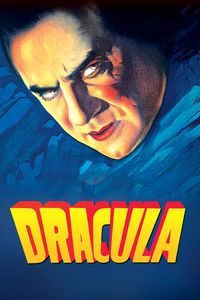
    (On TV, July 2018) It’s amazing to realize how much standard Halloween iconography (“Halloween” being used here as “mainstream watered-down portrayal of horror”) can be traced back to a handful of 1930s Universal movies. In-between The Wolfman, The Mummy, Frankenstein, The Invisible Man and Dracula (released in 1931–1933, except for The Wolfman in 1941), you have the five classic monster archetypes and the associated iconography. A ridiculous amount of what has become associated with vampire movie portrayals is owed directly to Bela Lugosi’s portrayal of Count Dracula, down to the exaggerated vocal performance (equally taking from the theatrical and silent movie acting styles) and quotable material. It means that Dracula is still worth a look today … but those very same qualities also make it an overly familiar borderline-dull experience. Much like Frankenstein, the film moves through an intensely well-worn plot that was made just as well earlier (Nosferatu) and much later (Bram Stoker’s Dracula). That certainly does not make it a bad film (its legacy can still be found everywhere come late October), but it does nibble at some of the basic enjoyment of watching a film to see what’s going to happen: In this case, we know exactly what will happen and that makes it more like a repertory piece—even to first-time watchers! I’m still glad I saw it, but the rough early-1930s production values mean that if I’m going to watch something based on Bram Stoker’s original novel, I’m going to volunteer the rather entertaining Coppola version.

  • The Mummy (1932)

    The Mummy (1932)

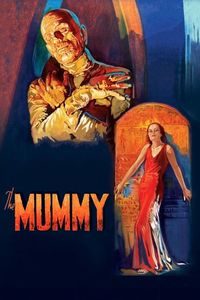
    (On Cable TV, February 2018) I was surprised to find out that the original Universal Monster movie The Mummy is such a restrained piece of work. Eschewing easy scares and thrills, this surprisingly romantic film seems to run long even at 73 minutes, relying on repeated full-face shots of Bela Lugosi as Imhotep to carry much of the movie. It’s not bad, but it moves surprisingly slower than you’d expect. The brute-force stereotyped Egyptian flavour feels comfortable, but in-between the laborious exposition and the pauses for romance there is a lot of time to contemplate the way the film doesn’t move forward very quickly. At least Lugosi is convincing as the Mummy, and Zita Johann still looks surprisingly good with longer curly hair. As someone who saw the 1999 remake in theatres and immediately liked it a lot, I’m satisfied to have finally seen the original … but I’m not going to claim that it is anything other than a film of its time.