Bella Thorne

  • Girl (2020)

    Girl (2020)

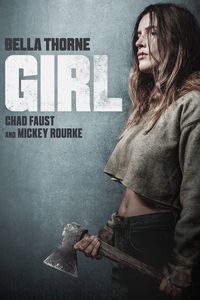
    (On Cable TV, April 2021) I don’t particularly like Girl, but there is something admirable about how crazy it’s willing to become in order to deliver thrills on a budget. Shot in Sudbury and set in AnyNorthernSmallTown, North America, it’s a thriller whose minimalist execution contrasts with its sensational plotting. From the first few moments, it’s obvious that this won’t be like most other movies: As a girl gets off the bus at an isolated stop on a two-lane road and walks to the nearest town, we’re set to understand that this is not meant to be a fun film. And yet, as the minutes advance, the screenplay seems at odds with the directing. The absurdities and implausibilities accumulate, such as the girl finding her father dead and being angry that she didn’t get to finish the job. It gets weirder as the film advances, as she discovers not one but two hitherto unknown uncles, who coincidentally end up being the two men she’s spent the most time antagonizing since the beginning of the film. It gets even better, what with a hidden treasure, the sudden arrival of a missing character, a small-town conspiracy, capture, torture and escape. Girl features revenge, fiery death, a fatal stabbing and near-universal abuse by and to all characters. It could have been an exploitation film, but it’s not always directed as such. Other than a dynamic laundromat fight and some suspense sequences, much of the film plays at a slow, gritty pace, somehow going for grimy naturalism when it should go big and wild in order to match its script. A few more characters may have helped round off the unreality of the result, but I’m not so sure that’s a good idea. The cast somehow includes Bella Thorne as the titular girl and Mickey Rourke as the final antagonist — both do well but not that well. There are some fitful attempts to go for big philosophical material throughout, but it’s clear that the film is most at ease in the suspense and action department — a rewrite could have leaned a bit more in that direction. As a result, I’m generally cool to Girl — there are promising elements here, but they seem mishandled in such a systematic way that I’m even wondering if writer-director Chad Faust understood the kind of film he was making, or the kind of film he could have made.

  • I Still See You (2018)

    I Still See You (2018)

    (On Cable TV, November 2019) One of the fundamental writing lessons that they don’t often teach in how-to books is focus. Or, in other words, “calm down, and don’t make it so complicated.”  Writers often spend so much time with their story that it becomes almost a necessity to add fancy adornments to it. To make it even more complex. To add a plot so complicated that no one else can follow it. This is even more crucial in screenwriting, given the necessities to fit everything in a limited amount of time. Focus, screenwriters, focus! Don’t throw everything but the kitchen sink, then add a romance, a murder mystery, a voyage of discovery and a global apocalypse on top of everything. But novelist Daniel Waters didn’t listen and screen writer Jason Fuchs didn’t listen and director Scott Speer didn’t listen in the making of I Still See You, with starts with a future world in which ghosts have some influence over the real world, but then goes on to add romance, grief, conspiracy, murder and self-actualization on top of it. Pick two out of five, maybe. I Still See You doesn’t help its case by inventing a new vocabulary to talk about its ghosts, and then impose a curriculum that requires you to learn about a decade’s worth of future history in order to even make sense of what’s happening. The story becomes even worse once you discover that there’s someone in the protagonist’s entourage that has a significant role in how this world-changing incident happened. At some point, it all becomes too much for too little return. I would be amazed to say this considering that I spent a lot of time in my life enjoying thick science-fiction books about entire future empires, but the problem is that I wanted to enjoy those SF series, whereas I really don’t care about any aspect of I Still See You: it’s dark, dull, painfully less interesting than it imagines itself to be, and doesn’t have anything to keep viewers invested in what it has to say. A great story will spawn hundreds of fanfiction stories to expand upon the world it suggests, but as proved here a bad story will make viewers reluctant to even engage with its core. Goth Bella Thorne could have been interesting … but not in this film. There are plenty of other better YA horror (ish) stories out there to spend any more time even thinking about I Still See You. Go see those instead.  Please, no sequels.