Betty Hutton

  • The Miracle of Morgan’s Creek (1943)

    The Miracle of Morgan’s Creek (1943)

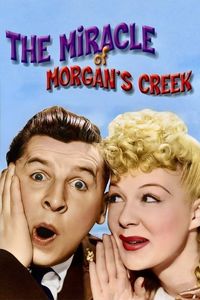
    (On Cable TV, July 2021) Writer-director Preston Sturges famously made his mark in the early 1940s with an impressive string of comedies that fired on all cylinders, and The Miracle of Morgan’s Creek is clearly part of that run, even if it’s not quite up to the standard set by at least three of Sturges’ previous films. I suspect that some of that lessened impact has to do with social mores — the idea of having a young woman pregnant from an unknown father and desperately trying to save her reputation by marrying the nearest hapless clerk was reportedly a scandal back then, but not quite as hard-hitting today. (And probably not as comic either.)  Betty Hutton stars as the party-loving girl who drinks too much and wakes up both married and pregnant (albeit without a clue as to her husband’s identity), but for once the brassy Hutton gets upstaged by Eddie Bracken, whose tics-ridden performance as an exceptionally nervous young man walks a fine line between sympathy and exasperation. The script here is a thing of beauty (even if it was reportedly re-written on the fly to accommodate apoplectic censors) — flashbacks, satire, character-driven comedy with absurd flights of fancy affecting even the highest personalities of the time: Hitler gets outraged at “the miracle,” Mussolini resigns and, most hilariously of all, Canada protests (in a clear echo of the Dionne quintuplets). Managed at a pace that still impresses, The Miracle of Morgan’s Creek isn’t quite as madcap as Palm Beach Story, as cutting as The Lady Eve or as philosophical as Sullivan’s Travels, but it still packs a punch today and should play well even with jaded audiences.

  • Here Come the Waves (1944)

    Here Come the Waves (1944)

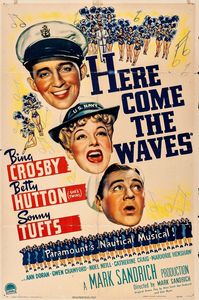
    (Second Viewing, On Cable TV, November 2020) The advantage of a film having, say, Bing Crosby as a headliner is that it can coast on his charm for a long time. Fortunately, Here Come the Waves does have a bit more than that in its assets, including a spirited double performance from Betty Hutton as twin sisters crushing hard on a crooner (Bing, obviously). As with many wartime movies, it’s meant to showcase a very specific section of the military service—in this case, the Navy Women Accepted for Volunteer Emergency Service (WAVES)—along with a big helping of musical numbers. The standout song here is probably “Ac-Cent-Tchu-Ate the Positive,” which, alas, is performed in blackface. That blemish aside, Here Come the Waves is an innocuous, almost unremarkable WW2 musical. There isn’t anything memorable about the result even despite the easy charm of Crosby or the way Hutton acquits herself well in two roles with a fair amount of interaction. It doesn’t do much to impress, but it’s watchable enough, with a few good jokes and musical numbers. Anyone compiling a list of which branches of the US military forces were covered by which WW2 film (it’s a long list) should make a note of Here Come the Waves even if it’s not exactly a very realistic portrayal.

  • The Greatest Show on Earth (1952)

    The Greatest Show on Earth (1952)

    (Google Play Streaming, June 2020) Some Best Picture Oscar Winners are almost universally recognized as being weaker than the others, and The Greatest Show on Earth is often one of them. It’s not helped by the fact that it won the prize in the same year as High Noon (which was nominated) and Singin’ in the Rain (which wasn’t) were released. It rarely plays on TV, and I don’t recall any sustained critical attention about it except to bash it en passant in discussing Oscar-winners. I suppose that’s one of the reasons why it’s taken me so long to get to this film. It’s true that The Greatest Show on Earth is narratively weak—For a nearly two-and-a-half-hour film about the circus, there’s a three-ring-circus of subplots but only one of them is meant for the main stage. Revolving around a season in the life of the Barnum circus, the film often stops dead in its tracks to simply showcase the circus: the winter preparations, the train travels, the setup and takedown in each town and especially the numbers themselves. By most standards, this makes the film a bit uneven to watch, and dubious if you’re used to evaluating movies on strictly narrative merits. But (as much as it pains younger me, who believed it fervently) there’s a lot more to movies than plot, and The Greatest Show on Earth does exist in the same space as many early-talkie Hollywood movies that intended to bring the spectacles of other mediums (often Broadway) to the big screen. In historical context, The Greatest Show on Earth came at a time when movies were reacting to the arrival of TV with Technicolor and a wider aspect ratio and a conscious effort to show wonderful things to audiences. There’s something fascinating about depicting the intricate machinery of a circus and the sights and sounds of something grandiose. The film was produced with an exceptional amount of cooperation from the real Barnum Ringling circus, to the point of occasionally feeling like a big commercial. This takes on an even more precious quality now that the circus has, since 2017, stopped operating. Capturing the sights and sounds of the circus is important enough, and it will amply justify the film’s viewing for those people who may be interested in those things. The plot itself does serve in sticking things together, but most of its merit is in showcasing the circus rather than having stories. Still, it is fun to see Charlton Heston as a no-nonsense circus manager, James Stewart as a clown with a dark past, or Betty Hutton as a trapeze artist. The Greatest Show on Earth may not be a particularly strong Best Picture winner, but I’m still glad that I had an excuse to see it, as it may very well be the purest expression of Cecil B. DeMille’s thirst for spectacle.

  • Annie Get Your Gun (1950)

    Annie Get Your Gun (1950)

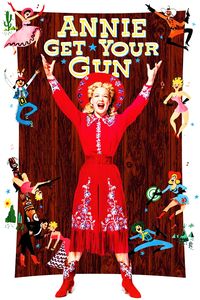
    (On Cable TV, February 2020) As a white male superficially undistinguishable from previous generations of film buffs, I have a significant privilege in watching Classical Hollywood movies—these were movies made by people like me, often for people like me and I can usually manage to overlook the less admirable elements of sexism, racism and other characteristics often found in older movies. But that privilege is not absolute immunity, and some movies still manage to raise my hackles even when considering the historical context. Which leads me to this: I love a third of Annie Get Your Gun, I like another third of it, and I loathe the remaining third. The part I love is that it’s an exuberant, expensive musical in the grand MGM tradition: expansively staged, with a higher-than-average number of great songs and a brassy lead performance by Betty Hutton. Inspired by the life of real-life Annie Oakley, it’s about a sharpshooting rural girl who gets swept away in Buffalo Bill’s Wild West Show, and then into a romance. If that was all there was to it, I could still count it as a really good musical: Terrific musical numbers (“Anything You Can Do I Can Do Better” and the classic “There’s No Business Like Show Business”), fair filler, and one great lead performance. Sadly, though, the film goes the extra mile to offend with outdated sexism and even worse racism. Even by the coarse sensibilities of the 1950s, Annie Get Your Gun is embarrassingly dismissive of its Native American characters, portraying them with a mortifying succession of simple-minded clichés and reinforcement of their otherness. As a consequence, sequences of the film are actively difficult to watch, such as the disturbing “I’m an Indian too.” That’s bad enough to overshadow the dodgy way Oakley’s character is treated as someone who can only be completed by submitting to a romantic partner, somewhat undermining (by twenty-first century standards) the portrait of a strong self-reliant protagonist. Annie Get Your Gun is tough enough to recommend on the surface, but the more you know about its production history (with Judy Garland replaced during the shoot after developing severe mental health issues, and being replaced by Hutton) the more you get to the conclusion that this film might have been best unmade. If you do watch it, consider fast-forwarding past the worst moments—except that there are many of them, and they’re not all separate from the musical numbers. Maybe line up the three or four best songs and call it a day.

    (Second Viewing, On Cable TV, May 2021) After a disappointed first viewing, I decided to give another chance to Annie Get Your Gun for two reasons. For one thing, it’s freshly restored from a 4K-grade effort, meaning that it’s never looked better. For another, I was curious to see if I’d feel as strongly about the film’s mortifying depiction of Native Americans the second time around. The basics of the film remain the same: This is Betty Hutton’s best-in-career show as the legendarily brassy sharpshooter Anne Oakley. This highly fanciful musical comedy, adapted from a Broadway stage play, doesn’t really care about historical accuracy when there are musical numbers, some romance, cheap gags and pure Americana to play with. The film may best be remembered for two memorable tunes: “There’s No Business Like Show Business” and “Anything You Can Do” still work really well. I still quite like Louis Calhern’s mellifluous performance as William F. “Buffalo Bill” Cody. But results from this second viewing turn out to be… mixed. While Annie Get Your Gun has indeed never looked better with sharp images and rich vivid colours (and this is a film with plenty of vivid colours!), it also underscores the studio-set artificiality of many sequences in the film, especially the faker-than-ever backdrop to “Doin’ What Comes Natur’lly.”  Then there’s the whole depiction of Native Americans, which goes deep into iconography and stereotypes. It’s a vexing blight on the film, but the only reason why it’s not more than an annoyance is that it’s done in a warm comedic tone fit for a musical – unlike other low points of Native Indian representativeness in Hollywood (ugh, that Peter Pan scene), the character of Sitting Bull is allowed a few good comic lines and more depth than simply portraying an icon. Still, I would hope that no modern production of the film would include anything as tone-deaf as “I’m an Indian Too,” especially considering that the number is practically an explicit paean to cultural appropriation. While I’m warmer to some moments of Annie Get Your Gun (and considering the tumultuous production history of the film, with Hutton replacing Judy Garland at the beginning of the shoot, it’s nearly a miracle that the film ended up reasonably good), I’m just as annoyed at other moments of it.
  • The Perils of Pauline (1947)

    The Perils of Pauline (1947)

    (On TV, November 2019) I too-often record movies without quite being able to explain why, and that can lead to a few surprises later when I do get around to watching them. I’m still not too sure why I recorded The Perils of Pauline, but watching it a year later was like discovering a forgotten present. While it makes no sense to talk about this film in the same breath as Singin’ in the Rain, there are a few points of similitude between the two—it’s a satirical look at Hollywood history in the form of a musical, and it’s surprisingly funny as it recreates the era of the silent comedy. It has plenty of flaws—the pacing is uneven, the script is weak, and the suddenly maudlin ending isn’t all that satisfying … but an extraordinary performance from Betty Hutton compensates for much. Her brassy, high-energy portrayal of an equally noticeable character makes the film quite a bit better than it would have been on the page, although a number of funny sequences also help compensate for the lull in the overall narrative. The Perils of Pauline is in the public domain, meaning that it can be watched from even the film’s Wikipedia page … but the visual quality is disappointing even if the film is entertaining.