Bill Nighy

  • The Bookshop (2017)

    The Bookshop (2017)

    (On Cable TV, April 2021) I can recognize a strong, strong bibliophilic wish-fulfillment aspect to The Bookshop, largely by virtue of being a bibliophile myself. Taking place in a 1950s backwater coastal English town, it’s about a woman (Emily Mortimer) bringing civilization to the unenlightened masses by opening a bookshop in a poorly maintained property. But things don’t play out harmoniously, as she comes in conflict with an influential local woman (Patricia Clarkson, unusually malevolent) who had her own plans for the property… and the prejudices of the local population. This being an adaptation of a book aimed at readers, we’re meant to nod in recognition, as some of the time’s literary sensations become plot elements:  One stuffy character’s enthusiasm for Bradbury’s Fahrenheit 451 immediately brands him as a likable character (well, he is played by Bill Nighy), while we know that Nabokov’s Lolita is going to cause some trouble for the protagonist. Where The Bookshop does distinguish itself from expectations, however, is in the somewhat less-than-triumphant finale where the forces of (literary) enlightenment don’t win the fight. You can certainly argue that the defeat reinforces the “you, dear readers, are terrific!” message in showing what happens when the ignorant masses get their way. It’s not necessarily the conclusion we might have hoped for, but it is announced by somewhat austere cinematography that doesn’t miss a chance to show how damp and drafty the setting can be. The Bookshop is meant as a quiet and perhaps even contemplative film — don’t expect any big confrontations, as even the head-to-head arguments between characters are handled with quite a bit of British restraint. It may be manipulative, but it’s not an unpleasant watch: It plays a lot like a rainy-afternoon kind of book.

  • Sometimes Always Never (2018)

    Sometimes Always Never (2018)

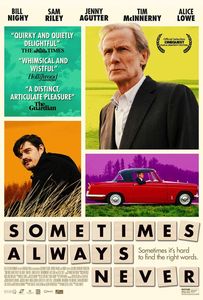
    (On Cable TV, December 2020) Bill Nighy has a considerable amount of charm, but it’s a mistake to think that this specific appeal is enough to compensate for a dull movie project. Sometimes Always Never proves that this is not the case. Nighy ably plays a grieving father who, after years of searching for his lost son, tries to grow closer to his other son, identify a body, and perhaps find his missing son behind an online pseudonym. Stylized, off-beat and yet not quite compelling enough, this is a moody film that tries hard, but struggles to succeed. It’s not as if it’s completely uninteresting – the focus on Scrabble is promising, Ella-Grace Gregoire is very cute, Nighy is up to his high standards, and Alexei Sayle makes a welcome appearance. But despite Sometimes Always Never’s self-conscious quirk, it never manages to lift and carry audiences with it.

  • Emma. (2020)

    Emma. (2020)

    (On Cable TV, November 2020) At this stage, Jane Austen adaptations are worth watching more for the quirks than the core. The stories are familiar thanks to a dozen previous versions, so every new take is free to play around with the foundation until it has something specific to say. No pressure on delivering a best or faithful adaptation. This 2020 version of Emma, as directed by Autumn De Wilde, is slightly skewed toward the comedic end of the spectrum, making heavy use of background jokes and musical cues to reassure us that this is all lighthearted. The great Bill Nighy aside, it’s a good showcase for the young actors, even though few make any lasting impression. In the end, this Emma is likable without being all that special—which is not necessarily a criticism, considering that I like Austen best as a flurry of costumes, period settings and deliciously arch dialogue. As such, this version is almost exactly what it meant to be, and should make any viewer even hallway sympathetic to Austen adaptations feel completely satisfied.

  • The Best Exotic Marigold Hotel (2011)

    The Best Exotic Marigold Hotel (2011)

    (On Cable TV, April 2017) Ensemble romantic comedies are a dime a dozen, but few of them tackle the topic of retiree romance as well as The Best Exotic Marigold Hotel. While I don’t entirely buy the premise (pensioners moving from Britain to India for their last few years), it does make for a clever way to put familiar characters in new situations. As they navigate the unfamiliarity of modern India, our cast of character grows from their new surroundings, we viewers get a good dose of exoticism and various subplots are left free to develop. A good ensemble casts helps—While Judy Dench and Tom Wilkinson are the standouts here, Bill Nighy manages to make a weak-willed character sympathetic and Maggie Smith gets the difficult role of a stone-cold racist changing her ways after immersion in a foreign culture. Dev Patel also gets a good role as the young Indian man trying to hold a plan together despite the actions of his western guests. Colorful, sympathetic and gently upholding admirable values, The Best Exotic Marigold Hotel is the kind of pleasant surprise that British cinema does so well. It’s not spectacular, but it works well enough.

  • About Time (2013)

    About Time (2013)

    (On Cable TV, December 2014) On one hand, this is a terrible science-fiction film.  On the other hand, this is an excellent science-fiction film.  Those aren’t necessarily contradictions, if you accept that SF is at its best when it aims to illuminate facets of humanity and if you accept that genre SF has evolved to be as self-consistent as possible.  Written and directed by Richard Curtis, a talented artist with no background in genre SF, About Time firmly belongs to the naïve school of SF that believes that the worst logical flaws are irrelevant as long as viewers are moved by the emotional consequences of the science-fictional device.  And on that point, About Time is quite successful: While its time-traveling device isn’t much more that fuzzy wish-fulfilment (go in a closet, close your fists and wish really hard) with no consistent set of rules save for those that can be ignored by dramatic impact, the film does manage to poke at some of life’s biggest emotional dilemmas in a way that feels relatively fresh.  It helps, of course, that it’s part of the gentle British rom-com tradition: Domhnall Gleeson makes for an affable romantic hero, whereas Bill Nighy steals every scene as an amiable man who has figured out much of his life.  The film is a bit of a slow burn, starting in firmly comic territory before going into heavier themes.  Sure, it’s frustrating that the rules of the premise don’t seem to hold together, or that lies seem built-in most of the protagonist’s relationships.  But the film itself is pure charm, and such likability goes a long way in leaving viewers with a big smile and a bit of a heartache.

  • I, Frankenstein (2014)

    I, Frankenstein (2014)

    (On Cable TV, November 2014) An intense impression of familiarity is what first emerges from expensive-but-generic action fantasy film I, Frankenstein.  Seemingly built using the same pieces as the Underworld series, Van Helsing and so many other attempts at shoe-horning familiar characters into a generic template, this film has the generic east-European blandness of so many other forgettable urban-fantasy films.  The Manichean mythology is dull, the poor lonely hero is dull, the visuals are dull and there are few surprises along the way to the Big Fight at The End.  Still, I, Frankenstein isn’t a complete dud for a few reasons: The first is Aaron Eckhart, using his square jaw to good effect as the stoic patchwork hero.  The second is writer/director Stuart Beattie, quite a bit better as a director of action sequences than as the screenwriter: While the script is bland, some of the fight sequences are handled with a decent amount of fluidity and lengthy takes.  Bill Nighy does a little bit of scenery-nibbling as the villain, but not enough to become a memorable antagonist.  While the film has thematic ambitions, most of those lose themselves in meaningless nonsense, especially whenever the film tries to claim that its hero is soulless. (What does that even mean?)  The humorlessness of I, Frankenstein doesn’t contribute to any enjoyable campiness, leaving very little as a feature when the film can’t emerge from its downbeat muck.  Too bad for Eckhart (who hasn’t really broken through as a big star despite a few great performances), but too bad for viewers as well, served reheated fantasy leftovers as if they were somehow important.

  • Wrath of the Titans (2012)

    Wrath of the Titans (2012)

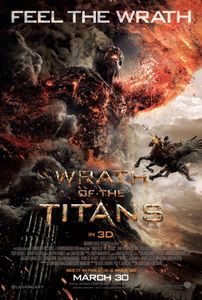
    (On Cable TV, January 2013) The sad news is that Wrath of the Titans doesn’t have the arch melodramatic tone that made its predecessor so much fun to watch: “Release the Kraken!”, anyone?  The good news is that this sequel to Clash of the Titans remains a relatively entertaining action/fantasy film: the bare-bones plot serves handily as an excuse for well-choreographed action sequences involving grander-than-life fantastical creatures.  Director Jonathan Liebesman shows a good eye for flowing action sequences, and the film has a few gorgeous continuous shots in which the action plays out beautifully.  Tons of fiery special effects add more interest, especially when dealing with the skyscraper-sized end boss.  Sam Worthington holds the film together as no-nonsense reluctant hero Perseus, but Bill Nighy has a bit of fun as a half-mad god while Liam Neeson also makes an impression as a bound Zeus.  Thematically, there’s a flicker of interest when we realize that the story is taking place at the twilight of the gods’ influence over human affairs: there’s a last-hurrah atmosphere to the plot that interesting in its own right.  Still, let’s not kid ourselves: this is pure spectacle, the fantasy elements being excuses for bigger action set-pieces.  Wrath of the Titans works well in this context, and delivers the high-gloss entertainment factor that viewers of the first film expected.  That first entry wasn’t all that good, but this follow-up best succeeds at what it tries to do, and that’s already quite a bit better than many recent action/fantasy hybrids.

  • Wild Target (2010)

    Wild Target (2010)

    (On-demand video, March 2012) I could go on and on about this being the epitome of the quirky/funny low-budget British crime comedy if it wasn’t for the fact that it’s a remake of French film Cible Émouvante.  Still, Wild Target is short, dark, witty, quite funny and British to the core.  Bill Nighy is up to his usual charming standards as a dapper, uptight hit-man contemplating getting away from it all, and he finds a great foil in the beautiful Emily Blunt as a flighty con artist needing protection who comes to change his regimented life.  For a film that got nearly no press in North America, this is a very enjoyable surprise: the script is smarter than average, the actors look as if they’re having fun and the film perfectly doses a small amount of violence in this dark but not overly downbeat comedy. The dry humor doesn’t pander too much, and the film manages to remain interesting even when it abandons London (after a hilariously clever “car chase” through the City) for a small country estate.  Wild Target‘s production qualities are fine for its low budget, Jonathan Lynn’s direction is generally unobtrusive and the result is worth a look.  This is the kind of film that plays a lot better on the small screen as an “eh, might as well watch this one” choice than a big-screen event.