Bob Hope

  • Misbehaviour (2020)

    Misbehaviour (2020)

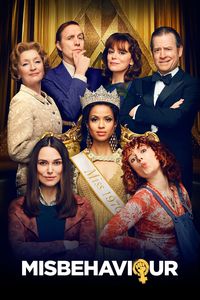
    (On Cable TV, April 2021) The grrl-empowerment drama is a well-established genre by now, and Misbehaviour seems to be following in the steps of half a dozen examples of the form, perhaps most closely the recent Battle of the Sexes. You can check off the elements: a historical recreation a few decades past highlighting unbelievable sexism, plucky heroines banding together to fight the patriarchy, potshots at the institutions’ refusal to move forward, one hissable patriarch as an antagonist, queer characters, lighthearted tone, all savvily wrapped in well-executed crowd-pleasing style. It’s now common because it’s fun, mind you: you can’t be against the message of the film, and the underdog narrative always plays well even if it feels increasingly calculated. Misbehaviour does a little bit than most entries in the subgenre by being slightly more ambivalent about its message than a rote regurgitation of feminist talking points. Largely taking place in 1970 London, it tells us about the protests that targeted the Miss World contest held at the time, featuring a few activists going against none other than emcee legend Bob Hope, who comes to personify the worst aspects of the patriarchal agenda—hero of a generation, villain of the next. Our protagonists, anchored by Kiera Knightley (even though Jessie Buckley has a more striking role), aren’t the only ones with progressive credentials, however, as a very interesting subplot featuring Gugu Mbatha-Raw ends up establishing. Progressivity and diversity are multidimensional movements that have the good luck of all sharing white men as antagonists, and part of what makes Misbehaviour more interesting is in opposing different views about the Miss World contest, and what happens when the contest ends up scoring a victory for diversity even within the confines of the structure that our (white) protagonists are contesting. That kind of complementary complexity is something that reflects real-world tensions within the progressive communities, and something I’d like to see a bit more rather than simplistic underdog fairy-tales. As a result, Misbehaviour does get better as it goes on, and then becomes much better once it hits its final moments. The style is meant to be easily accessible, and the viewing experience reflects that: it’s an easy film to watch and to like even when it plays close to the obvious formula. Despite the film’s hit-job, I still like Bob Hope — but then again, I can pass as a patriarch if I need to.

  • The Facts of Life (1960)

    The Facts of Life (1960)

    (On Cable TV, April 2021) If you’re watching the Lucille Ball/Bob Hope headliner The Facts of Life and expecting something like the three other films they did together, you’re going to be surprised. Not that surprised, as Hope is still trading bon mots and Ball has occasional moments of comedy, but surprised nonetheless, because The Facts of Life is about two married people grappling with having an affair, and there’s an entire undercurrent of guilt and drama running close underneath the jokes. It’s somewhat reflective of its era in American cinema, where the rigid standards of censorship were ever-so-slightly relaxed in reflection of how society was changing, but not quite blown apart as they’d ben by the end of the decade. As a result, The Facts of Life does feel like a strange halfway film — willing to contemplate a difficult topic, but not able to completely give it the treatment it would have deserved, and possibly held back by the persona of its stars. As a result, it’s not completely satisfying, but neither it a failure — the film was nominated for a handful of Academy Awards and presents Hope in one of his better quasi-dramatic roles. It’s worth a look, especially for Hope fans who are already used to seeing him in other goofier roles.

  • The Iron Petticoat (1956)

    The Iron Petticoat (1956)

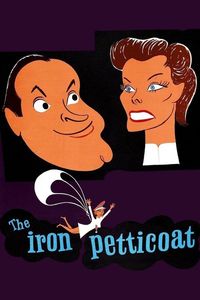
    (On Cable TV, March 2021) As far as unusual screen couplings go, Katharine Hepburn and Bob Hope is about as interesting as it comes. Stuck in a film where she plays a cold-hearted Soviet defector and he plays an American officer tasked with keeping tabs on her (and letting her discover the hedonistic joys of the west), their clashing style makes about half of the result’s entertainment factor. The inspiration from Ninotchka is obvious (both the equally similar Jet Pilot and Silk Stockings would be released the next year), especially in the way she is portrayed as a humourless automaton-like product of a caricatural Soviet regime. The production history of the film was… tumultuous, with the original script being a Hepburn vehicle pairing her with someone like Cary Grant. When Hope came onboard, the script was rewritten to suit his broad comic style (incidentally making him the lead, at her expense), and the finished film feels as if Hepburn is a stranger in her own film, trying to keep up with Hope’s constant mugging and wisecracking. To be fair, a lot of it is actually funny — the quips work and seeing Hepburn stuck in a straighter-than-straight role is amusing in itself. (As a romance, though? Eh.)  The Cold War comedy atmosphere is almost charming at this point and the film would make a splendid double-bill with Silk Stockings, even if it pales in comparison. In narrative terms, The Iron Petticoat does the strict minimum to get the characters to a happy ending — the film’s strongest point comes in the earlier dialogue rather than the wrapping-up of the tale. A must-see for fans of Hepburn, the result is fascinatingly uneven and almost a case study of what happens when two mismatched leads are stuck in the same project.

  • Bachelor in Paradise (1961)

    Bachelor in Paradise (1961)

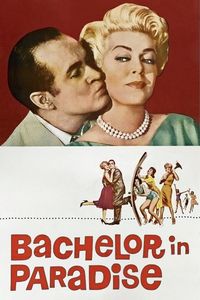
    (On Cable TV, February 2021) If you believe the movies, Americans woke up in the 1960s and starting to notice all sorts of new phenomena around them. What is that sex thing? ask the movies of the time. The truth is somewhat less revelatory — it’s the movies that unshackled themselves from a prudish reflection of American society, and it had to be done in a very gradual way, as so not to shock the masses. A first step along the way were the cute sex comedies of the early 1960s, in which the films barely hinted at naughtiness — which, to be fair, was a step up from the previous decade. It’s in the vein that Bachelor in Paradise features Bob Hope as a salacious best-selling playboy author who infiltrates a suburban community in the hopes of researching a new book. While over there, he’s confronted by the prejudices of neighbourhood gossip queens, especially when he, a single eligible bachelor, finds himself surrounded by lovelorn housewives. As usual for films of the time, Bachelor in Paradise is as interesting for its unspoken presumptions and period detail than for the elements of its narrative. The sequence set inside a grocery store is a fascinating throwback to how people shopped at the time, while the various social taboos being broken are often more revelatory of 1961 American than the filmmakers would care to admit. Bob Hope does make for a funny protagonist — and seeing Lana Turner as his romantic foil doesn’t hurt, even though I find Turner more generic than many other commentators. (I rather would have liked Paula Prentiss in the role, but that would have broken her expected on-screen pairing with Jim Hutton.)  While Bachelor in Paradise remains quaintly sexist, is not built for social commentary and pales in comparison of more groundbreaking films later in the decade, it’s intriguing, cute, charming, and quite a bit of fun to watch even today.

  • Critic’s Choice (1963)

    Critic’s Choice (1963)

    (On Cable TV, January 2021) I probably shouldn’t feel all that surprised that critics are seldom portrayed favourably in Hollywood films. When they’re not ridiculously mean-spirited to compensate for past slights received by the screenwriter, they’re usually played as arrogant idiots as in the case in Critic’s Choice (or the somewhat similar Please Don’t Eat the Daisies). Here, Bob Hope pairs up with Lucille Ball for the fourth and final time: he plays a well-regarded Broadway critic, while she, as his wife, keeps going from one hobby to another, ultimately settling on writing a play. She’s far more successful than either of them imagined, however, and the cracks in their marriage, already exposed while she was working with a playboy director (a young Rip Thorne—surprisingly slim and handsome for those of us used to his late-career looks), are further widened when he insists on panning the play upon opening night. (And that, ladies and gentlemen, is why us conscientious critics are prompted to disclose any real or imagined conflict of interest, to the point of consciously not reviewing works from people we feel close to.)  Critic’s Choice, clearly, works on a comic rather than realistic level—although the relationship issues discussed late in the film feel unusually pointed for what’s supposed to be a silly comedy. Marie Windsor shows up in a small role, but the spotlight remains on the lead hope as they bicker (often unpleasantly) throughout the picture. Hope doesn’t have the good role here—his character, to put it bluntly, acts like an idiot in his third act choices, and the film wraps up in a somewhat unconvincing fashion to try to make up for it. It’s a somewhat by-the-numbers film considering that Hope and Ball are both involved, but it can be fun to have a look back at the 1960s Broadway scene.

  • My Favorite Brunette (1947)

    My Favorite Brunette (1947)

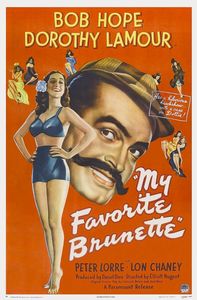
    (On TV, January 2021) There are movies that sound far better on paper than on the screen, and My Favorite Brunette is certainly one of them. It’s a fairly rare example of a contemporary film noir parody—Bob Hope plays a baby photographer who’s mistaken for a private detective and thus dragged in a convoluted mystery plot with a number of actors (such as Peter Lorre and Lon Chaney, Jr.) spoofing their screen personas along the way. In theory, it wounds wonderful. In execution, it’s underwhelming: While Hope quips away shamelessly and the rest of the cast is certainly aware of the joke, the comedy of the film feels low-key and low-energy. The satire seems less ferocious than it could have been, and director Elliott Nugent’s work feels curiously unmemorable. This being said, I may revisit this one later on—I suspect that I may not have been in the ideal frame of mind for a fluffy comedy, and my reaction to My Favorite Brunette feels like one that could be unusually sensitive to mood.

  • Boy, Did I Get a Wrong Number! (1966)

    Boy, Did I Get a Wrong Number! (1966)

    (On TV, October 2019) There are movies that you must see merely because of their titles, and Boy, Did I Get a Wrong Number! certainly qualifies. Can anything measure up to the promises of the title? Well, maybe. In this case, we get Bob Hope as a middle-aged married man who accidentally gets his phone call connected (back in the time of operators who could mess up the cabling) to a runaway Hollywood bombshell desperate to stay away from the limelight. Many hijinks ensue, all the way to the police thinking he murdered the woman. It’s all complicated by the meddling of his maid, played as performance art by the irrepressible exploded-haired Phillis Diller. Boy, Did I Get a Wrong Number! is not what we’d call a refined or subtle comedy: The reactions are all exaggerated as if this was an extended sitcom episode, and the film barely makes an attempt to smooth in Hope’s usual one-liners or Diller’s over-the-top antics. Both of them easily outshine Elke Sommer, playing the bombshell and filmed as provocatively (in a bubble bath) as a 1960s film could get away with. The plotting is elementary, but the film strikes a chuckle every few minutes, and it’s amiable enough to be charming in its own way. (I’ve seen the film mentioned a few times as the “worst” of this-or-that category and that seems an exaggeration—perhaps the title was too imposing for those reviewers.)  All in all, Boy, Did I Get a Wrong Number! is a happy discovery—and it does live up to its magnificently silly title.