Boris Karloff

  • You’ll Find Out (1940)

    You’ll Find Out (1940)

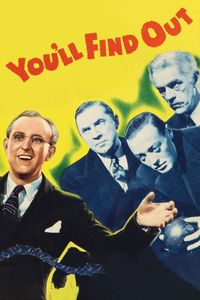
    (On Cable TV, June 2021) I’ve written before about the brief and unlikely stardom of Kay Kyser, band leader and radio personality (as the host of “Kay Kyser’s Kollege of Musical Knowledge”) who, in the early 1940s, got to star as himself in a series of rather charming vehicles before retiring and living to have a long and rewarding pastoral life. Most of his movies rely on his very curious personal charm as a slight, soft-spoken, bespectacled presence in contexts where you’d expect a traditional Hollywood leading man. (Swing Fever is the film that got me wondering, “how is this guy presented as a leading man?”)  Even in a short but outlandish filmography, You’ll Find Out is in the running as one of the weirdest — here, Kyser plays himself as he and his band are invited to an heiress manor to help celebrate her birthday party, and end up discovering a plot against her. While that doesn’t sound too bad, consider that this is a film with supporting roles for Peter Lorre, Boris Karloff and Bela Lugosi — the only time those three legends would share the screen. The film soon takes a turn for the haunted-house occult (how could it be otherwise with that cast?) but don’t worry: it’s all a comedy with a few musical interludes provided by Kyser’s band. One musical number, “I’d Know You Anywhere,” eventually got nominated for an Academy Award. It’s rather fun to watch, and a must-see if you’re a Kyser fan. (If I can become one, I’m sure there are dozens—dozens—of us.)
  • The Ghoul (1933)

    The Ghoul (1933)

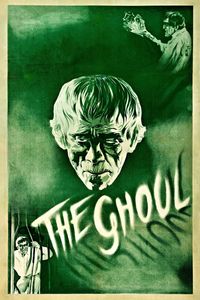
    (On Cable TV, June 2021) I really did try to get interested in The Ghoul. It is a Boris Karloff film, after all, and the early 1930s were an unusually fruitful period for horror. Film historians will further pile on and point out that this was a pivotal film for Karloff (who filmed it in his native England while on a contract dispute with his Hollywood studio), that it’s considered the second-earliest British horror film and that the entire film disappeared from the 1940s to the 1970s, when a terrible version was found and was considered the best available until a reference-quality version was finally discovered in the late 1980s. I like those rescued-from oblivion comeback stories, but even learning that wasn’t enough to make me forget the ponderousness and repetitiveness of the result. It certainly does not help that the film is quite similar to The Mummy, which also starred Karloff but was released a year earlier. Both films share the same actor, obviously, but also strong neo-Egyptian themes (in keeping with the 1930s craze), themes of immortality, the resurrection of an ancient monster and a macabre atmosphere. It pales in comparison to the earlier American effort, although it does have some really good makeup for the time. Best recommended to Karloff and horror completists — more casual audiences should be happier with The Mummy instead.

  • The Body Snatcher (1945)

    The Body Snatcher (1945)

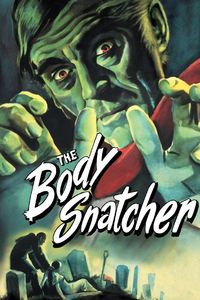
    (On Cable TV, May 2021) For classic horror fans, The Body Snatcher features a mixture of familiar names— infamous murderers/graverobbers Burke and Hare, for one (their infamy extending well into twenty-first-century takes), producer Val Lewton for another, and also chameleonic director Robert Wise in one of his earliest directing credits (and perhaps his first true end-to-end project). But what will get most people’s attention is Boris Karloff and Bela Lugosi in the same film, neither of them playing the monster archetypes they’re best known for. This certainly isn’t their only collaboration, and Lugosi’s role is minor at best — but Karloff is quite good, and more importantly he’s good in a somewhat respectable context: The Body Snatcher is heavy on atmosphere and historical references, helmed by a director who clearly wanted to impress. Even the premise, having to do with murderous graverobbers, is far from lurid monster features. The result is very decent no matter the age of the film: it’s a signpost in the filmography of many familiar names, but it’s also a film that holds up decently as long as you don’t walk in expecting cheap thrills or camp monsters.

  • The Raven (1963)

    The Raven (1963)

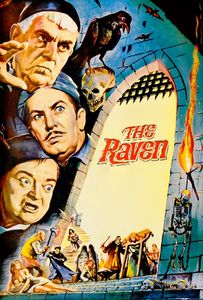
    (On Cable TV, March 2021) Some movies should come with warnings along the line of “don’t watch this before you watch those other movies.”  If that was applied to The Raven, the prerequisite would probably include movies featuring Vincent Price, Boris Karloff and Peter Lorre just so you’d come into it expecting their screen persona. You would probably also want to include at least one of producer/director Roger Corman’s horror films of the period just to give an idea of what audiences were expecting. Finally, it wouldn’t be a bad idea to throw in a later film from Jack Nicholson to show how far he’d go from this film to superstardom, and probably a modern fantasy film just to highlight what happens when a genre becomes fully defined. But let me explain — Roger Corman, at the time, was adapting classical works of horror literature (many of them from Edgar Allan Poe) as pretexts for horror films. Price and Karloff were already horror movie icons, whereas Lorre was a fixture as “creepy guy” in a variety of films. Jack Nicholson was barely beginning his long career, and fantasy as a genre (not just as movie genre) was at least a decade from being codified. But The Raven tried something weirdly different, delivering a fantasy comedy based on Poe’s “The Raven” that allowed Price and Karloff to portray rival sorcerers trying to one-up each other. The poem’s “Lenore” is a traitorous harridan, while Lorre portrays The Raven, occasionally spitting feathers. It’s definitely a comedy, although modern viewers may want to temper their expectations regarding the density and impact of the jokes. Sometimes, The Raven seems to bask simply in how weird it is, without going the extra mile of making itself funny — but then again, I suspect that Corman’s idea of what’s funny wasn’t that of a conventional comedian. From modern lenses, the weirdness of the film also comes from working with unbuilt tropes — picture “wizard” in your head, and you won’t match the film’s vision of “wizard” because it came in ten years before the printed version of The Lord of the Rings and, in turn, the way wizards have been portrayed in fantasy literature since then. Any circa-2021 attempt to retell the same story would be far more overly funny, but would also deal in visual archetypes familiar to audiences from decades of fantasy films all going for the same iconography. Where that leaves The Raven for modern audiences is more akin to interesting experiment… as long as you’re familiar with the prerequisites of the film. Seeing Karloff and Price in a lighter register than usual is fun, but the film stops well short of hilarious. If you’ve seen the prerequisites, though, go ahead and have fun — The Raven is meant to be playful all the way to its closing lines: Nevermore!

  • Targets (1968)

    Targets (1968)

    (On Cable TV, November 2020) Aside from the content of the film itself, there’s a wistful quality in Targets that comes from seeing the beginning of a career and the end of another—this being Peter Bogdanovich’s first film, and Boris Karloff’s last starring role. The production history of the film has its quirks—it came from Roger Corman being owed two days of work by Karloff, and instructing then-young writer-director Bogdanovich to make a low-budget movie around this constraint. Taking advantage of the social turmoil of the time, Bogdanovich ended up building a clever twin-strand plot featuring an aging horror film actor and a young Vietnam veteran going on a murderous rampage. The intention is obviously to confront old horror and new monsters, and the ending does finally bring everything together. Targets can feel surprisingly modern at times—the idea of a random person just shooting people off the highway still unnerves, and the gritty handheld style of the film does echo far newer films. The result is worth a look, although it can feel like a drag at times—by shooting around Karloff’s schedule, Bogdanovich was inspired by creative constraints but wasn’t quite able to tie everything up in a completely seamless way. Still, Targets makes an interesting argument at the dawn of New Hollywood, and benefits from having an old-school star in the lead role.

  • Five Star Final (1931)

    Five Star Final (1931)

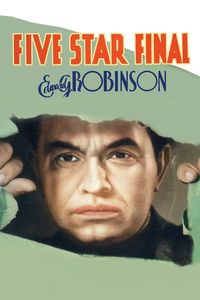
    (On Cable TV, August 2020) Considering today’s issues with social media, it’s either comforting or dispiriting to realize that every era has had its problems with then-new communication mediums… and that cinema has been there to chronicle the issues since the 1920s. Five Star Final takes us in the heated tabloid newspaper scene of the big city 1930s, when newspapers published multiple editions per day, and raced hard to outdo the competition in circulation. If sleaziness was the way to boost readership, then the answer was obvious. Here we have Edward G. Robinson as a two-fisted newspaper editor, not comfortable with the sensationalistic direction that his publisher requires, but reluctantly dragged into a sordid tale of public shaming with real consequences. Boris Karloff also appears in a few scenes as a menacing reporter. The film, being from the everything-goes pre-Code era, is markedly more interesting than many newspaper movies of later decades (and I say this as someone with an inordinate fondness for newspaper movies)—not to spoil anything, but characters don’t necessarily make it out alive of this story, and the attitude toward tabloid journalism is decidedly critical. Mervyn Leroy’s direction is relatively fast-paced, and there are a few flourishes here and there—most notably the use of split screen and fancy special effects at the time. It does make for a compelling movie, more for its time-capsule experience than a story that has been done in more recent years (albeit not from the Code years from 1935 to 1955) but still interesting, and not simply because it was nominated for a Best Picture Oscar.

  • The Black Cat (1934)

    The Black Cat (1934)

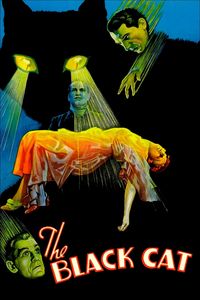
    (On Cable TV, January 2020) I wish I had a bit more to say about The Black Cat, the first movie that managed to get Béla Lugosi and Boris Karloff as antagonists. It starts as a sympathetic and rather dull film, as newlyweds take a train to eastern Europe—where, as all classic horror movie watchers know, only bad things happen. Out of nowhere, a mysterious man (Lugosi) joins them and says that he’s off to see an old friend. Nobody will be surprised to see that Karloff plays the old friend in question, or that the two men are locked in a mortal struggle. When the couple is forced to stay at the old friend’s home, well, all the bets are off. To be fair, The Black Cat does a lot of mileage on subtlety. As a classic-era horror sound film from Universal, it doesn’t enjoy the notoriety that its contemporaries do—the lack of a distinctively supernatural (and iconic) monster certainly doesn’t help. But, much like the near-contemporary The Phantom of the Opera, it may hold a few more surprises in store than the deeply familiar takes on Frankenstein and Dracula. At the very least, it’s a remarkably short movie (barely 69 minutes), and it’s heavier on atmosphere than one would expect. Perhaps a bit too esoteric for the average moviegoer, The Black Cat is nonetheless an interesting surprise for classic horror movie buffs.

  • How the Grinch Stole Christmas! (1966)

    How the Grinch Stole Christmas! (1966)

    (Second viewing, On TV, December 2018) This being December and all, I thought it was an appropriate time for revisiting the first classic adaptation of Dr. Seuss’ How the Grinch Stole Christmas. I distinctly recall seeing it as a kid—or at least the sequence in which the Grinch’s machine folds upon itself, which stuck in mind as one of the coolest things ever. With Chuck Jones as the director and Boris Karloff as the narrator, there’s even some serious star-power included. Alas, time has not been kind to a middle-aged second look at the film. It’s very familiar by now, and I do wonder how much of the film’s reputation runs almost entirely on nostalgia. Short and not quite as impressive (on a technical level) as I had remembered it, How the Grinch Stole Christmas does still have a very nice (if overused) message. Still, I can’t help but being disappointed. But considering that the entire thing is barely 26 minutes long, I should probably just stop here.