Brian Yuzna

  • Beneath Still Waters (2005)

    (In French, On Cable TV, August 2021) In horror, it’s not infrequent to find the setting and atmosphere taking over the plot to no one’s displeasure. Beneath Still Waters isn’t all that conventional in terms of story (it has something to do with someone destroying a town in order to prevent its great evil from escaping), but the most memorable element of the film is the flooded town in which much of the action takes place, as the characters dive underwater to discover all about the ancient threat it contains. Directed by horror legend Brian Yuzna, the film easily promises more than it delivers… but it does score a few remarkable images along the way. Unfortunately, Beneath Still Waters doesn’t completely cohere into something interesting: the plot remains subordinate to the visuals, and as a result the entire thing is flimsily justified, with some basic implausibilities that remain unanswered — and an ending that doesn’t satisfy. My standards for horror are so low these days that anything halfway interesting that’s not a slasher gets bonus points. I still think that Beneath Still Waters is more interesting than other 2000s horror films, but I won’t push my luck into claiming that it’s any better.

  • Necronomicon (1993)

    Necronomicon (1993)

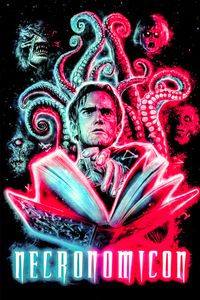
    (In French, On Cable TV, June 2021) Horror anthology films are a roll of the dice every time — not only are the films themselves a gamble, but so are their individual segments as well. Necronomicon has the distinction of focusing on adaptations of Lovecraft’s short stories, but that’s about all that the segments have in common. The framing device has Jeffrey Combs playing Lovecraft as he reads the Book of the Dead in an evil library — not a bad concept, but clearly not the meat of the film either. The rest is uneven. The first segment, “The Drowned,” has some marine chills and an authentic Lovecraftian monster as an antagonist. Follow-up “The Cold” is a more domestic piece that gets away from classic Lovecraftian mythos to deliver an ill-fated romance between a male prey and a female monster (although it does feature David Warner). Final segment “Whispers” is thankfully crazier, going back and forth between reality and fantasy and climaxing with an insane kind of revelation that’s both fun and makes the segment rather pointless. Behind the scenes, there are some impressive names in the crew, from Brian Yuzna to Tom Savini to Christophe Gans. But the result doesn’t quite match the intent — Necronomicon is watchable without being memorable, and there’s a feeling that the tight budget may have limited some ambitions. It’s likely that a modern attempt at the same would be closer to its intentions due to digital special effects technology. More substantially, there’s something regrettable in seeing that the “Lovecraftian” horrors conjured here are about the flash of gooey creatures more than the headier cosmic horror often found in the author’s work. But that’s evaluating Necronomicon based on later, loftier standards — it does remain a decent piece of 1990s horror, and one thankfully focused on supernatural creatures rather than psycho slashers.

  • Beyond Re-Animator (2003)

    Beyond Re-Animator (2003)

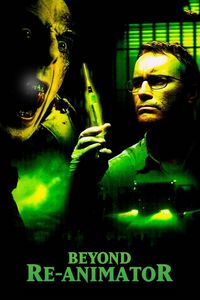
    (French, On Cable TV, January 2021) While I watch a lot of horror movies (I’d wager that in a given year, I see more horror movies than the total number of movies watched by casual cinephiles!), I’m not entirely eager to call myself a fan of the genre: Putting aside the formulaic and nihilistic nature of most horror films, much of the genre seems to attract a strange blend of fans—having attended a number of World Horror Conventions in my fannish heydays, I’m familiar with the gore-loving rough black comedic attitude of many aficionados, and I’m not nearly as attracted to that than by the thematic possibilities of the genre once it moves beyond just being about the monsters it portrays. But if you’re familiar with that tone, there are a bunch of horror movies out there that seek membership in a very specific semi-comic genre—not quite soul-suckingly bleak as other horror films, clearly more playful than straight-up monster slashers, and specifically talking to like-minded fans. This unforgivably meandering introduction is meant to place Beyond Re-Animator in its proper place—as a semi-comic, semi-gory, semi-ironic paean to the genre itself, riffing off the strengths of its previous instalments (mostly Reanimator—there’s not much here reminiscent of Bride of Re-Animator) in order to deliver more of the same. The plot has to do with a young doctor seeking the tutelage of Dr. Herbert West, now imprisoned after the events of the previous films. Thanks to new plotting devices, West is now able to reanimate dead bodies more efficiently, and the film plays out in a prison where death is frequent but not permanent. Beyond Re-Animator integrates lovingly crafted gory practical effects with a dollop of CGI to expand the cinematography of its predecessors, but otherwise doesn’t improve much on them. The humour is muted compared to the first instalment, and while the plot is slightly more interesting than Bride of Re-Animator, it doesn’t fly all that much higher. Still, the point here is for horror filmmakers like Brian Yuzna to deliver what horror filmgoers expect—Jeffrey Combs is easily the film’s main draw as the deranged Dr. West. Overall, though, it’s a somewhat average entry in its subgenre—a treat if you’re tracking down the Re-Animator films, but not something that will convert you to the subgenre if you happen to stumble on it without sympathy for what it’s trying to do. That’s fine—fannish audiences grow through stellar examples of the genre, but are sustained by average entries until the next big hit.

  • Return of the Living Dead III (1993)

    Return of the Living Dead III (1993)

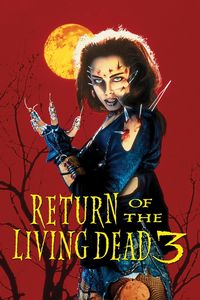
    (In French, On Cable TV, October 2020) My movie selection is eclectic and far more dependent on TV schedules than you’d think, and if I had my choice, I’m not sure that I’d go through the Return of the Living Dead series in ante-chronological order: After seeing the first, I skipped over to the fourth and just now watched the third. Although, considering the reputation of the series as getting worse and worse, maybe that watching order makes more sense: Whet your appetite with a solid first film, then go to the bottom and work your way back up. Return of the Living Dead III is certainly a step up from its disconnected follow-up Necropolis: It even approaches Hellraiser body horror territory at times by following two teenagers, as one of them is brought back from the dead and discovers that the only way to avoid succumbing to zombie urges is to practise extreme masochism. What’s not there, however, is the humour of the first instalment: this third entry is increasingly grim, and the final act of the film gets darker and approaches Day of the Dead levels of nihilism. That final act feels contrived, especially as the film could have ended minutes earlier with an equally powerful last shot—but no, it just keeps going in darker and more frustrating territory the longer it goes on, renewing with hackneyed weaponization clichés and terrible operational procedures that could have been left elsewhere—although the zombie cyborg thing is not bad. Under director Brian Yuzna’s supervision, Return of the Living Dead III is a blend of intriguing elements sometimes used effectively, and sometimes in ways that are too reminiscent of other zombie films. Melinda Clarke is not bad as the teenager who eventually becomes a vision of masochistic fetichism, but far more care has been spent on the gory special effects. Fans of the subgenre will find something in here to like, but I just miss the comic tone of the series’ first film. Although, come to think of it, I still have the second instalment to watch.

  • From Beyond (1986)

    From Beyond (1986)

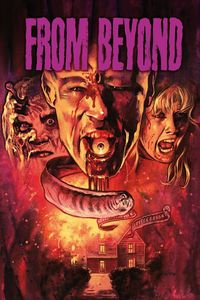
    (On Cable TV, May 2020) I should like—no, I should love From Beyond. In theory, it’s everything I like best about 1980s horror films—off-the-wall premise, Lovecraftian plot elements, wild use of practical effects and makeup, go-for-broke weirdness, over-the-top melodrama, nudity, a sense of fun bigger than the gore, Stuart Gordon directing, Brian Yuzna writing, Jeffrey Combs starring, multidimensional terror and body horror packaged as one, some comedy, some science fiction. If I had to put together my ideal fictional 1980s horror film, it would look a lot like From Beyond. And yet, the result just isn’t where it should be. The pacing is off, the horror seems almost too restrained, and it doesn’t quite seem funny enough for the material. I mean—I still enjoyed From Beyond (it does get admirably gloopy toward the end, not bloody), it’s just that it didn’t feel as if it made the most out of its ambitions. Still, it’s rather over-the-top fun if that’s your thing—and it is my thing.

    (Second Viewing, In French, On Cable TV, February 2021) It hasn’t been that long since I first saw From Beyond, but my willingness to see it a second time has as much to do with it being caught on my DVR as it has with an underappreciated facet of 1980s horror films. The more I watch some of the wilder horror films of the decade, the more I’m struck by how, even limited by practical effects, those movies weren’t afraid to go for pure inspired madness. In From Beyond, we have a wild concoction of body horror, science-fictional nonsense, slimy gloopy creatures, nudity, gore, mutated horrors, dark comedy and explosions and I have to wonder — Have I been watching the wrong movies, or has this streak of utter madness disappeared from the current horror corpus? Why aren’t we using CGI to have some more of that fun? I’m not generally an advocate for gore, but gore is the least of what made films such as From Beyond (or Reanimator, or Evil Dead, or Braindead, or…) — it’s rather the goofy sense of fun with horror/SF tropes, the generous heaping of nudity and humour, the demented scientists and likable protagonists. I feel as if the latest crop of horror films is either far too serious for its own good, unadventurous in its use of special effects despite near-infinite capabilities, and just plain boring in how it simply goes back to the same sources of inspiration. Maybe those films exist and they’ll re-emerge as cult classics in a few years. But there’s a reason why From Beyond and its close equivalents have aged so well for horror fans: in many ways, they’re simply not making them like that any more.
  • Society (1989)

    Society (1989)

    (In French, On Cable TV, January 2020) When a crazy body-horror comedy takes on a title like Society, it’s a fair bet that we’re in for a much wilder ride than a simple late-1980s slasher. Conflating society-at-large with a specific secret society of nameless horrors in Los Angeles’ upper class, this is a film that follows the growing horror of a young disaffected man who comes to suspect that there’s something far more sinister than anyone would expect behind closed doors. Director Brian Yuzna takes sheer delight is messing with his audience early and often, playing the uncanny discomfort along with the gaslighting, the uncertainly about what is really happening and the disquieting soundtrack. Society, among other problems, arguably overplay sits hand early on, leading to frayed nerves and disbelief well before the first hour is through. By the time our misfit-with-issues protagonist (a fitting character for a teenager who doesn’t even feel he’s part of his own family) sees impossible things through a shower door, or a hand that should not be where a hand should be, it’s easy to doubt everything in the film. But Society does redeem itself with one of the craziest ending sequences of its decade (which is saying a lot)—a nightmare of pulsating flesh, ultra-dark humour, surrealism, social criticism, terrifying makeup effects, and existential invitations to annihilation into the whole. It’s a lot, and perhaps the worst about Society is also the best: This is a lot to take in and the execution of the film isn’t slick enough to do it all justice. Yuzna’s first-time direction is a bit of a mess with disorienting transitions and I’m not sure that the much-discussed ending actually sticks the landing in carrying the film’s themes to completion. Despite its faults, though, I am fascinated, seduced and amused by Society. It’s certainly kinky and sexy—although keep in mind that, having come of age in the late-1980s, I will always be partial to the kinds of hairstyles and clothing shown here—There are some nice bikini bunnies here, and Devin Devasquez is nothing short of whew. (I really would not have minded if the Big Secret was just some kind of weird sex cult without the body horror, but I guess that’s just me.) The other thing I really like about Society is that it seldom forgets to be funny. The final sequence is disgusting but not repulsive due to some well-placed touches of off-beat humour, and the film is very much aware of just how transgressive it’s trying to be. The ending is unexpectedly happy for the protagonist and his friends, which works in one way while not working in others. Anyway— I suspect I’m going to revisit Society within a few years, because there’s a lot to unpack here and I feel as if I’m just done with the essentials.