Brooke Shields

  • The Hot Flashes (2013)

    The Hot Flashes (2013)

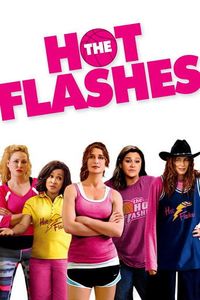
    (On TV, November 2021) Older stars don’t quietly fade away in supporting grandmother roles any more: In the best cases, they get vehicles that openly acknowledge their age and take advantage of it. So it is that The Hot Flashes reunites a number of middle-aged actresses and get them to play their age as an impromptu basketball team competing against high-schoolers to raise money for a breast cancer detection truck. (Yes, it sounds far-fetched, but those are the stakes that this small-town comedy goes for.)  Brooke Shields stars as the hobby-seeking housewife who tries to correct a lapse in judgment by leading the fundraising effort, but she regularly gets outclassed by the supporting cast:  Wanda Sykes remains a reliable scene-stealer as a woman wondering what basketball will do for her mayoral campaign, while Camryn Manheim incarnates a cannabis enthusiast and Virginia Madsen plays the town trollop (or so others say) with a considerable amount of charm. This being a film focused on women, it’s not surprising if nearly everyone gets a self-empowerment dramatic arc, from the lead character confronting her no-good philandering husband (an inglorious turn from Eric Roberts) to the lesbian character coming out, to characters regaining their confidence and beating down the arrogant teenagers. It’s not meant to be a very deep film — the clichés fly fast even when they’re being subverted (the small town is called “Burning Bush,” for goodness’ sake) and director Susan Seidelman is more interested in an accessible middle-of-the-road comedy than anything else. The Hot Flashes feels very familiar, even in its occasional hints of so-called subversion: the idea of older people embracing young people’s things has been frequently exploited over the past few years, and the feminist message of the film is not particularly progressive nor well-executed. But there’s something to be said for older actresses finding good solid age-appropriate roles even as Hollywood tries to discard them as past decades’ flavours — those films may be familiar, but they can be worth a look.

  • The Blue Lagoon (1980)

    The Blue Lagoon (1980)

    (Second viewing, On TV, June 2017) I’ve been revisiting many movies from my childhood lately, and I’m often amazed at how I misremembered some of them. The Blue Lagoon is in a category of its own, because for years, I had taken bits and pieces of the movie and reconstructed it in my mind as something of a horror film. From “two kids shipwrecked on an island; having a baby; baby having trouble feeding; skeleton on the beach”, I had confabulated memories of a stomach-churning drama in which a brother and a sister end up shipwrecked, and grow up to have a baby that then dies of malnutrition. You can imagine my horrified expression when I heard about the film as “the most innocent movie ever!” Checking it out again, I realized my confabulation … but also how, in being so innocent, the film can feel transgressive as well. So, the basics of The Blue Lagoon are, indeed, “two kids shipwrecked”, except that they’re cousins, and a crusty old sailor lives with them for a few years before dying of a drunken mishap (hence the skeleton on the beach later on). They do grow up and have a baby in the middle of a tropical paradise, except that they do figure out how to feed it and escape from the Island more or less accidentally. The finale is halfway ambiguous … unless, apparently, if you see the cruel first few minutes of the sequel. Brooke Shields and Christopher Atkins supposedly star, but their acting is terrible and they’re constantly upstaged by the footage of the island and the tropical creatures. Seriously: The Blue Lagoon is far more palatable as nature footage loosely surrounded by a plot than anything else. The curious tone of the film is indeed one of innocence, to the point that it becomes uncomfortable to modern audiences—I suspect that any reaction to The Blue Lagoon is strongly dependent on the social context of the time. Circa-2017 North America isn’t built for innocent earnestness, a sexualized teenager (Shields was, famously, 14 years old when shooting the film), cousins having kids or the kind of Victorian melodrama that this film adaptation of a 1908 novel encapsulates. It’s so innocent that it feels perverse, in a way. And while the movie isn’t the horror-show that I remembered, I’m arguably more off-put by the film as an adult than as a kid.