Bruce Willis

  • Red 2 (2013)

    Red 2 (2013)

    (Video on Demand, December 2013) The original Red dared to combine aging action stars with quirky comedy and strong action sequences to deliver a film that wasn’t entirely successful, but remained distinctive enough to distinguish itself in a crowded field.  This sequel is slightly improved by a better understanding of how to combine humor with action, and it can dispense with the tedious work of introducing its main characters.  Bruce Willis plays his familiar world-weary tough-guy role, quipping when he’s not exasperated at being thrown once again out of retirement.  Among the returning cast, Helen Mirren is as much fun as ever as a top assassin, while John Malkovich is a bit less crazy (but more sympathetic) this time around, even as Mary Louise Parker furthers her transition from adrenaline junkie to rookie operative.  There’s a fascinating “throwback to the cold war era” atmosphere as the action goes well beyond the borders of the United States and to Europe, with Anthony Hopkins bringing new laughs as a crazed weapons designer and Catherine Zeta Jones earning a few chuckles of her own as a once-fatale assassin.  While the CGI works gets a bit tiresome by the end of the final chase sequence, most of the other action scenes are good enough.  Red 2 doesn’t work on a particularly high level, but it’s adequate and in some ways moves past the whole “retired action heroes” shtick into a post-Cold War plot that seems to grow organically out of the characters’ age.  It works just fine as an unassuming action film, and even a little better as a sequel.

  • The Cold Light of Day (2012)

    The Cold Light of Day (2012)

    (On Cable TV, September 2013) The risk in relying on familiar thriller tropes is that while they can provide structure, they can’t, in themselves, substitute for wit and originality.  It’s not a bad idea to propose as a premise an American tourist in Spain getting caught in a complex web of espionage thrills and double-crosses, but it has to be handled with some competence.  Alas, The Cold Light of Day is a purely generic product down to its meaningless title, and a roster of familiar actors can’t save the film from by-the-number plotting, familiar plot points, murky motivations and tedious pacing.  Henry Cavill gets (and fumbles) a chance to prove himself a contemporary action hero as he finds himself alone and running in Madrid, but he’s easy to forget when sharing scenes with Bruce Willis (as a father with a hidden second and third life) and Sigourney Weaver (as an immediately-suspicious high-level intelligence officer).  Much of the film is straight out of the “man running for his life” thriller sub-genre, and while director Mabrouk El Mechri has the occasional good eye for filming action scenes, they feel overlong and perfunctory in the middle of such a familiar framework.  (The final car chase definitely has its moments, but it’s too long by at least half its duration)  While The Cold Light of Day will act as a pretty good showcase for Madrid’s tourist attractions, it’s not much of a calling card for anyone else involved: the characters are uninvolving, the narrative excitement is flat and nearly everything about the film seems wasted.  For a film produced with decent means and known actors, there isn’t much here to distinguish it from a run-of-the-mill TV movie.

  • Lay the Favorite (2012)

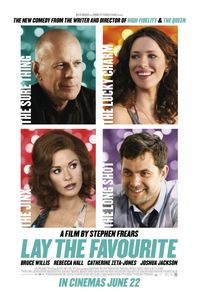
    Lay the Favorite (2012)

    (Video on Demand, May 2013) For an actress I didn’t even know at the beginning of the month, I’m suddenly quite impressed by Rebecca Hall’s screen presence and the range she shows from the “hero scientist” of Iron Man 3 to the “ice-cold English noble” of Parade’s End to the “trailer-park chic” of her role in Lay the Favorite.  [July 2013: Although the “non-nonsense pragmatist” of The Awakening and Vicky Cristina Barcelona suggest that Lay the Favorite is a bit of an outlier.]  Her performance is one of the few things that transform the somewhat ordinary script for Lay the Favorite to something worth remembering the day after.  A gambling comedy set in the sports-bookie world of Las Vegas, it at least has the merit of exploring a new subculture and doing so with just enough style to be interesting.  Much of the plotting is purely serviceable, with the expected story beats all carefully lined up in a row.  But it’s light-hearted enough to be unobjectionable and one suspects that the light breezy tone has a lot to do with how it landed notables such as a smiling Bruce Willis in the lead, usually-reprehensible Vince Vaughn as an antagonist of sorts, and Catherine Zeta-Jones in another of her increasingly-frequent strong supporting roles.  Still, the film really belongs to Hall, and she makes the most of her role, even elevating the somewhat slight film built around it.  Despite weak romances, tonal inconsistencies and a dull ending, she’s the reason why Lay the Favorite remains watchable throughout and leaves a generally favorable impression even despite its familiarity and lack of substance.

  • Moonrise Kingdom (2012)

    Moonrise Kingdom (2012)

    (On Cable TV, April 2013) I had trouble enjoying writer/director Wes Anderson’s earliest films, but with 2007’s Fantastic Mr. Fox and now Moonrise Kingdom, things may be turning around. I’m not the same person who saw Anderson’s first films as they appeared in theaters, obviously, and Moonrise Kingdom is a lot like Fantastic Mr. Fox in that it takes Anderson’s fascination for the twee presentation of flawed characters and puts them in a more broadly accessible context than, say, The Life Aquatic with Steve Zissou. Simply put, here we get kids acting like adults rather than adults acting like kids and that makes a huge difference: As Moonrise Kingdom follows the repercussions of two 12-year-olds eloping together, the film feels charming, comic and affectionate at once. A strong cast of eccentric adult characters (Bruce Willis as a policeman, a pitch-perfect Edward Norton as scoutmaster, hangdog Bill Murray, Tilda Swinton as a social services meddler) acts as a good foil for teenage protagonists Jared Gilman and Kara Hayward. Moonrise Kingdom’s whimsical tone seems perfectly controlled, and it’s hard to watch the film without looking forward to the next trick to come out of Anderson’s fertile imagination. It’s an odd film, with comparisons to be found mainly in Anderson’s cinematography (well, maybe that of Jared Hess as well), but it works better than it should. I’m calling Moonrise Kingdom a pleasant surprise, especially given that I expected practically nothing from it.  I may, however, expect more from Anderson in the future.

  • Looper (2012)

    Looper (2012)

    (Video on Demand, January 2013) There are quite a few things that annoy me about Looper: The inanity of its time-traveling premise, the slap-dash way its future is assembled, the way the two main stories of the film don’t seem to mesh seamlessly, the lengthy time-out in the third quarter of the film… all elements that could and should have been fixed.  But these doubts having been expressed, let us not be distracted from the fact that Looper remains one of the strongest SF films of 2012 in a relatively crowded field: It’s a solid movie, a confident effort that doesn’t spoon-feed its audience and engages with provocative questions about our relationship with ourselves (in the first plot-line) and our duty to the future (in the second).  Joseph Gordon-Levitt stars as the younger version of a character also played by Bruce Willis, but it’s writer/director Rian Johnson who emerges as the big winner of the film: not only does he turn in an accomplished piece of cinema, he also plays with SF archetypes in a refreshing matter-of-fact fashion that allows him to use those elements to get to the core of the drama he wants to set up.  Looper goes effortlessly from the streets to the cornfields, striking a Midwest SF atmosphere that feels refreshingly different from many of the other recent SF blockbusters.  While the script has weaker points, it manages to present a few complex ideas cleanly, and its second half’s sense of moral uncertainty is uncanny in the best sense.  For SF fans who are tired of the same old visually-spectacular-but-dramatically-hollow products, Looper is a small triumph and another entry in the mini-boom of good original cinematic SF since District 9.

  • Red (2010)

    Red (2010)

    (In theaters, November 2010) By now, the action/comedy genre is so familiar that everyone should cheer whenever a quirky off-beat project tries to do something differently.  While originality isn’t always an advantage (Knight and Day showed that quirkiness can’t replace solid screenwriting), films like Red can tweak the usual formula and make it feel just a bit fresher than usual.  The story is familiar (a renegade secret agent tries to find out who wants him dead, accompanied by a reluctant love interest), but the details aren’t as overused:  The agent is retired, his allies are old and paranoid, his enemies are deep within the government and his would-be girlfriend initially has to be tied, drugged and dragged along before she comes to appreciate the action-comedy lifestyle.  Red flies around the United States, literally showing postcards along the way –which may give you an idea of its particular sense of humour.  Bruce Willis may be the Red’s headliner, but the real appeal of the film is through Mary Louise Parker’s wide-eyed evolution from house-bound kitten to adrenaline junkie.  Helen Mirren is delightful as an aging assassin, while John Malkovich has a typical turn as a deeply paranoid retiree.  Action highlights include a shootout in New Orleans and the use of heavy artillery in a Chicago hotel parking lot.  Much of the plot is routine, but the film is a lot more enjoyable during the comedic moments between the characters.  Fans of the original comic book may want to forget all about the source material, because Red is quirky and light-hearted whereas Warren Ellis’ story was sombre and nihilistic.  While Red often goes spinning too fast in all sorts of directions to be truly effective, the result isn’t too bad as long as you don’t expect the sort of straight-ahead action-with-quips blockbuster: Red is handled with another kind of sensibility, and if the result is often a bit too off-beat to be fully enjoyable, it delivers what is expected with a little bonus that no one asked for.

  • The Expendables (2010)

    The Expendables (2010)

    (On DVD, August 2010) It’s said that films should be judged on the basis of their ambitions, and the least one can say about writer/director/star Sylvester Stallone’s The Expendables is that it really wants to be a gift to 1980s action movie fans.  The ensemble cast is among the most extraordinary ever assembled for an action film, in between Stallone, Jason Statham, Mickey Rourke, Dolph Lundgren, Jet Li and others, with great cameos by Bruce Willis and Arnold Schwarzenegger.  Unfortunately, the cast (Statham in particular) is about the only thing going for this film, which is so successful in recreating the eighties that it has forgotten that most action films of the era were deathly dull.  Reviving Regan-administration Latin-American politics, the film is mired in a dull banana-republic setting where only Americans can kill the right people to restore peace and deniable capitalistic hegemony.  But even worse is Stallone’s action direction, which cuts away every half-second in an effort to hide that the actions scenes don’t have a lot of interest.  The explosions are huge, but the rest is just confused: in-between the excessive self-satisfied machismo of the film, it’s not hard to grow resentful at the stunning waste of opportunities that is The Expendables.  A perfect example is a dock strafing sequence that could have been great had it actually meant something: instead, it just feels like the gratuitous hissy fit of a pair of psychopaths.  But the nadir of the film has to be found in its script, especially whenever it tackles perfunctory romance: Sixty-something Stallone may helm the film, but it’s no excuse to slobber over a girlfriend half his age.  Another dramatic monologue delivered by Rourke stops the film dead in its tracks and sticks out as the endless scene that doesn’t belong.  Too bad that the script doesn’t know what to do with what it has: despite the obvious nods and little gifts to macho cinema, The Expendables quickly indulges in the limits of the form.  Guys; don’t argue with your girlfriend if she wants both of you to see something else.

  • Fast Food Nation (2006)

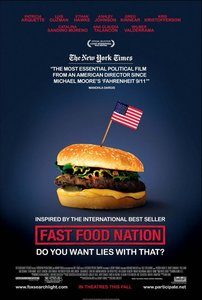
    Fast Food Nation (2006)

    (On DVD, March 2010) Adapting a book to a movie is a gamble even in the best circumstances, but adapting a well-regarded non-fiction classic into an ensemble drama is really asking for trouble.  To its credit, Richard Linklater manages to touch upon much of Eric Schlosser’s critique of the fast-food industry: We get a taste of its reliance on students and migrant workers, the bloody mass butchery required to keep those burgers flowing, the external costs inherent in cheap food and even details such as made-in-laboratory flavours.  What the film doesn’t do as well is in dramatizing those issues: Often, Fast Food Nation feels like a talky issues show in which every scene mentions a problem or two.  (Even a quick walk through school corridors can’t help but feature metal detectors and drug-sniffing dogs.)  Some characters are more interesting than others (there are plenty of cameos and small roles for familiar faces, the best of which being a single-scene semi-villainous turn for Bruce Willis), but the film shuts down before it can tie up most situations adequately: it’s all setup and little payoff, although it leads, Heart of Darkness-style, to a revelatory climax showing the gruesome nature of the “Killing Floor” discussed so often during the rest of the film..  This unflinching moment, filmed in a real Mexico butchery said to be cleaner than US ones, is meant to disgust –but it may not be the film’s intended climax for viewers who already understand that animals become meat become burgers.  Still, Fast Food Nation generally sticks close to reality, and its failings as a piece of narrative fiction are profoundly linked to its strength as a semi-documentary exposé.  It could have been much stronger by including a third act, presenting its messages more carefully (although, thanks goodness, it avoids the most obvious “fast food will make you fat”) and sticking closer to its characters.  But even with its flaws, it’s a worthwhile film: the issues are there to ponder, and there are a handful of scenes good enough to make the film compelling.  Don’t plan on eating much fast-food right after, though.  Appropriately, viewers may come to appreciate the film more after listening to co-writers Linklater and Schlosser on the audio commentary track: they discuss what material was kept from the book, the nature of low-budget moviemaking and some of the themes they were tackling.  A handful of other extras round up the DVD, the most memorable of them being the now-classic Meatrix Flash animation short films.

  • Cop Out (2010)

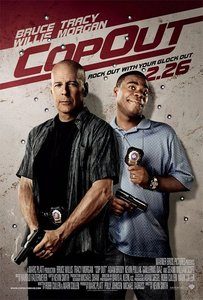
    Cop Out (2010)

    (In theatres, March 2010) The most profound irony about Cop Out, as directed by Kevin Smith from someone else’s script, is that the film’s direction is quite a bit better than its screenplay.  This should surprise Smith fans: after all, hasn’t it been a trademark of his movies that their writing frequently rises above their often-pedestrian direction?  Here, through, Smith has a budget and presumably the time to present a more visually ambitious vision.  Alas, the script just isn’t there: As a pair of policemen bumble their way through a dull storyline involving Latin gangsters in Brooklyn, Bruce Willis does well as the veteran leader of the pair but I remain unconvinced by Tracy Morgan’s comedic style.  Worse, though, is the script’s fondness for police intimidation as a plot driver: in Cop Out’s reality, it’s hilarious for heroes to jam pistols and tattoo needles in civilians’ face to extract information.  As for the rest of the film, it’s more miss than hit.  Seann William Scott has an intriguing character that’s played for senseless giggles.  Other characters come and go, with a dramatic plot heavy-handedly jammed in the middle of the comedy.  There’s a noticeable lack of flow to the proceedings, and the spot-the-references-to-eighties-action-movies game quickly grows tiresome.  For a comedy, Cop Out has a noticeable lack of laughs: even what is supposed to be amusing just feels dumb.  On the other hand, the direction feels undistinguishable from most cookie-cutter cop comedies, which marks a step up for Smith.  He’s still not doing it well, but at least it’s not as blatantly bad as in his first few films.  Hopefully it’s a lucrative enough project that he’ll be able to work on something else soon.  Still, even in mercenary work-for-hire projects, he may want to pick material that’s stronger than Jersey Girl.

  • Surrogates (2009)

    Surrogates (2009)

    (In theatres, September 2009) It’s a truth, universally acknowledged, that the best movies make you think.  But it’s a less-acknowledged universal truth that even bad movies can lead one to conclusions.  In this case, Surrogates is the kind of hit-and-miss film that makes one think that film really isn’t the ideal medium for idea-driven Science Fiction.  On a surface level, some things work well: Bruce Willis is his usual dependable self as a cop investigating unusual murders, Boston makes a great backdrop to the action, and director Jonathan Mostow has kept his eye for good action sequences and efficient storytelling –although, frankly, I would have liked longer cuts during the chase scenes.  The idea of a future where “surrogates” effectively allow one to decouple body from mind is rich in thematic possibilities, and the film does investigate a few of them.  If nothing else, Surrogates is a decent way to spend an hour and a half; at least it’s a bit more ambitious than most other movies at the theatre.  Alas, that’s not saying much, and the credibility problems with the film start with the first few frames.  In flagrant violation of market economics, human nature, bandwidth limitations and just plain logic, this is a film that depends on 98% of the (Boston? American? Human?) population relying on highly advanced and presumably expensive equipment just 14 years in the future.  Never mind that some people don’t even have cell phone today: Surrogates rushes into the bad clichés of a Manichean monolithic society in which everyone has and enjoys a surrogate, except for the easily-dismissible hillbillies and weirdoes who apparently choose to live in technology-free reserves.  Never mind that the world is usually a great deal more complex and that the kind of technological breakthrough that surrogates represents could lead to a world where the very concept of incarnation would be abandoned: Surrogates simplifies issues to the point where anyone with half a working brain will cringe at the way the film ignores possibilities and takes refuge in cheap movie mechanics.  The ending is particularly frustrating, as it all boils down to “press this button to save a billion lives!!!”  That a lot of those issues were present in Robert Vendetti’s script for the original underwhelming graphic novel isn’t much of an excuse when the film takes such liberties with the source material.  (If anything, Surrogates owes more to the I, Robot film than the graphic novel, down to James Cromwell in near-identical roles)  The contrast between Surrogates and thoughtful written SF is strong enough to make one suspect they’re barely in the same genre.  (Compare and contrast with Richard Morgan’s Altered Carbon for a particularly enlightening experience.)

  • The Bonfire Of The Vanities (1990)

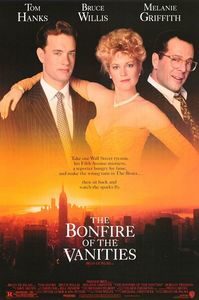
    The Bonfire Of The Vanities (1990)

    (On DVD, October 2008) This movie was critically lambasted upon release, but if it’s not quite a success, it’s not the disaster that some reviewers have reported. As an adaptation of Tom Wolfe’s novel, it manages to hit most of the high points of the novel, and if Wolfe’s prose can’t be fully adapted to the screen, it finds an appropriate counterpart in Brian de Palma’s swooping direction and ambitious cinematography. The long continuous opening shot is a small marvel of the form, while other sporadic flourishes keep things hopping along. Things aren’t as slick regarding the script, which does an intriguing job re-casting Wolfe’s story into a satiric comedy mold, but falters in the film’s second half with a number of limp scenes that don’t advance the story as efficiently as they should. It’s too bad that the manic quality of the original is only half-finished here. The result isn’t terrible, but it certainly could have been better. The first-generation DVD, regrettably, doesn’t include any supplementary material about the film, which is a shame given that an entire book has been written about the film’s troubled production.

    (Second viewing, On Cable TV, August 2021) After enjoying TCM’s podcast adaptation/update of Julie Solomon’s The Devil’s Candy, which offers four hours of material on the making of The Bonfire of the Vanities, the mandatory next step was to watch the film itself. (Actually, I watched it between the sixth and seventh episode – the best possible timing considering that the seventh episode opens on the first public showing of the film.)  Once again, a rewatch had me protesting that the result wasn’t that bad, even enjoyable. Oh, it’s clear that as a film, The Bonfire of Vanities falls considerably short of its potential. The dark cynical humour is mishandled and neutered by a final speech that shouldn’t be in the film. It’s miscast from top to bottom – Tom Hanks is not bad in the last third of the film when he’s free to play up his comic persona, but he’s really not the right choice for playing a high-powered adulterous stockbroker. Melanie Griffith has never been much of a draw for me, so her casting as an irresistible femme fatale is wasted. Morgan Freeman’s not bad, even when saddled with the film’s most awkward dialogue. Surprisingly, I found Bruce Willis to be the most watchable, but only when he fully plays into the quasi-noir role of the crumpled journalist working hard for his bylines. (This is not, however, the character in the book.)  Visually, the film is far better than its script – The first ten minutes overpromise a film that’s not to be found later on, as a magnificent overhead shot of New York City leads to an astonishing steady-cam shot and then to the memorable image of Tom Hanks dragging his dog off to a sodden walk (and a misguided phone call that triggers everything that follows). Narratively, you have enough to keep viewers invested, but there is often a clash between the original intentions of author Tom Wolfe and the neutered execution that Brian de Palma ends up delivering. Part of it is clearly due to an attempt at mainstream filmmaking – I don’t think that major studios were ready back in 1990 to bet the bank on a highly cynical work, at least not as much as today. You can see the compromises all the way through, even as the atmosphere of a New York City divided along racial and class lines is still quite pertinent as long as you ignore the Bronx caricatures. It’s frequently (but intermittently) funny, at least enough to keep the film from being dull. I strongly suspect that The Bonfire of Vanities’ reputation partially comes from overinflated expectations considering the success of the original book, partially because entertainment pundits were (and are) always looking for a fall-from grace story from Hollywood, and partially because the gap between that the film aimed for and what it achieved is so visible. As someone who routinely watches near-unwatchable cinematic tripe made with only a fraction of The Bonfire of Vanities’ assembled talents, the circa-1990 hyperbolic pans of the film are embarrassing for those taking the potshots: The Bonfire of the Vanities is misguided, disappointing, even a case study in how even the best intentions can go wrong in such a complicated production as a Hollywood film, but there’s more than enough here to make viewers happy – even its problems can be entertaining once you get into them.

  • Live Free Or Die Hard [Die Hard 4.0] (2007)

    Live Free Or Die Hard [Die Hard 4.0] (2007)

    (In theaters, June 2007) The good news are that the fourth instalment of the Die Hard series is a very enjoyable return to the roots of the good old action film: explosions, dastardly villains, a wisecracking hero, spectacular action set-pieces and things we haven’t yet seen. The not-so-good news are that it falls short of being a good Die Hard film. Over the long run, I suspect that it won’t matter: the two previous Die Hard sequels initially disappointed moviegoers who then grew fonder of them as time went by. At the very least, an older “John McClane” is back, fighting terrorists who are really robbers and trying his damnedest to save family members from consequent harm. The story is a pack of silliness (Hackers! National infrastructure! Turning all traffic lights to green!) with more logical howlers than you can imagine (including a convenient absence of traffic when needed), but at least it gives Bruce Willis something to do and plenty of opportunities to look good with an increasing number of cuts and bruises. Though the villains are a bit wasted (Timothy Olyphant’s villain never projects too much menace, while Maggie Q is wasted as a sidekick who can’t help but go “yah!” as she’s kung-fu fighting) and the direction is too scattered to be truly inspiring, there are a number of really good action sequences here and there. There’s a bit of parkour, a wall-smashing gunfight, at least one flying car, some hot jet-on-truck action and a crumbling symbol of American power. Good stuff, though I’d like a cleaner look for the action than the fashionable CGI-boosted shakycam stuff. More globally, it’s fascinating to see a mainstream American action thriller take on a plot-line that would have been pure science fiction (in concept and execution) barely twenty years ago: our heroes use cell phones, shrug over memories of 9/11, do some social engineering via OnStar and stare intently at webcams even as McClane is derided as “a Timex in a digital world”. It’s too bad that this is a different McClane than the one who starred in the first Die Hard, but I won’t complain: Fast-paced action movies are rare enough that I’ll take what I can get.

    (Second viewing, On DVD, February 2008) I’m shocked: This film actually works better the second time around. Free from the initial impact of silly plotting and logical howlers, this fourth Die Hard installment surprises by how well it understands the mechanics of the character, while the direction is a cut above the jerky style commonly used nowadays. The pacing is steady and the climax delivers on its promise. The bare-bones DVD version still includes a fairly entertaining commentary with Bruce Willis and director Len Wiseman (who redeems himself after the two Underworld movies): it explains a fair bit about the conception and the making of a project that was a long time in the making. I didn’t actually expect this film to hold up to a second viewing, but it does do quite well.

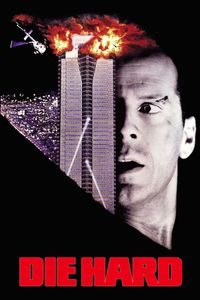
  • Die Hard (1988)

    Die Hard (1988)

    (Third viewing, On TV, April 1999) It’s always risky to sit down and watch an old favorite movie. Who knows if you’re not setting yourself up for a disappointment? Maybe your memory isn’t as good at you think it is, and “enhanced” the movie beyond its actual worth? Fortunately, Die Hard still possesses -even after countless imitators- the same qualities that made it an action classic: a tight script, a good premise, nicely-defined characters, a nasty and believable villain, comic relief, great pacing and -perhaps above everything- a superb performance by Bruce Willis. Though perhaps unintentionally ridiculous by moments -like Powell recovering his… er… virility-, Die Hard still stands as one of the action genre’s towering achievements.

    (Fourth viewing, On DVD, October 2001) The classics never get old, and so you can watch Die Hard on a yearly basis and still find yourself sucked into its magic. Are there any flaws to this film? Probably, but I can’t be bothered to find them. It’s just too much fun to watch uncritically. The “Five-Star” DVD edition is adequate, but somehow disappoints by not offering more, more, more about the film.