Burgess Meredith

  • Story of G.I. Joe (1945)

    Story of G.I. Joe (1945)

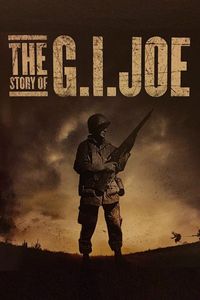
    (On Cable TV, April 2021) You could be forgiven for assuming, from the opening credits, that Story of G.I. Joe is going to be focused on Pulitzer-winning American journalist Ernie Pyle, who famously reported while embedded in WW2 campaigns in Tunisia and Italy. The film contains narration inspired (or copied) from Pyle’s columns and was filmed as Pyle was reporting from the Pacific Front. (Pyle, who was involved in the film’s production, was killed on Okinawa two months before the film premiered.)  But when you get into the film, you eventually notice that Pyle’s character ends up a supporting character reporting the actions of the company he’s with, and so Story of G.I. Joe indeed becomes the story of the grunts working the frontlines. Robert Mitchum gets a first great role as an officer who provides material for the reporter’s columns, easily (and by design) outshining the less flamboyant Burgess Meredith playing Pyle. Entirely produced during WW2, the film ends up being a convincing portrayal of ground troops during the campaigns of Tunisia and Italy. It does have some added interest in having a journalist act as a narrator (one who finds out, in the field, that he won the Pulitzer), giving an additional dimension to what could have been another war movie.

  • Of Mice and Men (1939)

    Of Mice and Men (1939)

    (On Cable TV, September 2019) In some ways, there’s very little to say about the 1939 adaptation of John Steinbeck’s Of Mice and Men—It’s a solid drama, an adaptation tailored to the big screen (in altering some plot elements for easier consumption) and an actor’s showcase as well. It’s very much like the novel you likely read in high school. One of the advantages of the film adaptation is how it depicts the migrant worker life in the 1930s, adding another layer of interest to the story of its two protagonists. Burgess Meredith has the lead role as George, but Lon Chaney Jr. has probably his finest dramatic role as the hulking Lennie. Competently shot in black-and-white and with admirable restraint when it comes to the depiction of its most violent moments, Of Mice and Men hasn’t aged all that much—it’s firmly set in the 1930s and has become a period piece along the way. It’s one more piece of evidence for 1939 as one of the finest years for cinema, and an engrossing film in its own right.

  • That Uncertain Feeling (1941)

    That Uncertain Feeling (1941)

    (On Cable TV, March 2019) I don’t think today’s audiences can quite approach Ernst Lubitsch comedies with the same thrill as they did upon release: Social attitudes are not what they were, and the impish sense of the perverse that powers his comedies has often been outpaced by progressivism. But Lubitsch wasn’t just there to shock for comic value: the execution of his films was based on a solid sense of sophistication that, frankly, has rarely been equalled since. That Uncertain Feeling, for instance, takes on a comedy of remarriage as its topic, casually bandying around a divorce as if it was no big deal for a woman to leave her husband for an eccentric new man. It’s all sophisticated like many comedies of the time were, set within the upper-class Manhattan set with more romantic comic worries than money problems. Built on witty dialogue, much of the humour comes from characters acting unusually calmly to stressful situations … although That Uncertain Feeling’s biggest laughs come from having them revert to type and punch someone who aggravates them. The character work isn’t bad either—while Merle Oberon is splendid as the wayward wife and Melvyn Douglas does some great seething, Burgess Meredith is a highlight as a pianist who becomes the object of the female lead’s attention, causing chaos with gnomic utterances, misplaced dislikes, odd anxieties and a complete lack of care. It ends as we may expect, with a remarriage—both because the pretender is hopeless, but more importantly because (and here’s the heartfelt awww underpinning the comedy) our two leads never stopped loving one another. That Uncertain Feeling leaves a clear impression even in modern reviewers: it has aged quite well (perhaps helped along by a freer attitude toward divorce) and while it may not be Lubitsch’s best, it’s sufficiently clever and witty to remain interesting … and funny.