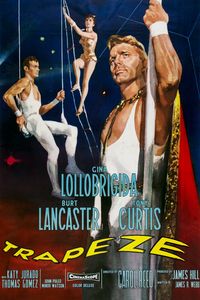
Trapeze (1956)
(On Cable TV, February 2021) There are a few good reasons to have a look at Trapeze, but almost all of them start with the casting: Burt Lancaster as a crippled trapeze artist, Tony Curtis as an up-and-comer seeking guidance, and the deliciously-named Lola Lollobrigida as (obviously) the woman that comes between them. Probably the next-best reason is the trapeze footage, still impressive today due to the impressive physicality of the performers (some of it without stunt doubles), and the apparent danger of some of the acts. Considering that the story is about the pursuit of the elusive and dangerous triple somersault, visual danger appropriately reflects the stakes at play here. Otherwise, much of Trapeze runs along familiar tracks once you exclude the (rather impressive) Parisian circus aspect of the story: a veteran, an up-and-comer and the love triangle that takes place once a woman comes along. Director Carol Reed does his best in the circus ring, with the rest of the film being along more familiar lines. Still, the Lancaster/Curtis pairing is interesting as a preview to their far better-known Sweet Smell of Success, and Lancaster notches another film in a more interesting filmography than you’d expect from a multi-decade leading man.