Casey Affleck

  • The World to Come (2020)

    The World to Come (2020)

    (On Cable TV, August 2021) It would be fun to claim that I went in The World to Come completely ignorant of its nature, expecting a Science Fiction film along the lines of the classic Things to Come. But that would be a lie — I knew exactly what kind of film The World to Come would be because it’s not subtle about it. From the premise, poster and first few minutes, there’s no doubt about its nature: a “forbidden period romance” (i.e.: non-heterosexual romance in intolerant times) almost too eager to revel in the misery of its characters. Nothing that follows is surprising. Our narrating heroine is a young woman out of place and out of time: She’s living in a hardscrabble rural area of 19th century America, with her husband toiling the land as she keeps (pick one at random and repeat:) grieving her dead daughter; rebuffing her husband’s advances; bemoaning being stuck in the middle of nowhere; craving the companionship of equals; writing in her diary. You know — exactly like a twenty-first century urban lesbian would act in the same situation. But then, at long last in-between the deliberately spirit-killing scenes of rural farming, comes a new fiery-headed neighbour. This is followed by more waiting, as we wait for the same-sex relationship to blossom into a full-fledged love affair. (All during which the husband keeps toiling the land.)  Further playing along expected lines, our newcomer’s husband is clearly abusive and we all know what that means. Which the film obligingly follows. The ending was foretold from the start — especially considering the heavy-handed message of how unhappy the female leads are supposed to be except when each other. My sarcasm is puerile but not surprising: “forbidden period romances” are the new hotness in independent film and while I liked The Favourite, I’ve also seen Lady on Fire and a few others and can’t really muster up any more interest for a film whose main points have been done better elsewhere. You may be surprised, after the above, to hear that I did like some aspects of The World to Come: Vanessa Kirby is terrific as the object of fulfillment and desire, and she looks amazing in symbolic red curls. I’ve been wondering for a while if she’s about to become The Next Big Thing, and this is the kind of performance that nicely counterbalances a few striking turns in big-budget action films. I have some sympathy for the poor dumb hard-working farmer played by Casey Affleck, doomed to a perpetually unhappy wife/life and yet helping her out to get to the end of her journey. The cinematography is not enjoyable in its depiction of hardscrabble frontier living, but it is remarkably convincing. Despite being the furthest thing from The World to Come’s intended target audience, I still went into the film hoping that something would hook me. The result is not satisfying — sure, some fine acting and cinematography, but the rest is often obnoxious in its insistence on repeating an increasingly clichéd formula as if it was brand new. Given so, I’ll have a rewatch of The Favourite before I touch this one again.

  • Manchester by the Sea (2016)

    Manchester by the Sea (2016)

    (Amazon Prime Streaming, September 2017) Most movie misanthropes are simply eccentric people who just need a little bit of love and compassion before they become whole again. But not the protagonist of Manchester by the Sea, a haunted man who would rather work in a menial job and avoid human contact (including advances from attractive clients) due to an unspecified trauma in his past. But as his brother dies and he’s forced to take responsibility for his nephew, the nature of his past becomes more obvious, and his all-consuming guilt explained. Casey Affleck has never been the most sympathetic of actors, and he’s just about perfect in this movie as he plays a character going through life through motions, not quite believing that he deserves to live. (The flashback that explains his all-consuming grief has a spectacular suicide attempt, for reasons entirely comprehensible to the audience.)  Having lost it all, he doesn’t believe that he deserves it back, and the ending only offers a very brief glimmer of flickering hope. From the above description, you’d think that Manchester by the Sea was an unrelenting assault of gloom, but one of the savviest ironies of this well-controlled film is the bleak dark humour that permeates it, making it feel far more interesting than a pure drama would have been. Writer/director Kenneth Lonergan has put together something unexpectedly interesting considering the dark subject matter, and it’s as sure an instant Oscar contender as you can imagine. 

  • Out of the Furnace (2013)

    Out of the Furnace (2013)

    (On Cable TV, January 2016) There’s an acknowledged dearth of mainstream realistic adult dramas in today’s cinematic landscape, but I’ll gladly watch a stream of escapist superhero fantasies if the alternative is feeling like slitting my wrists. Unusually dull and sombre films such as Out of the Furnace aren’t the antidote when they’re paralyzed by so much unbearable self-importance. Taking place in the rusted ruins of American industry, it features two down-on-their-luck brothers trying to fit in a world that doesn’t want them once they’ve gone to prison or to war. Out of the Furnace is never a cheerful film, but it gets steadily worse as the protagonists are pushed in increasingly desperate situations. Director Scott Cooper does know how to handle such a film—alas, the material he’s serving isn’t meant for casual consumption. Christian Bale is fine yet not particularly remarkable as the lead, while Casey Affleck is more memorable, but also less likable, as his brother. There are many familiar actors in smaller roles. The dour tone of Out of the Furnace carries through the ending, which almost comes as a relief given how badly we want to get away from this place.

  • The Assassination of Jesse James by the Coward Robert Ford (2007)

    The Assassination of Jesse James by the Coward Robert Ford (2007)

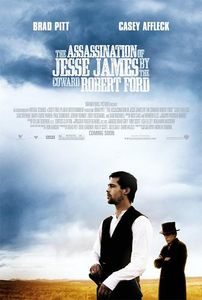
    (On DVD, December 2015) I did not really expect to like The Assassination of Jesse James by the Coward Robert Ford.  Westerns don’t grab me, and the film’s running time, as well as its reputation for being an art-house-friendly character study, didn’t exactly fill me with enthusiasm.  Some lovely shots aside, the first hour or two of the film doesn’t exactly work at dispelling that reluctance: The film drags on and on, with elliptical scenes that don’t really care about effectively moving the story forward with a minimum of fuss.  The emphasis, at least early on, is on the complex relationship between a folk hero and an admiring young man; it’s about striking cinematography of western landscapes; it’s about deconstructing the myth of Jesse James, bit by bit.  This being said, the film becomes quite a bit more interesting after the titular “assassination”: rather than cutting quickly to credits, the film details the hell-on-earth that Robert Ford created for himself, endlessly reliving the shooting through hundreds of theater recreations, being reviled for taking down a popular man and being unable to escape his notoriousness until his bitter end.  It’s not quite the triumph that viewers may expect, and if it completely blurs the lines of what a satisfying third act is supposed to be, it was the section of the film that held my interest most closely.  Brad Pitt is quite good as James, and so is Casey Affleck in a role not meant to be liked or admired.  (Meanwhile a pre-stardom Jeremy Renner shows up, as well as political legend James Carville in an unexpected cameo.)  Director Andrew Dominik still has much to learn about concision (His follow-up Killing Them Softly wasn’t entirely an improvement), but he’s obviously hitting the targets he’s aiming for, and as a result The Assassination of Jesse James by the Coward Robert Ford isn’t quite as dull as a two-hours-and-a-half character study may suggest.

  • The Killer Inside Me (2010)

    The Killer Inside Me (2010)

    (On DVD, October 2010) Medium-budget films featuring a cast of known actors but popping up unexpectedly on DVD shelves always present a challenge for viewers: Is it possible to guess why the film wasn’t given a wide theatrical release?  In the case of The Killer Inside Me, the truth gradually dawns that in-between the period setting, awkward staging, rough sex and unconvincing script, the film would have been savaged by reviewers looking for a middle-of-the-road thriller.  And yet, the cast remains impressive, with a few standouts being Jessica Alba as a prostitute who gets the worst of a bad deal, whereas Kate Hudson is strangely credible as a white-trash woman and Casey Affleck becomes as repulsive as he can be as a deputy sheriff gradually revealed as a full-blown psychopath.  The period setting is a hint that the film is adapted from a classic noir novel by Jim Thompson, but a bigger clue is found in the strikingly clumsy staging and character motivations as portrayed on-screen: Novels allow for inner monologues that don’t always translate harmoniously to the big screen, and The Killer Inside Me often feels forced in its graphic violence against women, unexplainable character motivations and repellent protagonist.  A novel getting in the head of a criminal is something that a film simply portraying that violence can’t aspire to.  Numerous decisions, such as the graphic brutality directed at women, the loathsome protagonist and the slow pacing, end up grating more than they convince.  As such, the adaptation can’t aspire to much more than a curiosity for noir fans, even though the period detail is convincing (except for the anachronistic trailer-tanker that shows up during a chase sequence) and the acting talent does the best with the script it’s given.  By the end of the film, there’s no doubt that its proper place is on DVD shelves, and then on to oblivion for most viewers.