Catherine Deneuve

  • La femme aux bottes rouges [The Woman with Red Boots] (1974)

    (On Cable TV, November 2021) In watching a Buñuel movie, I expect weirdness, and weirdness is what I got with La femme aux bottes rouges — although I didn’t get the Buñuel I expected. Writer-director Juan Luis Buñuel is the son of Luis Buñuel, but you wouldn’t necessarily be able to tell the difference considering how closely does this film seem to stem from the same place as Le Charme Discret de la Bourgeoisie. Having the beautiful Catherine Deneuve in the lead reminds us of Belle de Jour, and the controlled surrealism of the film clearly owes much to Buñuel père. The story, as much as can be gathered without an explanatory guide, has to do with a young woman (Deneuve) being courted by an elderly rich gentleman (Fernando Rey, remarkable), leading to rifts with her current lover, lust from another man who ends up shooting his wife in a hunting accident, and artists gathering at a retreat. But that’s not the weird part yet, because our heroine is a woman with the power to change reality, to make others do her bidding and create passageways out of paintings. What’s rather charming in La femme aux bottes rouges as it flirts with fantasy is the decidedly low-tech approach to its magic: Things appear, disappear or change after editing cuts: a low budget, low-effort approach that does enhance the eeriness of the fantastic by leaving the magical unseen. It’s really up to the viewers to pay attention and realize unnatural changes even though there are no showy special effects calling attention to themselves. (Speaking of special effects, I had to laugh at one scene in which Deneuve’s character briefly reveals herself naked to the elderly gentleman — she’s wearing a “naked” flesh-coloured bodysuit, and not a subtle one at that.)  As for the rest, well, weirdness abounds: Rey plays his mysterious character with quiet panache, while Deneuve remains enigmatic throughout. It’s a trip throughout art, dreams, semi-pretentious dialogue and people acting bizarrely. Frankly, it took me two attempts to get through La femme aux bottes rouges: I started the first attempt expecting something I could watch out of the corner of my eye and was mystified when the film resisted such a divided-attention approach: it worked much better when watched carefully, especially given what happens in between its cuts. It’s not necessarily recommended for everyone, but if you’re at the end of the Buñuel père’s filmography, consider this one a bonus.
  • Tristana (1970)

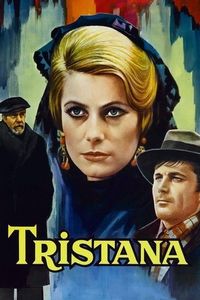
    Tristana (1970)

    (On TV, November 2021) I know just enough about Luis Bunuel’s filmography to expect the unexpected — from the wild surrealism of his earliest films to the more controlled comedy of his last, to the melodrama of his Mexican period and the satire of his Spanish years, who knows what you’ll get with each new film? In Tristana, I certainly got bits and pieces of nearly everything else in his career: intense melodrama with perverted material, social critique, distasteful cruelty, a battered protagonist, and restrained direction despite the lurid subject matter… it’s a surprisingly quiet (even glacially-paced) film but it has quite a bit of material to chew on. Catherine Deneuve is interesting here, zigzagging her own image as a beautiful woman in various ways that run counter to what viewers may expect. I can’t say that I liked Tristana (can one really like Bunuel films?) but it’s intermittently interesting and certainly one of the purest expressions of Bunuel’s lifelong obsessions as put on film.

  • Les demoiselles ont eu 25 ans [The Young Girls Turn 25] (1993)

    Les demoiselles ont eu 25 ans [The Young Girls Turn 25] (1993)

    (On Cable TV, April 2021) While other people praise Les parapluies de Cherbourg, my favourite Jacques Demy musical is, without a doubt, Les demoiselles de Rochefort, one of the rare pastiches of American musicals that actually work as a great movie on its own. I’m far from being the only one to think highly of the film, as Les demoiselles ont eu 25 ans goes back to Rochefort in order to celebrate the film’s twenty-fifth anniversary. Amazingly enough, this documentary was directed by none other than French cinema legend Agnès Varda, Demy’s widow who was present during the celebrations to receive the homages in lieu of her husband (who died in 1990). While short at 63 minutes, the film blends footage of the original film and the celebrations with interviews from various players in the film, including Catherine Deneuve. We also get a look, through archival footage and recollections, at the making of the film. It’s clear from the footage that by 1993, Rochefort had immensely benefited from the film’s enduring reputation — various local officials speak fondly of the impact the film had on tourism. While the result is more utilitarian than inspiring, it’s not a bad way to revisit the impact of Les demoiselles de Rochefort and to refresh your brain with the terrific earworm of its best-known song. Clearly made for fans of the film, it delivers everything we can ask of a twenty-fifth anniversary celebration.

  • The Hunger (1983)

    The Hunger (1983)

    (On Cable TV, April 2020) In director Tony Scott’s hands, The Hunger goes from potboiler vampire horror (adapted from a novel by—ugh—Whitley Streiber) to something far more stylish. Of course, having a trio of lead actors like Catherine Deneuve, David Bowie and Susan Sarandon helps a lot in elevating the material, but style is not to be underestimated when working with such thin material. The atmosphere holds everything together, even if there are notable storytelling flaws like the very last scene. Squarely drawing upon the vampiric symbolism of sex and death held together, The Hunger goes from high to low, portraying a high-class vampire couple that nonetheless is enslaved to violent and oft-sexual desires—once they draw in a third person into their arrangements, things quickly fly apart. Thanks to Scott, The Hunger has aged very, very well—the then-shocking bisexual content now seems in-tune with the times, and the stylistic insistence of the cinematography ensures that it will keep a place as a neo-gothic minor classic for a long time. Far more often than you think, maximalist execution of minimalist material is the best way to go.

  • Le dernier métro [The Last Metro] (1980)

    Le dernier métro [The Last Metro] (1980)

    (On Cable TV, September 2019) Distinctive for being one of writer-director François Truffaut’s last movies, Le dernier metro takes us backstage in Nazi-occupied Paris, as the story draws a love triangle between a theatrical actor who moonlights as a Resistance member, his opposite leading lady who owns the theatre, and her Jewish husband hiding underneath the stage. Executed with clever period detail, Le dernier métro borrows from theatrical lore, Nazi occupation atmosphere and romantic suspense to deliver a film that’s as rich as it’s long at 131 minutes. Featuring no less than Catherine Deneuve and Gérard Depardieu at their youngish peaks, feeling as if it misses an entire third act, the film culminates in a scene that straddles dreams and the theatrical stage, with a lack of a dramatic finale that weirdly plays in the film’s favour. Le dernier métro may not be one of Truffaut’s top-tier film, but it’s good enough to be worth a look, knowing that it’s not going to play out conventionally.

  • Belle de jour (1967)

    Belle de jour (1967)

    (Criterion Streaming, August 2019) There’s quite a bit of (tasteful) perversity at play in Belle de jour, and it’s consistent with what I know of writer-director Luis Bunuel’s work. It does begin with a sequence that seems to go quickly from plausibility to complete deliriousness, only for the truth to emerge and make the sequence even more perverse as a fantasy. This lands us in the head of our protagonist, a married woman unable to be intimate with her husband, but increasingly tempted to become a high-end prostitute by day. Much of the remainder of Belle de jour is taken up with her experiences at the house where she practises her trade, various clients rotating through the film. Two more off-putting fantasies spice things up. It’s possible to see quite a few themes at play here, but the one I’ll highlight has to do with prostitution not as a sexual act, but as one of willing compliance—the protagonist learns from the other girls that the trade isn’t as much about pleasing clients sexually as presenting to them the façade of what they expect from a partner compliant to their desires. The switch between their two faces is fascinating and handled with a decent dark humour that prevents the film from being unbearable. Catherine Deneuve makes the most out of her 1960s doll-like features as the titular Lady of the Day—she’s fascinating and the film doesn’t have any trouble making us interested in what will happen to her next. I should also be noted that there is almost no nudity in Belle de jour besides a few exposed backs—the film takes place on another register, far more pernicious. It’s more interesting than I would have expected.

  • Les demoiselles de Rochefort [The Young Girls of Rochefort] (1967)

    Les demoiselles de Rochefort [The Young Girls of Rochefort] (1967)

    (In French, On TV, December 2018) Just as I was tempted to dismiss writer/director Jacques Demy on the basis of the unbearable Les parapluies de Cherbourg, here comes the much better Les demoiselles de Rochefort to redeem it all. This far improved follow-up fixes my two biggest annoyances with the previous film: Much of the dialogue is spoken rather than sung, and it does feature a happy ending (even though it’s by mere seconds—the film does toy with its audience toward the end, perhaps keenly aware that those having seen Les parapluies de Cherbourg almost expected an unhappy ending.) That alone could have been enough to make it a good movie, but then it goes the extra mile. Not only does it feature a young gorgeous Catherine Deneuve and her sister Françoise Dorléac, but here is no less than Gene Kelly (visibly older, but still capable) walking in for a few scenes and a dance number. Very, very colourful, Les demoiselles de Rochefort makes the best of its coastal-town setting, starting with an elevated bridge dance sequence, then spending much of its time in a public square with a fantastically glassed-in café set. There’s a little bit of atonal weirdness when it turns out that there’s an axe murderer (!) hanging around, but otherwise the film is far more successful than its predecessor. “Chanson des Jumelles” is a great, memorable number, but it’s really the cheerful colourful atmosphere of the film that wins audiences over. I happened upon the movie by chance, playing as it was in the middle of the night on an unlikely TV channel, and almost gave it a pass. Only Gene Kelly’s name drew me in, and I’m glad it did—Les demoiselles de Rochefort is now one of my favourite French films of the 1960s, which is saying something considering the strengths of the decade for French cinema.

  • Repulsion (1965)

    Repulsion (1965)

    (On Cable TV, May 2018) I’m still not too sure what to make of writer/director Roman Polanski’s Repulsion. I was bored for most of it, not because it’s a dull movie (it does feature a protagonist going murderously crazy) but because it seems like fifteen minutes of plot stuffed in an hour and a half movie. Once the protagonist’s slide into madness begins and the film reflects her inner reality, there aren’t that many places to go, and much of the rest of the film films both repetitive and preordained. To be fair, the film is effective, and perhaps for no better reason than star Catherine Deneuve herself: She looks like a porcelain doll at the beginning of the film, but there are incredible issues boiling behind her perfect façade—as superficial as it sounds, the film would have been a far lesser one with a less beautiful actress or one with a more aggressive kind of beauty. I’m tempted to think that movies have also moved on since 1965—the kind of subjective-perspective show of a schizophrenic breakdown has been remade so often since then that it has lost much of its shock. No matter the reason, I’m cool (but not cold) about Repulsion—it still works fine as a psychological thriller, but it probably could have been better by cleaning up the script and removing thirty minutes from it.