Cecil B. DeMille

  • The Plainsman (1936)

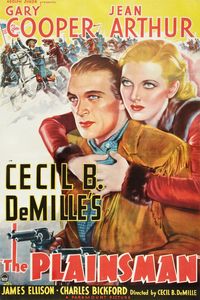
    The Plainsman (1936)

    (On TV, January 2021) While I can appreciate individual westerns, I am not a genre western fan and a quick look at The Plainsman demonstrates why. Now best known as an amalgamation of historical mistakes and simplifications (so much so that there’s even an academic article cleverly arguing for its less-than-terrible authenticity) by notoriously loose director Cecil B. DeMille, The Plainsman plays like a who’s who of historical western figures even if they never significantly interacted or if the chronology doesn’t make sense (such as having Lincoln in the opening scene of a post-Civil War film). The film does score points for featuring big 1930s stars such as Gary Cooper and Jean Arthur, but the impact of the result is underwhelming. Part of it is having Western as a spectacle of American expansionism, which gets less effective one centimetre past the American frontier. It probably doesn’t help that The Plainsman is as plain as Westerns got at the time—let’s remember that the big revolution in western-as-a-deeper-genre came years later with Stagecoach. Until then, The Plainsman is still a western about the western, since it cares so little about the facts to make any impact as historical fiction. Both Cooper and Arthur were bland stars at their best, and this film doesn’t do much to make them look any better. (Although Arthur with a bullwhip is definitely something special.)  I strongly suspect that I’d like The Plainsman if I had more interest in western history, or even in westerns as genre. As such, it simply looks average—although the glut of much better westerns to come in later decades may work against even the best of what the 1930s had to offer.

  • The Greatest Show on Earth (1952)

    The Greatest Show on Earth (1952)

    (Google Play Streaming, June 2020) Some Best Picture Oscar Winners are almost universally recognized as being weaker than the others, and The Greatest Show on Earth is often one of them. It’s not helped by the fact that it won the prize in the same year as High Noon (which was nominated) and Singin’ in the Rain (which wasn’t) were released. It rarely plays on TV, and I don’t recall any sustained critical attention about it except to bash it en passant in discussing Oscar-winners. I suppose that’s one of the reasons why it’s taken me so long to get to this film. It’s true that The Greatest Show on Earth is narratively weak—For a nearly two-and-a-half-hour film about the circus, there’s a three-ring-circus of subplots but only one of them is meant for the main stage. Revolving around a season in the life of the Barnum circus, the film often stops dead in its tracks to simply showcase the circus: the winter preparations, the train travels, the setup and takedown in each town and especially the numbers themselves. By most standards, this makes the film a bit uneven to watch, and dubious if you’re used to evaluating movies on strictly narrative merits. But (as much as it pains younger me, who believed it fervently) there’s a lot more to movies than plot, and The Greatest Show on Earth does exist in the same space as many early-talkie Hollywood movies that intended to bring the spectacles of other mediums (often Broadway) to the big screen. In historical context, The Greatest Show on Earth came at a time when movies were reacting to the arrival of TV with Technicolor and a wider aspect ratio and a conscious effort to show wonderful things to audiences. There’s something fascinating about depicting the intricate machinery of a circus and the sights and sounds of something grandiose. The film was produced with an exceptional amount of cooperation from the real Barnum Ringling circus, to the point of occasionally feeling like a big commercial. This takes on an even more precious quality now that the circus has, since 2017, stopped operating. Capturing the sights and sounds of the circus is important enough, and it will amply justify the film’s viewing for those people who may be interested in those things. The plot itself does serve in sticking things together, but most of its merit is in showcasing the circus rather than having stories. Still, it is fun to see Charlton Heston as a no-nonsense circus manager, James Stewart as a clown with a dark past, or Betty Hutton as a trapeze artist. The Greatest Show on Earth may not be a particularly strong Best Picture winner, but I’m still glad that I had an excuse to see it, as it may very well be the purest expression of Cecil B. DeMille’s thirst for spectacle.

  • The Ten Commandments (1956)

    The Ten Commandments (1956)

    (On TV, April 2018) I’m not sure about you, but when I was a boy attending French Catholic Grade School, Easter was a season during which we were all herded in the auditorium and shown one of two movies as put on the flickering projector: Either “the story of Jesus” (which I think was 1965’s The Greatest Story Ever Told) or The Ten Commandments. So, watching this again thirty years later … is almost an ordeal, although not necessarily for artistic or atheistic reasons. No, in order to understand why The Ten Commandments is a bit of a bother these days, just look at the four hours running time. I understand that epics need to be long in order to be epic … but four hours is a long time. It also doesn’t help that it’s such a familiar story—If you want a zippier take, then 1998’s animated The Prince of Egypt zooms by at 100 minutes (with songs!), while much better special effects and actors can be found in 2014’s 150-minute Exodus: Gods and Kings. This being said, I certainly wouldn’t want to suggest that the 1956 version isn’t worth a look. I mean: Yul Brynner as Ramses and Charlton Heston as Moses? Christian Bale and Joel Edgerton wish they could be Brynner and Heston. Plus let’s not underestimate the appeal of Anne Baxter and Yvonne De Carlo. But most of all, what’s in The Ten Commandments and not in Exodus is the sense of the sacred—I may lean toward atheism, but I think that a sense of awe and wonder is a requirement for the story of Moses. Awe is what The Ten Commandments delivers in spades, augmented by the arch melodrama so typical of Cecil B. DeMille’s epic films. Sure, it may sound silly and look even worse compared to today’s realistic aesthetics, but it does work on a level we can’t quite understand. The parting of the Red Sea sequence remains a yardstick even despite the unbearably dated special effects because it’s done with so much conviction that modern CGI spectacles can’t even compare. The script could use quite a bit of trimming, but keep in mind that in 1956, audiences couldn’t be happier to get four hours of spectacle for the price of their movie tickets. The word “epic” is often overused, but it’s strikingly appropriate for the large-scale sequences with a literal cast of thousands, offering all-real images that remain impressive even today. Watching the film as broadcast on ABC for decades, I also enjoyed the sense of participating, once again, in a ritual of sorts. It may be long, but The Ten Commandments is worth the trouble.