Charles Boyer

  • Algiers (1938)

    (On TV, November 2021) Having seen French classic Pepe le Moko a few weeks ago, I was unaccountably happy to see its Hollywood remake, Algiers, show up on the TV schedule, even if it was the battered public domain version complete with low-contrast audio, washed-out video and frequent scratches. The remake sticks so closely to the original that it’s not as if I had to pay attention to follow along: Almost a scene-for-scene remake with a few accommodations for language and American censors (the biggest one being at the end of the film, although it doesn’t affect the result all that much), it very much feels like the same film. Considering how similar it is, it’s tempting to directly compare each actor in their roles:  Charles Boyer is no Jean Gabin, but the outsider’s spin he puts on Pepe Le Moko’s character was striking enough to inspire Looney Tunes lothario Pepe Le Pew. Hedy Lamarr, in her Hollywood movie debut, is a clear upgrade over the original actress in sheer sex-appeal, and matches far better with Sigrid Gurie as her romantic rival than in the original. (In Pepe le Moko, the two women are so different that it’s a dull-blonde-versus-exotic brunette scenario, whereas the American remake has them looking very similar, significantly changing the meaning of the triangle to its thematic essence.)  Then there’s Joseph Calleia, who does surprisingly well as the slimy inspector Slimane, something I would not have expected given the very specific appeal of the actor playing the character in the original film. But then again — legend has it that Algiers’ director John Cromwell showed scenes of the original film to the remake’s actors and instructed them to hit the same marks. Amazingly enough, and cinematographer James Wong Howe gets all the credit for it, the film was entirely shot in Hollywood, with a few inserts very cleverly used to give some sense of place to the studio production. The result, though, is distinctive enough in the details. Made for mass appeal rather than poetic realism, Algiers is almost as good as Pepe le Moko, but focused more on straightforward entertainment than cinematic art. The differences are slight, but they’re fascinating to study in their cumulative impact. If forced to choose one for a second viewing, I’d probably go for Algiers… but only for Lamarr and Gurie.

  • Fanny (1961)

    (On Cable TV, September 2021) There’s an undeniable tension in becoming an aging playboy — what sounds cute as a young man pursuing equally young women curdles and turns creepy when it’s the same older man still hitting on just-as-young women, and if you want to talk about the enduring flaws of Hollywood, that’s a big one. I would hope that the recent readjustment in tolerance for sexual harassment will lead to change in this area, but, in the meantime, we still have decades of examples to contend with. One of the chief exhibits in this field would be Maurice Chevalier — a perfectly charming young premier in the 1930s who, by the 1960s, found himself back in Hollywood as a much older man. The traditional way to address this is to go the look-but-don’t-touch route, with older men dispensing love wisdom and memories of past romances to younger men, while still looking appreciatively at the younger women around them. In the Oscar-nominated Fanny, however, we get a much more complex take on a similar idea, as Chevalier (then 73) plays a rich older man in French coastal Marseilles, who overtly courts a much younger woman (Leslie Caron, then 30) for marriage. But there are complications — the biggest being that the young woman loves an equally young man who has left to sea after impregnating her. The April-October romance becomes more acceptable as a way for her (and her father, and the village) to save face. But there’s a lot more in store, and much of the interest in the middle section of the film is in those unpredictable plot developments popping up to make things more complex, and chip away at the male fantasy of an old man marrying a younger woman. The ending gets us back to where this was all going (with age-appropriate romantic partners) but the way to get there is more picturesque than expected. The film has other assets — the seaside Marseilles atmosphere is often very likable, and Chevalier gets to spar on-screen with long-time friend and fellow French expat Charles Boyer. Caron simply looks timelessly beautiful with long hair, and having Chevalier in one of his last decent romantic roles goes better than expected. Fanny, rather than leave the creepy older-man/younger-woman romance unexamined, squarely engages with the trope and gets a lot of dramatic mileage out of it: it’s really not as distasteful as you’d expect.

  • Love Affair (1939)

    Love Affair (1939)

    (On Cable TV, February 2020) By sheer happenstance, I happened to have Love Affair waiting on my DVR after watching An Affair to Remember and finding out that it was a remake of this film. Watching both at a few days’ interval only highlighted the similarities between both versions and what it takes to make it work. Both movies are easier than most pairs to analyze: after all, both are (co-)written and directed by Leo McCarey, and both share a structure that is almost scene-per-scene identical. Love Affair is in black-and-white, whereas An Affair to Remember is in Technicolor, but that’s not the most significant difference: Stars Charles Boyer and Irene Dunne are in the lead roles and while they’re certainly not bad or unlikable actors, they simply can’t compare to Cary Grant and Deborah Kerr, who shoulders almost all of the remake’s added interest over its progenitor. Perhaps the best example of this difference can be found in the weepy last scene—a bit silly and melodramatic with good actors, but somehow almost convincing with superior ones. Oh, I liked Love Affair well enough, despite thinking that the first half isn’t as funny as the remake’s first half. It’s more even and less frustrating in parts when compared to the melodramatic remake. But even if the remake is flawed, it’s still far more memorable than the first movie. So it goes—Hollywood alchemy, unpredictable and striking at once.

  • Hold back the Dawn (1941)

    Hold back the Dawn (1941)

    (On Cable TV, February 2020) I’m a good sport for anything written by Billy Wilder, but even I remain underwhelmed by Hold Back the Dawn. Wilder’s biography tells us that it was largely inspired by his own life—as an immigrant from Europe, Wilder had to spend some time waiting at the Mexican/American border for his right to enter the country. Of course, Wilder’s stay was uneventful—the story here is quite different. Charles Boyer stars as a European gigolo trying to gain entry to the US and resorting to what he does best—seduction. Taking aim at a visiting American schoolteacher, he inevitably develops feelings for his mark, and much of the film follows the consequences of trying to square everything away. We know from the framing device that he will make his way to Hollywood, but there’s more than him to care about. Olivia de Havilland plays the romantic interest, adding a further bit of star-power to the result—although Paulette Goddard is more interesting as a vengeful flame. Hold back the Dawn is unapologetically a grand Hollywood romantic drama. It seldom holds back in terms of melodrama, and toys with audience expectations in its very dramatic third act. While it does end well (at least for most characters), there are plenty of dramatic complications along the way, and chances for the actors to deliver sob-inducing speeches. I liked it well enough as an example of that kind of film, although I can’t say that I have any particular affection for it over similar examples.

  • Break of Hearts (1935)

    Break of Hearts (1935)

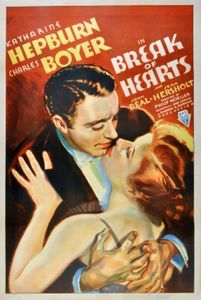
    (On Cable TV, July 2019) Being a fan means tracking down even the more obscure films, which is why I’m now one of the relatively select audience of people having seen the somewhat forgotten 1935 drama Break of Hearts. (How forgotten? Well, even TCM played it in the wee hours of the morning, without subtitles, and it barely gets a few hundred votes on IMDB.)  I was obviously there for Katharine Hepburn; In full mid-1930s form, she headlines this somewhat dull romantic drama of the film. Here, an unknown composer (Hepburn) begins a relationship with a famous, troubled, handsome (etc.) conductor (Charles Boyer). There’s a whirlwind romance, some heartbreak, and so on. Hepburn is far better than the material (which often undermines the headstrong persona that she was trying to establish at the time), and she does get to wear a few good outfits out of the whole experience. At the very least, it’s a short film: this plays both to its disadvantage (as we compress through a deteriorating relationship not that far removed from A Star in Born) and to ours, as it’s over relatively quickly. Worth watching for Hepburn fans. Everyone else? Not so sure.

  • Gaslight (1944)

    Gaslight (1944)

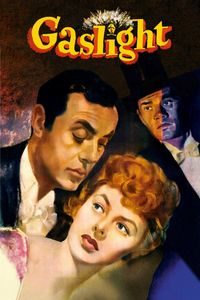
    (On Cable TV, April 2018) The term “gaslighting” seems to be everywhere these days thanks to the truth-denying efforts of the current US administration, so why not go back to the source that named the issue? Fortunately, there’s a lot to like in Gaslight beyond the terminology—this story of a woman being deceived and endangered by her husband remains a really good thriller today. Ingrid Bergman is as attractive as ever as the heroine, while Charles Boyer handles the transformation of his character from attractive stranger to an abusive husband very well. An 18-year-old Angela Lansbury shows up in a small role. The film’s cinematography is notable in that it gradually transitions from a brightly lit romance to a stark chiaroscuro Gothic (or noir) thriller as the story evolves. The suspense is gripping, and the use of mystery does help propel the narration forward. Director George Cukor is best-known for comedies, but he was equally adept at adapting novels to the screen and Gaslight is a perfectly acceptable thriller. There were a fair number of women-in-domestic-distress thrillers during the 1940s but Gaslight holds its own against most of them.