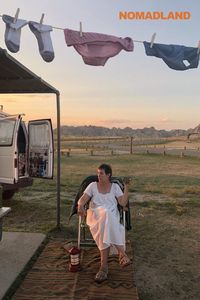
Nomadland (2020)
(Disney Streaming, April 2021) Something very expected happened in the twenty-four hours between seeing Nomadland and writing this review — it won the Academy Award for the Best picture of 2020. Working from the theory that the Academy Awards are a gigantic Public Relation exercise in which Hollywood tells the world how it wants to be seen, it was an incredibly predictable win. In a year where the COVID-19 pandemic upended nearly everything about the movie industry, in which the number of major studio releases plummeted to nearly nothing, in which diversity became a rallying cry, in which economic anxiety peaked even more as millions of Americans slid into poverty, well — Nomadland seemed like a distillation of many, many things. A film (inspired by a growing trend) about a woman choosing to live in her van, going from one seasonal job to another, it seemed like a distillation of decades’ worth of gradual civilizational decline. Written and directed by Asian-American woman, visually composed to emphasize the widescreen aspect ratios of American landscapes, Dickensian in its depiction of people overcoming misery, Nomadland doesn’t just check off all the boxes — in such a miserable year, it seems almost tailored to make Academy voters think that this is the film that they want people to think about when they think about Hollywood. But now that we’ve explained why it won the Big Trophy, let’s get to the heart of the matter: it’s actually a good movie. Not the most enjoyable one, certainly not my own favourite of the nominees (currently a race between The Trial of the Chicago 7 and Mank), probably not a film that people will flock to over and over again, but a good film nonetheless. It is, admittedly, a slow burn. I wouldn’t blame anyone for overloading on the misery of the first half-hour, as our protagonist finds herself driven to a “houseless” lifestyle that would be intolerable to most viewers, as we’re once again reminded of the inhumanity of Amazon, as the cold blue winter cinematography makes everything feel so much worse. Things get a bit better as she starts making inroads in the nomadic community, getting tips and help about the lifestyle. As the film goes on, it becomes clearer that this rootless existence is a choice more than an obligation: she not only turns down two offers for a permanent residence, she starts taking in the freedom that comes with a moving dwelling, taking in the spectacle of America and finding her friends here and there. The film ends on a much better note than it began, and Frances McDormand’s performance is about as raw as the film can get close to documentary. The mixture of actors and non-actors playing “themselves” reinforces writer-director Chloé Zhao’s intention to avoid conventional filmmaking technique, something echoed in the script’s refusal to highlight pivotal moments and instead dwell in the spaces in between. It’s not a perfect film—characters have the grating tendency to explain themselves as if to a journalist, which is so very much not the protagonist—call it a holdover of adapting a non-fiction book. But even in its imperfect, often uncomfortable state, Nomadland (No mad land?) is a sobering reflection, hopefully not a portent, and a striking piece of cinema in its own right. It highlights something new, humanizes it and leaves us to consider the flip side of the situation. Yes, that’s the film that people will see when the open up those “Cinema in 2020” retrospective articles.