Chris Farley

  • I Am Chris Farley (2015)

    (On TV, September 2019) I wasn’t much of a Chris Farley fan — his comedic appeal is undeniable, but I always felt it was better-suited to others. In I Am Chris Farley, documentarian Derrick Murray uses the familiar “I Am” formula to describe Farley’s meteoric rise and abrupt death. Much of the film consists of interviews with fellow comedians and SNL alumni, interspaced with clips from Farley’s best-known sketches. Unlike some of the other films of the series, this one doesn’t allow any niceties regarding Farley’s drug abuse — it’s all handled respectfully, with testimonials from friends (and some very insightful commentary from people in the same celebrity sphere as Farley was), but there’s no mistaking the criticism of his behaviour. Perhaps the most entertaining aspect of the documentary ends up being the insider’s look at comedy by seasoned comedians — from Adam Sandler (with bad audio), Bob Saget, Tom Arnold, Dave Foley and such. Some sketches are dissected almost beat-by-beat, as other professionals try to explain how a comedian can transform written material into something else (or outright steal a sketch with a single line). There is some repetitiveness to the clips used, rerunning the same sketches a few too many times. Still, the whole thing does stand as an eloquent testimonial to Farley’s oversized personality, his prodigious appetites, his almost childish attitude toward many things, and how he could elevate material through performance. It may not be the best “I Am” biopic, but it’s solidly in its good tradition.

  • Tommy Boy (1995)

    Tommy Boy (1995)

    (In French, On Cable TV, December 2018) The formula behind Tommy Boy isn’t complicated—take an outrageous comedian with a funny physique (that would be the late Chris Farley) and cast him as a man-child chaos-maker, then pair him up with a somewhat more conventional comedian with an ability to freak out in amusing way (that would be David Spade) as the straight man, and send them off on a road trip. There’s a sub-genre with a list of movies a mile long all revolving around the same concept, and Tommy Boy doesn’t break any new ground in following tradition. The details are unimportant, what with two young men trying to save their auto part company from going under by going on an extended sales trip. There’s some mechanistic character development, perfidious antagonists, comedy legends in secondary roles (Dan Aykroyd!) and a car that gradually breaks down over the course of the trip. As is tradition with road movies, it also features both characters singing along to a song. Narrative cohesion isn’t a big concern of the script, as much of the details are of the episodic one-thing-after-another variety. In execution, however, Tommy Boy depends a great deal on the specific comedy of Farley and Spade (better yet; both of them together), a pop-heavy soundtrack and some outrageous visual gags. (If you’re a fan of cars gradually falling apart, this is a movie for you.) It’s not good, it’s not memorable, it’s not clever but it just may be enough for an undemanding viewing in-between more substantial fare. Just don’t get Tommy Boy confused with the other Farley/Spade movie.

  • Beverly Hills Ninja (1997)

    Beverly Hills Ninja (1997)

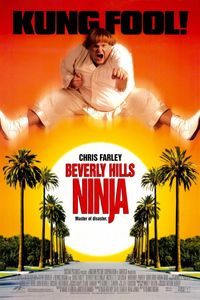
    (Second Viewing, On Cable TV, September 2015) I’m pretty sure I saw Beverly Hills Ninja in theaters, three months before I started writing these online movie reviews in early-1997.  There’s no wonder, though, as to why I’ve kept almost no memories of the film: It’s terrible.  Starring Chris Farley as a dim-witted buffoon trained as a ninja, Beverly Hills Ninja is one pratfall after another, played broadly enough to appeal to all the kids in the audience.  Farley is more annoying than endearing, and the film never loses a moment going for subtlety when endless hammering of the same joke is possible.  Worse yet: Many of the physical gags can be seen coming long in advance, adding to the misery of the entire film.  The bright spots are few and frustrating: Robin Shou is a far more enjoyable protagonist as a competent ninja fixing the title character’s mistakes, while Chris Rock shows up and doesn’t have much to do as the sidekick.  There are echoes of Beverly Hills Ninja in Kung-Fu Panda, but the comparison is almost cruel to the latter animated feature.  There are films best left in the sands of time, and Beverly Hills Ninja is an unremarkable example of those.