Christopher Guest

  • Waiting for Guffman (1996)

    (On Cable TV, September 2022) Look, I know that Waiting for Guffman is dearly beloved. Christopher Guest’s filmography is incomplete without it; it stands on numerous “best comedies” lists, and it’s a not-infrequent reference even twenty-five years later. But I’m more of a Best in Show person—and when it comes to comedy, I’d rather watch something tightly written than improv that goes all over the place. I also suspect that some of the clichés on which the film is built—which is to say: the backwardness of small-town America—don’t hold quite as true today. Still, that’s what we’ve got: In celebrating a historical milestone, a very small Midwestern town puts on a musical and everyone involved is convinced that they’re one New York agent (the titular Guffman) away from becoming rich and famous. Of course, there’s a quite a gulf in-between their talent and their self-assessment of that talent and that’s where much of the comedy comes in. Guest himself plays a not-very-closeted flamboyant man with Broadway experience trying to orchestrate the show. Around him are various townspeople with delusions of grandeur, small-minded folks not quite grasping what the musical is trying to do, and an assortment of just-normal-people swept up in the craziness. To be fair, Waiting for Guffman is steadily amusing—with people such as Eugene Levy, Bob Balaban, Catherine O’Hara and Fred Willard in the cast, it’s hard not to have at least a smirk throughout. But Guest’s much-vaunted improvisational approach (leading to multi-hours assembly cuts that need to be whittled to a much-shorter final film) is a specific taste, and there’s often the impression that the film is going in several directions at once, only to be reluctantly led down a specific path. One thing that may or may not help is the utterly deadpan nature of the comedy: while that’s an impressive alignment of improvisational material (in that no one is obviously mugging for the camera), it takes a specific comedic wavelength to be in-tune with what’s going on. Save for the visually ridiculous musical sequences at the end (some of them surprisingly snappy), there’s little here to suggest at first glance that you’re watching a comedy—you have to pay attention to decode the jokes. It may also be a case of hype exceeding the material—I expected nothing from Best in Show and laughed through the entire thing, whereas I was expecting much from Waiting for Guffman and merely chuckled a few times. It’s certainly not a bad movie—but I’m allowed to pick other guest films as favourites.
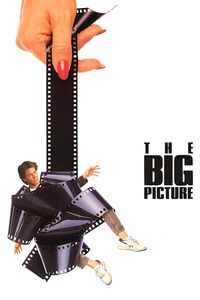
  • The Big Picture (1989)

    The Big Picture (1989)

    (On Cable TV, September 2020) The premise of The Big Picture will be intensely familiar to anyone who’s ever seen a Hollywood satire: Smart Midwestern student filmmaker earns the attention of Hollywood producers, is gradually coopted by the studio system until he’s no longer himself, loses it all and fights to get to do it his way. That plot outline could be written on a napkin, but it’s not the point of the film. The point of it is the visual humour that writer-director Christopher Guest injects in his narrative, as our protagonist (a very likable Kevin Bacon) can’t help but supplement what’s happening to him with imagined spots heavily inspired by Hollywood classic movies. Tons of small visual jokes pepper the story, challenging viewers to pay attention. The cast can be surprising at times, especially when it comes to smaller roles: Teri Hatcher looks amazing as an opportunistic actress, John Cleese (sans moustache) plays an American bartender, Elliott Gould has a few moments as an imaginary prosecutor, Jennifer Jason Leigh is a wacky artistic type, Martin Short gets to play the stereotype of a talent agent, and Fran Drescher shows up as a trophy wife. Clearly produced as a satire of Hollywood for Hollywood people rather than the general public, The Big Picture is noteworthy in Guest’s filmography for not being a mockumentary, but rather a full narrative film, with plenty of imaginary asides. It’s quite a bit of fun, and probably ranks as one of those Hollywood satires that not enough people have seen. It’s well worth a look, and not solely as a filler for Guest completionists.

  • For Your Consideration (2006)

    For Your Consideration (2006)

    (On DVD, May 2011) As much as writer/director Christopher Guest’s ensemble improvisation mockumentaries have produced some gems in the past (Best in Show), the format can also be a recipe for an unfocused mess, and that’s pretty much what happens with For Your Consideration.  Another Hollywood home movie that probably feels funnier to the filmmakers than the filmgoers, For Your Consideration depicts the sudden accession to stardom that veteran actors can face.  As their film earns favourable buzz and increased media attention, the protagonists react in different ways that show variations on Hollywood’s fundamental insecurities.  So far so good; alas, I never completely bought into the film’s reality: Awards buzz starts once the film is completed and shown to audiences, not while it’s shooting; furthermore, actors who run good chances of being Oscar-nominated usually end up with a slew of other awards and nominations, making the film’s downfall moments ring a bit hollow.  It really doesn’t help that For Your Consideration seems to be running everywhere without focus, lame scenes flashing by without necessarily making a point.  (Tellingly, the DVD contains a number of deleted scenes that don’t appear any more or less funny than what’s in the film itself –the sole exception being more of Nina Conti’s delightful ventriloquism.) Even the film’s lack of time/space unity (jumping months forward in time after a lengthy first segment) seems just as sloppy as the rest of the picture.  The actors are fine (Fred Willard is hilarious as usual), some of the material is admirable and the glimpse behind the Hollywood mythmaking machine is amusing, but it just doesn’t cohere into anything as good as it should be.  At least the DVD audio commentary makes it clear that the largely-improvised filmmaking process is to blame.