Christopher Walken

  • Seven Psychopaths (2012)

    Seven Psychopaths (2012)

    (Video on Demand, June 2013) Writer/director Martin McDonagh clearly isn’t happy doing the usual or the expected: With this crime comedy, he plays around with structure, experiments with form, and uses a comic crime thriller to reflect on the place of violence in movies.  Collin Farrell is low-key but effective as a screenwriter who turns to a friend in order to get some inspiration for his next screenplay.  Sam Rockwell is quite a bit flashier as said friend who finds himself creatively inspired, and starts bringing the screenwriter into his own criminal enterprise, where we meet an unusually reflective Christopher Walken.  It quickly leads to a clash between true psychopaths, repentant ones and unexpected ones.  McDonagh’s dialogue is as good as could be expected from a playwright, and his directorial technique feels a bit more natural than in his previous In BrugesSeven Psychopaths takes a turn toward meta-fiction in the third act, as it tries to reconcile the impulses of thrill-seeking viewers with the humanistic instincts of a filmmaker trying to avoid gratuitous violence.  While the result feels a bit more scattered than it should, it’s an unusually intriguing film, and one that has quite a bit more thematic depths than the usual crime thriller.  As a bonus, it’s also quite funny… except when it decides not to be.

  • The Addiction (1995)

    The Addiction (1995)

    (On DVD, June 2009): It goes without saying that a horror monster is seldom “just” a horror monster, but Abel Ferrara’s The Addiction takes things to a conceptual extreme by cramming vampires in a film chiefly about addition and the philosophical implications thereof. Pretentious? Very much. Intriguing? Definitely. Shot in stark black-and-white, The Addiction features a number of notable names (including an unusually fetching Lily Taylor, and a scene-grabbing cameo from Christopher Walken) and an improbable number of soliloquies that, stripped of their pretentiousness, still manage to deliver a number of fascinating ideas. The vampire here is a junkie who has managed to blame others for his addiction, and whose appetite is only matched by self-loathing. As horror, it’s generally lame (although there is a vampire feeding frenzy late in the film), and yet there’s no denying that The Addiction is a lot more worthwhile to watch than any half-dozen cheap vampire movies.

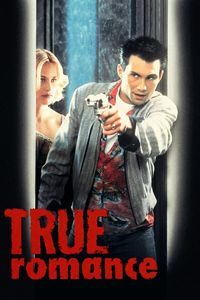
  • True Romance (1993)

    True Romance (1993)

    (In theaters, November 2000) The first time I tried to watch this film on TV, I drifted off fifteen minutes later, distracted by housework. This time, stuck in a second-run movie theater, I had no choice but to keep on watching, and I must that that the end result isn’t bad at all. A lot of famous names and faces (including one good sequence between ever-dependable Christopher Walken and Dennis Hopper) plus an odd script from the pen of Quentin Tarantino, built around only a few sequences that last a long time each. Some surprises, a good action finale and crunchy dialogue make up for ridiculous plot development seemingly lifted from teenage fantasies and a roster of largely unsympathetic characters.