Claudia Cardinale

  • The Professionals (1966)

    The Professionals (1966)

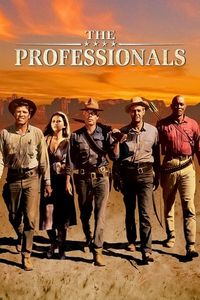
    (On TV, September 2021) I’ve seen too many undistinguished westerns lately to expect much from yet another one, but The Professionals gradually won me over. The casting certainly gets things rolling in the right direction: with Lee Marvin and Burt Lancaster sharing the lead as mercenaries going into Revolutionary War Mexico, you’re in good hands — but then throw in Claudia Cardinale and Jack Palance and it just gets better. The film also cranks up the action by featuring an explosive-heavy plot with a demolition expect (Lancaster, looking suitably ragged-down) as a rich American asks them to go south to rescue his wife (Carnivale, lovely) from a Mexican warlord (Palance). Many explosions pepper what happens next, plus a slightly-twisty plot that could have been taken from a film noir. This already sets the film apart from so many other westerns, but the execution more than supports the premise. There are really interesting parallels to be made between The Professionals and the spaghetti westerns that were emerging as renewal engines for the western genre — A Fistful of Dollars had come out in 1964, but the clearest parallels in terms of explosive Mexican Revolution action are with the later A Fistful of Dynamite (1971). Still, compared to many American westerns of the 1960s, The Professionals has more energy, more distinctiveness and more fun to it. No wonder I liked it a lot more than the usual western of the time.

  • Il gattopardo [The Leopard] (1963)

    Il gattopardo [The Leopard] (1963)

    (YouTube Streaming, August 2021) There’s a fun blend of international elements in The Leopard, being an Italian film from writer-director Luchino Visconti, with Claudia Cardinale, American Burt Lancaster and French Alain Delon in the starring roles. The plot takes us deep in Italian history, as a late-19th century Italian prince contemplates the way the world is changing (a nearby war doesn’t help) and wanders forlornly around a palace. That’s roughly all there is to the point of the film — the rest is window dressing, albeit technically successful window-dressing, as the film really shows its historical recreation budget. It’s sort-of-fun to see Lancaster with impressive facial hair, going up against both Delon and Cardinale — three actors not normally associated with each other. The much-ballyhooed ballroom sequence is the film’s finest moment. On the other hand, it’s a long sit at more than two hours, seemingly even longer considering the slow pacing of the thing and the interiority of the plot. I can admire that intention, but I can’t say that the execution of The Leopard is all that entertaining.

  • Ruba al prossimo tuo [A Fine Pair] (1968)

    (On Cable TV, July 2021) Film comedy is harder than many people think — it’s not enough to write a lighthearted script when you also have to make sure that the acting, cinematography and direction are up to the task of presenting the comedy on the page. If nothing else, A Fine Pair is an exemplary case of what happens when no one in the film’s production seems to be trying for comedy. The premise has Rock Hudson as a NYPD detective being more or less seduced (by Claudia Cardinale, one of the film’s few highlights) into becoming an international jewel thief. You can already think of a few other films of that era with similar premises (most notably How to Steal a Million), but if you’re expecting something along those lines from A Fine Pair, you’re going to be solely disappointed. Where to begin? We can start with Rock Hudson — often presented as the successor to Cary Grant, except that Grant would mumble and wiggle his way into more laughs than Hudson even could. He’s not exactly wrong as the humourless police officer, but as with many of his comedies, he’s asked to deliver more than he can. I’m not going to ding Claudia Cardinale as the jewel-stealing temptress — although I’ll note that she seems to be playing a broad take on similar roles that often dips into national stereotypes. But by far the biggest problem with A Fine Pair is that if you watched the film without sound, you would swear you’d be watching a grimy depressing 1970s crime thriller. The cinematography is in cold black and blue (far more black than blue), with wintertime NYC looking sinister and the rest of the European jaunt not being much better with its decrepit sets and naturalistic lighting. We are a long way from bright Hollywood cinematography and lighting, making the entire thing feel lugubrious at best. Further technical problems keep sucking all the fun out of the final film: ADR dialogue with terrible sound editing and hard cuts between samples, laborious staging of dialogue that feels more painful than amusing, and bad set design that makes everything feel claustrophobic. It’s almost amazing how the film mishandles an easy comic premise in order to deliver something that looks and feels like the most depressing film in the world. Cardinale is, fortunately, not that bad (I’d rather watch her than Doris Day) but that’s not enough when the image is dark enough that we can barely make the outline of her face even at the best of times. Hudson (or Cardinale) completists will eventually make their way to A Fine Pair — I’m told that the film’s long-time unavailability created pent-up interest — but all will agree that this ranks low in the lowest tier of both actors’ filmography.

  • Don’t Make Waves (1967)

    Don’t Make Waves (1967)

    (On Cable TV, September 2020) The mid-1960s were a strange time for Hollywood movies—at once poking and prodding at the social changes occurring over the United States, yet still being held back by decades of slavish adherence to the Hays Code. One of the laboratories through which to study this interregnum is the sex comedy genre, which pushed the envelope… but never too much. They feel charmingly quaint these days, as they play with ideas of infidelity, female characters with their own sexual agenda, and newish modes of living, such as muscle-bound surfers. Is it any surprise if much of it is about the ways Californians were breaking free from US orthodoxy? Such is the situation at the beginning of Don’t Make Waves as a New York promoter drives to California with everything he owns in his car… only to lose it all due to the actions of an inattentive Italian artist. This forces him to live with her, however briefly, and get caught up in a complex web of infidelity, surfing hippies, swimming pool salesmanship and unstable coast-side housing. Tony Curtis is up to his usual good standards as the fast-talking New Yorker almost completely out of his element on the West Coast, but most of the attention usually goes to his female co-stars: Sharon Tate in one of her few roles, this time as a young fit surfer, and the divine Claudia Cardinale as the scatterbrained Italian at the root of his problems. There’s clearly a satirical intention to Don’t Make Waves that’s probably wasted today, as the film goes from one contemporary hot topic to another in a way that may be less obvious in a future in which these topics have become commonplace. Much of the film’s comedy is to be found in one weird situation or another, although the film does hit a highlight later on by featuring a big physical comedy set-piece as the characters are stuck in a house tumbling down a hill. Don’t Make Waves is certainly not a great movie, but like many lesser-known films of the 1960s, it offers a slightly different view on the obsessions of the time, and perhaps even a more honest one even through the comic exaggerations.

  • C’era una volta il West [Once Upon a Time in the West] (1968)

    C’era una volta il West [Once Upon a Time in the West] (1968)

    (On DVD, October 2018) Is Once Upon a Time in the West the western to end all westerns? Probably not, but watching it after seeing Sergio Leone’s Eastwood-led man-with-no-name trilogy, I was struck at the sheer scope of his achievement here. Far from the low-budget heroics of A Fistful of Dollars, Leone goes for big-budget maximalism in showing how the railroad makes its way to an isolated western town, and the violence that ensues. It takes a while for everything to come into focus, but when it does we have a four-ring circus between a nameless protagonist (Charles Bronson’s “Harmonica,” and you know the tune he plays), a woman trying to transform herself in the West (Claudia Cardinale, captivating), an evil industrialist henchman (Henry Fonda, playing a villain!) and a bandit there to mess everything up (Jason Robart, not outclassed by anyone else). The four quadrants of the plot having been defined, the film then takes on its narrative speed—although at no fewer than 165 minutes and considering Leone’s typically contemplative style, there isn’t quite enough plot here to sustain the film’s duration. Still, it’s entertaining enough if you’re not in a hurry—This is clearly a film by someone who has seen a lot of westerns, and it regurgitates familiar elements in entertaining permutations. Plus there’s Leone’s visual style—the film’s best shot is a slow pullback from a man about to be hanged from an arch, with Monument Valley as a majestic backdrop. Not being much of a Western fanatic (although I appreciate it more and more as I see the best movies of the genre), I can say that there’s a limit to how much I can like Once Upon a Time in the West, but it was more entertaining than I expected, and almost as good as its lengthy running time would justify.

  • The Pink Panther (1963)

    The Pink Panther (1963)

    (In French, On Cable TV, September 2018) The biggest surprise about The Pink Panther is that it turns out to be an ensemble bedroom romp with a limited role for Peter Sellers’s Inspecteur Clouseau—and, in fact, he gets played like a fool for the entire film, with a conclusion that doesn’t do the character much good. Sellers did such a striking job with the role that later instalments, starting with the follow-up A Shot in the Dark, would develop the Clouseau mythology in earnest. In the meantime, what we have here is a tangled mess of characters lusting for one another, with Clouseau unaware that his wife (the lovely Capucine) is carrying an affair with the master thief (the wonderful David Niven) that he’s chasing. Meanwhile, the gentleman thief is trying to seduce a princess (Claudia Cardinale!) who own the titular diamond, while his nephew is also trying to seduce Clouseau’s wife. It takes a diagram to figure it out, but fortunately the film is much easier to absorb as it gradually introduces its character as they converge on a European ski resort. Comedy director legend Blake Edwards slowly tightens the funny screws, culminating in a bedroom sequences in which characters hide under the bed and exit through windows while Clouseau remains blissfully unaware of how many pretenders his wife has within purring distance. It takes a while to get going and does end on a less jolly note, but the ski resort sequence of the film is a small success in creating a sexy comic atmosphere. Even out-of-nowhere moments, such as Fran Jeffries crooning an Italian song around a communal fireplace, are more charming than puzzling. Niven does stellar work here as an impeccable gentleman thief, but Sellers was simply spectacular enough that the series would therefore focus on him. So it goes—plans never unfold exactly as everyone thinks they will, especially in the Pink Panther universe.

  • 8½ (1963)

    (1963)

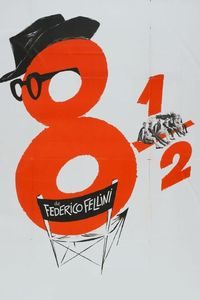
    (On Cable TV, September 2018) Approaching Frederico Fellini’s comes with a heavy set of expectations: How can you watch something widely lauded as one of the best movies ever made without feeling at least a bit apprehensive? Do I have to turn in my film critic’s card if I don’t like it? Won’t the cool kids at the European arthouse table make fun of me? After all, I’m already not such a big fan of surrealist black-and-white auteur-driven European cinema. As it turns out, I shouldn’t have worried, because I ended up enjoying a lot more than I expected. Not to the level of an all-time favourite, but well enough to considering it reasonably entertaining. It helps that the film has a lot of hooks to be interesting. It was remade as a big-screen musical in 2010 as the disappointing Nine, giving me an idea of the (disconnected) plot ahead of time. It features a movie director having trouble with his latest science-fiction epic, hitting at least two of my soft spots in one premise. It does have the advantage of a gallery of attractive actresses fawning over the protagonist. (Leading to a hilarious dream sequence in which the protagonist imagines visiting all of his past relationships living under one roof.) It features Marcello Mastroianni, who embodies the coolest of what 1960s Italy had to offer. It partially takes place at a health retreat, the kind of dream resort that wealthy Europeans like to portray on-screen. does end up being remarkably funny at times, in-between Fellini looking so deep inward that the film ends up feeling like a Klein bottle. Much of the film’s deeper effect is lost on me due to incomplete knowledge: I partially resent how much of (including its very title) is incomprehensible if you’re not thoroughly up to speed on Fellini and the state of circa-1963 Italian cinema. Wikipedia does help, but movies should not require a reading list prior to viewing. Still, it works well enough even during surface viewing. Though it does feel too long and isn’t as tightly sewn as I would have preferred, is a remarkable piece of cinema that works on several levels and does offer a playful look at some resonant issues. I won’t put it near the top of my personal pantheon, but I liked it a lot more than I expected. In my mind, my /Nine mashup has gorgeous colour cinematography, an out-of-control Sci-Fi spectacular, snappy musical numbers and Mastroianni dreaming that he’s Daniel Day-Lewis cavorting with Penélope Cruz and Claudia Cardinale.