Clea DuVall

  • Happiest Season (2020)

    (Amazon Streaming, December 2021) There’s a good chance that Clea DuVall will leave a stronger legacy as a writer-director than an actress — at least if her work keeps improving the way it went in-between The Intervention and Happiest Season. Her latest spin on the dysfunctional family Christmas comedy features sad-faced Kristen Stewart as a young woman heading to attend the holiday celebrations with her girlfriend’s very traditional family a few states away… but with her girlfriend having neglected to tell her parents about her relationship, or even coming out of the closet in the first place. Not that it’s the only secret just waiting to explode as tensions run higher and higher on the way to Christmas. Thus is the stage set for a mild comedy of manners, lies, misunderstandings, humiliation and a cathartic finale. Best seen as a small-scale film featuring dramatic showpieces, it plays with Christmas tropes while still, ultimately, bowing to familiar values. The acting talent here is not bad — Stewart is clearly in her very specific niche, alongside such notables as Aubrey Plaza (in a somewhat looser role than usual), Alison Brie, the ever-captivating Mary Steenburgen as a matriarch, and Victor Garber is a charming take on the befuddled father trying to make sense of his family suddenly expressing themselves. Still, it’s Dan Levey who steals the show as a stereotypically catty best friend showing up for the pyrotechnics. Despite a few mystifying contrived plot turns, Happiest Season delivers on its promise of decent Christmas film — it’s several steps above the usual Hallmark comfort material even if, in the end, it’s not that different.
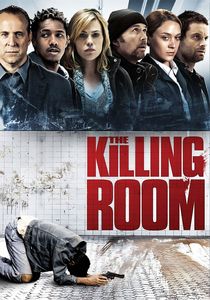

  • The Killing Room (2009)

    The Killing Room (2009)

    (In French, On Cable TV, March 2021) It’s amazing how much a little perspective can put things in their place. Twelve years later, we’re barely starting to process the awfulness of the Bush administration and how America had to overcome the post-traumatic stress disorder of 9/11 (and then Afghanistan, and then Irak). Looking back at the socially conscious entertainment from this period at a slight distance can be revelatory — the paranoia against the government at the time was at an all-time high, and since then, the latest Republican president has done much to destroy any notion of an all-powerful, all-capable administration capable of doing anything more complex than not tripping over itself. This brings us to The Killing Room insofar as this is a psychological thriller that could only have been born in the post-Bush era. It starts with mystery, as strangers are assembled in a room and then quickly faced with a life-and-death situation as a doctor explains to them the parameters of the test they’re about to undergo… and then shoots one of them in the head. The rest is the kind of locked-room paranoid thriller that we’ve seen everywhere from Cube, Exam, The Belko Experiment and other examples of killer-psychological test horror movies. It’s mildly intriguing up until the time when it becomes ludicrous — specifically, by the time the film builds a preposterous narrative saying that these tests are being conducted en masse to find dedicated killers for the government. There are so many wrong things in that statement that it’s hard to know where to begin (and the film does itself no favours by referencing the MK-ULTRA program) — this is a clear case where the film should have avoided clearing up the mystery justifying what it really wanted to do: crank up a low-budget thriller exorcising that era’s paranoia. Narrative nonsense aside, the film is not badly executed: thanks to director Jonathan Liebesman (who did far higher-budget films afterwards) and a cast that somehow brings together players as familiar as Chloé Sevigny, Timothy Hutton, Clea DuVall and Peter Stormare, the film assumes its clinical griminess and delivers what it intends. A shame about the escalating stupidity of the justification, but so it goes. Nowadays, of course, the film is more interesting as a reflection of where America was at psychologically at the end of Bush’s second mandate — not in great shape, and terrified of what an ultra-competent government could do to them.

  • The Intervention (2016)

    The Intervention (2016)

    (In French, On TV, September 2020) There are a few actresses out there that may not be household names, but have attracted my attention one way or another. I make a half-hearted effort to follow what they’re up to, especially when they leave the world of big-budget movies to do smaller movies. The Intervention not only brings together four of those actresses, but is also written and directed by none other than Clea DuVall, an actress whose first decade in the business was filled with roles in big-budget pictures, and then switched to lower-profile projects and TV series. With The Intervention, she works on both sides of the camera and delivers what could be called a Hollywood home movie: a low-stakes drama set in a secluded location, featuring an ensemble cast of characters played by friends and acquaintances. As a strategy to become a writer-director, it’s a clever one: the budget stays low, the friendships between the actresses translate into screen chemistry and the film can be approached as an actor’s showcase without the logistical complication of big costly sequences. The flip side of Hollywood home movies, however, is that they often feel similar: As with a theatrical piece, we get a first half of growing complications, and a second half of detonations. The camera moves in traditional ways, the script is good enough to provide a template, and the focus is on the performances. The Intervention does not escape the mould and, at times, feels like half a dozen other movies. Still, it does have its advantages. It’s set in Georgia rather than in the Hollywood Hills, and the cast is filled with recognizable names. You may not care as much as I do about Melanie Lynskey and Natasha Lyonne (here reuniting with DuVall seventeen years after the classic But I’m a Cheerleader!), or Alia Shawkat and Cobie Smulders, but here they are playing off each other. I found the overall result more interesting than entertaining, but it’s true that I’m far from the target audience for the film. I wish the film could have taken more cues from theatre plays in setting up and then playing off its interpersonal conflicts: there’s a tendency here to pull back from confrontation that I found annoying, but only in the context of wishing for a harder-hitting piece. If DuVall wanted to deliver something softer, then it’s up to her, and The Intervention accomplishes those objectives.