Clive Barker

  • Book of Blood (2009)

    Book of Blood (2009)

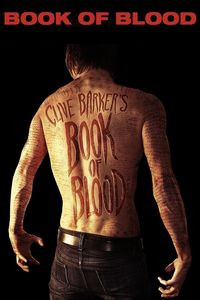
    (In French, On Cable TV, March 2021) Films adapted from Clive Barker’s stories are not assured of greatness, and so there’s a meta-textual suspense element to a film daring to tackle Barker’s celebrated Book of Blood series: Will it do justice to it? As it turns out, writer-director John Harrison’s Book of Blood is nowhere near perfect, but it just about inches its way across the “not bad” finishing line. Substantially more stylish and moodier than other comparable horror films, it does delve into Barker’s usual mixture of body mutilation, violent eroticism, free-flowing blood and supernatural scares. After what seems like a lengthy set-up, the film finally gets going in its last twenty minutes or so, finally unlocking the post-mortem horror that it’s been building toward. A few of the film’s main ideas don’t make sense: the scars and inscriptions “telling the story of the dead” are not quite convincingly executed on-screen, and the film does overreach by going both for exploitative gore and for uplifting afterlife expiation at once. Still, as far as tone and execution are concerned, there have been some much, much worse movies to come out of Barker’s work and Book of Blood is intermittently interesting from time to time. It’s not a big success, but it’s better than many similar movies and that’s already not too bad.

  • The Midnight Meat Train (2008)

    The Midnight Meat Train (2008)

    (On Cable TV, August 2020) There’s a bizarre mixture of elements in The Midnight Meat Train that entertains as much as it frustrates. At first, we may or may not be in psychological thriller territory as a Manhattan photographer (Bradley Cooper, in a pre-stardom role) takes pictures of people who then die or disappear in the subway. Is he to blame? The police seem to think he’s a person of interest, even as we’re shown the violent actions of a butcher (Vinnie Jones, suitably menacing) who seems to be using a subway car as his own abattoir. Fantasy or delusion? The excessively gory nature of the story is in-keeping with the origins of the script in a splatterpunk Clive Barker story, even if it certainly should have been toned down. The mystery as to whether this is happening or not is resolved in the last fifteen minutes of the film with a plot development so extreme that you’re allowed a few minutes (in the form of a meaningless fight) to digest it. It’s certainly… out there. Whether it works is to be debated, as the film takes a hard-supernatural turn that the beginning of the film may not have properly foreshadowed. Still, it does transform The Midnight Meat Train from a routine psychological thriller(ish) to something far more interesting to discuss.

  • Nightbreed (1990)

    Nightbreed (1990)

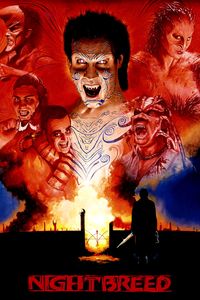
    (In French, On Cable TV, May 2020) There is something far more interesting than usual in Nightbreed when compared to most other horror films of that era. It has authentic sympathy for the monsters that would be antagonists in other horror films, and much of the protagonist’s journey is joining and protecting those monsters from human opponents. (As per Wikipedia, there’s an entire queer subtext to Nightbreed that flew over my head upon watching the film.) When writer-director Clive Barker set out to make the film, he was aiming for a menagerie of creatures on par with Star Wars, and a quasi-mythological resonance to the story. He doesn’t quite get there, but his intentions certainly resonate in the final result. The version I was the much-decried original cut of the film rather than the more definitive “Cabal Cut,” so quite a bit got lost—The serial killer subplot does make the film far trashier than it should have been and the result isn’t quite as interesting as the creatures it features. As an American backwoods gothic, Nightbreed brings to mind an approach not dissimilar to Guillermo del Toro’s love of monsters and empathy in approaching the other. If you’re looking for another reason to watch the film, there’s David Cronenberg playing the antagonist, which is good for a chuckle or two. Still, and perhaps to the chagrin of Nightbreed’s considerable cult following, this film is more one of missed opportunities than outright success—it doesn’t quite work, and I’m not sure that even a recut version would be significantly better.

  • Candyman (1992)

    Candyman (1992)

    (In French, On Cable TV, February 2019) I remember some of the marketing for Candyman back in 1992, but for some reason had almost forgotten about the film until now. I’m almost glad I did, because it allowed me to discover something that, under the garbs of a horror movie, is quite a bit more than a standard supernatural slasher. In addition to a villain that almost qualifies as original, Candyman does delve quite a bit into themes of urban decay, social injustice and black mythology as presented through urban legends. From a gripping opening, the film develops a specific visual style made of overhead shots of Chicago slums, bee imagery and askew camera angles. When combined with the fantastic screen presence of Tony Todd as the titular boogeyman and a rather good turn by a young Virginia Madsen (plus Kasi Lemmons in a supporting role), Candyman is significantly more interesting than most horror films of the early 1990s. Unusual plot developments keep our attention, and the well-executed sense of alienation of a white woman plunged into urban black myth leads to an effective descent into hell. Writer/director Bernard Rose cleverly adapts a Clive Barker story to an American setting, throws narrative curveballs and manages an effective atmosphere of dread making judicious use of its slum setting. It’s a much better film than you’d expect from its era. My biggest (minor) qualms are not the film’s fault—I happen to think that 1990s Virginia Madsen doesn’t look as good as 2010s Madsen, and catching the film in French deprived me of Todd’s distinctive voice. All the better reasons to rewatch the film again at some point. Considering the renewed interest in black-themed horror with social relevance, Candyman seems almost perfectly placed for a remake and whaddaya know—one is being planned right now.

  • Hellraiser (1987)

    Hellraiser (1987)

    (On VHS, May 2001) As with many horror film, Hellraiser‘s potential exceeds its actual execution and leaves us wanting a better film. The characters are drawn in a realistic, rather than iconic fashion, but unfortunately they come across as unsympathetic, not authentic. The featured creatures are uniquely designed and their origin hint at some wild cosmology, but unfortunately, they’re used in the context of a more ordinary story that does the job without actually reaching its full potential. The early-eighties special effects are showing their age. Of more interest to horror fans and scholars, but not worth the while for everyone else.

    (Second viewing, On Cable TV, June 2019) It was time for a rewatch, after nearly two decades’ worth of additional experience in horror movie-watching. (If I recall correctly, my first viewing was affected by a very bad VHS copy that visibly degraded as I was watching it.)  It’s not that I completely dislike Hellraiser — it’s that the film never quite manages to reach a good chunk of its potential. It’s got good iconic villains, an intriguingly baroque moral system, a wonderfully perverse attitude, some truly stylish visuals, and better-than-average writing from Clive Barker. It’s also quite a bit more unpredictable than most horror films, either then or now. But despite those sizable assets, Hellraiser never fulfills its potential — it spends too much time in less-interesting subplots, doesn’t fully dig into its mythology, and doesn’t quite know what to do. The disappointment is all the more striking in that the sequels never measure up to it either. Maybe a remake will get it right some day.

    (Third Viewing, On Cable TV, February 2020) Given how I managed to get all of the first four Hellraiser movies onto my DVR, the next step was to revisit the first film once more.  In rewatch, Hellraiser is both more and less what I expected. On the upside, it’s significantly more original than most horror movies of the time. The supernatural component is always more interesting than some psycho with a knife, and this one benefits from imaginative creature design, as well as taking inspiration from extreme S&M rather than more prosaic true-crime horrors. Much is left to the imagination, which is where the film becomes lesser than remembered: not much background is given to the creatures except for a few cursory lines. Much of Hellraiser in fact, is dedicated to another plotline entirely, with a victim of the puzzle box being regenerated from the blood of his lover’s victims. The cenobites themselves are there for a few minutes—the rest is perverse family horror. I quite liked Ashley Laurence as the heroine trying to discover the strange shenanigans in her father’s attic, although that may just be my preference for curly-haired brunettes. Opposite her, Clare Higgins impresses with a deliciously evil role. But the stars of the show are the Cenobites and their barely sketched presence—no wonder the film led to a number of sequels.