Cuba Gooding Jr.

  • Daybreak (1993)

    (In French, On Cable TV, July 2021) I will forever defend the unique way in which science fiction should be used as commentary on current issues, but that intention only works when the parallels are not as blatant as the ones in Daybreak. Adapted from a theatrical play, it’s a blatant message movie based on AIDS-era proselytism that has really not aged particularly well even when seen at the tail end of a real-life global pandemic. The wafer-thin story takes us in a dystopian future where a deadly sexually-transmitted disease has led the government to suspend civil liberties (yawn) and create camps where sick people are tattooed (yawn) and segregated (yawn) and left to die (yawn) even as the general population is kept in the dark (mega yawn) about it all. Essentially playing to the most caricatural fears of a naïve audience, Daybreak does itself no favours with its AIDS-meets-Holocaust approach, even as it has characters realizing minutes after the audience all that the film has on its mind (which isn’t much). Made for HBO but, to my knowledge, not often rebroadcast (indeed, the version I saw was the French dub, which does not depend on HBO’s choices of what to unearth from their archives), Daybreak is blunt-force allegory artlessly set two decades in the future. Everything in the film is about the disease concentration camps, with very little care put in credible world-building to allow the metaphor to take wings. It quickly becomes obnoxious, and that’s even despite one of Cuba Gooding Jr.’s most interesting dramatic roles. Even the finale is disappointing, putting a damning cap on an already-shaky execution. There’s a laziness to the way Daybreak is put together that deflates whatever power it may have as a dystopian cautionary tale. Much better could have been possible on the same topic, had just a bit more imagination gone into it.
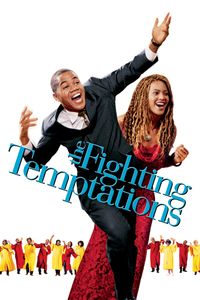
  • The Fighting Temptations (2003)

    The Fighting Temptations (2003)

    (On TV, June 2021) I couldn’t be farther removed from a small-town Georgia black gospel choir, but there’s something curiously comforting in The Fighting Temptations given how it embraces familiar characteristics. Using an urban character returning home as a way into the complexities of a local choir, this is a film built on familiar settings, broad characters and formulaic storytelling. The shortcomings of that mode are obvious, but the underestimated advantage is that nearly every filmgoer, no matter where they come from or what they look like, instantly “knows” what to expect from the characters and the setting. Oh, so the prodigal son returns, eager to get back to Manhattan? Not going to happen. Oh, so the cute childhood crush is back in the picture and she can sing? I know where this is going. This power-mad middle-aged woman is running roughshod over members of the choir? I wouldn’t want to be her at the end of the film! It’s all predictable, but the draw in The Fighting Temptations is more about the actors playing close to their personas, and the choir/gospel music that makes up much of the soundtrack. As such, it’s not bad. Beyoncé Knowles doesn’t stretch too much by playing a singer, while Cuba Gooding Jr. makes for an audience anchor as he goes back home and is saddled with extensive requirements in order to inherit from his deceased aunt. Many bit-players have their own short arc in the ensemble cast of characters, but there isn’t much here to irritate… or to remember. The pieces all fit nicely by the end of the film and we wouldn’t have it any other way. As a sympathetic approximation of churchgoing black life in the small-town south, The Fighting Temptations is quite likable even to those who have never been close to anything like it.

  • The Tuskegee Airmen (1995)

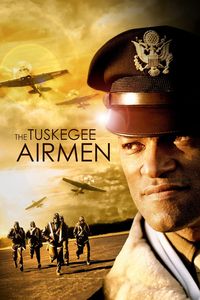
    The Tuskegee Airmen (1995)

    (On Cable TV, February 2021) It’s interesting to go spelunking into movie archives and unearth films that should be better known. At times, others do it for you—which explains why The Tuskegee Airmen gets a TCM airing in the middle of Black History Month as a reminder not only of the WW2 all-black fighter squadron, but also of the film’s existence—I could have named George Lucas’ 2013 film Red Tails as a Tuskegee film, but this first one dates from 1995 and seems to have slipped through the cracks of movie memory. To be fair, these are a few practical reasons for this — produced by HBO at a pre-digital time when TV movie budgets were synonymous with low production values and cut corners, The Tuskegee Airmen does amazing things with meager means (most notably by reusing historical footage and snippets from other WW2 movies, or cutting away when there’s a crash) and never got the kind of wide-scale theatrical or home video release that would have enshrined it as a reference. But that obscurity means an opportunity for rediscovery, especially given how it features Laurence Fishburne, then-recent Oscar-winner Cuba Gooding Jr. and John Lithgow in a supporting role as a senator. The script itself is decent without being overly remarkable, taking us through training and deployment to the European front, constantly reminding us of the opposition and outright racism that the airmen experienced throughout the war. The historical details are reportedly more faithful than you’d expect from a Hollywood production, which does help a film that sets out to remind us of a remarkable historical fact. The Tuskegee Airmen is not an ideal film, but neither was Red Tails, so the definitive Tuskegee film remains to be put together. In the meantime, have yourself a double-bill if you can find the film — and you’ll find that Cuba Gooding Jr. stars in both!

  • Boyz n the Hood (1991)

    Boyz n the Hood (1991)

    (On Blu-Ray, December 2015) There have been so many imitators and spiritual successors to Boyz n the Hood (all the way to 2015’s Dope) that it can be hard today to see the film as it must have appeared in 1991, abruptly bringing South Central L.A. to the suburban multiplex.  But revisiting the film is more than worth it even twenty-five years later, because John Singleton’s debut feature has the kind of depth and subtlety that most of its imitators forgot about.  It’s a film dominated by crime, for instance, but it is not primarily a criminal film: The drama is strong, multifaceted and the film never loses sight that its authority figure (Lawrence Fishburne, in a terrific role) is right in counseling his son to stay away from even the slightest disregard for the law.  The rest of the cast is fantastic, from Angela Basset to Ice Cube to Cuba Gooding Jr. to Nia Long.  The film stock grain is obvious on the Blu-Ray disc, but the film is shot cleanly and features a number of sly visual jokes, from the first STOP sign to Reagan references.  No doubt about it: Boyz n the Hood remains an impressive piece of work despite time and imitators.

  • Men of Honor (2000)

    Men of Honor (2000)

    (In French, On TV, March 2015) What a dull, dull movie.  It shouldn’t have been that way, especially considering that it melds social issues with military heroics.  The true story of the first black master diver in the US Navy, Men of Honor features Robert de Niro (as a crusty instructor) and Cuba Gooding Jr. (as the first black master diver), each of them doing their best but never quite giving life to the roles.  Much of the script is strictly by-the-numbers, its inspiring story ill-served by familiar dialogue and dramati situations.  Men of Honor is not exactly a bad movie, but it’s almost instantly forgettable the moment the end credits roll.  Or even before then, if my wandering attention is any guide.

  • The Hit List (2011)

    The Hit List (2011)

    (On DVD, December 2011) If nothing else, this direct-to-video thriller has an intriguing premise: What if, discussing a very bad day at the local bar, you accidentally made a deal with a hit-man willing to take care of your hit-list?  Unsurprisingly, the film’s execution can never quite match the development of the premise: Shot on a budget in Spokane, The Hit List looks and feels like the newest digitally-shot direct-to-video effort: acceptable cinematography, two or three big action sequences, and some directing flair.  It’s in the limp script that the film’s limited ambitions become clearer.  The protagonist is meant to be portrayed by Cole Hauser as an everyman pushed beyond his limits, but he initially comes across as a schmuck and never recovers from this initial impression.  Cuba Gooding Jr. impresses as a grizzled hitman, although though his performance seems erratic and his dialogue feels forced.  The script shies away from its most interesting implications, and wastes time showcasing an overlong, mean-spirited and largely unnecessary police station shoot-out.  The lacking quality of the script, from its overreaching dialogues to its lack of thematic depth to the graceless way it moves its plot pieces, is the film’s biggest disappointment: While it tries to ape a bit of Collateral’s impact, The Hit List never really rises above its mediocre execution.  The ideas are there, but the polish isn’t… and as any good hit-man will tell you, execution is far more important than intentions.