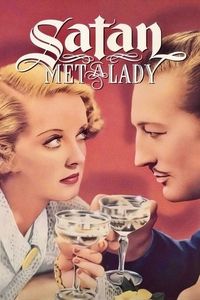
Satan Met a Lady (1936)
(On Cable TV, August 2021) It’s hard to argue that Satan Met a Lady is an interesting film by itself — while it features a killer title (especially for a film released so soon after the enforcement of the Hays Code), it’s executed like many jocular detective movies of the 1930s, and there are far better examples of the form than this one. But where Satan Met a Lady becomes truly special is in the exemplary lesson it offers in how tone can reshape a film adaptation. For this is, amazingly, an adaptation of Dashiell Hammett’s The Maltese Falcon, five years before the John Huston adaptation that would help ignite the film noir genre and launch Humphrey Bogart to superstardom. The protagonist here, played by a twinkle-eyed Warren Williams, couldn’t be farther away from Bogart — he’s a smooth romantic operator and a constant one-liner generator who barely takes himself seriously. Not that he is the most outrageous deviation of the adaptation, which takes so many liberties with the source material than even viewers with fresh memories of the 1941 version will have trouble spotting the similarities. But the frankly comic tone is where the film is most distinctive, and perhaps most enjoyable as well. It’s not a good movie — Bette Davis, one of the film’s lone bright spots as the femme fatale, famously rebelled and refused to show up on set for the first few days of shooting—but it becomes fascinating when you put it against the film noir style of telling roughly the same story. Then again, film noir wasn’t even in the cards in 1936 — amateur sleuths and high-society escapes from the Depression were the vogue, and Warner Brothers was clearly aiming at chasing trends of the time. Despite a plot that becomes unpalatable late in the film’s brisk 74 minutes, Satan Met a Lady is not an unbearable watch, but it’s far best appreciated as the second feature in a Maltese double (or triple) bill.